Entering 2026, imagine front desk staff at your independent hotel spending an average of 45 minutes every shift on manual data entry and verification for KBS and Pol-Net reporting. This is not just lost time; it means risks of potential errors, delays, and administrative fines that can each reach thousands of liras. At a time when staffing shortages and operational efficiency are more critical than ever, managing mandatory compliance tasks this way directly undermines your hotel's profitability and guest experience. But what if there were a solution that eliminated this burden entirely, allowing your team to focus on making guests smile and generating incremental revenue? This article will explain step by step how to streamline KBS and Pol-Net reporting through automation, reduce risks, and boost your operational efficiency.
What You Will Learn in This Article
- Lightening the Mandatory Reporting Burden: Why Automate Now?
- Boost Staff Productivity: Farewell to Manual Processes
- Elevate the Guest Experience and Ensure Data Security
- Seamless Integration with Otelciro: Automated Compliance
- Indirect Profitability Growth: Strategic Resource Reallocation
- Frequently Asked Questions
Lightening the Mandatory Reporting Burden: Why Automate Now?
What Are KBS & Pol-Net, and Why Do They Matter?
KBS (Identity Reporting System) and Pol-Net are legal systems that mandate accommodation facilities in Türkiye to report guest identity information instantly to the General Directorate of Security. The primary purpose of this practice is to ensure public safety, and it is a legal requirement for hotels. However, this obligation creates significant operational challenges.
The manual process generally looks like this:
- The guest's ID or passport is collected.
- The details are entered into the PMS (Property Management System).
- The KBS/Pol-Net portal is opened in a separate browser window.
- The same information is manually re-entered into this portal by referring back to the PMS.
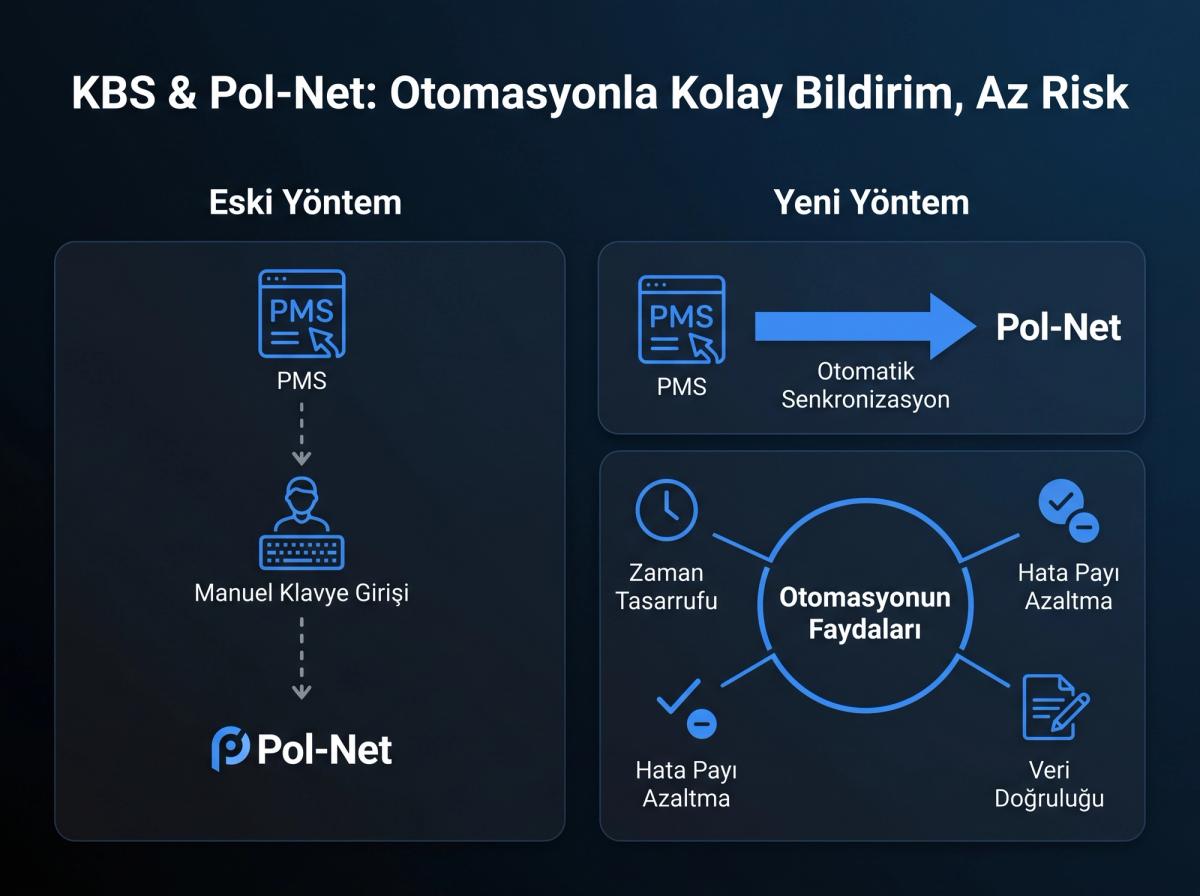
- The submission is made, and the process repeats for the next guest.
These steps are time-consuming, prone to error, and place severe pressure on staff, especially during peak check-in hours. A single typo or a forgotten report can be deemed non-compliance.
Operational Pressures and the Cost of Compliance in 2026
In 2026, the difficulty of finding qualified staff and rising labor costs push hoteliers to seek efficiency in every area. In this context, every minute spent on compliance tasks is a minute stolen directly from profitability. The cost of non-compliance is not limited to lost time either:
- Administrative Fines: Fines imposed for delayed or inaccurate reporting can reach thousands of liras and multiply upon repeated offenses.
- Reputational Damage: Legal issues can damage your hotel's professional image.
- Operational Disruptions: A potential inspection or investigation can disrupt your hotel operations.
For these reasons, automating KBS and Pol-Net reporting is no longer a luxury—it is an operational necessity.
Watch For: The most common errors in manual reporting are entering Turkish characters incorrectly in names/surnames or confusing letters and numbers in passport numbers. Even these minor mistakes can invalidate your report and trigger the risk of fines.
Boost Staff Productivity: Farewell to Manual Processes
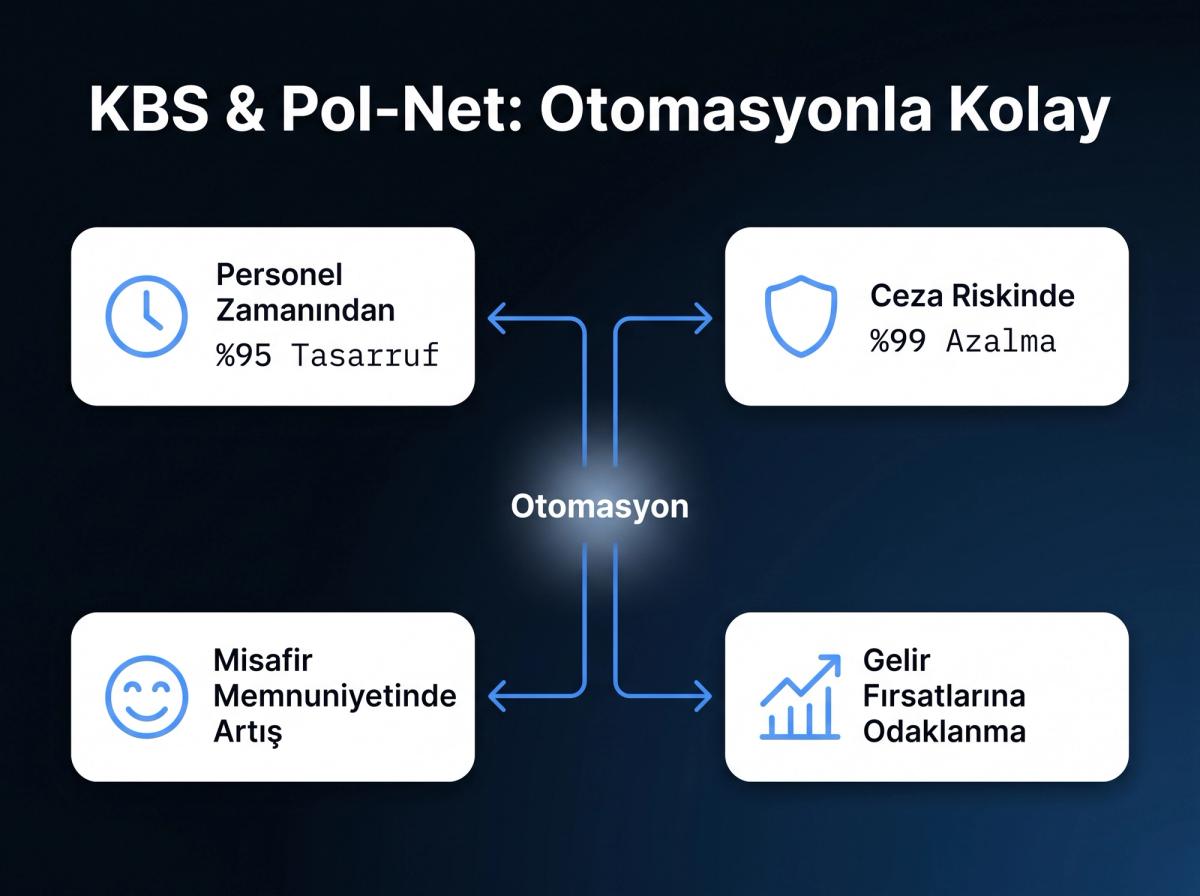
The most direct and measurable benefit of automation is winning back time for your front desk team. When manual data entry, double checks, and separate reporting workflows are eliminated, your staff can focus on creating genuine value.
Making the Front Desk Team Guest-Centric
Time saved through automation can be used to enrich the guest experience. Instead of acting like data entry clerks, your staff can step into the role of hospitality professionals:
- Personalized Welcome: Asking guests if it is their first time in the city and offering tailored restaurant recommendations.
- Upsell & Cross-sell Opportunities: Offering a room with a better view, a breakfast package, or the hotel's spa services during check-in.
- Problem Solving: Proactively addressing guest requests.
Example: Consider a 75-room city hotel with an average of 40 check-ins per day. If manual reporting takes an average of 2 minutes per guest, that translates to 80 minutes a day, or 40 hours of workload per month. That equals an entire week of work for one staff member. Dedicating this time to upsell opportunities can have a direct, positive impact on ADR (Average Daily Rate).
Reducing Operational Costs and Improving GOPPAR
An increase in staff productivity helps you optimize labor costs. A team that accomplishes more in less time can reduce the need for additional staff, especially during peak seasons. This directly improves your hotel's GOPPAR (Gross Operating Profit Per Available Room) metric. Remember, GOPPAR reflects not only revenue, but also how efficiently operational costs are managed. Automating manual, repetitive tasks is one of the clearest ways to drive this efficiency. This optimization accelerates return on investment even further for hotels considering technology investments through incentives like KOSGEB.
Elevate the Guest Experience and Ensure Data Security
KBS automation is not merely a back-office efficiency tool; it directly impacts your guests' experience from the moment they first step into the hotel.
A Fast and Frictionless Check-in Process
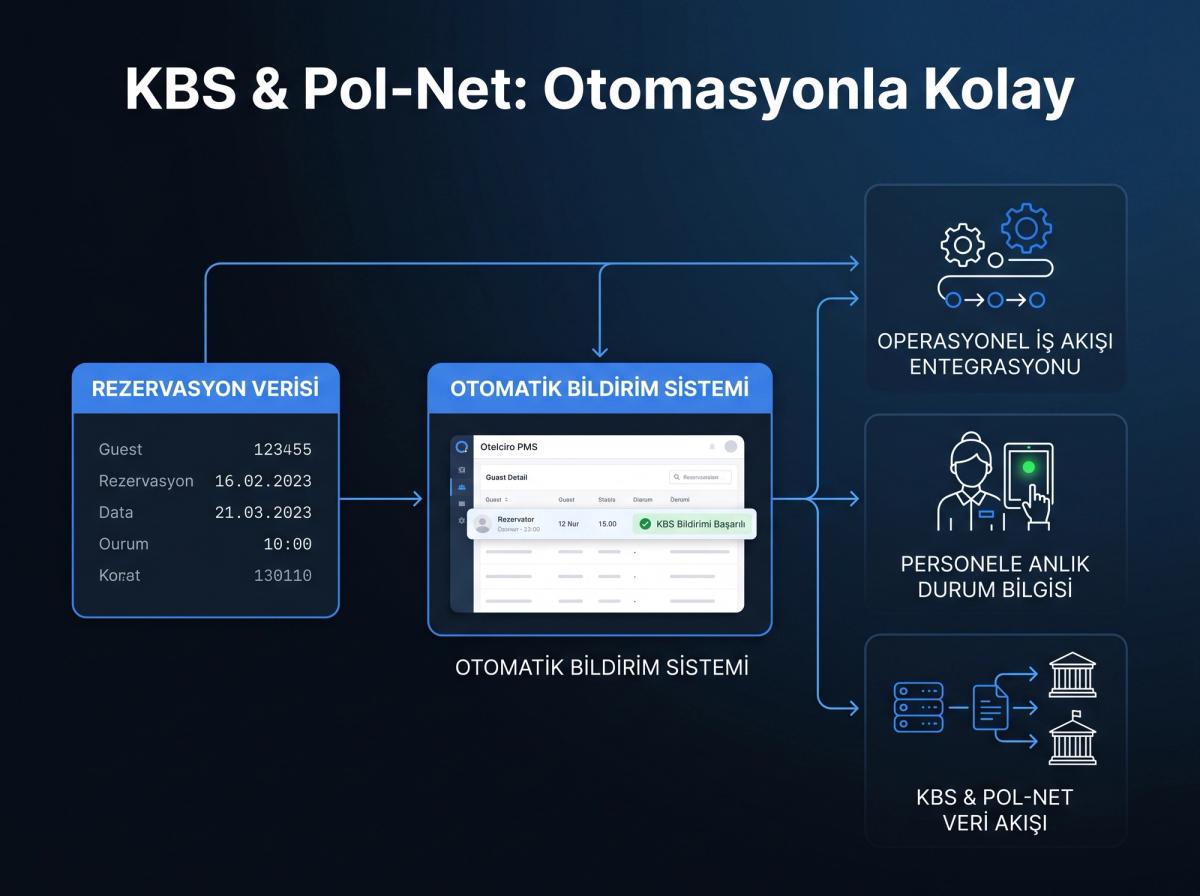
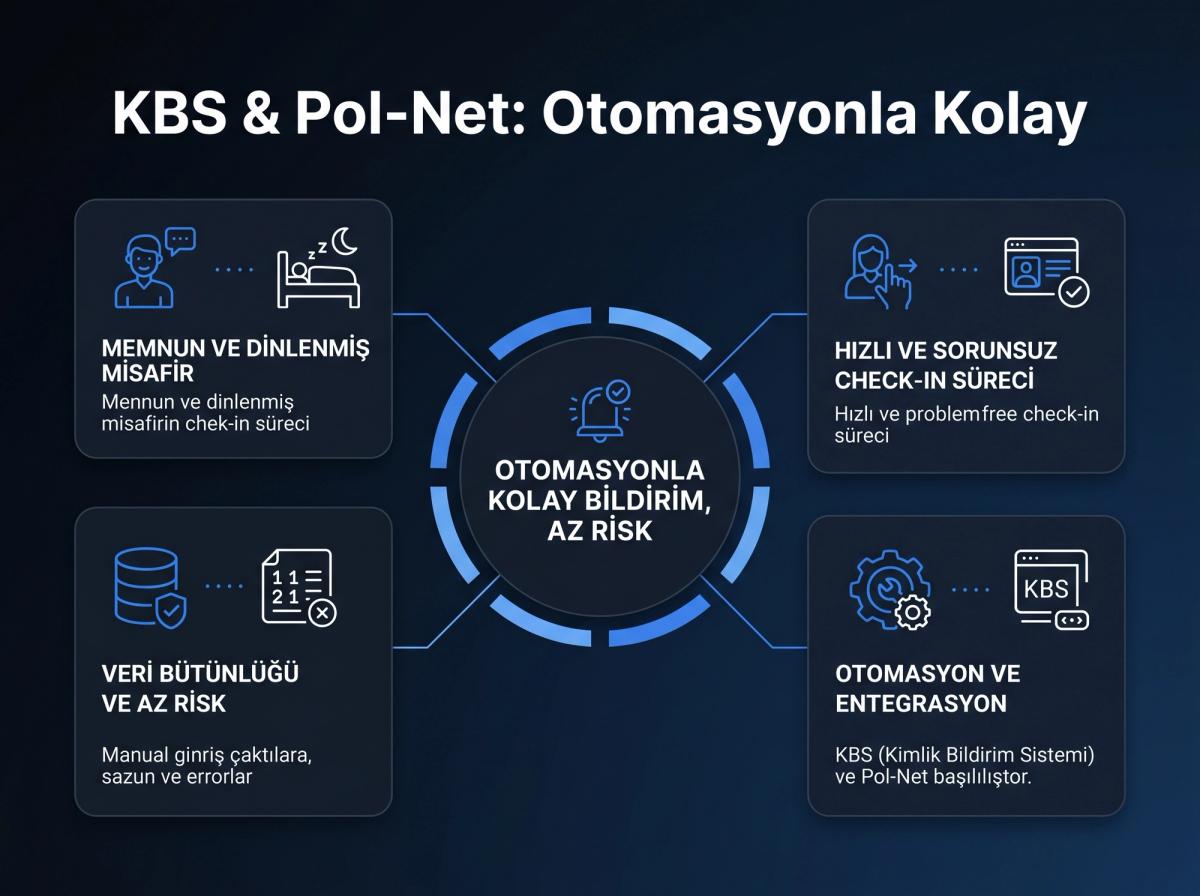
No guest wants to wait for minutes at the front desk counter after a long journey. Automated ID data capture and background reporting processes significantly shorten check-in time. The guest's ID is scanned, data instantly populates the PMS, and the KBS notification is automatically sent. This process is virtually invisible to the guest.
Pro Tip: A fast check-in process is one of the most critical satisfaction factors, especially for business travelers or exhausted families. The phrase "fast and easy check-in" frequently appears in online reviews and directly influences your hotel's rating.
The result is a smoother, less intrusive, and more professional welcome experience. This positive first impression reflects in guest satisfaction scores and online reviews, strengthening your hotel's digital reputation.
Data Accuracy, Security, and KVKK Compliance
Manual data entry is prone to human error. Automation eliminates this risk, increasing the accuracy of the reported information. This not only reduces the risk of fines, but also ensures the consistency of your records.
More importantly, integration with a modern PMS enhances the security of sensitive guest data. Manually copying data across different systems increases the risk of data leaks and complicates KVKK (Personal Data Protection Law) compliance. In an integrated system, data is transmitted directly from a single secure source (the PMS) to the government system via encrypted channels. This strengthens your hotel's cybersecurity posture and reassures your guests that their data is safe.
Seamless Integration with Otelciro: Automated Compliance
The most effective way to achieve this automation is to use a modern hotel operating system that speaks natively with KBS/Pol-Net systems.
The Central Role of the PMS: Single Source Management
An integrated PMS like Otelciro acts as a centralized "single source of truth" for guest data. When a guest checks in, Otelciro PMS captures the required ID details and automatically submits them to the KBS/Pol-Net system in the background. This turns a compliance task into a natural part of the operational flow, rather than a separate, tedious chore.
Thanks to this integration:
- Double Data Entry Ends: Information is entered only once, during check-in.
- Instant Reporting Is Ensured: The notification is submitted automatically the moment check-in is completed, eliminating any risk of delay.
- The Error Rate Approaches Zero: The system pulls data directly from the ID reader, preventing manual typos.
Easy Setup and Maintenance for Independent Hotels
For independent and boutique hotels without large IT teams, complex software integrations can be daunting. Otelciro's KBS/Pol-Net integration is designed with a "plug-and-play" logic. Setup is straightforward, and once configured, the system requires minimal maintenance. This allows hoteliers to focus on their guests and growing their business rather than wrestling with technical details.
Indirect Profitability Growth: Strategic Resource Reallocation
The value of KBS automation is not limited to saved time or prevented fines. The real strategic benefit emerges from where you redirect the freed-up resources.
Risk Mitigation and Resource Optimization
When you eliminate compliance risk and operational burden, your management team's mental and temporal focus shifts. Instead of worrying about "Were the reports submitted?", you can focus on "How can we increase occupancy this week?" This is a transition from a reactive management mindset to a proactive strategy.
Focusing on Revenue Management and Direct Bookings
Freed-up staff and management time can be directed toward revenue-generating activities:
- Revenue Management Strategies: Analyzing market demand, monitoring competitor rates, and executing dynamic pricing strategies.
- Direct Booking Initiatives: Dedicating time to increasing website traffic, building loyalty programs, and optimizing hotel schema for AI-powered search engines.
- Guest Satisfaction Programs: Enhancing service quality by analyzing guest feedback.
This strategic focus creates an indirect yet powerful positive impact on key performance indicators such as RevPAR (Revenue Per Available Room), ADR, and GOPPAR. Automation does not just save you time; it gives you the focus required to gain a competitive edge. This is one of the most concrete examples of how data analytics can unlock profit for independent hotels.
Conclusion: From Compliance to Strategic Advantage
Automating KBS and Pol-Net reporting has evolved from merely a compliance task into a strategic operational advantage for independent hotels in 2026. Beyond simply meeting your legal obligations, this is a step that allows you to reclaim your staff's valuable time, elevate the guest experience, and ultimately increase your hotel's profitability. Thanks to Otelciro's integrated PMS and Operations modules, these complex processes can now run seamlessly in the background, allowing you and your team to focus on what truly matters: delivering unforgettable moments to your guests and driving your hotel's growth. Hotels that embrace this automation will not only prevent fines, but also stay one step ahead in tomorrow's competitive market.
Call to Action
Audit your hotel's current KBS/Pol-Net reporting process today and calculate how much time your front desk staff spends on this task weekly. Then, request a demo to discover how Otelciro's integrated solutions can automate this process.
Share this post
Frequently Asked Questions
What is KBS and Pol-Net reporting, and why is it mandatory?
KBS (Identity Reporting System) is a legal requirement mandating that accommodation facilities in Türkiye report the identity information of staying guests in real time to the General Directorate of Security. This system is used to ensure public safety and is a regulation that all hotels must comply with.
How does KBS Pol-Net automation work?
Automation establishes a direct integration between your hotel's PMS and the systems of the General Directorate of Security. When an ID or passport is scanned during guest check-in, the information is recorded in the PMS and simultaneously sent automatically and securely to the KBS/Pol-Net system. This completely eliminates the need for manual data entry.
What are the risks of manual reporting?
Manual reporting is prone to human error (typos, missing information), delays, and oversights. These situations can lead to administrative fines reaching thousands of liras each, legal liabilities, and damage to the hotel's reputation.
Can small or boutique hotels also benefit from this automation?
Absolutely. In fact, automation is even more critical for small and boutique hotels operating with limited staff. Modern PMS platforms like Otelciro provide integrated solutions that can be easily set up and managed without the need for large IT teams, allowing small businesses to benefit from this efficiency as well.