
Picture your Tuesday morning pickup report: occupancy is at 92%, and your ADR has climbed 5% over last year. In 2022, you would have celebrated. But in 2026, with labor costs up 14% and OTA commissions siphoning 18% of every booking, that high occupancy might actually be costing you money.
The 'RevPAR trap' is real, and it’s thinning margins for independent boutiques and resorts alike. As we look toward 2026, the question isn't 'How do we fill the rooms?' but 'How do we protect the bottom line against inflationary pressure?'
This guide moves beyond top-line vanity metrics to show you how to transition from a room-seller to a true asset manager. By leveraging GOPPAR and attribute-based pricing, you will learn exactly how to ensure every check-in contributes to actual profit, not just a busy lobby.
What You'll Learn
- Mastering the GOPPAR Pivot: Why RevPAR is No Longer Enough
- Beyond Room Types: Implementing Attribute-Based Pricing (ABP)
- Total Revenue Management: Monetizing the Entire Property
- Predictive Demand Sensing: Moving Beyond Historical Data
- The Tech Stack Evolution: Integrating PMS and RMS for 2026
- Frequently Asked Questions
Mastering the GOPPAR Pivot: Why RevPAR is No Longer Enough
The Hidden Erosion of Room Revenue
For decades, Revenue Per Available Room (RevPAR) was the gold standard of hotel performance. But RevPAR is blind to expenses. When you factor in rising energy surcharges, inflated linen costs, and labor-intensive housekeeping turnovers, a €150 room sold on a high-commission OTA might yield less net profit than a €130 room booked directly.
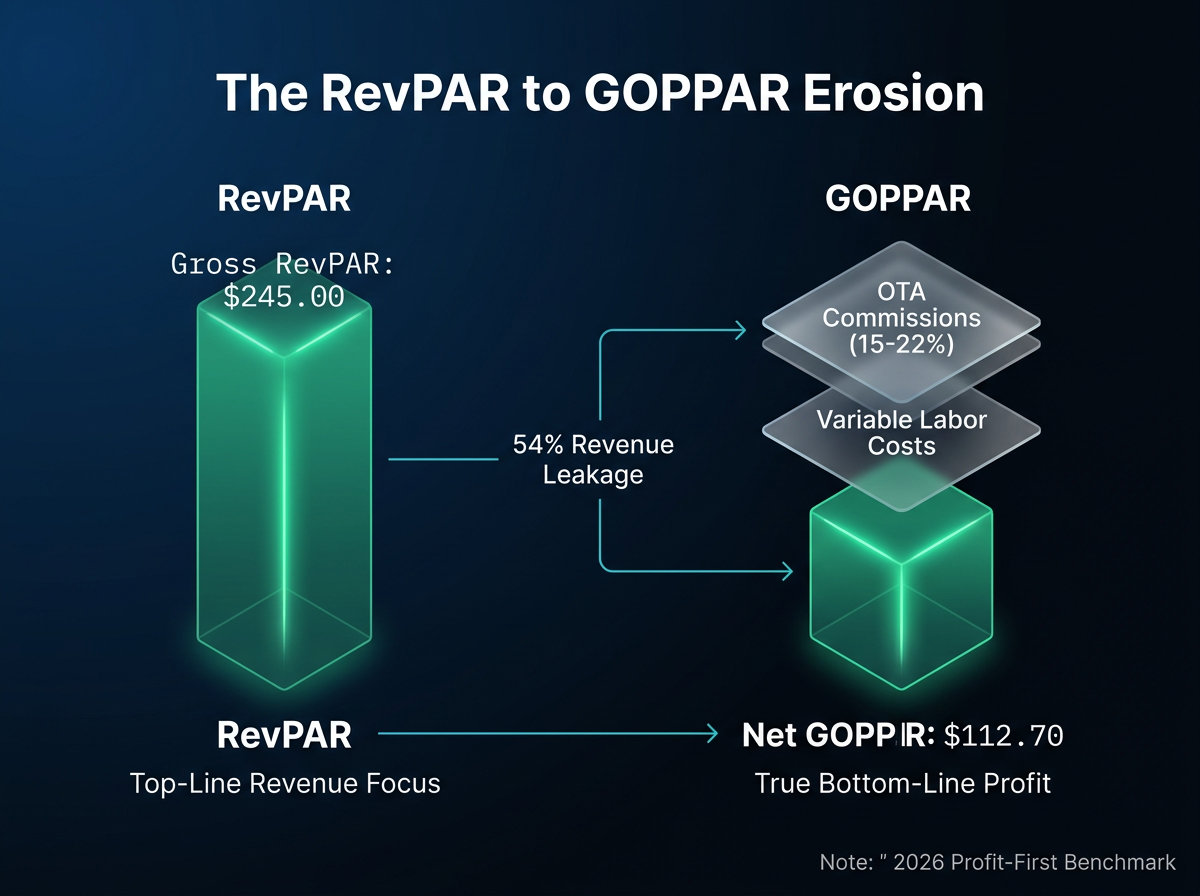
To survive the margin compression of 2026, revenue managers must audit the "leakage" in their current Average Daily Rate (ADR). This means calculating your true Cost Per Occupied Room (CPOR) and shifting your primary KPI to Gross Operating Profit Per Available Room (GOPPAR).
Example: A 120-room urban boutique with 71% occupancy at €145 ADR is producing ~€103 RevPAR. But if CPOR has risen from €32 to €45 over the last two years, selling the last 10% of rooms at a discounted OTA rate actually drags down total daily profitability.
Shifting KPIs from Volume to Velocity and Value
Transitioning to a GOPPAR-centric model requires filtering your reporting through a "Net-RevPAR" lens. This means automatically stripping out customer acquisition costs (OTA commissions, GDS fees, wholesale discounts) before evaluating channel performance.
By implementing dynamic pricing strategies that prioritize Net-RevPAR, you can identify which high-occupancy dates are yielding lower net margins and adjust your distribution mix accordingly.
Pro Tip: Reconcile channel manager inventory against PMS overnight, not midday — overlap with high-checkin windows masks parity drift. Channel parity drift of more than 4% on a major OTA typically triggers a rate-suppression penalty that can cut visibility by 20–30% within 48 hours.
Beyond Room Types: Implementing Attribute-Based Pricing (ABP)
Deconstructing the Room into High-Value Features
The traditional model of static "Standard," "Deluxe," and "Suite" categories is obsolete. In 2026, profitability lies in Attribute-Based Pricing (ABP)—unbundling the room and pricing specific features dynamically.
Instead of a flat €20 upgrade to a Deluxe room, ABP allows you to charge €15 for a "high floor," €25 for a "balcony," and €10 for "early check-in." As noted in recent EHL Insights research on attribute-based pricing, this micro-segmentation empowers guests to build their ideal stay while allowing hotels to yield individual physical assets based on real-time inventory pressure.
Example: A 75-room independent in a leisure market shifts midweek base ADR from €120 to €135 by unbundling premium features. If occupancy holds at 68%, that's roughly €765 per day in incremental room revenue before mix effects.
Reducing 'Discount Fatigue' with Hyper-Personalization
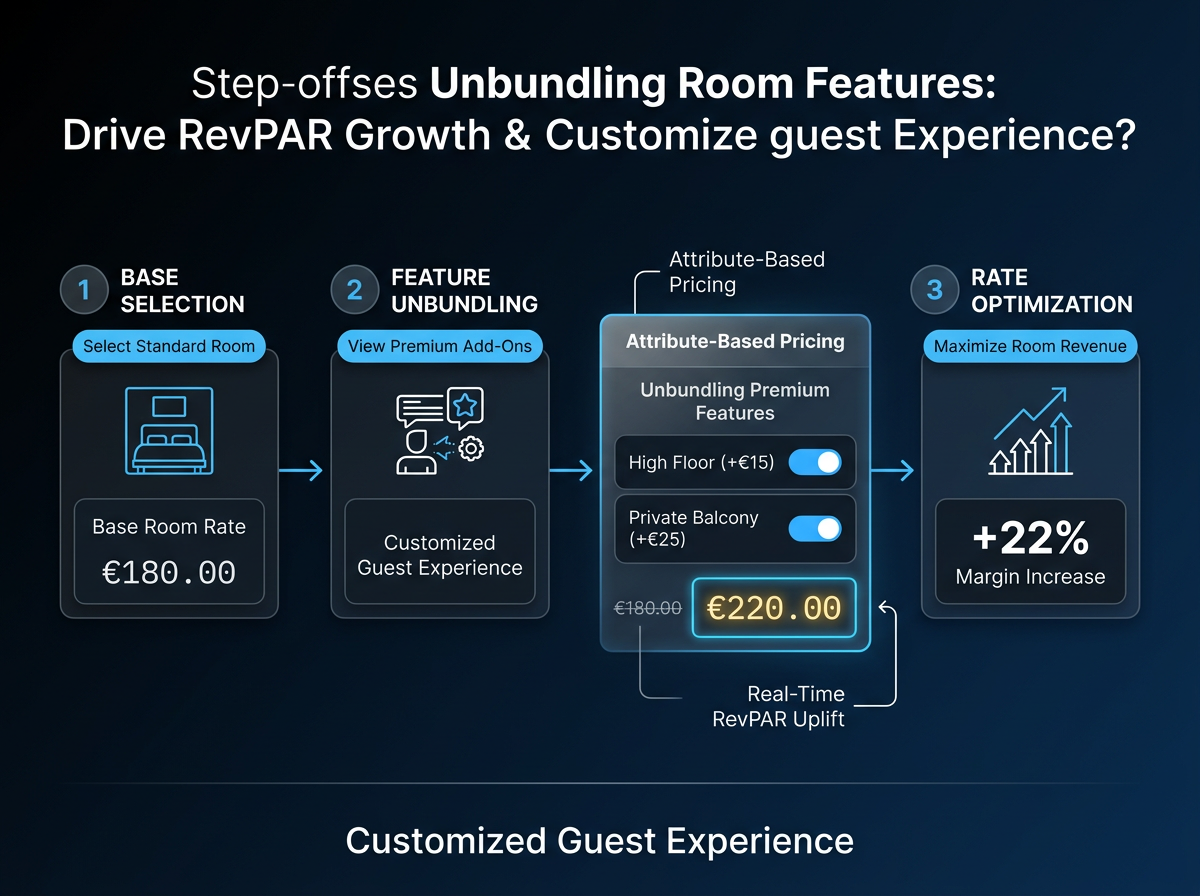
ABP also acts as a natural defense against parity restrictions. By configuring your PMS to recognize guest preferences from previous stays, you can offer "hidden" personalized rates. If your CRM knows a guest routinely pays for late checkout, your booking engine can automatically bundle it into a direct-booking offer that an OTA cannot match.
To execute this at scale, hoteliers are deploying accessible Voice AI and chatbot technologies to automate upsells at the point of booking, capturing incremental revenue without adding to front-desk queues.
Total Revenue Management: Monetizing the Entire Property
TrevPAR: Capturing the Guest’s Total Wallet Share
Optimizing room rates in a vacuum leaves money on the table. Total Revenue Management shifts the focus to TrevPAR (Total Revenue Per Available Room), integrating non-room outlets like F&B, spa, parking, and cabana rentals into your pricing algorithm.
When your Revenue Management System (RMS) talks to your Point of Sale (POS), you can generate a 'Total Revenue' score per guest profile. A guest booking a €120 room who spends €80 in the restaurant is more valuable than a guest booking a €140 room who only sleeps there. Yielding strategies should protect inventory for these high-TrevPAR profiles during peak compression.
Watch For: Dynamic pricing in ancillary services can alienate locals. If you yield spa rates up 20% on a busy Saturday, ensure you have a "local resident" code to protect your year-round community base.
The Rise of Hybrid Spaces: Co-working and Day-Use Revenue
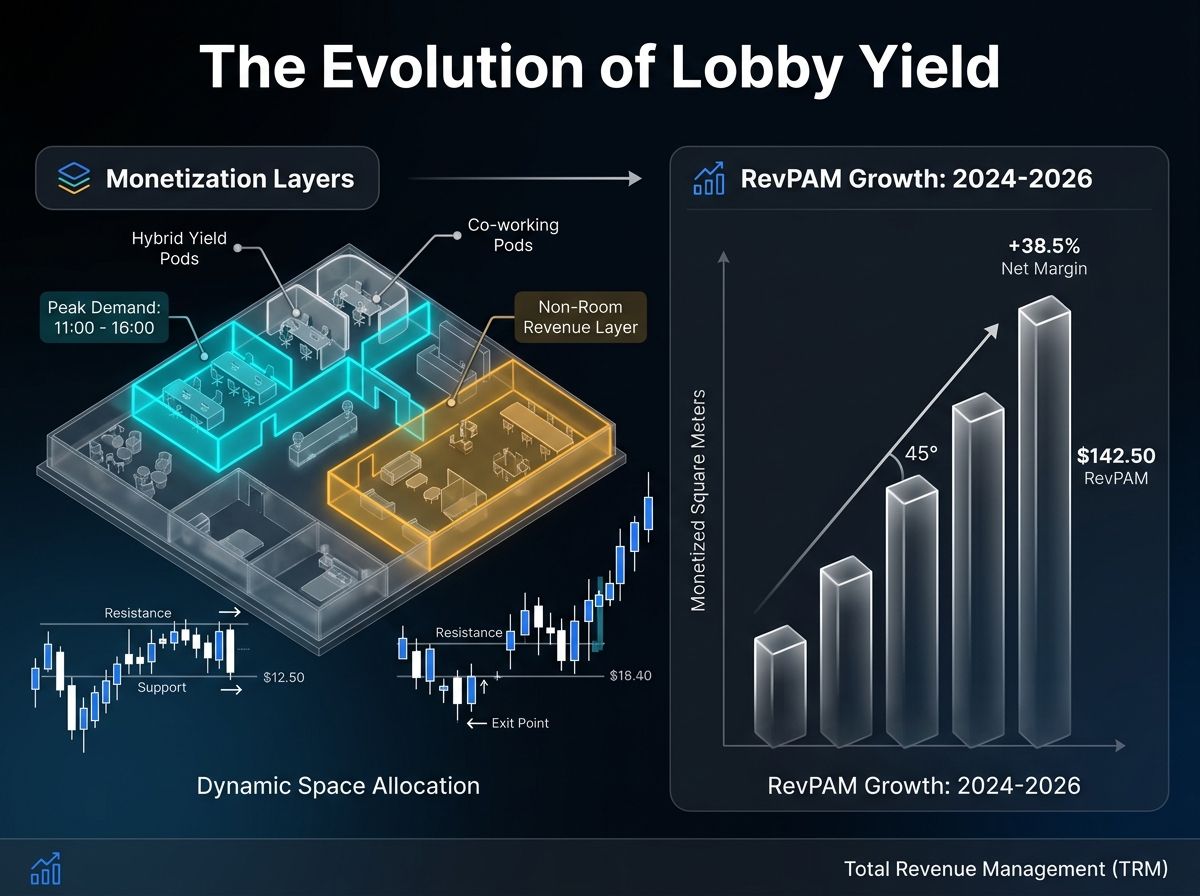
The 2026 property operates 24/7, monetizing the dead zone between 10 AM and 4 PM. Operationalizing the "Day-Stay" model effectively doubles the yield of your physical inventory. By packaging empty rooms for transit travelers or remote workers, and converting underutilized lobby areas into premium co-working spaces, independent hotels can add a completely new revenue line that drops straight to the bottom line.
Predictive Demand Sensing: Moving Beyond Historical Data
The Fallacy of 'Same Time Last Year' (STLY)
Basing your 2026 pricing strategy on 2025's pace is like driving while looking in the rearview mirror. Historical data is losing its predictive power. Modern revenue management requires forward-looking indicators: regional flight search volumes, local event sentiment, and even macro weather patterns.

By learning to integrate forward-looking data into your forecasts, you can sense demand weeks before it materializes into bookings. If flight searches to your city spike for a weekend three months out, your RMS should instantly adjust base rates before the first OTA booking drops.
Sustainability-Linked Pricing and the Eco-Conscious Premium
Predictive demand isn't just about volume; it's about shifting guest values. Implementing "Green Rates"—which offer carbon-offset inclusions or waive daily housekeeping for a food and beverage credit—appeals heavily to Gen Z and millennial travelers.
Crucially, these rates help cover the cost of sustainability certifications (like the EU Ecolabel) while simultaneously reducing your CPOR through lower utility and labor overhead.
Pro Tip: Use predictive analytics to adjust housekeeping schedules in real-time. Aligning your labor costs precisely with forecasted guest arrivals prevents overstaffing on low-turnover days, directly protecting GOPPAR.
The Tech Stack Evolution: Integrating PMS and RMS for 2026
Breaking Silos Between Marketing and Revenue
None of these strategies work if your tech stack is fragmented. In 2026, your Channel Manager, RMS, and PMS must share a single source of truth. Hyper-dynamic pricing shifts—sometimes updating rates dozens of times a day—will inevitably lead to overbookings if data syncs are delayed by even a few minutes.
To break OTA dependency, revenue and marketing teams must collaborate. You must leverage CRM data to fuel 'Loyalty-Only' rates that drive direct bookings. Shifting just 10% of your OTA business to direct channels immediately reclaims 15-22% in commission fees, drastically improving your Net-ADR.
Common Implementation Pitfalls to Avoid
The greatest danger in modern hotel tech is "Set and Forget" automation.
Watch For: Cutting a single Tier-3 OTA representing 4% of bookings is rarely worth it — the lost demand usually doesn't redistribute to direct; it just vanishes.
While AI can process millions of data points to recommend rates, human oversight remains critical. A revenue manager's understanding of local market nuances—like a sudden road closure or an unannounced corporate buyout—is exactly what prevents algorithms from making costly pricing errors.
Conclusion
The transition to 2026 hotel revenue management is fundamentally a shift from being a 'price taker' to a 'profit maker.' By focusing relentlessly on GOPPAR, embracing the flexibility of attribute-based pricing, and leveraging predictive demand data, independent hoteliers can reclaim their margins from OTAs and inflationary pressures.
The goal is no longer just a full house, but a profitable one. To execute this, your operational foundation must be flawless. Otelciro’s integrated PMS and Revenue Management modules are built specifically to handle these complex, profit-first workflows—ensuring your pricing updates instantly across all 35+ channels without manual data entry.
Your Next Step: Perform a Distribution Audit this week. Calculate your Net-ADR (ADR minus OTA commissions and transaction fees) for your top three channels over the last 90 days. Identify your most profitable booking source, and reallocate 10% of your marketing budget to defend it.
Share this post
Frequently Asked Questions
What is GOPPAR in hotel revenue management?
GOPPAR stands for Gross Operating Profit Per Available Room. Unlike RevPAR, which only looks at room revenue, GOPPAR subtracts operating expenses (like labor, utilities, and commissions) to show the actual profitability of your hotel inventory.
How do I implement attribute-based pricing?
Start by auditing your room types and unbundling premium features (e.g., high floors, balconies, guaranteed early check-in). Configure your booking engine and PMS to sell a base room rate, then offer these specific attributes as dynamic add-ons during the booking process.
What is Net-RevPAR and why does it matter?
Net-RevPAR is your room revenue per available room after deducting customer acquisition costs, such as OTA commissions and distribution fees. It matters because it reveals the true value of a booking channel, preventing you from chasing high-occupancy OTA business that yields low actual profit.
How do I calculate TrevPAR for my property?
To calculate Total Revenue Per Available Room (TrevPAR), divide your hotel's total revenue (combining rooms, F&B, spa, parking, and all other ancillary streams) by the total number of available rooms over a specific period. This metric helps you understand the total wallet share you are capturing from guests.