
![Hotel Demand Forecasting: AI Models That Work [2026]](https://cdn.sanity.io/images/1la98t0z/production/1c22bb78fc2523b8223045f19776874e44f110fc-1376x768.jpg?w=1920&q=65&auto=format&fit=max)
Forecasting: The Foundation of Revenue Strategy
Every pricing decision, staffing plan, and marketing campaign in a hotel should be informed by demand forecasting. Yet the accuracy gap between the best and worst forecasters in hospitality is staggering: top performers achieve 88-92% forecast accuracy, while the industry average languishes at 65-72%. That 20+ percentage point gap translates directly into RevPAR: hotels with superior forecasting report 10-18% higher revenue per available room.
In 2026, AI-powered forecasting has moved from experimental to essential. Machine learning models process thousands of variables simultaneously, identify non-obvious patterns, and adapt in real time — capabilities that are simply impossible with spreadsheet-based approaches.

Embed this image on your site
<a href="https://otelciro.com/en/news/hotel-forecasting-demand-prediction">
  <img src="https://cdn.sanity.io/images/1la98t0z/production/1c22bb78fc2523b8223045f19776874e44f110fc-1376x768.jpg" alt="Hotel demand forecasting infographic" width="800" />
</a>
<p>Source: <a href="https://otelciro.com">OtelCiro</a> — AI Hotel Revenue Management</p>
Related reading: AI Revenue Management Platform: The Complete Hotel Solution for 2026
Related reading: 65% of Travelers Accept Dynamic Pricing: Transparency Builds Trust
The Forecasting Model Landscape
Historical-Based Models
What they do: Project future demand based on historical patterns — same day last year, same week, seasonal trends.
Strengths: Simple, interpretable, reliable for stable markets Weaknesses: Cannot account for new events, market shifts, or unprecedented conditions Accuracy: 60-70% Best for: Stable, predictable markets with years of consistent data
Machine Learning Models
What they do: Analyze hundreds of variables to identify complex, non-linear demand patterns.
Common algorithms:
- Gradient Boosting (XGBoost, LightGBM): Excellent for structured hotel data
- Random Forests: Robust against overfitting, good for mid-range predictions
- LSTM Neural Networks: Excel at time-series patterns, capture long-range dependencies
- Prophet (Meta): Strong for seasonal decomposition with trend changes
Accuracy: 80-90% Best for: Hotels with 2+ years of data and multiple demand drivers
Ensemble Models
What they do: Combine multiple algorithms, weighting each based on its historical accuracy for specific scenarios.
How it works:
- Multiple models each generate independent forecasts
- A meta-model learns which individual model is most accurate for which situation
- Final forecast is a weighted combination optimized for overall accuracy
Accuracy: 85-92% Best for: Properties with complex demand patterns and diverse market segments
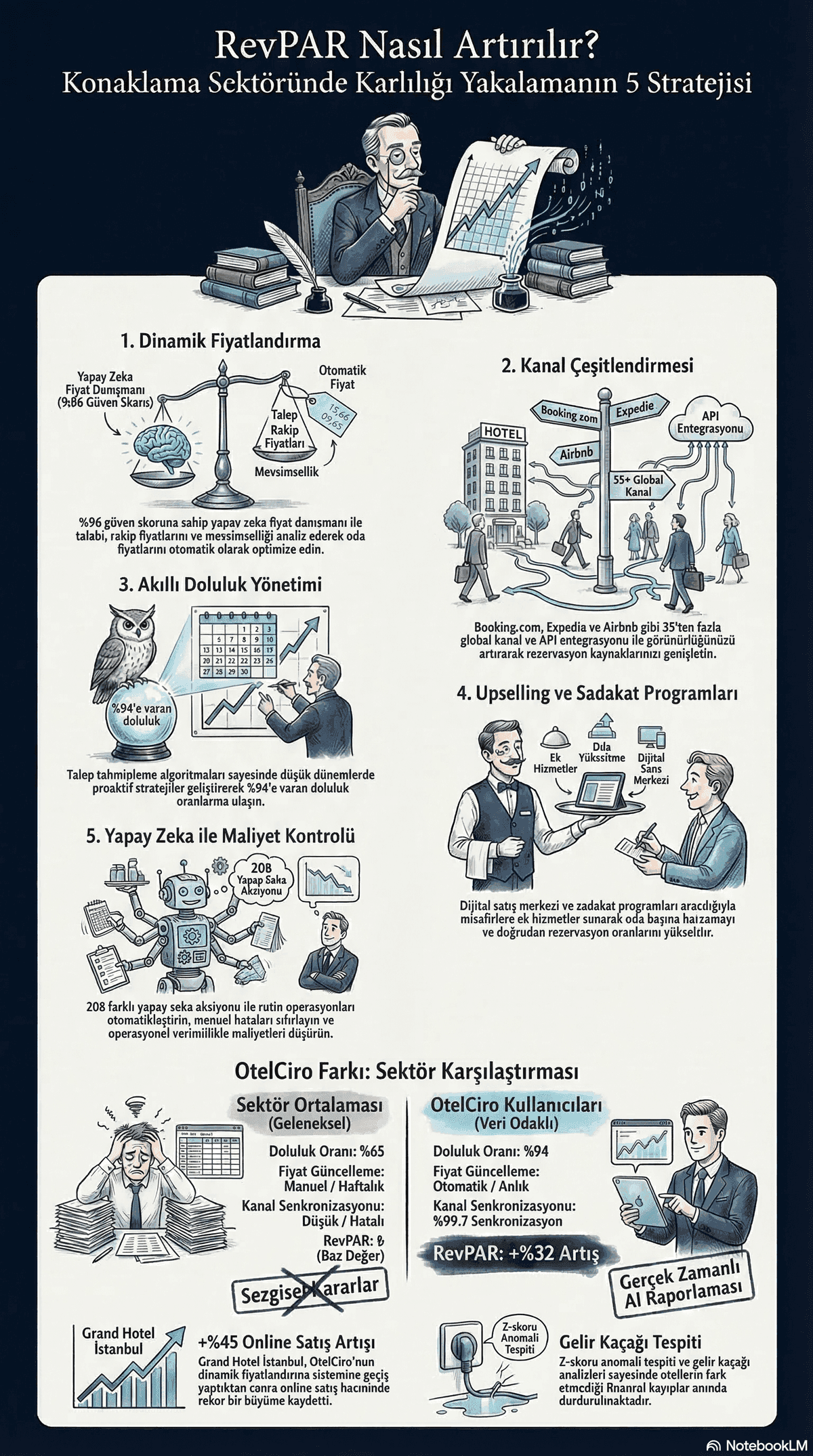
Embed this image on your site
<a href="https://otelciro.com/en/news/hotel-forecasting-demand-prediction">
  <img src="https://cdn.sanity.io/images/1la98t0z/production/7aad3e230cde611ee176402d03b7bcf0a35316f2-1200x2150.png" alt="RevPAR improvement strategies and tactics" width="800" />
</a>
<p>Source: <a href="https://otelciro.com">OtelCiro</a> — AI Hotel Revenue Management</p>
Data Inputs: What Feeds the Forecast
| Data Category | Examples | Impact on Accuracy |
|---|---|---|
| Internal historical | Bookings, revenue, occupancy by date | Critical (baseline) |
| Booking pace | On-the-books vs same period last year | Very high |
| Competitor rates | Real-time rate shopping data | High |
| Flight data | Inbound flight search/booking volumes | High |
| Events | Conferences, concerts, sports, festivals | High |
| Economic indicators | GDP growth, consumer confidence, exchange rates | Medium |
| Weather | Forecasts and historical weather-demand correlation | Medium |
| Search trends | Google Trends for destination keywords | Medium |
| Social signals | Social media mentions, sentiment trends | Low-Medium |
| Market supply | New hotel openings, competitor closures | Low-Medium |
The Data Quality Hierarchy
The single biggest determinant of forecast accuracy is data quality, not model sophistication:
- Clean historical data (2+ years): Accurate, categorized, no gaps
- Real-time booking pace: Updated daily with proper segmentation
- Event calendar: Comprehensive local event impact scoring
- Competitor data: Daily rate and availability monitoring
- External signals: Flight, weather, search data feeds
Related reading: How Many Hours a Year Does Your Hotel Run Empty? The True Cost of Unsold Rooms
Related reading: Hotel Ancillary Revenue: Unlock Hidden Profit Centers
Pick-Up Analysis: The Bridge to Action
Forecasting is academic unless it drives action. Pick-up analysis is the practical tool that connects forecast to pricing:
How pick-up analysis works:
For any future date, compare:
- Rooms on the books today vs. rooms on the books for the same date last year at the same lead time
Example:
- Date: April 15, 2026 (60 days out)
- Current bookings: 68 rooms
- Same date last year at 60 days out: 52 rooms
- Pick-up pace: +31% ahead
Action implications by pace category:
| Pace vs Prior Year | Action | Pricing Implication |
|---|---|---|
| >20% ahead | Reduce discounts, consider restrictions | Increase rates 10-20% |
| 5-20% ahead | Maintain current strategy | Incremental rate increases |
| Within ±5% | Monitor closely | Hold current rates |
| 5-20% behind | Activate promotions | Moderate discounts |
| >20% behind | Aggressive demand generation | Significant rate adjustments |
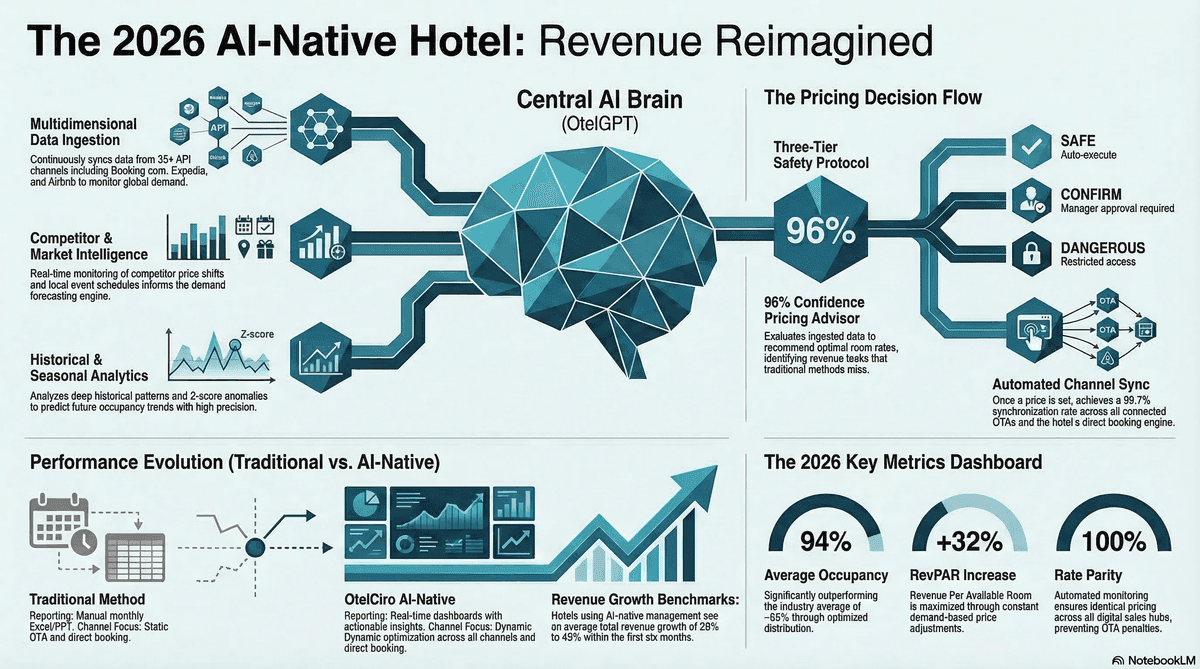
Embed this image on your site
<a href="https://otelciro.com/en/news/hotel-forecasting-demand-prediction">
  <img src="https://cdn.sanity.io/images/1la98t0z/production/0fde5a7ccfdfdadcbcaecd74553f2fb8fcb01270-1200x669.png" alt="2026 AI-powered hotel revenue management" width="800" />
</a>
<p>Source: <a href="https://otelciro.com">OtelCiro</a> — AI Hotel Revenue Management</p>
Forecast-to-Action Decision Flow
Short-Term (0-14 days)
- Focus: Tactical pricing and last-minute demand capture
- Forecast use: Identify dates with remaining unsold inventory
- Actions: Last-minute deals, OTA Visibility Booster, walk-in rate optimization
Medium-Term (15-60 days)
- Focus: Rate optimization and promotional planning
- Forecast use: Adjust pricing based on demand trajectory
- Actions: Dynamic rate changes, targeted market promotions, minimum stay adjustments
Long-Term (60-365 days)
- Focus: Strategic planning and budgeting
- Forecast use: Season planning, group pricing, marketing calendar
- Actions: Budget setting, staffing plans, renovation scheduling, marketing spend allocation
Measuring Forecast Accuracy
MAPE (Mean Absolute Percentage Error)
The standard accuracy metric: average percentage difference between forecast and actual.
| MAPE Range | Quality | Action |
|---|---|---|
| <10% | Excellent | Fine-tune |
| 10-15% | Good | Minor calibration |
| 15-25% | Acceptable | Review data quality and model inputs |
| >25% | Poor | Fundamental review needed |
Track MAPE by forecast horizon (7-day, 30-day, 90-day) and by segment to identify where the model is strongest and weakest.
Related reading: Dynamic vs. Static Pricing: How the Taylor Swift Effect Can Skyrocket Your Revenue
OtelCiro: Forecasting That Drives Revenue
OtelCiro's AI Engine uses ensemble forecasting models trained on hospitality-specific data to deliver demand predictions with industry-leading accuracy. The platform connects forecasts directly to pricing actions, creating a closed-loop system where better predictions automatically drive better pricing decisions.
For complementary strategies, explore our AI revenue management guide and dynamic pricing strategies.
Conclusion
Hotel demand forecasting in 2026 is a solved problem technologically — AI models consistently deliver 85-92% accuracy when fed quality data. The remaining challenge is organizational: ensuring forecasts drive action through integrated pricing systems, clear decision frameworks, and a culture of data-driven management. Hotels that close the gap between forecasting capability and operational execution will dominate their competitive sets.
Discover how OtelCiro's AI Engine can deliver accurate demand forecasts that automatically drive optimal pricing for your hotel.
![Hotel Upselling: AI-Driven Revenue Growth [2026]](https://cdn.sanity.io/images/1la98t0z/production/9850350573fc466b95b1490c7f689e8ac39c4f11-1200x669.png?w=1920&q=50&auto=format&fit=max)