
![Dynamic vs Static Pricing: 30% More RevPAR [2026]](https://cdn.sanity.io/images/1la98t0z/production/3b79fd62b01b52441eba637c6e1edccbc4bb5b4e-1200x1200.png?w=1920&q=65&auto=format&fit=max)
The Hidden Cost of Static Pricing
Many hotels still operate with a fixed seasonal rate card: high-season price, low-season price, done. This approach feels safe and predictable — but it leaves serious money on the table.
The biggest flaw of static pricing is its inability to capture demand spikes. A regular Tuesday evening and a Tuesday when a major concert, convention, or sporting event is in town carry the same rate. This violates the most fundamental principle of revenue management: delivering the right price, at the right time, to the right customer.
Related reading: 65% of Travelers Accept Dynamic Pricing: Transparency Builds Trust
The Taylor Swift Effect: A Real-World Case Study
Taylor Swift's Eras Tour is a textbook demonstration of dynamic pricing's power. Hotel data from concert host cities in 2024-2025 tells a compelling story:
Static Pricing Scenario
A city hotel sets its nightly rate at 200 EUR three months before a concert:
- 3 months before: Rate 200 EUR, occupancy 20%
- 1 month before: Rate 200 EUR, occupancy 70%
- 1 week before: Rate 200 EUR, occupancy 95%
- Concert night: Rate 200 EUR, occupancy 100% (sold out)
- Result: Every room sold at 200 EUR. Average ADR: 200 EUR
Dynamic Pricing Scenario
The same hotel using dynamic pricing:
- 3 months before: Rate 180 EUR, occupancy 25% (early-bird discount)
- 1 month before: Rate 250 EUR, occupancy 65%
- 1 week before: Rate 380 EUR, occupancy 90%
- Concert night: Rate 520 EUR, occupancy 100%
- Result: All rooms sold at varying rates. Average ADR: ~310 EUR
Difference: 55% higher ADR with the same occupancy level.
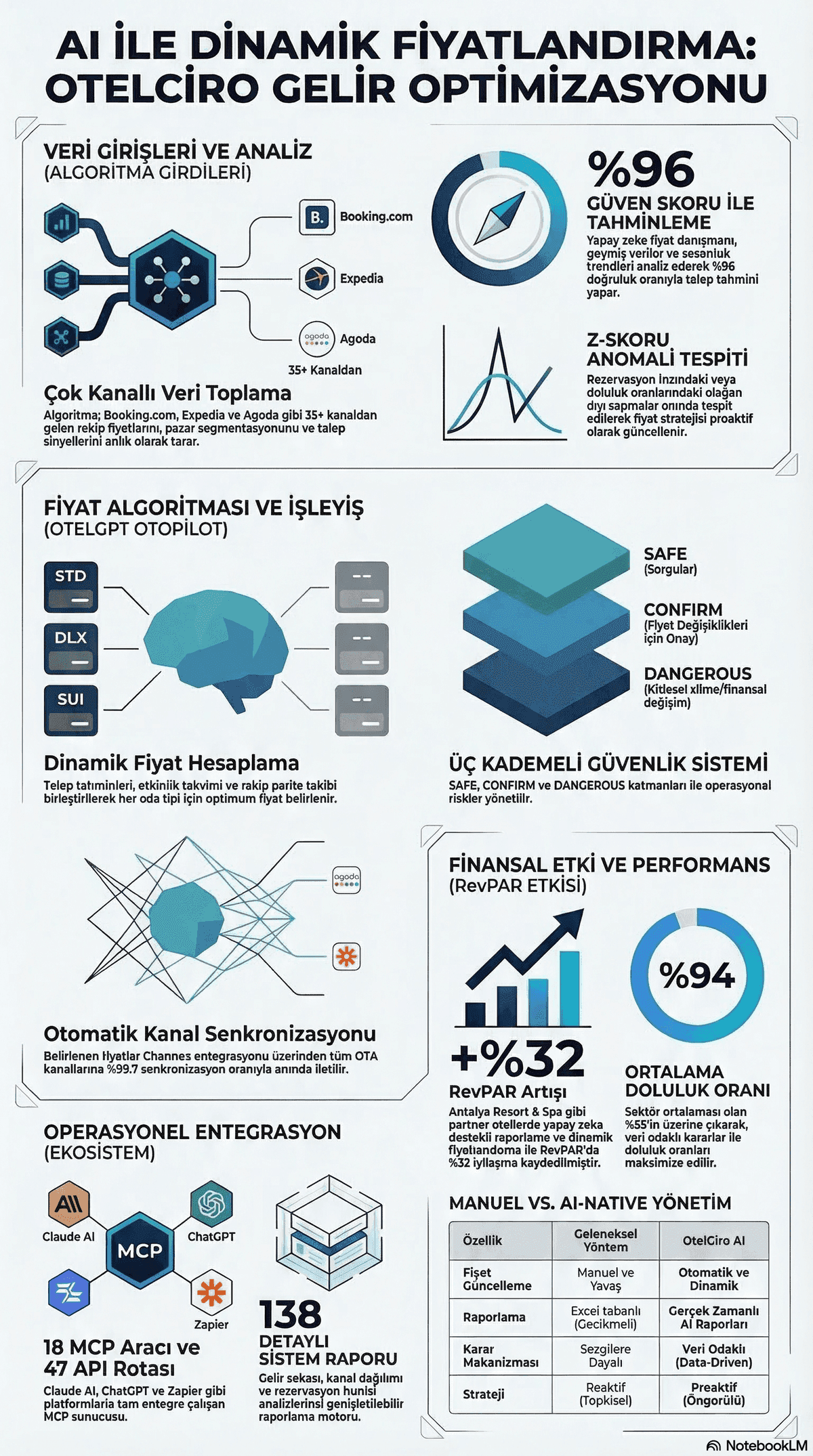
Embed this image on your site
<a href="https://otelciro.com/en/news/dinamik-vs-statik-fiyatlandirma">
  <img src="https://cdn.sanity.io/images/1la98t0z/production/6a97229e7f35d7df9e4e8a2cd6f4cfebc97cdc5b-1200x2150.png" alt="AI-powered dynamic pricing process" width="800" />
</a>
<p>Source: <a href="https://otelciro.com">OtelCiro</a> — AI Hotel Revenue Management</p>
Dynamic Pricing's RevPAR Impact
Industry research shows that hotels implementing dynamic revenue management achieve over 30% RevPAR improvement. The sources of that uplift:
| Source | Contribution |
|---|---|
| Event-based price surges | 35% |
| Weekday/weekend optimization | 25% |
| Seasonal transition periods | 20% |
| Last-minute rate adjustments | 15% |
| Length-of-stay discount tuning | 5% |
Related reading: Hotel Dynamic Pricing with AI: Rate Optimization That Maximizes RevPAR
How Dynamic Pricing Works
A dynamic pricing system analyzes multiple data sources simultaneously:
Demand Signals
- OTA search volume (how frequently is your hotel being searched?)
- Website traffic spikes
- Regional event calendars (concerts, conventions, sports matches)
- Flight load factors (passenger volume into your destination)
- Competitor price movements
Supply Signals
- Current occupancy rate
- Remaining room inventory
- Cancellation rate trends
- Room-type-level availability
- Rooms closed for maintenance or renovation
Market Signals
- Comp-set (competitive set) pricing
- Currency exchange rate movements
- Economic indicators
- Weather forecasts
- Holiday and public holiday calendars
The Booking.com algorithm also uses many of these same signals when determining ranking. When your pricing is aligned with market conditions, both your OTA ranking and your conversion rate improve.
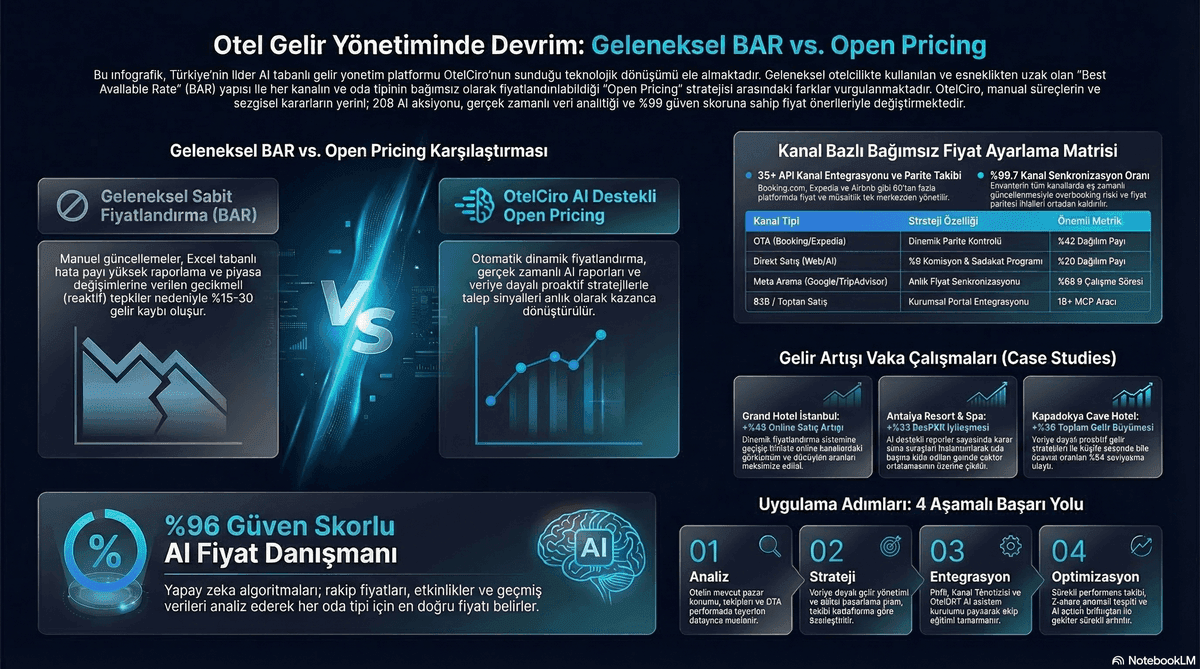
Embed this image on your site
<a href="https://otelciro.com/en/news/dinamik-vs-statik-fiyatlandirma">
  <img src="https://cdn.sanity.io/images/1la98t0z/production/38381e0dd477a4816db7ad9b1359befc08268365-1200x669.png" alt="Open pricing strategy for hotels" width="800" />
</a>
<p>Source: <a href="https://otelciro.com">OtelCiro</a> — AI Hotel Revenue Management</p>
The Risk of Static Pricing: Empty Room Cost
Static pricing is harmful not only during high-demand periods but also during low-demand ones. When the rate is fixed and demand drops, rooms go unsold. When you calculate your empty room cost, the true financial impact of every unsold night becomes clear.
Dynamic pricing addresses this on both ends:
- Low demand: Reduces rate to drive occupancy
- Medium demand: Finds the optimal price-occupancy balance
- High demand: Raises rate to maximize revenue
Related reading: Hotel Revenue Management Guide: Strategies, Metrics & Technology (2026)
Five Steps to Transition to Dynamic Pricing
1. Build Your Data Foundation
Centralize your PMS, channel manager, and OTA data. Historical occupancy, ADR, and RevPAR data should span at least 12 months.
2. Define Your Comp-Set
Identify 5-8 competitor hotels to benchmark against. Use criteria such as same area, similar star category, and comparable room count.
3. Set Price Floors and Ceilings
Establish minimum (floor) and maximum (ceiling) rates for each room type. Dynamic pricing operates within these boundaries.
4. Integrate the Event Calendar
Add all major city events — concerts, conventions, sporting fixtures, festivals — into your pricing calendar.
5. Test and Optimize
Treat the first three months as a pilot phase. Measure the impact of daily price adjustments on both occupancy and revenue.
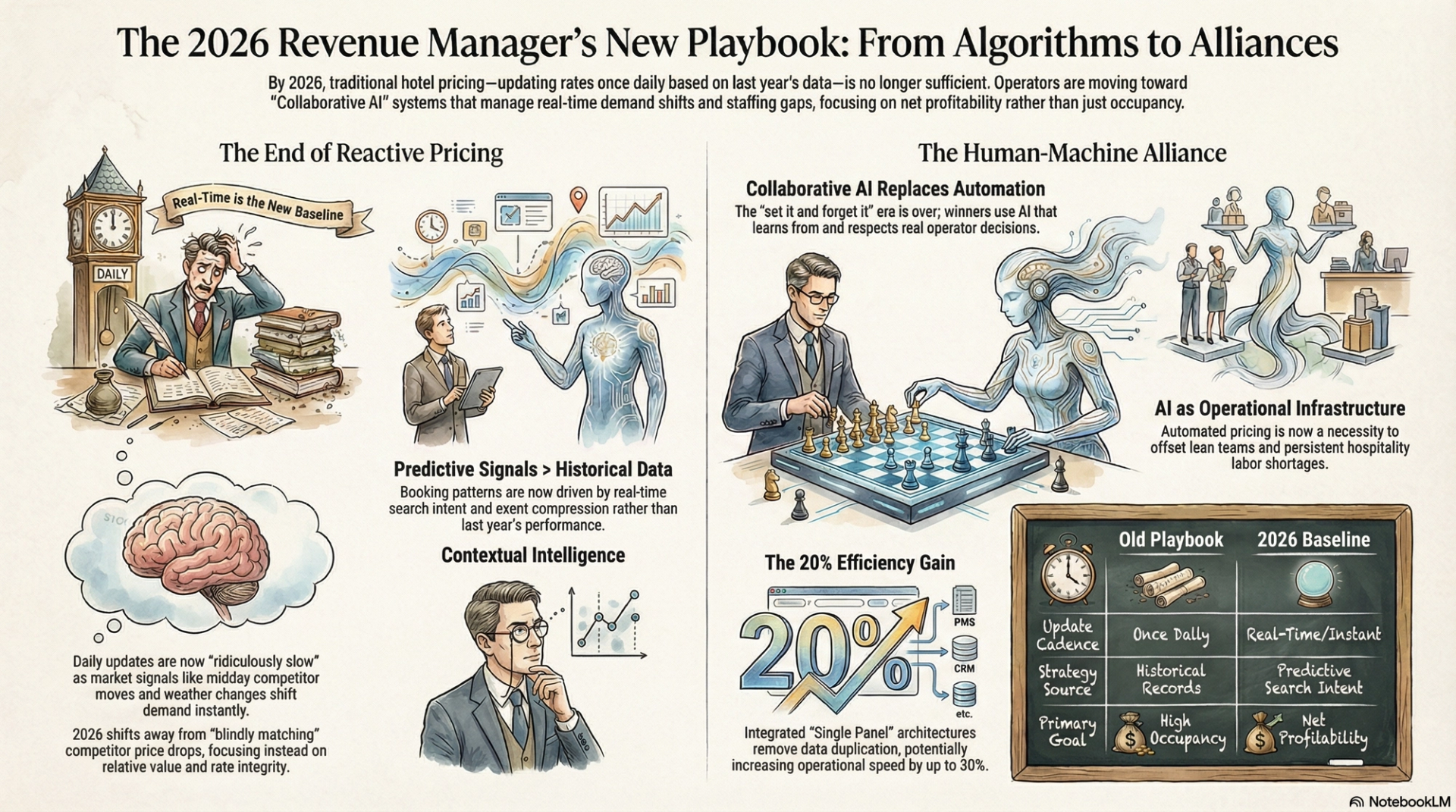
In the 2026 hospitality vision, AI-powered pricing systems automate all five of these steps and achieve forecasting accuracy of 95%.
Frequently Asked Questions
Does dynamic pricing upset guests?
Airlines and ride-sharing platforms have accustomed consumers to dynamic pricing. Guests understand that booking early means a better rate. Transparent messaging ("Early-bird advantage," "Last room offer") is the key to maintaining guest satisfaction.
Can small hotels use dynamic pricing?
Yes. Today, even a 10-room boutique hotel can implement dynamic pricing through cloud-based revenue management systems. The investment typically pays for itself within 2-3 months through incremental revenue.
How often should prices be adjusted?
Ideally, prices should be reviewed daily. During event periods or sudden demand shifts, intraday adjustments may be warranted. AI-powered systems handle this process automatically.
OtelCiro uses an AI-powered dynamic pricing engine to ensure every room in your hotel sells at the optimal rate. Discover OtelCiro to boost your RevPAR by 30% or more.
![Hotel Upselling: AI-Driven Revenue Growth [2026]](https://cdn.sanity.io/images/1la98t0z/production/9850350573fc466b95b1490c7f689e8ac39c4f11-1200x669.png?w=1920&q=50&auto=format&fit=max)