![Hotel Distribution: From GDS to AI [2026]](https://cdn.sanity.io/images/1la98t0z/production/7bd76ccfbc8c36110c2ec6dbeb0d9c5c047efaae-1200x1200.png?w=1920&q=65&auto=format&fit=max)
Three Major Disruptions in Distribution History
The hospitality industry has experienced three major distribution revolutions over the past 35 years. Each revolution resulted in 40-60% market share loss for hotels that were unprepared. In every case, the winners shared the same profile: properties that recognized the shift early and adapted fast. In 2026, we are at the third tipping point — and history is repeating itself.
Related reading: Hotel Channel Management Guide: Maximize Revenue Across OTAs
Era 1: The GDS Revolution (1990s)
The Sabre, Amadeus, and Galileo Age
Before the 1990s, hotel reservations were made by telephone, fax, and travel agencies. The Global Distribution System (GDS) — Sabre, Amadeus, Galileo, and Worldspan — was the first great revolution that digitized this process.
What GDS did:
- Gave travel agents a single screen to view thousands of hotels
- Made pricing and availability instantly queryable
- Enabled international distribution for the first time
- Forced hotels into a standardized inventory system
Winners: Hotels that connected to GDS early gained first access to the international market. Major chains (Hilton, Marriott, Sheraton) scaled rapidly through GDS. The corporate travel segment exploded.
Losers: Hotels that did not connect fell off travel agents' radar. Small and local properties lost access to international guests. Market share loss: 40-50%.
Lesson: Those who fail to adopt the new distribution channel become invisible.
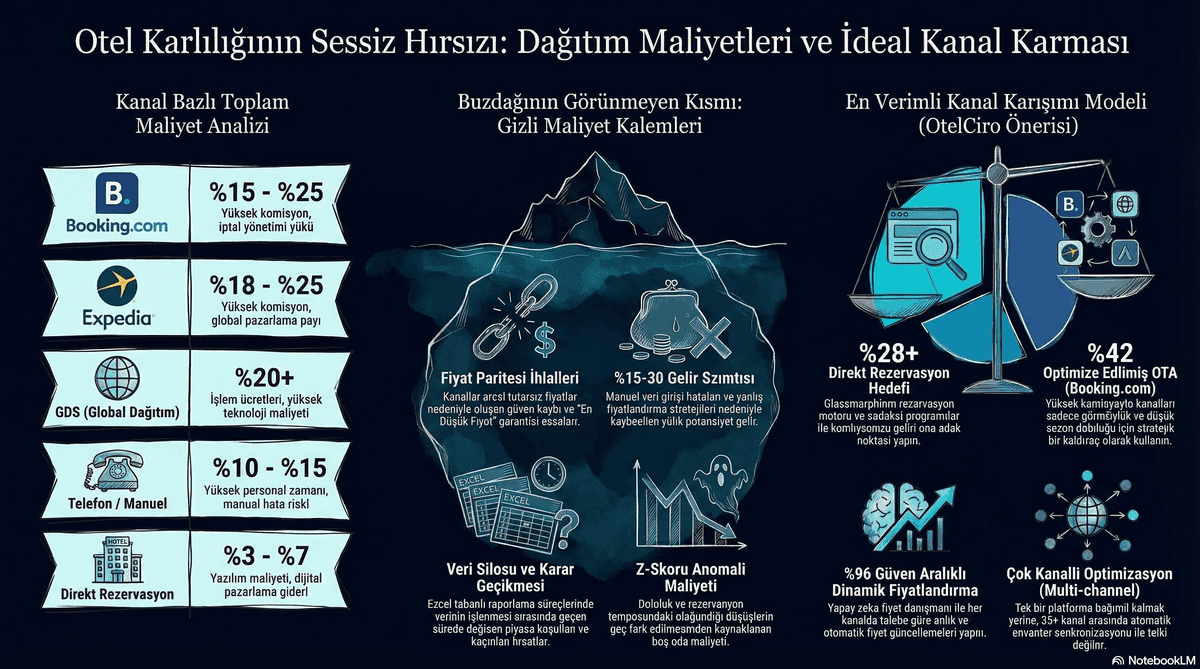
Embed this image on your site
<a href="https://otelciro.com/en/news/gds-den-ai-ya">
  <img src="https://cdn.sanity.io/images/1la98t0z/production/b84b7437a6ec87c2fe5cca259f9ec9d95f7d36ae-1200x669.png" alt="Hotel distribution cost analysis" width="800" />
</a>
<p>Source: <a href="https://otelciro.com">OtelCiro</a> — AI Hotel Revenue Management</p>
Era 2: The OTA Revolution (2000s)
The Booking.com, Expedia, and Hotels.com Age
The internet revolution of the early 2000s gave birth to OTAs (Online Travel Agencies). Booking.com and Expedia were founded in 1996 but experienced explosive growth between 2000 and 2010.
What OTAs did:
- Provided direct consumer access (B2C model)
- Made price comparison available to everyone
- Popularized the review and rating system
- Standardized the commission-based business model
Winners: Early OTA adopters experienced volume surges. Hotels that invested in content quality rose in rankings. Small and independent hotels gained global visibility for the first time.
Losers: Hotels that said "We don't need OTAs" suffered serious occupancy declines. Those dependent on GDS who did not transition to OTAs fell behind. Properties that neglected the direct channel got trapped in the commission cycle. Market share loss: 40-60%.
Lesson: Every new channel resets leadership in the old one. You must start fresh.
Related reading: How to Reduce Booking.com Commissions: 7 Proven Strategies for Hotels (2026)
Era 3: The AI Revolution (2025-2026)
The ChatGPT, Claude, Perplexity, and Gemini Age
In 2025-2026, AI assistants are triggering the third major distribution disruption. This revolution is faster and more fundamental than either of the previous two.
What AI is doing:
- Natural-language hotel search and booking (finding hotels by conversation)
- Personalized recommendations (matching the guest's exact needs)
- 0% commission direct booking
- Live data access through the MCP protocol
- Unmediated, direct hotel-guest connection
Emerging winners:
- Hotels that have completed MCP integration are appearing in AI searches
- Properties with structured data are achieving 14.2% conversion via ChatGPT
- Hotels with strong direct booking engines are growing commission-free
At risk of losing:
- Hotels that say "AI won't affect us"
- Properties fully dependent on OTAs with no alternative channel development
- Hotels with weak digital infrastructure, unready for data sharing
- Potential market share loss: 40-60% (the historical pattern is repeating)
Embed this image on your site
<a href="https://otelciro.com/en/news/gds-den-ai-ya">
  <img src="https://cdn.sanity.io/images/1la98t0z/production/b9cee47e03a0891ad8e615048e78be166bc641de-1200x2150.png" alt="Hotel channel management and OTA distribution strategy" width="800" />
</a>
<p>Source: <a href="https://otelciro.com">OtelCiro</a> — AI Hotel Revenue Management</p>
The Common Pattern Across Three Revolutions
The same pattern repeats in every distribution revolution:
| Phase | GDS (1990) | OTA (2000) | AI (2025-2026) |
|---|---|---|---|
| New channel | GDS terminals | Websites | AI assistants |
| Initial reaction | "Fax is enough" | "A website is enough" | "OTAs are enough" |
| Early adopters | Chain hotels | Digitally savvy hotels | AI-native hotels |
| Disruption timeline | 5-7 years | 3-5 years | 1-2 years |
| Market share loss | 40-50% | 40-60% | 40-60% (estimated) |
| Critical adaptation | GDS connectivity | OTA profile + SEO | MCP + GEO |
One striking observation: each revolution happens faster than the last. The GDS revolution took 5-7 years, the OTA revolution took 3-5 years. The AI revolution will reshape the industry within 1-2 years. The preparation window is shrinking.
Related reading: 2026 Hotel Survival Guide: Everything on One Page
Five Steps to Transition into the AI Era
In light of 2026 mega-trends, every hotel should take these steps:
- Build your MCP infrastructure: Open your PMS data to AI platforms
- Develop a GEO strategy: Transition from SEO to Generative Engine Optimization
- Strengthen your booking engine: Build the infrastructure to handle ChatGPT referrals
- Raise content quality: Prepare structured content that AI can understand
- Adopt data-driven decision-making: Implement real-time performance tracking and dynamic optimization
Those Who Learn from History Win
The winners of every distribution revolution share the same profile: hotels that embrace change rather than deny it, move early, and adapt quickly to the new channel. In 2026, carrying that profile means speaking to AI — and having AI speak about you.
Frequently Asked Questions
Is GDS still necessary or should we move entirely to AI?
GDS remains important, especially for the corporate travel segment. However, GDS's share of total distribution is declining year over year. The ideal strategy is to maintain GDS for corporate business while aggressively developing the AI channel. Do not abandon any channel entirely — shift your center of gravity.
Will the AI revolution bring the end of OTAs?
Not in the short term. OTAs will adapt, just as travel agencies survived both the GDS and OTA revolutions. However, OTAs' total market share will continue to erode. Smart hotels should not abandon OTAs but rather add the AI channel to their portfolio for risk diversification.
How long does this transition take?
The foundational steps of AI integration (MCP setup, structured data, booking engine compatibility) can be completed in 4-8 weeks. However, achieving meaningful visibility and conversion in AI may take 3-6 months. The important thing is to start now — because this revolution is moving far faster than the ones before it.
To navigate the transition from the distribution era to the AI age seamlessly, partner with OtelCiro. From MCP integration to GEO strategy, we manage the entire transition end to end.