
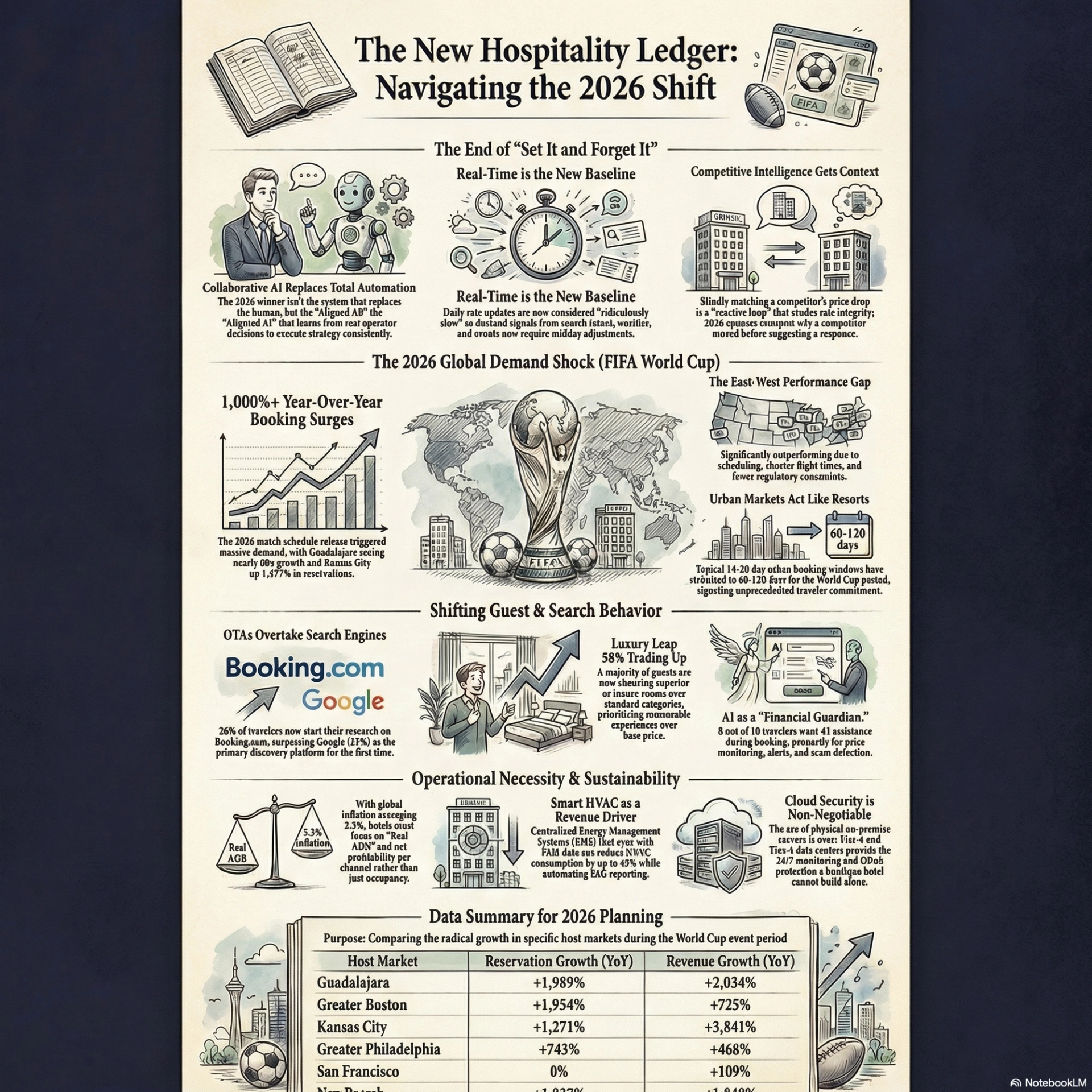
A New Era of Hotel Distribution
In early 2026, Marriott International and Google announced a partnership that sent shockwaves through the hospitality industry. The collaboration centers on integrating generative AI directly into the travel search and booking experience, effectively creating a pipeline that routes guests from Google Search to Marriott's own booking engine without ever touching an OTA.
This is not just another marketing integration. It represents a fundamental shift in how travelers discover and book hotels.
What Is the "Unified Digital Shelf"?
The concept borrows from retail, where brands like Procter & Gamble manage their presence across Amazon, Walmart, and DTC channels through a single data layer. Marriott's version applies this thinking to hospitality distribution.
In practice, the Unified Digital Shelf means Marriott's inventory, pricing, room imagery, reviews, and loyalty perks appear natively inside Google's AI-powered search results. When a traveler asks Google's AI assistant for a "boutique hotel in downtown Chicago for a weekend getaway," the response can surface Marriott properties with real-time availability and a direct booking link, bypassing Booking.com and Expedia entirely.
The Technical Architecture
The integration relies on three pillars:
- Structured data feeds: Marriott pushes real-time inventory and pricing to Google via enhanced schema markup and direct API connections
- AI-native content: Property descriptions, images, and amenity lists are formatted specifically for consumption by large language models
- Identity bridging: Marriott Bonvoy loyalty data connects to Google's user graph, enabling personalized recommendations without third-party cookies
The Acceleration Timeline: Why This Matters Now
Every major distribution disruption in hospitality has arrived faster than the last. The data tells a clear story:
| Distribution Shift | Adoption Timeline | Key Driver |
|---|---|---|
| GDS (Sabre, Amadeus) | 5-7 years | Travel agent automation |
| OTA (Booking, Expedia) | 3-5 years | Consumer internet adoption |
| AI-native distribution | 1-2 years (projected) | Generative AI search |
The GDS revolution took most of a decade to reshape booking flows. OTAs compressed that to roughly four years. AI-native distribution channels are moving at an unprecedented pace because the infrastructure -- search engines, mobile devices, payment systems -- already exists. The only new variable is the AI layer itself.
What This Means for Independent Hotels
Here is the uncomfortable truth: independent hotels risk being left behind. Marriott can invest tens of millions in a Google partnership because it has 8,800+ properties to amortize the cost across. A 50-room boutique hotel in Antalya does not have that luxury.
But the opportunity is not exclusive to mega-chains. Independent hotels can prepare by focusing on three areas:
1. Structured Data Readiness
Google's AI systems consume structured data far more effectively than unstructured web pages. Hotels that implement comprehensive schema markup for their properties -- including room types, amenities, pricing, availability, and review scores -- will be discoverable by AI systems regardless of whether they have a direct Google partnership.
2. Direct Booking Infrastructure
The hotels that benefit most from AI-driven distribution will be those with frictionless direct booking experiences. A traveler who discovers your property through an AI recommendation and lands on a clunky booking page will bounce to an OTA within seconds.
Related reading: AI Adoption in Hotels Hits 82% in 2026
3. Content Optimized for AI Consumption
Traditional SEO focused on keywords. AI-native discovery focuses on entity relationships and contextual relevance. Hotels need to ensure their digital presence answers the questions AI systems ask: What type of experience does this property offer? Who is the ideal guest? What makes it different from nearby competitors?
The OTA Response
Booking Holdings and Expedia Group are not standing still. Both companies have accelerated their own AI initiatives:
- Booking.com launched its AI Trip Planner in 2024 and has since expanded it to 40+ languages
- Expedia acquired PredictHQ and partnered with Affirm to create AI-powered dynamic packaging
- Airbnb is investing heavily in AI-curated collections that match travelers with unique stays
The difference is motivation. OTAs are building AI features to retain their intermediary position. The Marriott-Google partnership is designed to eliminate the intermediary altogether.
Related reading: Booking Holdings B2B Consolidation: What Hotels Need to Know
Five Actions Hotels Should Take Today
Regardless of your property's size, these steps will prepare you for AI-native distribution:
- Audit your structured data -- Run your website through Google's Rich Results Test and fix every gap
- Invest in direct booking UX -- Your booking engine should load in under 2 seconds and work flawlessly on mobile
- Create AI-friendly content -- Write property descriptions that answer specific traveler questions, not generic marketing copy
- Build your first-party data asset -- Email lists, loyalty programs, and guest preferences are your defense against disintermediation
- Monitor AI search visibility -- Track how your property appears in Google AI Overviews, ChatGPT, and Perplexity
The Bigger Picture
The Marriott-Google partnership is a signal, not an anomaly. Within the next 18 months, we will see similar deals between hotel groups and AI platforms. The hotels that thrive will be those that treat AI-native distribution as a core competency rather than an afterthought.
The question is not whether AI will reshape hotel distribution. It already is. The question is whether your property will be visible when travelers ask their AI assistant where to stay.
OtelCiro helps hotels build AI-ready distribution strategies and direct booking infrastructure. Request a free consultation to see how your property can compete in the new era of AI-native travel search.
![Reduce Booking.com Commissions: 7 Proven Tips [2026]](https://cdn.sanity.io/images/1la98t0z/production/64127ef2c1c822e43014834c83ff5e3da025ae9b-1376x768.jpg?w=1920&q=50&auto=format&fit=max)