![Reduce Booking.com Commissions: 7 Proven Tips [2026]](https://cdn.sanity.io/images/1la98t0z/production/64127ef2c1c822e43014834c83ff5e3da025ae9b-1376x768.jpg?w=1920&q=65&auto=format&fit=max)
The True Cost of Booking.com Commissions
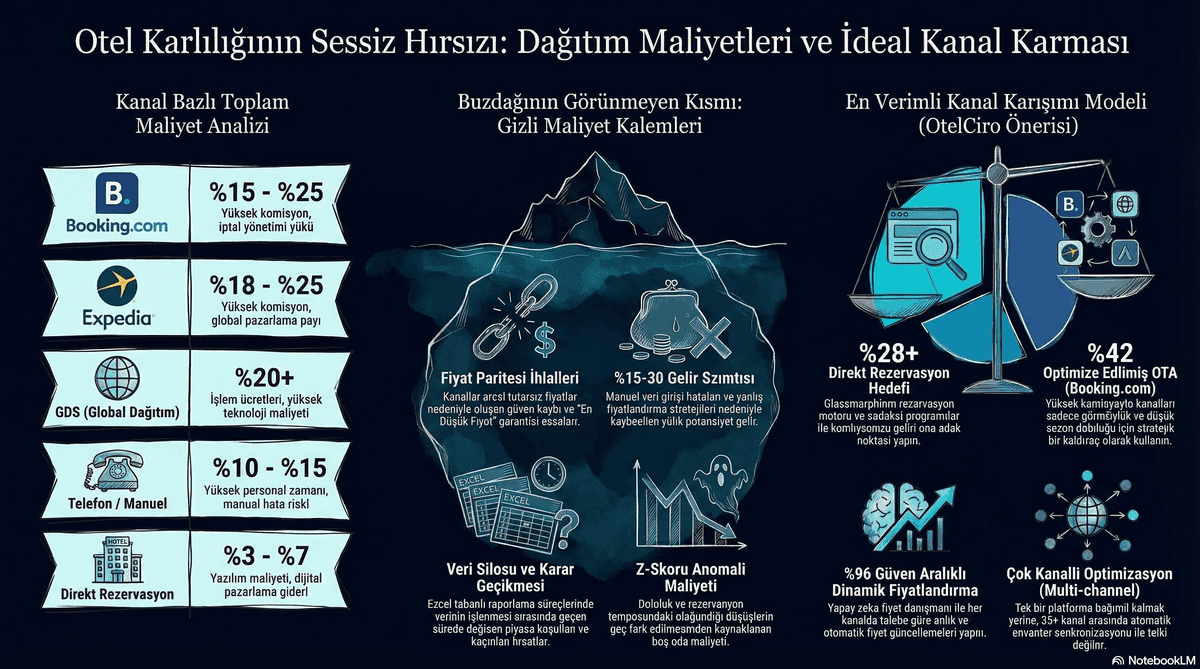
Booking.com dominates global hotel distribution with over 28 million listed properties. For many hotels — particularly independent and boutique properties — Booking.com accounts for 50-70% of total bookings. That reach comes at a significant and often underestimated cost.
Commission Structure (2026 Current)
Booking.com's commission rates vary by country, property type, and program participation:
| Program | Commission Rate | Additional Benefits |
|---|---|---|
| Standard | 15% | Basic listing |
| Preferred Partner | 17-18% | ~40% search ranking boost, badge |
| Genius Level 1 | 15% + 10% discount | Visibility to Genius members |
| Genius Level 2 | 15% + 15% discount | Enhanced visibility |
| Genius Level 3 | 15% + 20% discount | Maximum visibility |
| Visibility Booster | 15-25%+ | Dynamic ranking increase |
The Hidden Costs Beyond Commission
The stated commission percentage is only the tip of the iceberg. True cost includes:
- Genius discounts: You're funding 10-20% guest discounts on top of commission. Real cost reaches 25-35%.
- Preferred Partner premium: Higher commission plus mandatory flexible cancellation policies that increase no-shows.
- Guest data loss: Guest information from Booking.com is limited. Email addresses are masked, preventing direct remarketing.
- Rate parity pressure: OTA parity agreements historically restricted your ability to offer lower rates on your own website.
- Dependency risk: When Booking.com changes its algorithm or raises commission rates, your entire revenue structure is exposed.
Concrete calculation: A 100-room hotel with $180 ADR and 70% occupancy pays approximately $690,000 annually in Booking.com commissions at 15%. With Genius and Preferred Partner programs, that figure climbs to $850,000-$1,000,000 — likely your second-largest expense category after payroll.
Related reading: Hotel Channel Management Guide: Maximize Revenue Across OTAs
Related reading: Booking.com Connected Trip: New Threats and Opportunities for Hotels
7 Proven Strategies to Reduce Booking.com Commissions
Strategy 1: Build a High-Converting Direct Booking Engine
Direct bookings are the most effective commission reduction lever. But having a website is not enough — you need a conversion-optimized booking experience that competes with Booking.com's world-class UX.
Non-negotiable elements:
- Price advantage: Offer 5-10% lower rates on your website versus OTAs. The EU's Digital Markets Act (DMA) has removed wide rate parity requirements in many markets, giving hotels newfound pricing freedom.
- Instant value-adds: Direct booking exclusives — complimentary breakfast, early check-in, late check-out, room upgrade, welcome drink. These cost you far less than the commission you save.
- Frictionless process: No more than 3 steps from room selection to confirmation. A guest should complete their booking in under 2 minutes.
- Mobile-first design: 72% of hotel research starts on mobile devices. A booking engine that doesn't work flawlessly on mobile is leaking revenue.
- Trust signals: SSL certificate, secure payment badges, clear cancellation policy display, guest reviews.
The OtelCiro Smart PMS includes an integrated booking engine that delivers all of these elements in one system, increasing direct conversion rates by an average of 35%.
Strategy 2: Leverage the Billboard Effect
The billboard effect describes how OTA visibility drives additional traffic to your direct website. Research consistently shows that hotels listed on OTAs see a 15-25% increase in direct website traffic — guests discover you on Booking.com, then search for your hotel directly to compare.
Tactics to maximize this effect:
- Optimize your OTA profile: High-quality photos, detailed descriptions, current amenity information. The more compelling your OTA listing, the more guests will search for you directly.
- Dominate branded search: When someone searches your hotel name, your website must appear first. Optimize your Google Business Profile, run branded PPC campaigns, and ensure your direct booking link is prominently displayed.
- Price comparison widget: Show a "Best Rate Guarantee" comparison on your website demonstrating your price advantage over OTAs.
- Retargeting campaigns: Deploy Google Ads and social media retargeting to reach visitors who came from OTAs to your website but didn't convert.
Strategy 3: Launch a Guest Loyalty Program
Repeat guests are dramatically more profitable than new OTA acquisitions. A loyalty program is the most powerful mechanism for locking guests into your direct channel.
Effective loyalty program elements:
- Immediate value: 5% discount or complimentary service upon first enrollment. Points-only systems rarely provide sufficient initial motivation.
- Tiered rewards: Escalating benefits based on stay frequency — room upgrades, exclusive experiences, flexible cancellation.
- Personalization: Remember guest preferences — floor preference, pillow type, minibar selections, room temperature. This is a value proposition no OTA can replicate.
- Communication: Regular but non-intrusive email engagement. Special offers, local event recommendations, birthday acknowledgments.
Hotels with active loyalty programs report that repeat direct bookings account for 30-45% of total revenue, with acquisition costs near zero.
Strategy 4: Diversify Your Channel Mix
Reducing Booking.com dependency also means strengthening alternative channels. Over 50% dependency on any single OTA represents a strategic vulnerability.
Channel diversification roadmap:
- Expedia Group: Your second major OTA channel, reaching different demographic profiles. Particularly strong in North American and Asian markets.
- Google Hotels / Free Booking Links: Commission-free or low-cost listing opportunity. Google's metasearch traffic is growing rapidly, especially in Europe and the Middle East.
- TripAdvisor: Dual-purpose as both reputation management and booking channel.
- Niche OTAs: Mr & Mrs Smith (boutique), HRS (corporate), Hostelworld (budget travelers) — segment-specific platforms that deliver qualified audiences.
- GDS (Amadeus, Sabre, Travelport): Still essential for the corporate travel segment, with commission rates typically 8-15%.
- Social media: Direct booking integrations through Instagram and Facebook are maturing as viable channels.
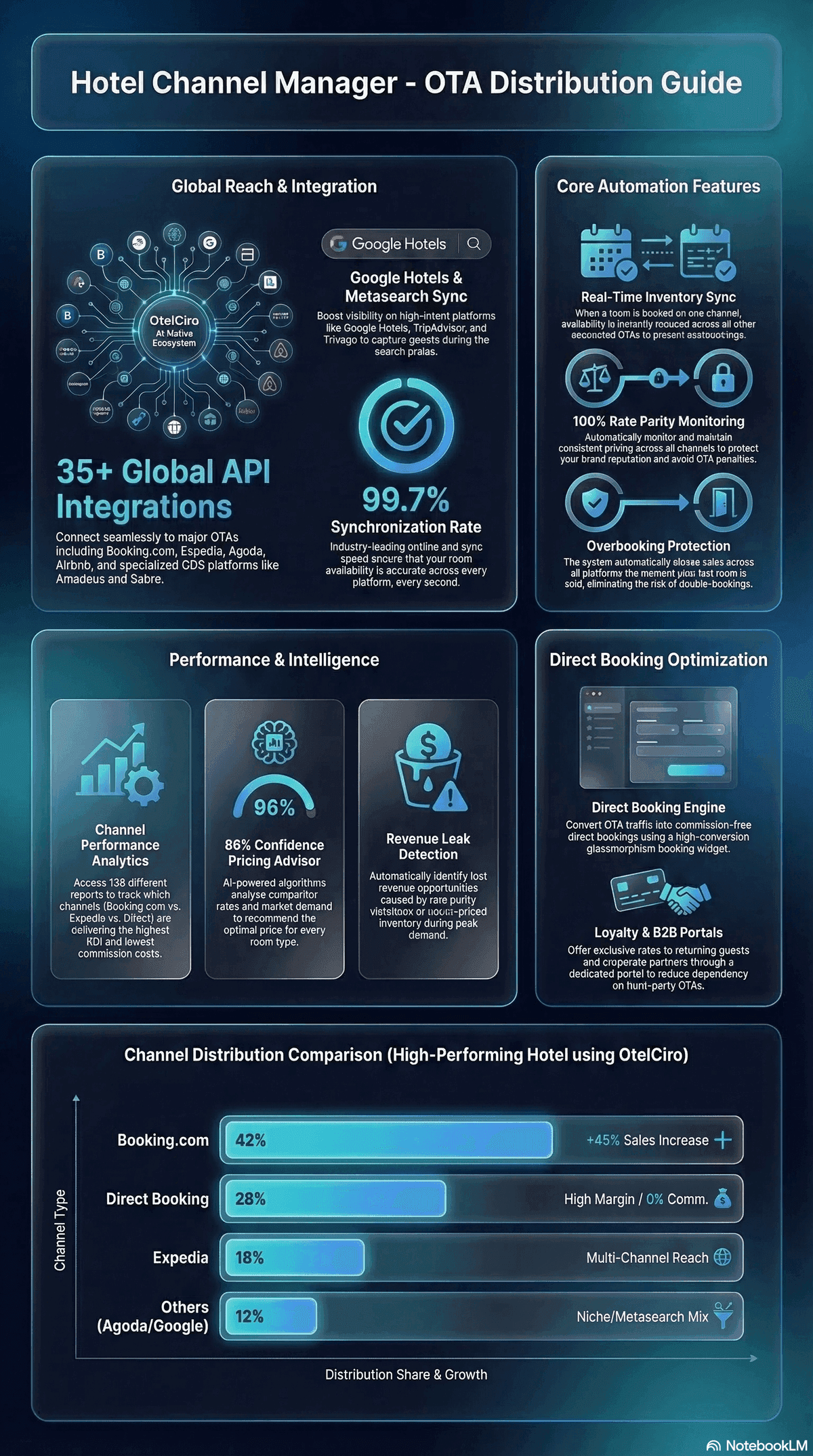
The OtelCiro Sales Module manages all channels from a centralized dashboard, providing per-channel profitability analysis and automated inventory distribution optimization.
Strategy 5: Invest in Metasearch Marketing
Google Hotels, Trivago, Kayak, and TripAdvisor metasearch operate on a CPC (cost-per-click) model rather than commission. This fundamental difference makes metasearch one of the most cost-effective distribution channels available.
Metasearch advantages:
- Lower cost: Average metasearch conversion cost runs 8-12%, versus 15-25% OTA commission. The difference goes directly to your bottom line.
- Direct relationship: The guest books on your website, and you retain all customer data for future marketing.
- Price positioning: You can display your rate alongside OTAs, highlighting your direct booking advantage.
Metasearch success playbook:
- Activate Google Hotels Free Booking Links (zero cost)
- Launch a Google Hotels paid campaign with a conservative test budget
- Connect to Trivago Rate Connect
- Ensure price consistency across all metasearch channels
- Monitor conversion rate and CPA; optimize continuously
Hotels that actively manage metasearch advertising typically achieve a 20-40% increase in direct website traffic within six months.
Strategy 6: Negotiate Smarter with Booking.com
Completely leaving Booking.com is not practical for most hotels. The goal is to make the relationship more profitable.
Negotiation tactics:
- Request commission reduction: Booking.com is open to negotiation, especially for properties in low-demand periods or newly listed hotels. Even a 1-2% reduction saves tens of thousands annually.
- Use Genius strategically: Activate Genius only during low-demand periods; deactivate during peak season when you can fill rooms through cheaper channels.
- Evaluate Preferred Partner carefully: Calculate whether the additional visibility actually generates enough incremental revenue to justify the higher commission.
- Control inventory allocation: On high-demand dates, limit rooms available to Booking.com. Reserve your last rooms for direct channels.
- Use Visibility Booster tactically: Only deploy during low-occupancy periods for specific dates, never leave it permanently enabled.
Strategy 7: AI-Powered Channel Optimization
Manual channel management cannot keep pace with today's complex distribution ecosystem. AI-powered systems perform real-time profitability analysis for every channel, automatically optimizing inventory allocation and rate distribution.
What AI channel optimization delivers:
- Instant decision-making: Every booking request analyzed in milliseconds — what is the most profitable decision for this room, this date, this channel?
- Dynamic inventory allocation: As demand increases, more rooms are directed to direct channels. As demand softens, OTA inventory opens up.
- Net RevPAR optimization: Maximizes post-commission net revenue rather than gross revenue.
- Parity monitoring: Automatic rate consistency checks across all channels.
The shift from managing gross revenue to optimizing net revenue per channel is arguably the most impactful change a hotel can make in its distribution strategy.
Embed this image on your site
<a href="https://otelciro.com/en/news/reduce-booking-com-commissions">
  <img src="https://cdn.sanity.io/images/1la98t0z/production/b9cee47e03a0891ad8e615048e78be166bc641de-1200x2150.png" alt="Hotel channel management and OTA distribution strategy" width="800" />
</a>
<p>Source: <a href="https://otelciro.com">OtelCiro</a> — AI Hotel Revenue Management</p>
Direct Booking Growth: A Practical Implementation Timeline
Months 1-3: Foundation
- Redesign website with mobile-first, conversion-focused approach
- Integrate a high-performance booking engine (3 steps maximum)
- Complete and optimize Google Business Profile
- Establish rate strategy: 5-10% direct booking advantage
- Activate Google Hotels Free Booking Links
Months 3-6: Growth
- Launch metasearch paid campaigns
- Roll out loyalty program
- Set up email marketing automation
- Deploy retargeting campaigns
- Enable social media direct booking integrations
Months 6-12: Optimization
- Conduct monthly per-channel profitability analysis
- Enter Booking.com commission negotiations
- Manage Genius program seasonally
- Target 3%+ direct website conversion rate
- Transition to AI-based channel optimization
Related reading: 2026 Hotel Survival Guide: Everything on One Page
Related reading: The Billboard Effect: Why OTA Commissions Are Actually Marketing Investments
Real Results: Commission Reduction Case Studies
Case Study 1: Cappadocia Cave Hotel (32 rooms)
Starting point: Booking.com 72%, direct 8%, other OTAs 20%
After 12 months:
- Booking.com: 72% → 42%
- Direct: 8% → 31%
- Metasearch: 0% → 12%
- Other OTAs: 20% → 15%
Annual commission savings: $48,000 — reinvested into website improvement and guest experience.
Case Study 2: Bodrum Beach Resort (85 rooms)
Starting point: Booking.com 58% share, annual commission spend $220,000
After 12 months:
- Booking.com share: 58% → 35%
- Direct booking share: 15% → 38%
- Annual commission: $220,000 → $132,000
Annual savings: $88,000 — used to renovate the spa area, which then increased ADR by 12%.
Embed this image on your site
<a href="https://otelciro.com/en/news/reduce-booking-com-commissions">
  <img src="https://cdn.sanity.io/images/1la98t0z/production/b84b7437a6ec87c2fe5cca259f9ec9d95f7d36ae-1200x669.png" alt="Hotel distribution cost analysis" width="800" />
</a>
<p>Source: <a href="https://otelciro.com">OtelCiro</a> — AI Hotel Revenue Management</p>
Frequently Asked Questions
Should we leave Booking.com entirely?
For most hotels, no. Booking.com remains a powerful distribution channel, and the billboard effect has measurable value. The goal is to reduce dependency, not eliminate the channel. An ideal target is bringing Booking.com's share down to 25-35% of total bookings.
Will Booking.com penalize us for breaking rate parity?
Under the EU's Digital Markets Act (DMA), Booking.com can no longer enforce wide rate parity across Europe. Narrow parity (your Booking.com rate cannot be higher than other OTAs) may still apply in some markets. Offering lower rates on your own website is largely unrestricted in the EU and several other jurisdictions.
How much direct booking can a small hotel achieve?
With the right strategy, a 20-50 room property can realistically reach 25-35% direct bookings. The keys are a strong website, a clear price advantage, and repeat guest cultivation.
How effective is Google Hotels?
Google Hotels is growing rapidly, especially in European and Middle Eastern markets. Free Booking Links provide a zero-cost entry point. When combined with paid campaigns, you can increase direct traffic by 20-40%.
Related reading: 5 Channels, 5 Different Rules: How Hotels Should Optimize Each One
Conclusion: Commission Management Is Profitability Management
Booking.com commissions represent one of the largest variable expenses for most hotels. Controlling this cost directly improves profitability — without selling a single additional room, without cutting staff, without compromising quality.
Commission reduction is not an overnight transformation. It requires a systematic approach, the right technology infrastructure, and consistent execution over 6-12 months. But the results are concrete and measurable: hotels that implement these strategies typically reduce their effective OTA commission burden by 30-50%.
The OtelCiro platform supports every stage of your commission reduction journey — from channel management and direct booking optimization to metasearch integration and AI-powered pricing. Start a conversation with OtelGPT to build a commission reduction plan customized for your property.
Every direct booking you capture today is thousands of dollars you won't pay Booking.com tomorrow.