![Hotel Channel Management: Maximize OTA Revenue [2026]](https://cdn.sanity.io/images/1la98t0z/production/9fac130b01fefd2ff41474d9404d4d7d5364cbdc-1376x768.jpg?w=1920&q=65&auto=format&fit=max)
What Is Hotel Channel Management and Why Does It Matter?
In modern hospitality, selling rooms from the front desk alone is a relic of the past. Managing inventory, rates, and availability simultaneously across Booking.com, Expedia, Agoda, Google Hotels, Airbnb, and dozens of other online travel agencies (OTAs) has become a strategic necessity. Hotel channel management is the discipline that addresses this exact challenge.
Channel management is the process by which a hotel distributes, prices, and updates its room inventory across multiple sales channels — OTAs, metasearch engines, the direct website, GDS, and wholesale platforms — in a consistent and synchronized manner. At the center of this process sits the channel manager software.
The Numbers Behind Channel Management
- The average hotel derives over 55% of its online revenue from OTA channels (Phocuswright, 2025).
- Hotels with effective channel management achieve 18-25% higher RevPAR compared to those managing channels manually.
- Manual channel management results in an average overbooking rate of 4.7%, while automated systems reduce this to below 0.3%.
- Hotels that fail to maintain rate parity experience up to 30% ranking drops on major OTA platforms.
The message is clear: channel management is no longer a nice-to-have — it is the backbone of hotel revenue management.
Related reading: How to Reduce Booking.com Commissions: 7 Proven Strategies for Hotels (2026)
Related reading: Booking.com 2025: 5 Critical Strategic Shifts Every Hotelier Must Know
What Is a Channel Manager? How Does It Work?
A channel manager is a cloud-based software solution that integrates with the hotel's PMS (Property Management System) and enables management of all distribution channels from a single dashboard. Its core functions include:
- Inventory synchronization: When a booking comes in from one channel, availability is instantly updated across all other channels.
- Rate distribution: Rates set by the hotel are simultaneously pushed to all connected channels.
- Restriction management: Minimum length of stay, CTA (Closed to Arrival), CTD (Closed to Departure), and other restrictions are applied on a per-channel basis.
- Two-way connectivity: Reservations from channels are automatically imported into the PMS, and changes made in the PMS are reflected across channels.
Here is how a modern channel manager works in practice:
- A guest books a room on Booking.com.
- The channel manager receives this information within milliseconds.
- The reservation is automatically written into the hotel's PMS.
- Availability on all other channels (Expedia, Agoda, the hotel website, etc.) is instantly updated.
- Overbooking risk drops to near zero.
This entire process occurs without human intervention. What would take hours with manual updates is completed in seconds with an automated system.
OtelCiro's Smart PMS incorporates channel manager functionality natively, eliminating the need for separate software and managing the entire process end-to-end.
Embed this image on your site
<a href="https://otelciro.com/en/news/hotel-channel-management-guide">
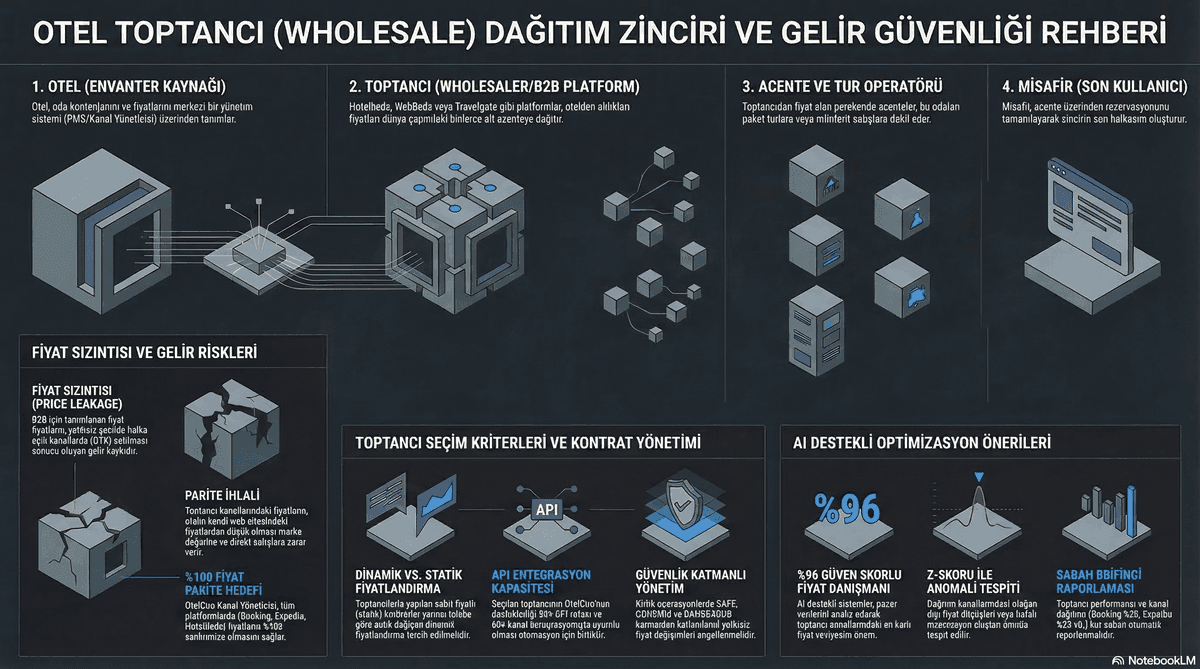
  <img src="https://cdn.sanity.io/images/1la98t0z/production/8c7389f65356dc716308dffb69a534a1d6baa7dc-1200x669.png" alt="Hotel wholesale distribution channels" width="800" />
</a>
<p>Source: <a href="https://otelciro.com">OtelCiro</a> — AI Hotel Revenue Management</p>
Key OTA Channels and Their Strategic Importance
Let's examine the most critical distribution channels and their unique characteristics.
Booking.com
Booking.com holds the largest market share among OTAs globally, accounting for approximately 38% of online hotel bookings in many European markets.
Key optimization factors:
- Aim for 100% Content Score — complete photos, descriptions, and amenity listings
- Genius program participation provides ranking advantages
- Mobile discounts are critical as 75% of traffic comes from mobile devices
- Review scores from the past 12 months carry the most algorithmic weight
Expedia Group
Managing a broad portfolio including Hotels.com, Vrbo, and Trivago, Expedia is particularly essential for the North American market.
Key optimization factors:
- Package deals (flight + hotel) increase conversion by 35%
- The Merchant Model keeps rate control with the hotel
- Offering exclusive rates to Expedia Rewards members improves rankings
Google Hotels
While not a traditional OTA, Google Hotels has evolved from a metasearch engine into a full booking channel. With free listings and Google Business Profile integration, it offers a low-cost distribution channel with massive reach.
Agoda
A critical channel for the Asia-Pacific market, Agoda is the primary platform for travelers from East Asia, Southeast Asia, and Oceania.
GDS (Global Distribution System)
Amadeus, Sabre, and Travelport remain indispensable for corporate travel and tour operators. Despite delivering 20-30% higher ADR on average, the technical integration requirements are more demanding.
Related reading: 5 Channels, 5 Different Rules: How Hotels Should Optimize Each One
Related reading: Booking.com Connected Trip: New Threats and Opportunities for Hotels
Rate Parity Management: The Most Critical Issue
Rate parity means offering the same room type at the same rate for the same date across all channels. In reality, however, this is far more complex than it appears.
Why Does Parity Break?
- Different commission rates: When Booking.com charges 15%, Expedia 20%, and a niche OTA 25%, the hotel's net revenue varies — creating an incentive to differentiate pricing.
- Promotional pressure: OTA demands for "exclusive discounts" erode parity.
- Manual update delays: Entering rate changes separately into each channel creates time gaps.
- Currency fluctuations: Channels selling in different currencies experience parity drift from exchange rate movements.
Consequences of Parity Violations
- OTA ranking penalties
- Erosion of guest trust
- Contract violations and potential channel removal
- Decreased direct website traffic (if guests can always find cheaper rates on OTAs, why book direct?)
The Solution: Dynamic Parity Strategy
An intelligent channel manager continuously monitors rates across all channels and alerts you immediately when inconsistencies are detected. OtelCiro's AI-powered pricing engine evaluates competitor pricing and market demand in real time, recommending dynamic rates that maintain parity while maximizing revenue. This way, you stay competitive on every channel without violating parity agreements.

Embed this image on your site
<a href="https://otelciro.com/en/news/hotel-channel-management-guide">
  <img src="https://cdn.sanity.io/images/1la98t0z/production/0fde5a7ccfdfdadcbcaecd74553f2fb8fcb01270-1200x669.png" alt="2026 AI-powered hotel revenue management" width="800" />
</a>
<p>Source: <a href="https://otelciro.com">OtelCiro</a> — AI Hotel Revenue Management</p>
Overbooking Prevention: Targeting Zero Errors
Overbooking — selling the same room on multiple channels simultaneously — is one of the most costly operational errors in the hotel industry.
The True Cost of Overbooking
- Guest compensation: Average costs of EUR 150-400 per incident including alternative accommodation and transfers
- Reputation damage: Each negative review costs an estimated EUR 1,500 in lost revenue
- OTA penalties: Repeated overbooking can result in channel suspension
- Staff morale: Constant stress on front desk teams dealing with displaced guests
How to Prevent Overbooking
- Real-time synchronization: The channel manager must maintain millisecond-level connectivity with all channels.
- Pool-based inventory management: Instead of allocating rooms to individual channels, sell from a single inventory pool across all channels.
- Automatic channel closure: When occupancy reaches a certain threshold (e.g., 95%), high-risk channels should close automatically.
- Buffer rooms: Especially during peak season, reserve 1-2 rooms as a safety buffer.
OtelCiro's operations module uses AI to predict overbooking risk proactively, sending alerts before issues arise. The system analyzes historical data and real-time demand to identify which dates carry the highest risk.
Building a Channel Distribution Strategy
Putting all your eggs in one basket is risky, but spreading thin across 30 channels without strategy is equally problematic. Here is how to build an effective channel distribution strategy.
Step 1: Analyze Current Channel Performance
Evaluate each channel on these metrics:
- Net revenue contribution: Actual revenue after commission deductions
- Average Daily Rate (ADR): Compare across channels
- Cancellation rate: Some channels can have cancellation rates as high as 40%
- Conversion rate: Views-to-bookings ratio
- Guest profile: Which channel brings the highest-spending segment?
Step 2: Optimize Your Channel Mix
A recommended channel distribution for a well-balanced hotel:
- Direct website: 25-35%
- Booking.com: 20-30%
- Expedia Group: 10-15%
- Google Hotels: 5-10%
- Other OTAs (Agoda, Trip.com, etc.): 5-10%
- GDS / Corporate: 10-15%
- Tour operators: 5-10%
Step 3: Develop Channel-Specific Pricing
Since each channel has a different commission structure, develop a pricing strategy that equalizes net revenue across channels. This must be done within parity rules — offering a "best rate guarantee" on your direct website is both legal and effective.
Step 4: Strengthen Direct Bookings
Direct reservations have the highest profit margin of any channel. On your website:
- Offer a price match guarantee
- Add loyalty program benefits
- Create a fast, frictionless booking process
- Provide live chat support
OtelCiro's sales module strengthens direct booking channels by combining CRM, email automation, and personalized offer tools in a single platform.
Step 5: Monitor Performance Continuously
Channel strategy is not static. As seasons change, market conditions shift, and channel policies evolve, your strategy must adapt accordingly. Weekly channel performance reports are the compass for this ongoing optimization.
With OtelCiro's reporting infrastructure, you can track revenue, occupancy, and ADR metrics by channel in real time, enabling data-driven decisions.
8 Criteria for Choosing the Right Channel Manager
Selecting the right channel manager is the foundation of channel management success. Here are the key evaluation criteria:
1. Number and Quality of Channel Connections
How many OTAs does the software connect to? For international markets, Booking.com, Expedia, Agoda, HotelBeds, and Google Hotels integrations are non-negotiable.
2. PMS Integration
The channel manager must work seamlessly with your existing PMS. Two-way data synchronization is a must.
3. Update Speed
How quickly do rate and inventory updates propagate? Anything above 5 seconds is considered slow by modern standards. The best systems update all channels within 1-2 seconds.
4. Reporting and Analytics
Choose a system that offers channel-level performance reports, revenue analysis, and trend visualizations.
5. Rate Parity Monitoring
Channel managers with automated parity checking and alert systems provide a significant advantage.
6. Bulk Update Capability
The ability to push seasonal rate changes to all channels in a single operation saves significant time.
7. Mobile Access
Hospitality is a 24/7 industry. You need the ability to manage channels from a mobile app or responsive dashboard.
8. Technical Support and Training
Responsive support, comprehensive training materials, and fast resolution times can be decisive factors in software selection.
Related reading: 2026 Hotel Survival Guide: Everything on One Page
Trends Shaping Channel Management in 2026
AI-Powered Channel Optimization
AI no longer just recommends pricing — it predicts which room type to sell on which channel at which price point for maximum net revenue. Solutions like OtelGPT allow hoteliers to query channel strategy in natural language and receive instant, actionable recommendations.
The Rise of Metasearch
Google Hotels, Trivago, and Kayak are challenging the traditional OTA model by offering an alternative path to guests. Your channel manager must support metasearch integration to capture this growing segment.
Direct Channel Strengthening
Rising OTA commissions are pushing hotels to invest heavily in direct booking channels. Social media bookings, WhatsApp reservations, and website booking engines are at the forefront of this trend.
Sustainability Certifications
As of 2026, many OTAs are giving preferential ranking to hotels with sustainability certifications. These credentials have become a new competitive factor in channel visibility.
Conclusion: Channel Management Is the Heart of Revenue Management
Effective channel management is the most direct path to maximizing a hotel's revenue potential. With the right technology infrastructure, data-driven strategy, and continuous optimization, you can increase both your occupancy rate and your average daily rate simultaneously.
Remember: no matter how beautiful a hotel may be, if it is not visible at the right price on the right channel, it is losing potential guests every day.
OtelCiro's end-to-end solution ecosystem — Smart PMS, AI Engine, and Sales Module — transforms channel management from a reactive operation into a proactive revenue strategy. Explore pricing plans and take your hotel's channel management to the next level.