
![AI Dynamic Pricing for Hotels: Maximize RevPAR [2026]](https://cdn.sanity.io/images/1la98t0z/production/e41b7ac3104ad8488f70d83e78d4135e4a401e88-1200x2150.png?w=1920&q=65&auto=format&fit=max)
Why Static Pricing Is Costing Your Hotel Revenue
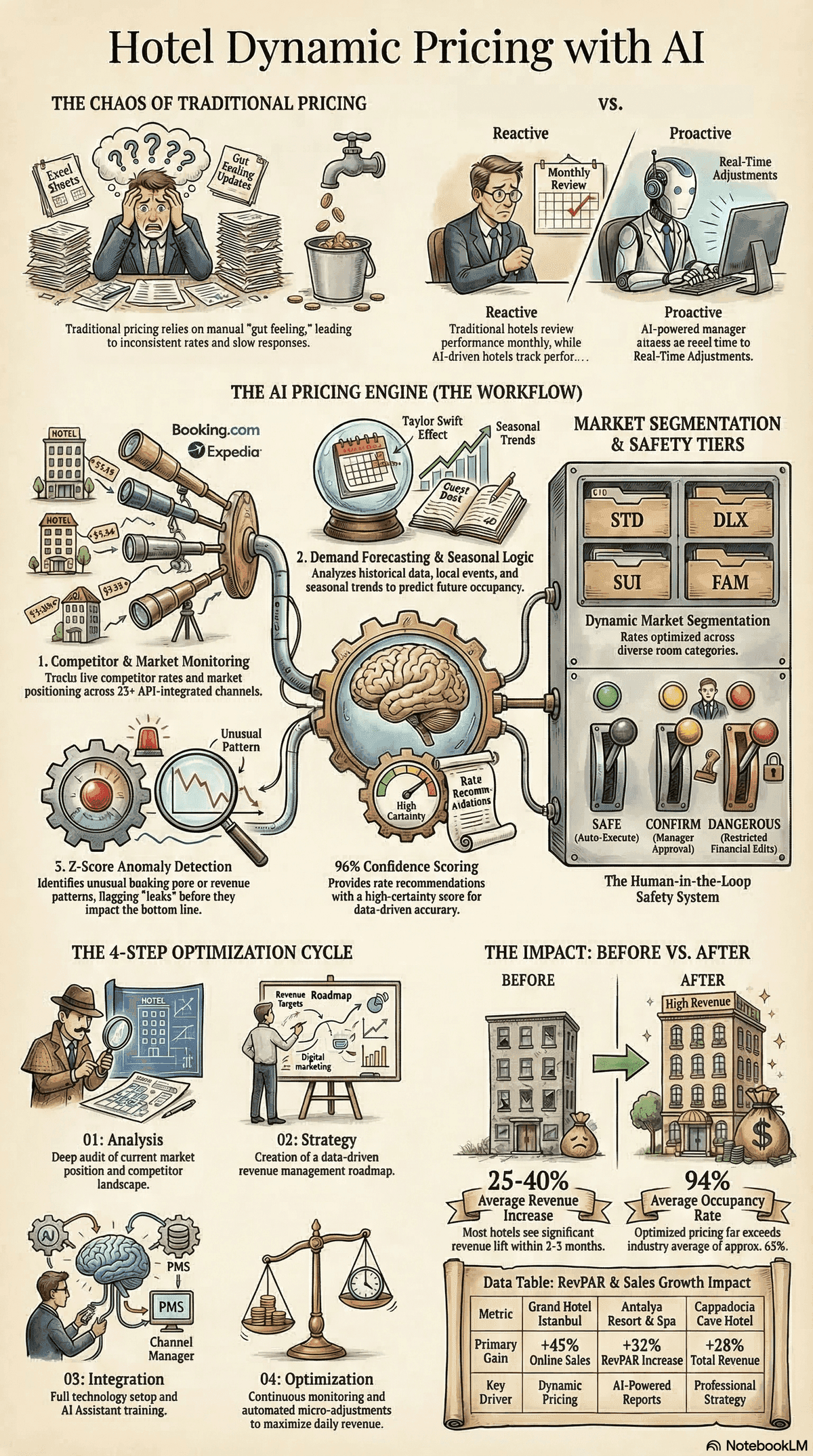
Every hotel room is a perishable asset. At midnight, an unsold room becomes zero revenue — permanently. Static pricing, where rates are fixed by season or day of week, ignores this fundamental economic reality. It charges the same rate on a Tuesday when the city is empty as it does on a Tuesday when a major conference is bringing 50,000 visitors to town.
The revenue cost of static pricing is substantial and measurable. Industry data from STR shows that hotels using manual, season-based pricing leave an average of 15-25% of potential revenue on the table compared to properties using dynamic pricing strategies. For a 100-room hotel with an ADR of $150, that gap translates to $200,000-$350,000 in lost revenue per year.
Dynamic pricing — the practice of continuously adjusting room rates based on real-time demand, competition, and market conditions — has been the theoretical answer for decades. But until recently, implementing it effectively required expensive software, dedicated revenue management staff, and constant manual attention.
AI has changed that equation entirely.
Embed this image on your site
<a href="https://otelciro.com/en/news/hotel-dynamic-pricing-ai">
  <img src="https://cdn.sanity.io/images/1la98t0z/production/e41b7ac3104ad8488f70d83e78d4135e4a401e88-1200x2150.png" alt="Hotel Dynamic Pricing with AI Infographic" width="800" />
</a>
<p>Source: <a href="https://otelciro.com">OtelCiro</a> — AI Hotel Revenue Management</p>
Related reading: How Many Hours a Year Does Your Hotel Run Empty? The True Cost of Unsold Rooms
Related reading: How to Increase RevPAR: 8 Proven Strategies (2026)
How Dynamic Pricing Actually Works
The Core Algorithm
At its foundation, dynamic pricing for hotels operates on a straightforward principle: price elasticity of demand. When more people want rooms than are available, prices should rise. When demand is soft, prices should decrease to stimulate bookings. The complexity lies in determining exactly how much to adjust, how fast, and across which channels.
A modern AI pricing algorithm processes these calculations through three sequential stages:
Stage 1: Demand Assessment. The algorithm evaluates current and predicted demand using dozens of signals — booking pace, search volume, competitor availability, event calendars, flight data, and historical patterns. It generates a demand score for each future date on a continuous scale.
Stage 2: Price Calculation. Based on the demand score, the algorithm determines the optimal rate for each room type. This is not a simple markup formula. It considers price elasticity curves specific to the property, the competitive rate environment, and the marginal revenue of each incremental booking.
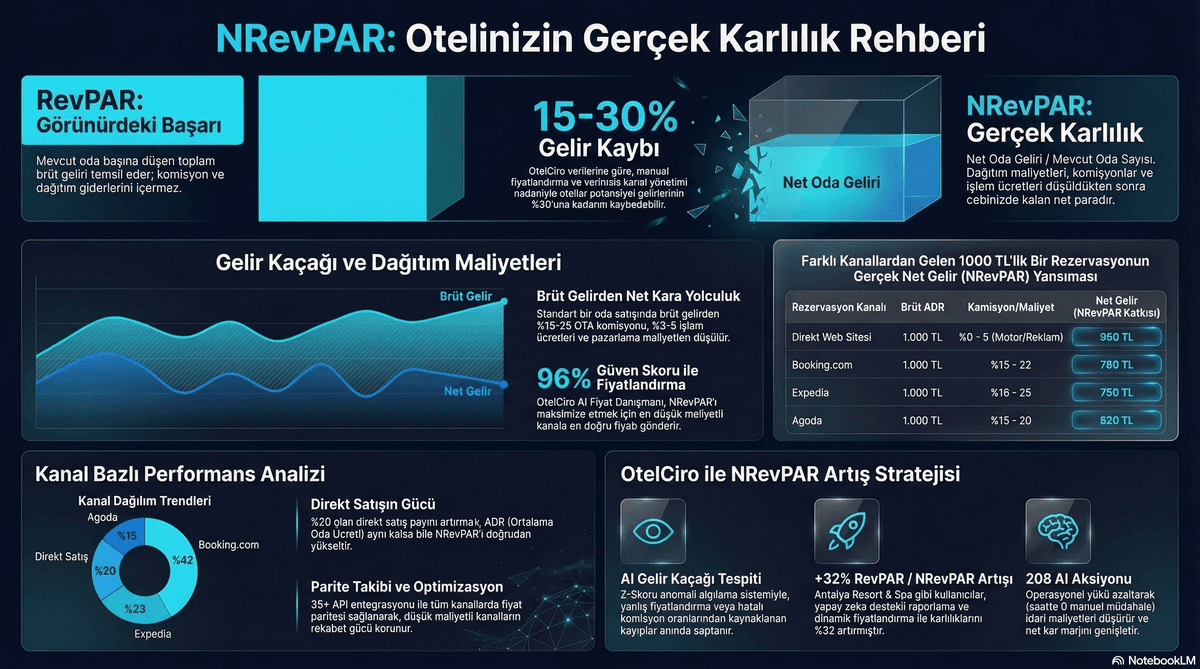
Stage 3: Distribution. The calculated rate is pushed to all connected channels — OTAs, metasearch engines, the direct website, GDS — with potential channel-specific adjustments based on commission structures and strategic priorities.
This three-stage process runs continuously, not once a day or once a week. OtelCiro's AI Engine recalculates pricing every time a significant data input changes, which in practice means rates are evaluated and potentially adjusted hundreds of times per day.
The Data Inputs That Drive Pricing Decisions
AI dynamic pricing is only as good as the data it consumes. Here are the primary data streams that feed a modern hotel pricing algorithm:
Historical booking data is the foundation. The AI analyzes 2-5 years of booking patterns to identify seasonality, day-of-week trends, lead time patterns, and cancellation rates. A hotel that consistently fills up three weeks before a local festival will see the AI start raising rates four weeks out, capturing the early demand at a premium.
Booking pace and pickup velocity compare how fast reservations are accumulating for a future date against the expected pace. If bookings for a Saturday two weeks out are running 40% ahead of the historical average, the AI recognizes excess demand and adjusts rates upward accordingly.
Competitor pricing is monitored in real time. The AI tracks published rates across the competitive set on major OTAs and metasearch engines, identifying when competitors raise or lower rates, when they sell out, and when they introduce promotional offers.
Event and calendar data captures conferences, festivals, concerts, sporting events, public holidays, and school vacation schedules. These demand generators are predictable and significant — a city-wide convention can increase hotel demand by 200-400%.
Flight and transportation data serves as a leading indicator. An increase in flight searches or bookings to your destination signals future hotel demand before it appears in your own booking data.
Weather forecasts matter enormously for leisure destinations. A predicted heat wave can boost beach resort demand, while a rainy forecast can suppress it.
Economic indicators including currency exchange rates, consumer confidence, and fuel prices provide macroeconomic context that influences travel spending patterns.
Embed this image on your site
<a href="https://otelciro.com/en/news/hotel-dynamic-pricing-ai">
  <img src="https://cdn.sanity.io/images/1la98t0z/production/55fdd76e2edd1933e8d4f438df35f4a8b4556534-1200x670.png" alt="GOPPAR calculation and usage guide" width="800" />
</a>
<p>Source: <a href="https://otelciro.com">OtelCiro</a> — AI Hotel Revenue Management</p>
AI vs. Manual Pricing: The Performance Gap
The difference between AI-driven and manual dynamic pricing is not a matter of opinion — it is documented across thousands of hotel implementations.
Speed of Response
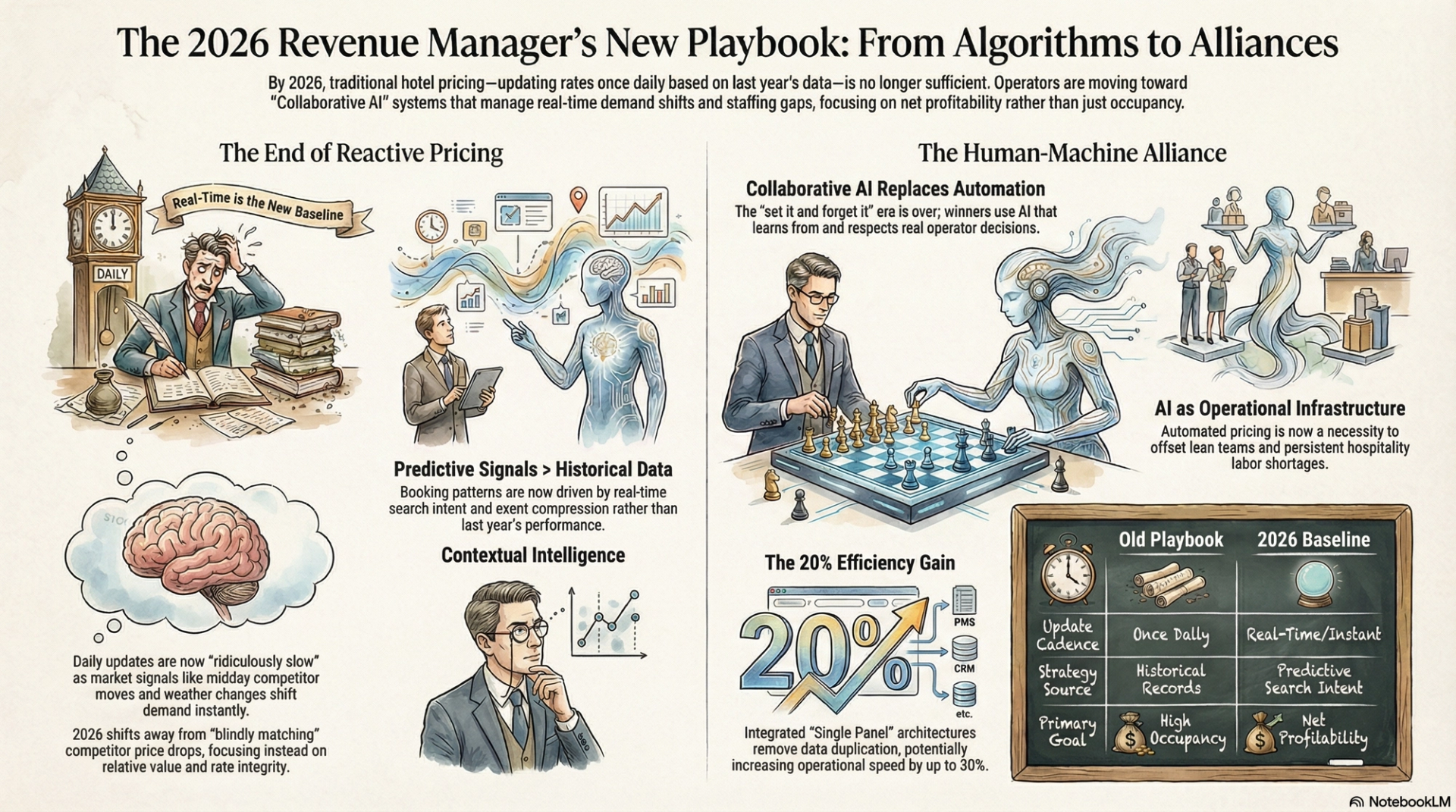
A human revenue manager can realistically review and adjust rates for a single property 1-3 times per day, assuming they also handle other responsibilities. An AI system evaluates and adjusts rates continuously, responding to market changes within minutes rather than hours or days.
When a competitor drops their rate by 15% at 2:00 AM, the AI responds before the morning shift arrives. When a major event is announced and demand spikes, the AI captures the early premium pricing that manual managers miss entirely.
Data Processing Capacity
Manual pricing decisions are typically based on 5-15 data inputs — yesterday's pickup, a handful of competitor rates, and the revenue manager's experience. AI pricing decisions incorporate 3,000-5,000 data points per calculation, identifying patterns and correlations that no human could detect.
For example, an AI might discover that when a specific airline adds a new direct route to your city, hotel demand increases 12% within three weeks — but only for certain room types. That kind of nuanced insight is invisible to manual analysis.
Consistency and Discipline
Human revenue managers are subject to cognitive biases. They tend to anchor on last year's rates, overreact to a single slow day, or hesitate to raise rates aggressively during peak demand because it "feels wrong." AI pricing is dispassionate and data-driven. It follows the optimal pricing curve without emotional interference.
Scale Across Room Types and Channels
A hotel with 5 room types distributed across 8 channels has 40 rate points to manage for each future date. Across a 365-day booking window, that is 14,600 rate decisions at any given time. Manual management of this matrix is impossible at the level of precision AI provides.
For a foundational understanding of dynamic pricing principles, our guide on what is dynamic pricing covers the essentials.
Related reading: Dynamic vs. Static Pricing: How the Taylor Swift Effect Can Skyrocket Your Revenue
Demand Forecasting: The Engine Behind Smart Pricing
Dynamic pricing without accurate demand forecasting is just guessing faster. The forecasting component is what separates intelligent pricing from reactive price matching.
How AI Forecasting Works
OtelCiro's demand forecasting engine generates predictions at three levels:
Short-term (0-14 days): High-confidence forecasts that drive immediate pricing decisions. At this horizon, booking pace and current market conditions dominate the prediction. Accuracy at this level typically exceeds 92%.
Medium-term (15-90 days): Forecasts that guide promotional strategy, minimum length-of-stay restrictions, and early pricing positioning. Event calendars, historical patterns, and competitive intelligence contribute most at this horizon.
Long-term (91-365 days): Directional forecasts that inform budget planning, staffing decisions, and strategic rate positioning. These rely heavily on macroeconomic trends, announced events, and multi-year historical patterns.
The forecasting engine updates continuously as new data arrives. A sudden surge in flight bookings to your destination three months from now will shift the medium-term forecast within hours, triggering proactive rate adjustments long before the demand materializes in your booking system.
Embed this image on your site
<a href="https://otelciro.com/en/news/hotel-dynamic-pricing-ai">
  <img src="https://cdn.sanity.io/images/1la98t0z/production/bbd5fe1bd7958fd95861b71905cdb9701e352e80-1200x669.png" alt="NRevPAR (Net Revenue) calculation method" width="800" />
</a>
<p>Source: <a href="https://otelciro.com">OtelCiro</a> — AI Hotel Revenue Management</p>
Competitive Intelligence: Pricing in Context
No hotel prices in isolation. Your optimal rate depends not only on your own demand but on what your competitors are charging, how full they are, and what promotions they are running.
What the AI Monitors
OtelCiro's competitive intelligence module tracks:
- Published rates across all major OTAs for each property in your competitive set
- Rate change patterns — some competitors adjust rates on specific days or at specific times, creating predictable opportunities
- Availability signals — when a competitor shows limited availability, it indicates strong demand in the market
- Promotional activity — flash sales, loyalty discounts, and package deals that temporarily alter the competitive landscape
- Review score shifts — a competitor's sudden drop in review scores can create pricing opportunities
Strategic Positioning
The AI does not simply match or undercut competitor rates. It positions your hotel strategically based on your quality positioning, guest segment mix, and revenue goals. A boutique hotel with superior reviews should price above commodity competitors, not at parity. The AI understands this and adjusts its competitive strategy accordingly.
Seasonal Adjustments and Special Events
While AI pricing is fundamentally dynamic, it also excels at managing the predictable patterns that define hotel revenue:
High-Demand Periods
During peak seasons, major events, and holiday periods, the AI maximizes rate capture by:
- Raising rates early in the booking window to capture price-insensitive guests
- Implementing progressive rate increases as the date approaches and inventory decreases
- Applying minimum length-of-stay restrictions to maximize total revenue per room
- Reducing or eliminating promotional offers and discount codes
Low-Demand Periods
During shoulder seasons and traditionally slow periods, the AI stimulates demand through:
- Competitive pricing that captures price-sensitive travelers
- Strategic promotional offers targeted at specific guest segments
- Flexible cancellation policies that reduce booking friction
- Channel-specific incentives that boost visibility on high-traffic platforms
Transition Periods
The most challenging periods to price are the transitions between high and low demand. The AI excels here because it detects the inflection points earlier than manual analysis, adjusting the pricing trajectory before revenue is lost.
RevPAR Impact: Before and After AI Dynamic Pricing
The ultimate measure of a pricing strategy is its impact on RevPAR. Here is what the data shows across hotels that have implemented AI dynamic pricing:
First 90 Days
- ADR increase: 8-15% as the AI eliminates underpricing during moderate and high-demand periods
- Occupancy impact: Neutral to slightly positive (1-3%) as improved pricing during low-demand periods stimulates bookings
- RevPAR improvement: 10-18%, driven primarily by ADR gains
6-12 Months
- ADR increase: 15-25% as the AI learns property-specific patterns and optimizes more aggressively
- Occupancy improvement: 3-7% as demand forecasting matures and promotional strategies become more targeted
- RevPAR improvement: 18-32%, with compounding effects from both ADR and occupancy gains
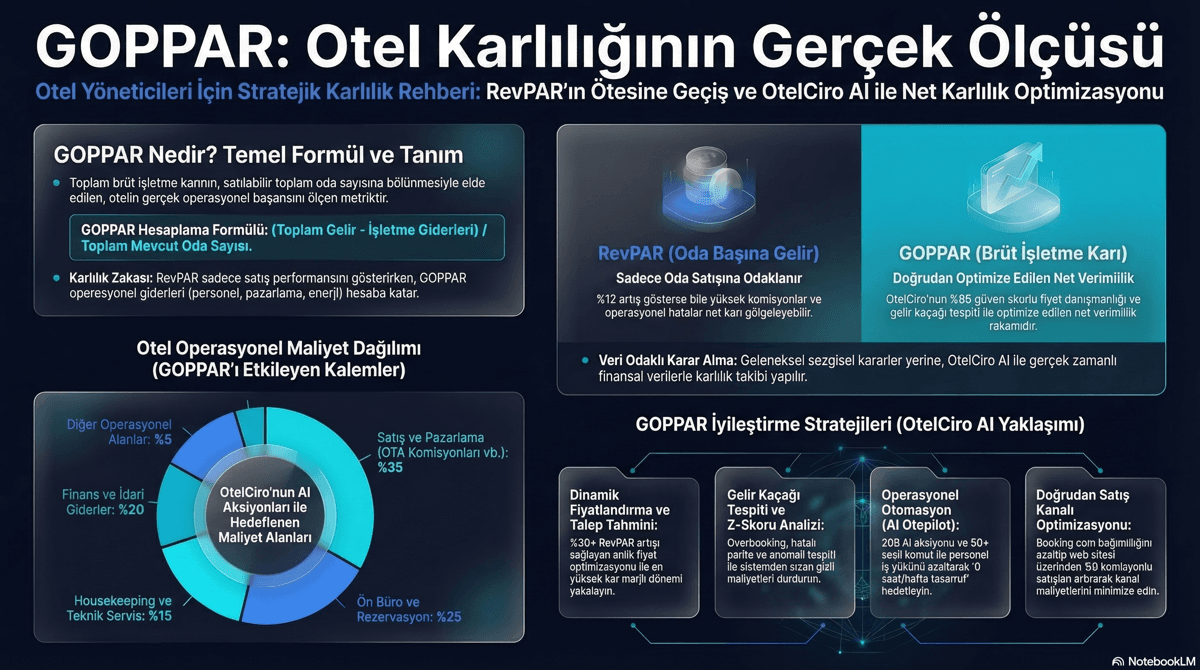
- GOPPAR improvement: 20-40% as revenue gains outpace any marginal cost increases
Beyond 12 Months
Hotels that have used AI dynamic pricing for more than a year report sustained RevPAR advantages of 20-35% above their pre-AI baseline. The improvement does not plateau quickly because the AI continuously discovers new optimization opportunities as it accumulates more property-specific data.
OtelCiro's Reports dashboard provides real-time tracking of these metrics, enabling hotel leadership to quantify ROI precisely and communicate results to ownership and investors.
Implementing AI Dynamic Pricing at Your Property
Prerequisites
Before implementing AI dynamic pricing, ensure your property has:
- A cloud-based PMS that supports API integration — OtelCiro's Smart PMS is designed for seamless AI integration
- At least 12 months of historical booking data (24+ months is ideal for seasonal properties)
- Connected distribution channels with automated rate push capabilities
- Defined competitive set of 4-8 comparable properties for benchmarking
The Transition Process
Moving from manual to AI pricing does not require a disruptive overhaul. The recommended approach is:
Phase 1 — Observation (2 weeks). The AI analyzes your historical data, current market conditions, and competitive landscape. It generates pricing recommendations without implementing them.
Phase 2 — Validation (2 weeks). The revenue team compares AI recommendations against their own decisions, building confidence and understanding.
Phase 3 — Guided automation (4 weeks). The AI implements pricing changes within conservative guardrails, with human approval required for changes exceeding defined thresholds.
Phase 4 — Full automation (ongoing). The AI operates autonomously within established parameters, with the revenue team providing strategic oversight rather than tactical execution.
Related reading: 65% of Travelers Accept Dynamic Pricing: Transparency Builds Trust
Common Concerns and How to Address Them
"Will the AI drop rates too low?" Every AI pricing platform allows you to set minimum rate floors by room type, season, and channel. The AI will never price below your defined minimums.
"What about special corporate and group rates?" Contracted rates operate independently of dynamic pricing. The AI manages transient and OTA pricing while honoring negotiated agreements.
"Can I override the AI?" Always. Effective AI pricing platforms provide easy override capabilities for situations where local knowledge exceeds what the data can predict — a private event, a road closure, or a VIP booking that requires special handling.
"What happens during system downtime?" OtelCiro maintains fallback pricing rules that activate automatically if the AI engine is temporarily unavailable, ensuring rates are never left stale.
For hotels looking to understand the broader revenue management context in which dynamic pricing operates, our comprehensive hotel revenue management guide provides the strategic framework.
Conclusion
AI-powered dynamic pricing is the single highest-ROI technology investment a hotel can make in 2026. It addresses the fundamental challenge of hotel revenue management — selling a perishable product at the optimal price — with speed, precision, and scale that manual processes cannot match.
The hotels that have already adopted AI pricing are compounding their advantages daily. Every night of optimized pricing adds to the data that makes tomorrow's pricing even more accurate. For properties still relying on manual rate management, the revenue gap grows wider with each passing month.
![Hotel Upselling: AI-Driven Revenue Growth [2026]](https://cdn.sanity.io/images/1la98t0z/production/9850350573fc466b95b1490c7f689e8ac39c4f11-1200x669.png?w=1920&q=50&auto=format&fit=max)