
![How to Increase RevPAR: 8 Proven Strategies [2026]](https://cdn.sanity.io/images/1la98t0z/production/21a4d045a8c646ac4bd81b7eb27579f2a799094f-1376x768.jpg?w=1920&q=65&auto=format&fit=max)
What Is RevPAR and Why Is It Your Most Important Metric?
RevPAR (Revenue Per Available Room) is the gold standard for measuring hotel performance. This single metric captures both your occupancy rate and your average daily rate (ADR) in one unified figure.
Formula:
RevPAR = ADR x Occupancy Rate
or
RevPAR = Total Room Revenue / Total Available Rooms
Example: A 100-room hotel operating at 70% occupancy with a $150 ADR:
- RevPAR = $150 x 0.70 = $105
Why is RevPAR so critical? Because looking at occupancy alone is misleading. A hotel achieving 95% occupancy at $80 ADR (RevPAR: $76) underperforms compared to one with 75% occupancy at $120 ADR (RevPAR: $90). RevPAR captures this balance in a single number.
Related reading: How Many Hours a Year Does Your Hotel Run Empty? The True Cost of Unsold Rooms
Related reading: Dynamic vs. Static Pricing: How the Taylor Swift Effect Can Skyrocket Your Revenue
2026 Global RevPAR Benchmarks
Before building your strategy, understand where you stand in the market:
| Segment | Global Avg. RevPAR | YoY Change |
|---|---|---|
| Luxury (5-star) | $195 | +8.2% |
| Upper Upscale (4-star) | $118 | +6.5% |
| Midscale (3-star) | $76 | +5.1% |
| Economy (2-star) | $51 | +3.8% |
| Boutique / Independent | $102 | +9.4% |
Source: STR Global, 2026 Q1 data
A standout data point: Boutique and independent hotels show the fastest RevPAR growth (9.4%) across all segments. This proves that with the right strategy, smaller properties can outperform large chains.
Embed this image on your site
<a href="https://otelciro.com/en/news/how-to-increase-revpar">
  <img src="https://cdn.sanity.io/images/1la98t0z/production/55fdd76e2edd1933e8d4f438df35f4a8b4556534-1200x670.png" alt="GOPPAR calculation and usage guide" width="800" />
</a>
<p>Source: <a href="https://otelciro.com">OtelCiro</a> — AI Hotel Revenue Management</p>
Strategy 1: Implement Real-Time Dynamic Pricing
Fixed-rate pricing is one of the biggest revenue leakage causes in 2026. Research shows that hotels adopting dynamic pricing increase RevPAR by an average of 12-18%.
Three Levels of Dynamic Pricing
Level 1 — Rule-Based (Basic):
- Occupancy threshold-based adjustments (discount below 60%, increase above 80%)
- Weekday/weekend rate differentiation
- Seasonal rate tiers
Level 2 — Market-Responsive (Intermediate):
- Competitor rate shopping and automatic matching
- Event and convention calendar integration
- Lead time-based pricing (early bird discounts, last-minute premiums)
Level 3 — AI-Powered (Advanced):
- Machine learning demand forecasting
- Minute-by-minute rate optimization per room type
- Weather, flight pricing, and social media data analysis
- A/B testing for continuous strategy refinement
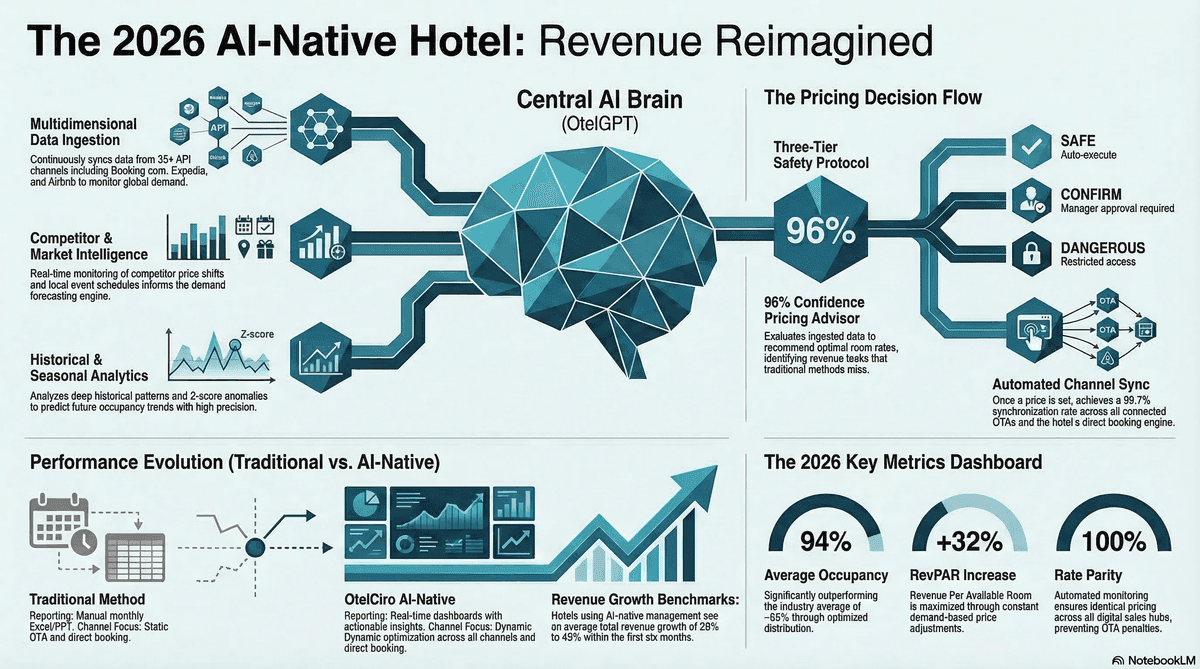
An AI-powered revenue management engine makes Level 3 pricing accessible to any property — even without a data science team.
Real-World Impact
A 120-room resort in the Mediterranean, after implementing AI-powered dynamic pricing:
- ADR: $95 → $118 (24% increase)
- Occupancy: 72% → 68% (slight decrease, expected)
- RevPAR: $68.40 → $80.24 (17.3% increase)
- Total room revenue: 17.3% increase — despite lower occupancy
This example proves that RevPAR growth doesn't always require occupancy increases.
Related reading: Hotel Revenue Management Guide: Strategies, Metrics & Technology (2026)
Related reading: 65% of Travelers Accept Dynamic Pricing: Transparency Builds Trust
Strategy 2: Optimize Your Channel Mix
Every distribution channel has a different cost structure and profitability profile. Optimizing the channel mix is the most effective way to achieve higher net RevPAR at the same occupancy.
Net Revenue by Channel
| Channel | Gross Rate | Commission | Net Revenue | Net/Gross Ratio |
|---|---|---|---|---|
| Direct (website) | $120 | 2-3% (payment) | $116 | 97% |
| Direct (phone) | $120 | 0% | $120 | 100% |
| Booking.com | $120 | 15-20% | $96-102 | 80-85% |
| Expedia | $120 | 18-25% | $90-98 | 75-82% |
| Tour Operator | $90 | 0% (net rate) | $90 | 75% |
| GDS (Amadeus etc.) | $130 | 10-12% | $114-117 | 88-90% |
Target: Push direct booking share above 40%. Industry average is 28%; top-performing hotels reach 55%.
How to Increase Direct Bookings
- Best rate guarantee: Always offer the best available rate on your website
- Value-add packages: Direct booking exclusives (free breakfast, late check-out, spa credit)
- Loyalty program: Reward returning guests
- Metasearch investment: Google Hotel Ads, TripAdvisor, Trivago
- AI assistant integration: Capture traffic from ChatGPT and similar platforms directly
Sales and channel management tools let you track each channel's net profitability in real time.
Embed this image on your site
<a href="https://otelciro.com/en/news/how-to-increase-revpar">
  <img src="https://cdn.sanity.io/images/1la98t0z/production/0fde5a7ccfdfdadcbcaecd74553f2fb8fcb01270-1200x669.png" alt="2026 AI-powered hotel revenue management" width="800" />
</a>
<p>Source: <a href="https://otelciro.com">OtelCiro</a> — AI Hotel Revenue Management</p>
Strategy 3: Strategic Upselling and Cross-selling
Upselling is the lowest-cost method to extract more revenue from existing guests. Successful upselling programs increase room revenue by 8-15%.
Effective Upselling Opportunities
Room Upgrades:
- Upgrade offers at check-in
- Pre-arrival email "bid" model
- Last-minute upgrade deals via mobile app
- Optimal pricing: Offer at 40-50% of the rate difference (e.g., if $50 difference, offer upgrade for $20-25)
Package Sales:
- Romance package (room + champagne + spa)
- Business package (room + meeting room + breakfast)
- Family package (room + extra bed + kids' activities)
- Experience package (room + local tour + restaurant)
Ancillary Services:
- Airport transfers
- Early check-in / late check-out
- Room decorations (birthdays, anniversaries)
- VIP welcome amenities
Upselling Timing
The right timing is critical for maximum conversion rates:
| Timing | Conversion Rate | Best Offer Type |
|---|---|---|
| At booking | 5-8% | Package upgrade |
| Pre-arrival (3-7 days before) | 12-18% | Room upgrade, transfer |
| At check-in | 15-25% | Room upgrade |
| In-stay | 8-12% | Experience, spa, dining |
Strategy 4: Demand-Based Minimum Length of Stay (MinLOS)
Minimum length of stay restrictions can dramatically increase RevPAR during high-demand periods.
When to Apply MinLOS
- Holiday periods: 3-5 night minimum
- Convention and trade show weeks: 2-3 night minimum
- Festival periods: 2-4 night minimum
- Peak summer season: 3-7 night minimum (resort properties)
Key Considerations
- Don't apply MinLOS too early — first verify that demand is genuinely strong
- Be prepared to relax MinLOS last-minute based on remaining inventory
- Consider channel-specific MinLOS strategies
- Use AI-based forecast models to make data-driven MinLOS decisions
Strategy 5: Segment-Based Pricing
Each guest segment has different price elasticity, booking windows, and behavioral patterns. A one-size-fits-all pricing strategy leaves significant revenue on the table.
Segment Analysis
| Segment | Avg. ADR | Booking Window | Price Elasticity | Cancellation Rate |
|---|---|---|---|---|
| Business travel | High | 1-7 days | Low | 12% |
| Leisure (couples) | Mid-High | 14-45 days | Medium | 18% |
| Family | Medium | 30-90 days | High | 15% |
| Group/MICE | Low-Medium | 60-180 days | Low | 8% |
| OTA Last-minute | Variable | 0-3 days | Very High | 25% |
Strategy: Create separate rate plans, cancellation policies, and value propositions for each segment. Smart PMS solutions manage this segmentation automatically.
Strategy 6: Total Revenue Approach
RevPAR measures only room revenue. However, modern revenue management focuses on TRevPAR (Total Revenue Per Available Room) — encompassing all revenue streams.
TRevPAR Components
- Room revenue: The core RevPAR component
- F&B revenue: Restaurant, bar, room service, minibar
- Spa and wellness: Massage, treatments, fitness
- Meetings and events: Room rental, AV equipment, catering
- Other: Parking, laundry, transfers, tour sales
In a typical 4-star hotel, non-room revenue represents 25-40% of total revenue. Optimizing these streams meaningfully impacts total RevPAR.
Implementation Tips
- Treat every guest touchpoint as a revenue opportunity
- Ensure your PMS integrates all departments in a unified system
- Bundle F&B and spa into room packages to increase total guest spend
- Use operations management tools to strengthen cross-department coordination
Strategy 7: Intelligent Overbooking Management
Overbooking is the most effective method to recover revenue lost to no-shows and last-minute cancellations. But when done poorly, it severely damages guest satisfaction.
Data-Driven Overbooking
A successful overbooking strategy relies on:
- Historical no-show rates: By day, season, and segment
- Cancellation patterns: When do last-minute cancellations spike?
- Walk-in probability: Seasonal analysis of walk-in traffic
- Guest segment: Business travelers vs. leisure guests show different no-show rates
Safe overbooking formula:
Safe Overbooking = (No-show Rate x Total Reservations) x 0.8
The 0.8 multiplier is a safety margin. AI-powered systems calculate this with 95%+ accuracy and maintain minimal safety margins — enabling more rooms to be sold.
Walk-Out Protocol
When overbooking results in a guest who cannot be accommodated:
- Secure accommodation at an equivalent or higher-tier property
- Cover transfer costs
- Offer a significant discount or gift for a future stay
- Communicate with sincerity and professionalism
Strategy 8: AI-Powered Revenue Optimization
While each of the 7 strategies above is individually effective, managing all of them simultaneously and optimally exceeds human capacity. This is precisely where artificial intelligence becomes essential.
AI's Impact on RevPAR — Hard Numbers
Performance data from hotels using AI-powered revenue management in 2025-2026:
| Metric | Pre-AI | Post-AI | Change |
|---|---|---|---|
| RevPAR | $78 | $94 | +20.5% |
| ADR | $105 | $121 | +15.2% |
| Occupancy | 74% | 78% | +4 pts |
| Net revenue margin | 22% | 28% | +6 pts |
| Manual rate changes | 3-5/day | 0-1/day | -85% |
Source: OtelCiro internal data, 50+ hotel average
What AI Does
- 24/7 market monitoring: Continuously tracks competitor rates, OTA rankings, and demand signals
- Multi-factor analysis: Simultaneously evaluates weather, event calendars, flight capacity, search volume, and 50+ data points
- Automatic rate adjustment: Calculates optimal rates and applies them upon approval
- Scenario simulation: Answers "what if?" questions within minutes
- Anomaly detection: Instantly flags unexpected demand drops or opportunities
With OtelGPT, you can query your revenue strategy in natural language — asking questions like "What would happen to our RevPAR if we increased Deluxe room rates by 10% in April?" and getting instant answers.
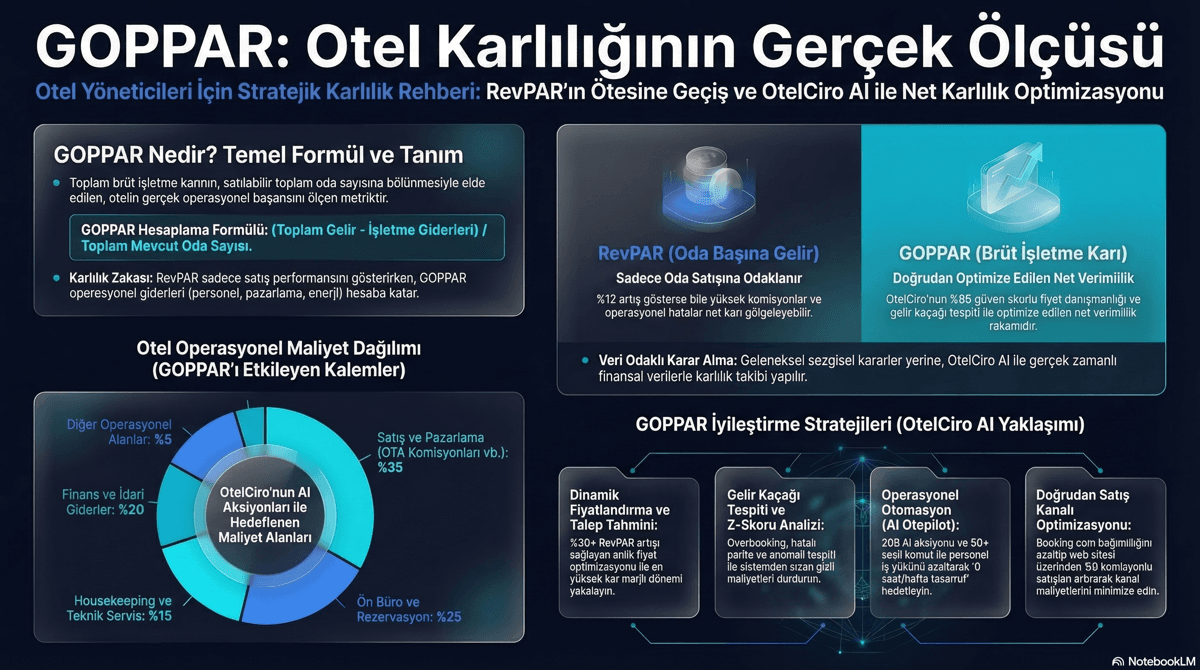
Related reading: Hotel Revenue Metrics & KPI Guide: From RevPAR to GOPPAR
RevPAR Improvement Roadmap
Here is a phased approach for implementing all 8 strategies:
Phase 1: Foundation (Days 0-30)
- Benchmark your current RevPAR performance
- Conduct net revenue analysis by channel
- Implement basic dynamic pricing rules
- Launch upselling program
Phase 2: Intermediate Optimization (Days 30-90)
- Build segment-specific pricing strategies
- Apply MinLOS policies to high-demand periods
- Formalize overbooking strategy
- Transition to total revenue approach
Phase 3: Advanced — AI Integration (Days 90-180)
- Deploy AI-powered revenue management platform
- Support all channel and pricing decisions with AI
- Integrate predictive analytics into daily operations
- Establish continuous improvement cycles
Conclusion: RevPAR Growth Requires Discipline and Technology
RevPAR improvement is not a single action — it is the disciplined, simultaneous execution of multiple strategies. In 2026, the hotels showing the highest RevPAR growth share these characteristics:
- They are data-driven — making decisions based on data, not intuition
- They embrace technology — viewing AI and automation as allies, not competitors
- They optimize channel mix — prioritizing direct bookings
- They maximize guest value — selling experiences, not just rooms
- They test continuously — maintaining an A/B testing and iteration culture
To take your RevPAR performance to the next level, explore OtelCiro's AI-powered revenue management solutions and review the pricing plans. It is time to unlock your property's true revenue potential.

![Hotel Upselling: AI-Driven Revenue Growth [2026]](https://cdn.sanity.io/images/1la98t0z/production/9850350573fc466b95b1490c7f689e8ac39c4f11-1200x669.png?w=1920&q=50&auto=format&fit=max)