
![The True Cost of Unsold Hotel Rooms [2026]](https://cdn.sanity.io/images/1la98t0z/production/34cdf74e428def8be4092e99b2ddf09bf3465617-1200x1200.png?w=1920&q=65&auto=format&fit=max)
The Hourglass Metaphor: Every Hour Is a Loss
An empty hotel room is like an hourglass. At midnight, that room's revenue potential drops to zero — unsold inventory cannot be stored. A retail shop can sell yesterday's unsold product today. A hotel cannot sell last night's empty room this morning.
This simple truth is the hospitality industry's most fundamental paradox: fixed costs accrue every single day, but revenue only arrives when rooms are occupied.
Related reading: 65% of Travelers Accept Dynamic Pricing: Transparency Builds Trust
What Does an Empty Room Actually Cost?
Let us work through the math for a 50-room city hotel:
- Daily fixed cost per room (energy, staff, insurance, depreciation): approximately 280 TL
- Average occupancy: 65% (industry average)
- Empty rooms per day: 17.5 rooms
- Daily loss: 17.5 x 280 TL = 4,900 TL
- Monthly loss: ~147,000 TL
- Annual loss: ~1,788,000 TL
These figures cover fixed costs alone. When you add the forfeited revenue opportunity (room rate x empty nights), the total annual loss easily exceeds 3–5 million TL.
Embed this image on your site
<a href="https://otelciro.com/en/news/bos-oda-maliyeti">
  <img src="https://cdn.sanity.io/images/1la98t0z/production/babd172d5d4e9762f3e1ec208c24dd03a431041a-1200x670.png" alt="Segment-based hotel pricing strategy" width="800" />
</a>
<p>Source: <a href="https://otelciro.com">OtelCiro</a> — AI Hotel Revenue Management</p>
Traditional Management vs. AI-Powered Revenue Management
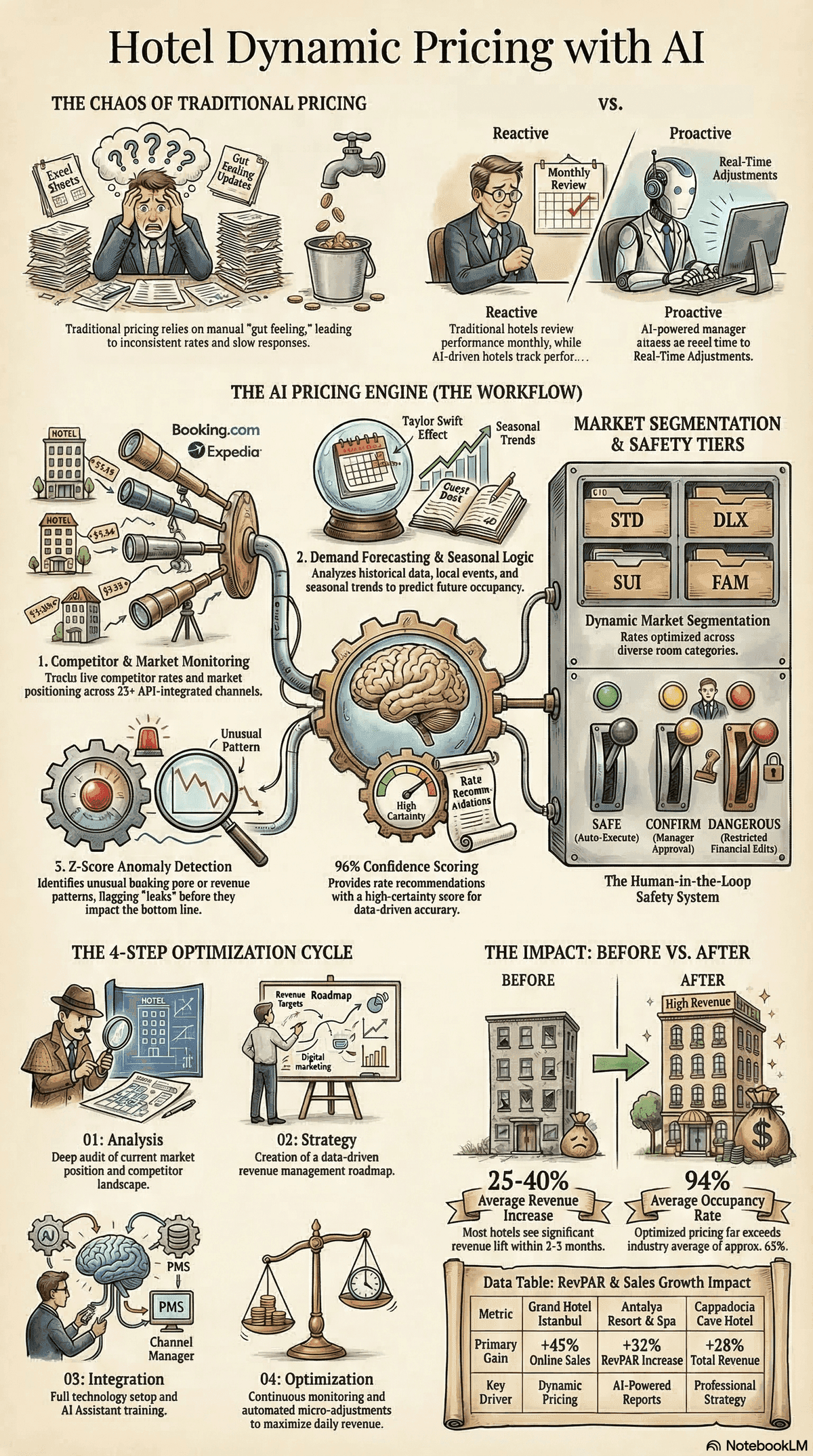
In traditional revenue management, prices are set at the start of the season and rarely updated throughout the year. This static approach simply cannot adapt to shifting market conditions.
| Criterion | Traditional Management | OtelCiro AI Model |
|---|---|---|
| Occupancy rate | 60–70% | 90%+ sustained |
| Price update frequency | Seasonal (2-3/year) | Daily/hourly |
| Demand forecasting | Intuition-based | Data-driven |
| RevPAR increase | — | +38% |
| Operational cost | High | 70% reduction |
The gap between dynamic and static pricing is not just about changing numbers — it is about rethinking the entire revenue strategy.
Related reading: How to Increase RevPAR: 8 Proven Strategies (2026)
Five Strategies to Fill Empty Rooms
1. Dynamic Pricing
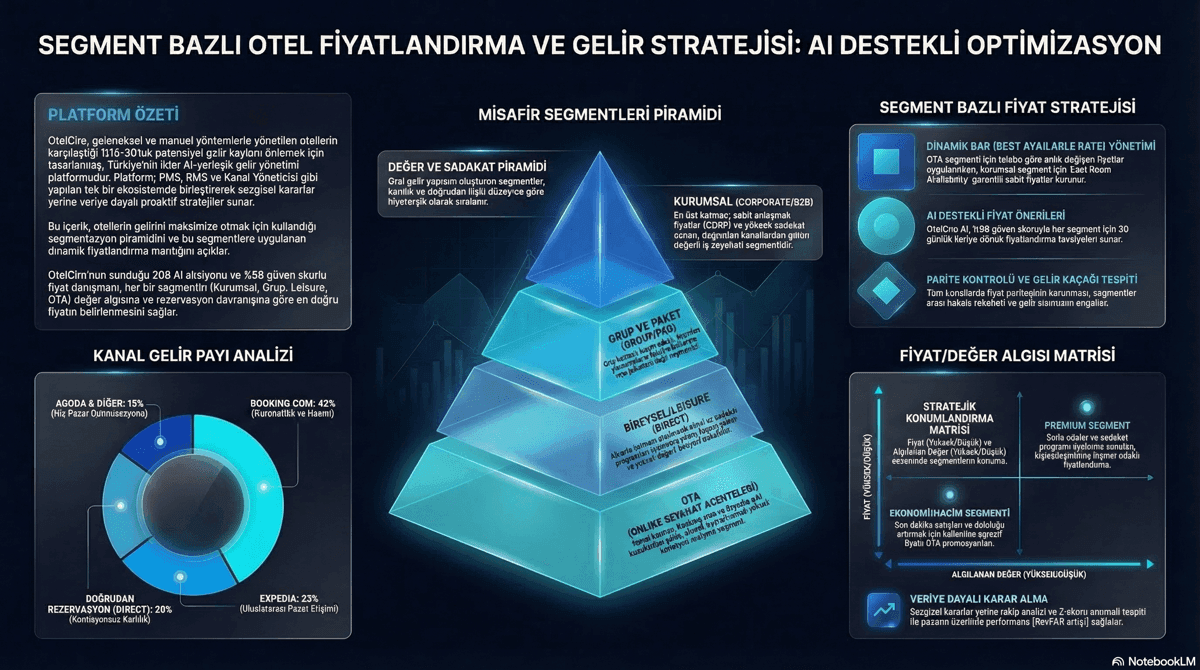
The core principle is straightforward: lower the rate when demand is weak, raise it when demand is strong. Doing this manually is both time-consuming and prone to human error. AI-powered systems analyze competitor rates, demand data, and historical patterns to determine the optimal price in seconds.
2. Last-Minute Campaigns
Targeted promotions for unsold rooms 24–48 hours before check-in can materially boost occupancy. Mobile apps and OTA last-minute filters are ideal channels for this strategy.
3. Length-of-Stay Management (LOS)
Keeping minimum-stay restrictions flexible — particularly allowing single-night stays during low-demand periods — can make the difference between an empty room and a sold one.
4. Segment-Based Pricing
Applying different rate strategies for business travelers, leisure guests, groups, and extended-stay segments ensures you extract maximum value from each customer type.
5. Channel Diversification
Relying on a single OTA is risky. Build a balanced distribution mix across Booking.com, Expedia, Google Hotels, your direct website, and corporate agreements. Understanding how the Booking.com algorithm works helps you calibrate this balance.
Embed this image on your site
<a href="https://otelciro.com/en/news/bos-oda-maliyeti">
  <img src="https://cdn.sanity.io/images/1la98t0z/production/e41b7ac3104ad8488f70d83e78d4135e4a401e88-1200x2150.png" alt="AI-driven hotel dynamic pricing model" width="800" />
</a>
<p>Source: <a href="https://otelciro.com">OtelCiro</a> — AI Hotel Revenue Management</p>
The Annual Loss Calculator
Want to calculate your own hotel's empty-room cost? Here is the formula:
Annual Loss = Total Rooms x (1 - Occupancy Rate) x 365 x Daily Fixed Cost
Example: 80 rooms x 0.30 x 365 x 300 TL = 2,628,000 TL/year
With the right revenue management strategy, a substantial portion of this loss can be recovered.
Related reading: Hotel Dynamic Pricing with AI: Rate Optimization That Maximizes RevPAR
Frequently Asked Questions
Does lowering prices in low season damage my brand?
Properly executed dynamic pricing does not erode brand value. The key is to create value packages rather than simply cutting the rate. Bundling breakfast, a complimentary transfer, or a spa amenity manages price perception while maintaining brand positioning.
Is it possible to reduce empty-room cost to zero?
100% occupancy is neither realistic nor desirable — maintenance, renovations, and operational needs require some buffer. However, AI-powered revenue management makes sustained 90%+ occupancy achievable.
What is RevPAR and why does it matter more than occupancy?
RevPAR (Revenue Per Available Room) is calculated by dividing total room revenue by the number of available rooms. While occupancy measures only fill rate, RevPAR evaluates both occupancy and price together. In the 2026 hospitality vision, RevPAR-focused strategy has emerged as the primary performance benchmark.
Conclusion
Empty rooms are the hotel industry's greatest silent loss. Every unsold night converts into millions in forfeited revenue over a year. AI-powered dynamic pricing, demand forecasting, and channel optimization can bring this loss to a minimum.
OtelCiro's AI revenue management system pushes your occupancy above 90% while increasing your RevPAR by an average of 38%. Request a free analysis to find out exactly what your empty rooms are costing you.

![Hotel Upselling: AI-Driven Revenue Growth [2026]](https://cdn.sanity.io/images/1la98t0z/production/9850350573fc466b95b1490c7f689e8ac39c4f11-1200x669.png?w=1920&q=50&auto=format&fit=max)