
![65% of Travelers Accept Dynamic Pricing [2026]](https://cdn.sanity.io/images/1la98t0z/production/c2e17607fc2221f0c9d3562db1f736337560ba78-1200x1200.png?w=1920&q=65&auto=format&fit=max)
Prices Change, Travelers Understand
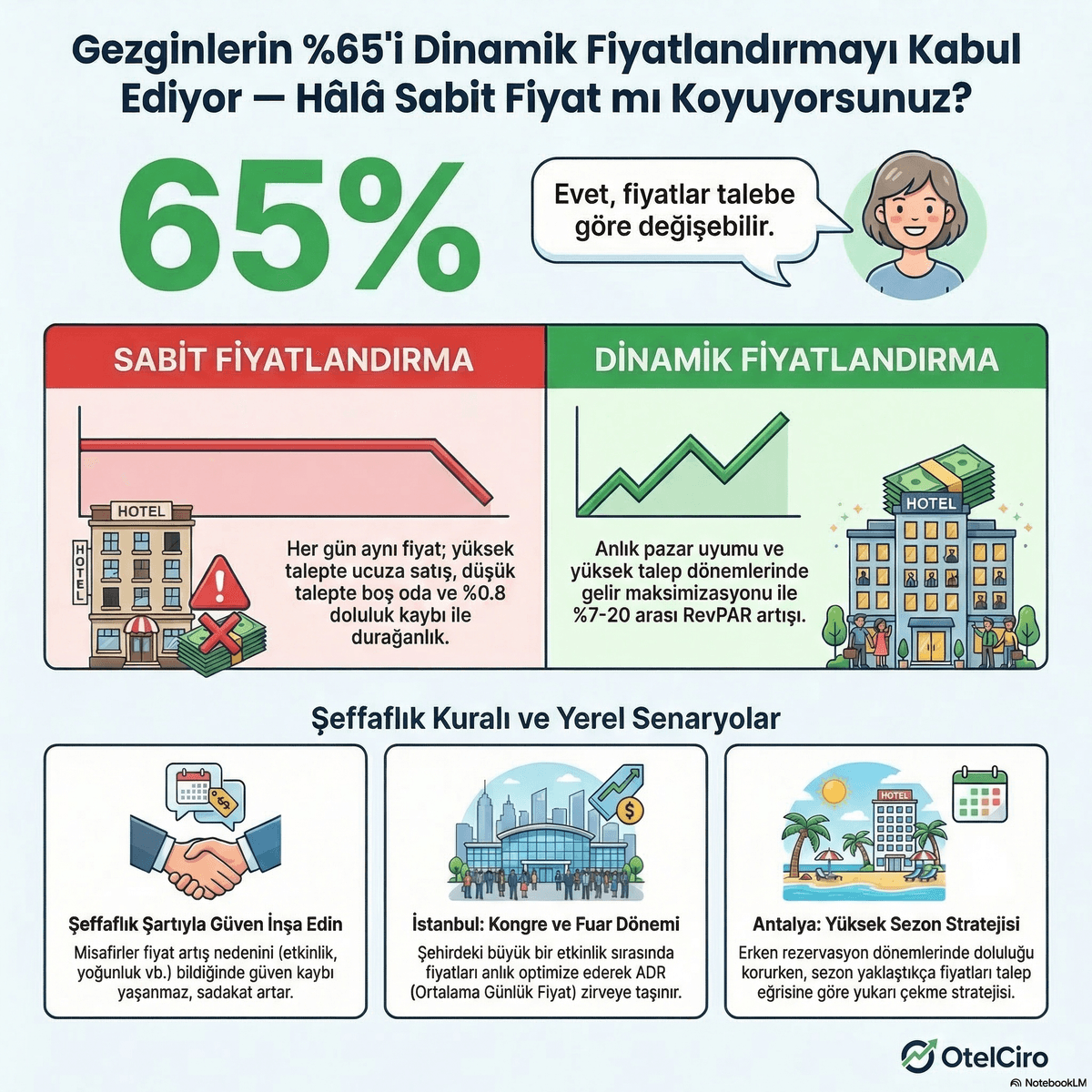
One of the most common fears in the hospitality industry goes like this: "If I raise the price, the guest will be upset." However, current research fundamentally debunks this fear. 65% of travelers accept that prices can change based on demand. In other words, two out of every three travelers find it reasonable to pay more during high-demand periods.
Embed this image on your site
<a href="https://otelciro.com/en/news/gezginler-dinamik-fiyatlandirma-kabul">
  <img src="https://cdn.sanity.io/images/1la98t0z/production/c2e17607fc2221f0c9d3562db1f736337560ba78-1200x1200.png" alt="Dynamic Pricing Acceptance Rates Infographic" width="800" />
</a>
<p>Source: <a href="https://otelciro.com">OtelCiro</a> — AI Hotel Revenue Management</p>
This data proves that dynamic pricing is not just a revenue management tool but an approach aligned with guest expectations.
Related reading: Hotel Dynamic Pricing with AI: Rate Optimization That Maximizes RevPAR
Static Pricing: Why It Fails
Same Price Every Day, Different Losses Every Day
In a static pricing model, prices are set at the beginning of the season and remain fixed throughout the year. The fundamental problems with this approach:
Selling cheap during high-demand periods: During a convention week, New Year's Eve, or a major festival, everyone fills up — but you are selling at the price set at the season's start. This is money left on the table. When a room could sell for 2,500 TRY but is listed at 1,800 TRY, that is a 700 TRY loss per room.
Empty rooms during low-demand periods: The same fixed price becomes too high when demand drops. Guests find more affordable alternatives, and you are left with empty rooms.
Result: Stagnation and loss Hotels using static pricing experience an annual 0.8% occupancy decline and revenue growth stagnation. A hotel standing still while the market grows is effectively regressing.
For a detailed comparison of dynamic vs static pricing, see our dedicated article.
Embed this image on your site
<a href="https://otelciro.com/en/news/gezginler-dinamik-fiyatlandirma-kabul">
  <img src="https://cdn.sanity.io/images/1la98t0z/production/0fde5a7ccfdfdadcbcaecd74553f2fb8fcb01270-1200x669.png" alt="2026 AI-powered hotel revenue management" width="800" />
</a>
<p>Source: <a href="https://otelciro.com">OtelCiro</a> — AI Hotel Revenue Management</p>
Dynamic Pricing: Real-Time Adaptation
Moving with the Market
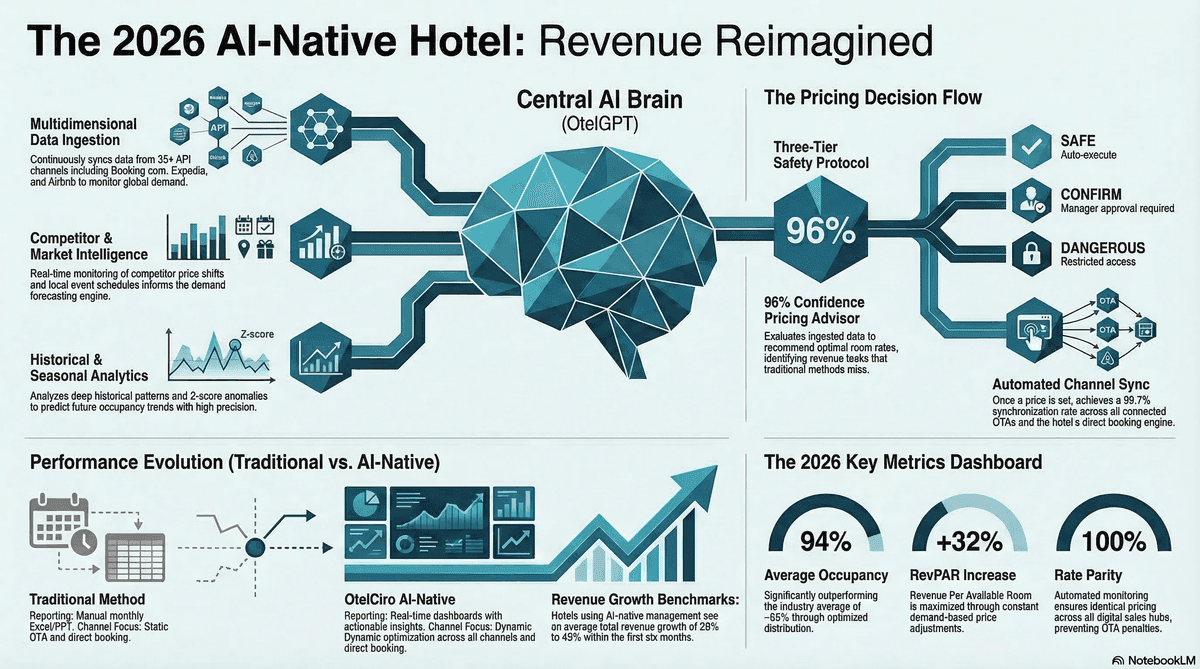
Dynamic pricing automatically adjusts rates based on real-time market conditions. What does this mean in practice?
- When demand rises: Prices increase gradually, revenue is maximized
- When demand falls: Prices move to competitive levels, occupancy is preserved
- In response to competitor moves: Market position is dynamically adjusted
- During events: Demand signals are detected in advance, prices are proactively updated
RevPAR Impact: 7-20% Increase
The average measured impact for hotels transitioning to dynamic pricing:
| Metric | Static Model | Dynamic Model | Difference |
|---|---|---|---|
| RevPAR growth | Baseline | +7-20% | Significant |
| Occupancy optimization | 60-65% | 80-94% | +15-29 points |
| ADR management | Fixed | Market-aligned | Flexible |
| Revenue forecast accuracy | 30-40% | 85-92% | 2-3x improvement |
These figures demonstrate that dynamic pricing is not "nice to have" but a competitive necessity.
Related reading: Hotel Revenue Management Guide: Strategies, Metrics & Technology (2026)
The Transparency Rule: Explain Price Increases
The Key to Building Trust
There is one prerequisite for the 65% of travelers who accept dynamic pricing: transparency. When guests understand the reason behind a price increase, they accept it. When they do not, distrust forms.
Effective Transparency Tactics
1. Reason explanation: "These dates fall within a high-demand period — occupancy across all hotels in the area has increased due to [Convention X] in Istanbul."
2. Value emphasis: "Guests staying during this period receive complimentary airport transfer and VIP lounge access."
3. Early booking advantage: "Guests who reserve these dates 30 days in advance receive a 15% early booking discount."
4. Price history sharing: "These dates sold for X TRY last year — the current price is still the lowest in the past 30 days."
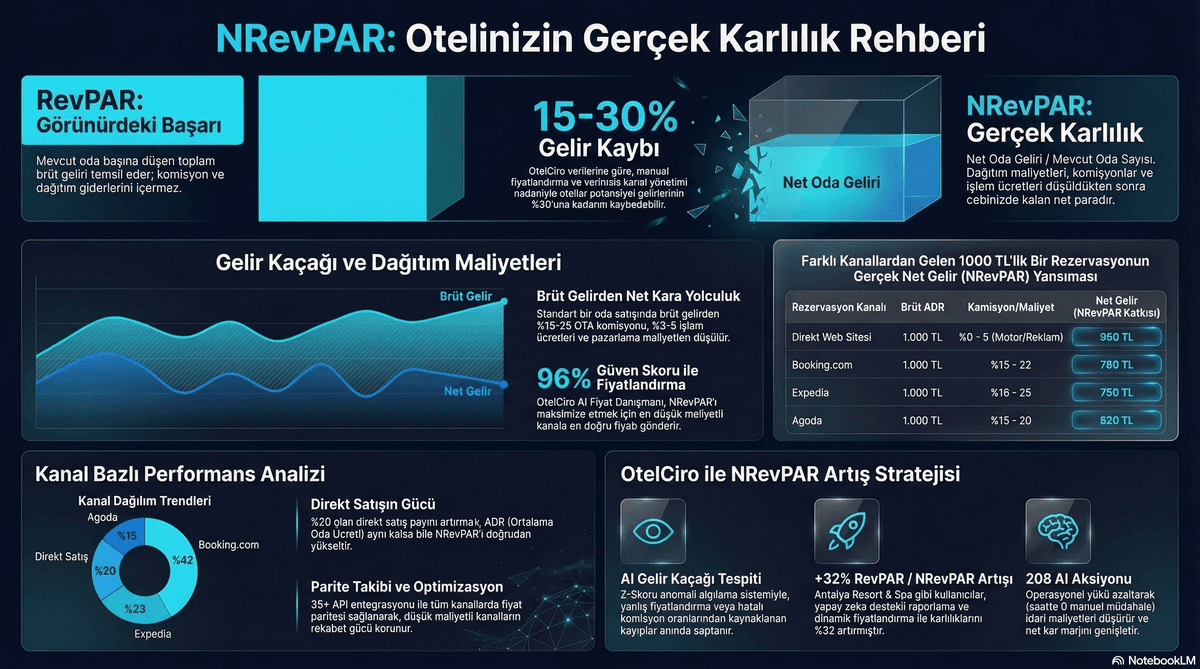
This approach also helps protect against Booking.com's hidden penalties — consistent and transparent pricing is rewarded by platform algorithms as well.
Embed this image on your site
<a href="https://otelciro.com/en/news/gezginler-dinamik-fiyatlandirma-kabul">
  <img src="https://cdn.sanity.io/images/1la98t0z/production/bbd5fe1bd7958fd95861b71905cdb9701e352e80-1200x669.png" alt="NRevPAR (Net Revenue) calculation method" width="800" />
</a>
<p>Source: <a href="https://otelciro.com">OtelCiro</a> — AI Hotel Revenue Management</p>
Istanbul Scenario: Convention and Exhibition Season
Real-World Application
Istanbul hosts more than 200 international conventions and exhibitions annually. Each event creates a demand wave for hotels in the area.
Scenario: International Textile Exhibition (5 days)
With static pricing:
- 5 days at regular rate: 1,500 TRY/night
- 95% occupancy (fills up anyway due to the exhibition)
- 100 rooms x 5 nights x 1,500 TRY = 750,000 TRY total revenue
With dynamic pricing:
- Day 1: 1,800 TRY (early demand spike)
- Days 2-3: 2,200 TRY (peak demand)
- Day 4: 2,000 TRY (demand easing)
- Day 5: 1,700 TRY (final day)
- 97% occupancy
- 100 rooms x average 1,980 TRY = 990,000 TRY total revenue
Difference: 240,000 TRY — in a single exhibition week, at essentially the same occupancy.
Multiply this difference across 20+ major events per year and the impact of dynamic pricing becomes clear.
Related reading: How to Increase RevPAR: 8 Proven Strategies (2026)
Antalya Scenario: High Season Strategy
Pricing Along the Demand Curve
Antalya's high season (June-September) is a period where the demand curve can be clearly observed.
Static approach: A single price from June through September. Selling cheap during July-August peak, overpricing in early June and late September.
Dynamic approach:
- Early June: Season opening, prices at mid-level
- Late June - Early July: Demand rising, prices increasing gradually
- Mid-July - Mid-August: Peak period, prices at maximum
- Late August: Demand easing, controlled price reductions
- September: Occupancy maintained through last-minute campaigns
This curve is continuously updated with weather data, flight data, competitor pricing, and prior-year patterns. AI revenue forecasting is the technology that automates these updates.
Guest Transparency Builds Trust and Loyalty
Short-Term and Long-Term Impact
Short-term: Transparent pricing increases conversion rates. When a guest understands why they are paying a certain price, the purchase decision accelerates.
Long-term: Trust breeds loyalty. The feeling of "this hotel is not trying to trick me" is the foundation of repeat bookings. Research shows that hotels with transparent pricing practices have 18% higher repeat guest rates.
Preventing Negative Perception
Dynamic pricing without transparency can create a "price gouging" perception among guests. Ways to prevent this:
- Banners or pop-ups explaining price changes
- Highlighting early booking advantages
- Price guarantee policies (best price commitments)
- Emphasizing price-value balance on review platforms
Market-Specific Dynamics
Factors that influence the acceptance of dynamic pricing vary by market:
Inflation Awareness
In markets with high inflation, consumers are already accustomed to price changes. This increases acceptance of dynamic pricing — but also raises transparency expectations.
Domestic vs International Guests
Domestic guests tend to be more price-sensitive, making early booking discounts effective. International guests focus on value-for-money and show higher willingness to pay for premium services.
Seasonal Fluctuations
Geographic diversity creates different seasonal patterns across regions. Istanbul is year-round, Antalya is summer-heavy, and Cappadocia peaks in spring and autumn. Each region requires its own tailored dynamic pricing strategy.
Conclusion: Dynamic Pricing Is No Longer Debatable
The acceptance of 65% of travelers settles the dynamic pricing debate. The question is not "should we change prices?" but "how do we change them transparently and effectively?"
Compared to static pricing's 0.8% occupancy decline and revenue stagnation, the dynamic model's 7-20% RevPAR increase presents a clear choice.
The key is transparency. A dynamic pricing strategy that explains price increases, offers early booking advantages, and prioritizes guest trust both increases revenue and strengthens guest loyalty.
OtelCiro's AI engine automatically manages all these scenarios — event-based pricing, demand curve optimization, channel-specific strategy. When you calculate the true cost of empty rooms, the value of this automation becomes even clearer.
Want to build a personalized dynamic pricing strategy for your hotel? Get in touch for a free consultation.

![Hotel Upselling: AI-Driven Revenue Growth [2026]](https://cdn.sanity.io/images/1la98t0z/production/9850350573fc466b95b1490c7f689e8ac39c4f11-1200x669.png?w=1920&q=50&auto=format&fit=max)