
![AI Revenue Forecasting for Hotels: 96% Accuracy [2026]](https://cdn.sanity.io/images/1la98t0z/production/d80e97054b7f8f32d0a70fcb817542a82e585ac4-1200x1200.png?w=1920&q=65&auto=format&fit=max)
Why Revenue Forecasting Is a Hotel's Most Critical Decision
Every room a hotel fails to sell on a given night cannot be carried over to the next day. Every unsold room is an irrecoverable loss. This reality makes revenue forecasting the most critical operational decision in hospitality. Accurate forecasting means accurate pricing; accurate pricing means maximum revenue.
Embed this image on your site
<a href="https://otelciro.com/en/news/ai-gelir-tahmini-otel">
  <img src="https://cdn.sanity.io/images/1la98t0z/production/d80e97054b7f8f32d0a70fcb817542a82e585ac4-1200x1200.png" alt="AI revenue forecasting 96 percent accuracy hotel revenue management infographic" width="800" />
</a>
<p>Source: <a href="https://otelciro.com">OtelCiro</a> — AI Hotel Revenue Management</p>
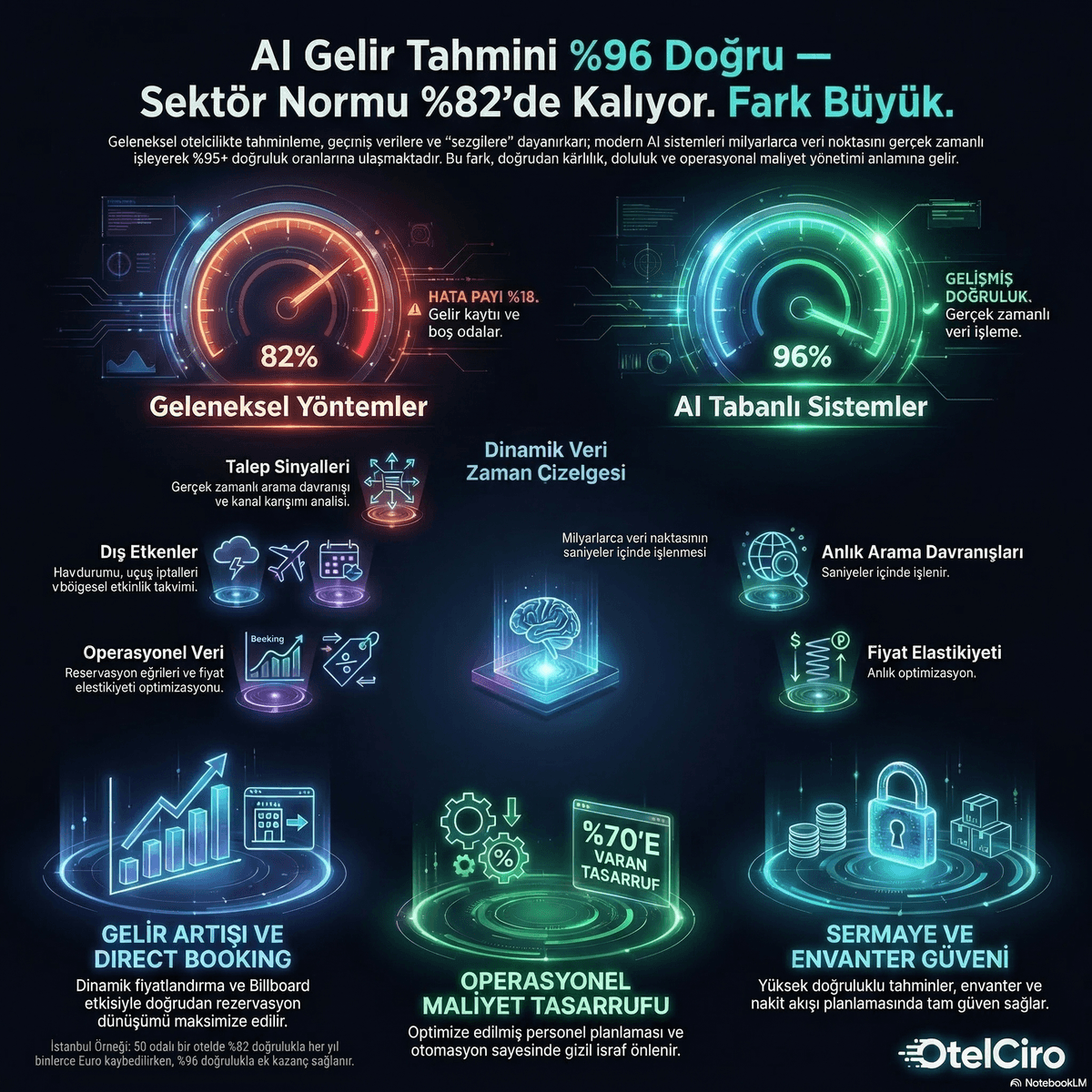
However, in 2026, the concept of "accurate forecasting" has undergone a fundamental transformation. Traditional methods achieve a 82% accuracy rate, leaving an 18% error margin. That 18% translates to missed revenue, empty rooms, or nights sold at prices far below optimal.
AI-based systems reach 96% accuracy, reducing the error margin to just 4%. The transformation of AI in hospitality is happening at exactly this pace.
Related reading: 2026 Hospitality Trend Map: 8 Mega Trends at a Glance
Traditional Forecasting Methods: Where They Fall Short
Traditional revenue management has served hotels for decades. But faced with today's data volume and market complexity, it encounters serious limitations:
Traditional Data Sources
1. Demand Signals:
- Prior year occupancy rates (year-over-year comparison)
- Same-period booking velocity (pace analysis)
- Pick-up reports (weekly reservation growth)
2. External Factors:
- Seasonal calendar (high/low season)
- Known events and trade shows
- Airline capacity (general flight data)
3. Operational Data:
- Prior year average daily rate (ADR)
- Group booking forecasts
- Average cancellation rates
Why It Plateaus at 82%
The fundamental problem with traditional methods is that they are retrospective — making assumptions about the future by looking at the past. But 2026's market dynamics look very different from the past:
- Travel behaviors permanently changed post-pandemic
- OTA algorithms update continuously
- Competitor prices change on an hourly basis
- Weather, local events, and flight prices create instant impacts
- Geopolitical developments can reshape the demand map within days
A spreadsheet or even an experienced revenue manager's intuition cannot process this complexity in real time.
Embed this image on your site
<a href="https://otelciro.com/en/news/ai-gelir-tahmini-otel">
  <img src="https://cdn.sanity.io/images/1la98t0z/production/e41b7ac3104ad8488f70d83e78d4135e4a401e88-1200x2150.png" alt="AI-driven hotel dynamic pricing model" width="800" />
</a>
<p>Source: <a href="https://otelciro.com">OtelCiro</a> — AI Hotel Revenue Management</p>
AI-Based Revenue Forecasting: What's Behind 96% Accuracy?
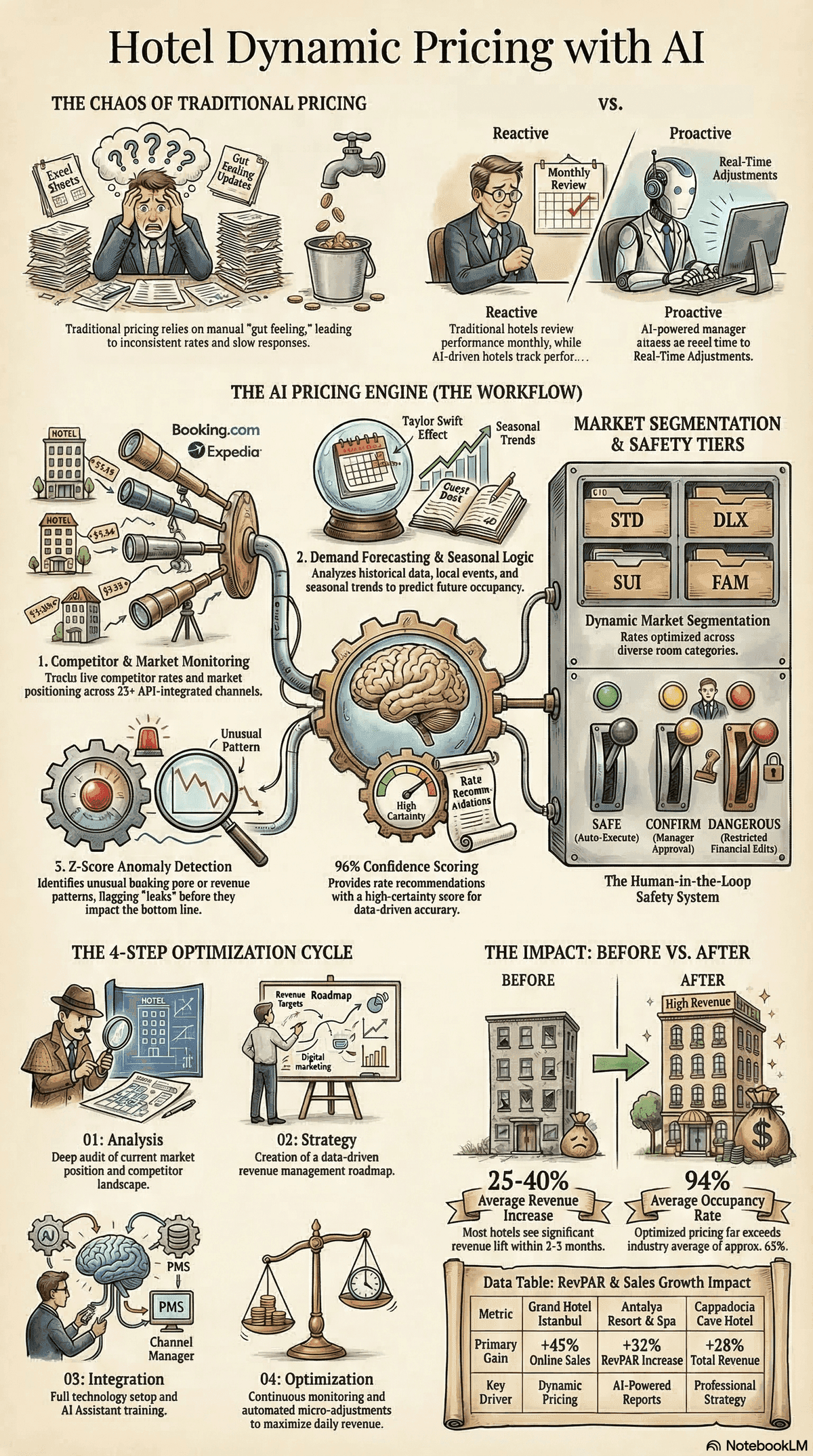
AI-powered revenue forecasting systems process all the data sources used by traditional methods plus a vastly wider data spectrum in real time.
AI Data Layers
Layer 1 — Demand Signals (Enhanced):
- Search behavior analysis: Real-time behavior of people searching for hotels on Booking.com, Google Hotels, and Expedia
- Search-to-booking conversion rates: Not just searchers, but actual bookers
- Source market trends: Which countries are showing increasing/decreasing search volume
- Mobile vs. desktop distribution: Device-based conversion differences
Layer 2 — External Factors (Real-Time):
- Weather forecasting: 14-day detailed weather predictions and their impact on travel decisions
- Flight data: Real-time flight capacity, ticket prices, new route announcements
- Regional events: Congress, concert, sports event, and festival calendars
- Geopolitical situation: Regional security assessments, visa policy changes
Layer 3 — Operational Data (Instant):
- Reservation curves: Hourly pick-up velocity
- Price elasticity optimization: Real-time impact of each price change on demand
- Cancellation predictions: Cancellation probability at the individual reservation level
- Room-type occupancy: Micro-forecasting across standard, superior, and suite categories
Layer 4 — Competitive Intelligence:
- Competitor price monitoring: Real-time prices from hotels in your comp set
- OTA ranking changes: Position tracking on Booking.com and Expedia
- Market share forecasting: Regional occupancy and ADR trends
Processing Billions of Data Points in Seconds
A traditional revenue manager can evaluate 50-100 data points per day. An AI-based system processes billions of data points within seconds. This difference in scale explains the accuracy gap between 82% and 96%.
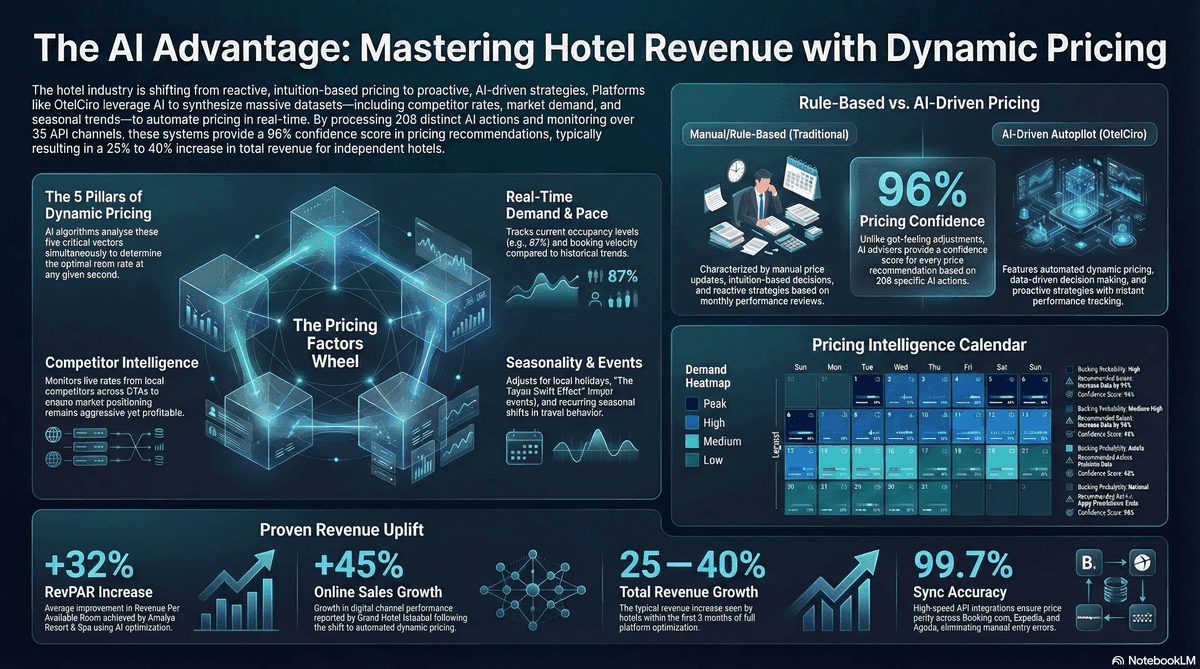
The dynamic vs. static pricing comparison illustrates this difference with concrete revenue figures.
Related reading: 2026 Travel Trends: The AI Assistant Era Begins
Dynamic Pricing + Billboard Effect = Maximum Direct Bookings
AI revenue forecasting is not just a prediction tool — it reveals its true power when combined with a dynamic pricing engine and channel optimization.
The Cycle Works Like This:
- AI forecast: Tomorrow's demand will result in 85% occupancy → optimal price: 180 EUR
- Dynamic pricing: 180 EUR price published across OTAs and direct channel
- Billboard effect: Guest sees the price on OTA, checks the hotel website
- Direct conversion: Same or better price on website + extra perks → direct booking
- Commission savings: 15-25% savings on OTA commission
- Net RevPAR increase: Both occupancy and profitability optimized
This cycle is unsustainable without AI. The optimal price point can change multiple times throughout the day — and each change must be updated consistently across all channels.
Embed this image on your site
<a href="https://otelciro.com/en/news/ai-gelir-tahmini-otel">
  <img src="https://cdn.sanity.io/images/1la98t0z/production/e4a81170ea23bc3464834633cf98f17b6e55f514-1200x669.png" alt="Hotel dynamic pricing strategies comparison" width="800" />
</a>
<p>Source: <a href="https://otelciro.com">OtelCiro</a> — AI Hotel Revenue Management</p>
Operational Cost Savings: Up to 70% Efficiency Gains
Beyond revenue growth, AI revenue forecasting's second major impact is operational cost optimization:
Staff Planning
- Accurate occupancy forecast → accurate staffing: Reduces the risk of overstaffing costs or understaffing service quality
- Housekeeping optimization: Number of rooms to clean is known in advance
- F&B planning: Breakfast and restaurant preparation based on demand forecasts
- Reception capacity: Check-in/check-out peaks planned in advance
Inventory and Procurement
- High-accuracy forecasting → reliable cash flow planning
- Mini-bar, amenity, linen/towel stock planning optimized
- Energy consumption forecasting (HVAC, lighting) based on occupancy
Automation Gains
With AI-powered systems, hotels can achieve up to 70% savings in operational costs — especially through optimized staffing and automation.
Collaborative AI vs. Blind AI: The Trust Issue
The most critical distinction in AI revenue management is between "blind AI" and "collaborative AI." This distinction directly determines a system's success.
Blind AI (Black Box) Approach
- Algorithm sets prices without showing its reasoning
- Hotel manager cannot answer "why this price?"
- Low trust → low approval rate → low efficiency
- Operator overrides AI, weakening the system's learning capacity
- Result: Low adoption, low performance
Collaborative AI Approach
- AI presents its price recommendation along with its reasoning: "3 reasons I'm suggesting this price..."
- Hotel manager approves, adjusts, or rejects the recommendation
- Every decision is added to AI's learning data
- Trust grows → approval rate increases → system learns better
- Result: High adoption, high performance, continuous improvement
The Trust Problem in Numbers
Industry data shows that only 36% of hoteliers trust AI price predictions. This means the majority of potential remains untapped.
The solution to the trust problem is not a better algorithm — it's a more transparent, collaborative approach. The formula of Human Intelligence + Artificial Intelligence = Learning Ecosystem forms the foundation of the agentic AI 2026 vision.
24/7 Adaptation: Updating Prices Once a Day Is No Longer Enough
In traditional revenue management, prices are updated once a day — usually in the morning. But in 2026, this approach leads to significant revenue loss:
Why Continuous Updates Are Necessary
- Competitor moves: A hotel in your comp set drops its price at 2:00 PM → your price loses competitiveness within 2 hours
- Weather changes: Rain forecast announced for the weekend → sudden drop in leisure demand
- Flight capacity: An airline adds a new service at 4:00 PM → demand increase from the target market
- Event announcement: Concert or congress announcement → sudden demand spike for specific dates
AI-powered RMS monitors these changes 24/7 in real time and automatically adapts prices. This continuous adaptation is the primary reason AI-powered systems deliver a 17% revenue increase.
The Financial Impact of Forecast Accuracy
The difference between 82% and 96% may seem small, but the financial impact is dramatic:
Scenario: 100-Room Istanbul City Hotel
Traditional method (82% accuracy):
- Annual capacity: 36,500 room nights
- 18% error rate = 6,570 room nights with incorrect pricing
- Average error cost: 15 EUR/night (over- or under-priced)
- Annual loss: ~98,550 EUR
AI-based system (96% accuracy):
- 4% error rate = 1,460 room nights with incorrect pricing
- Average error cost: 8 EUR/night (smaller deviations)
- Annual loss: ~11,680 EUR
Net difference: ~86,870 EUR additional revenue per year
This figure comes solely from the improvement in forecast accuracy. When dynamic pricing, billboard effect, and operational savings are added, the total impact is much greater.
5 Critical Steps in the Traditional → AI Transition
To successfully execute the AI transformation — one of the 5 historic turning points in hospitality:
Step 1: Prepare Data Infrastructure
- Ensure PMS data is clean, consistent, and accessible
- Historical data should be at least 2-3 years deep
- Channel manager integration must be in place
Step 2: Pilot Period (60-90 Days)
- Run the AI system in parallel (shadow mode)
- Compare existing decisions with AI recommendations
- Build trust and train the team
Step 3: Gradual Authorization
- Start with low-risk decisions (off-season pricing)
- Then medium-risk decisions (OTA parity management)
- Finally high-impact decisions (peak season strategy)
Step 4: Human-AI Collaboration Protocol
- Which decisions need AI recommendation only, which require approval?
- Override rules and feedback mechanisms
- Weekly performance review meetings
Step 5: Continuous Learning Loop
- Monitor AI model performance metrics
- Seasonal and market-specific calibration
- Increase team AI literacy
2026 Vision: Human + AI Learning Ecosystem
2026 hospitality vision reports indicate that the future of revenue management is not "fully autonomous AI" but "human-AI collaboration."
This vision materializes as follows:
- AI: Analyzes billions of data points, suggests optimal price, presents reasoning
- Human: Adds local knowledge, guest relations intuition, and strategic decisions
- Learning system: Every decision (approval or correction) makes the system smarter
- Result: Over time, AI recommendations become more accurate and human intervention becomes more strategic
The MCP AI revolution provides the technical infrastructure for this collaborative approach.
Conclusion: Forecast Accuracy = Revenue Accuracy
In 2026, hotel revenue management can no longer be done with "intuition + spreadsheets." Moving from 82% to 96% accuracy means six-figure annual improvements in revenue. But choosing the right AI approach — a collaborative, transparent, trust-building system — is just as important as the technology itself.
Pricing is no longer a decision updated once a day — it's a living process that adapts 24/7 to competitor moves and weather changes. With AI-powered RMS, a 17% revenue increase is becoming the industry standard.
OtelCiro's AI engine operates on a collaborative AI approach: it shows the reasoning behind every price recommendation, learns from operator decisions, and optimizes all channels in real time. For revenue management with 96% accuracy, request a demo.
![Voice Search for Hotels: Future of Booking [2026]](https://cdn.sanity.io/images/1la98t0z/production/8767dc5eeda140b181165bfc209e699c9b5ff698-1200x1200.png?w=1920&q=50&auto=format&fit=max)
![Hotel Tech Migration: Digital Roadmap [2026]](https://cdn.sanity.io/images/1la98t0z/production/50a2b86a9575f2987a5b57d8743f5a6f652fba79-1200x670.png?w=1920&q=50&auto=format&fit=max)
![[2026] Travel Trends: The AI Assistant Era Begins](https://cdn.sanity.io/images/1la98t0z/production/83f63d085ace864d32cad66bbd019cc5e62d1461-1200x1200.png?w=1920&q=50&auto=format&fit=max)