Hotels Caught Between Two Tectonic Forces
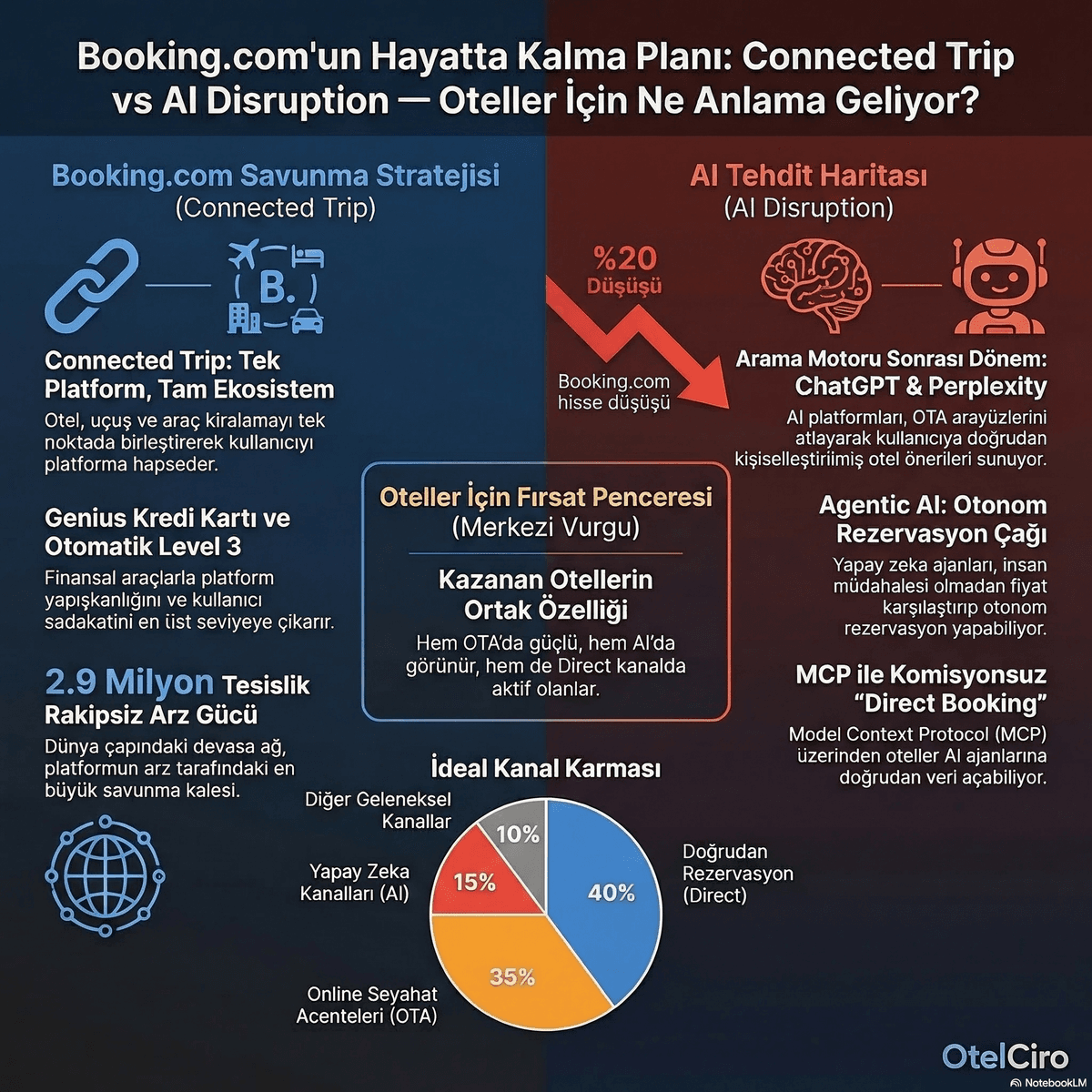
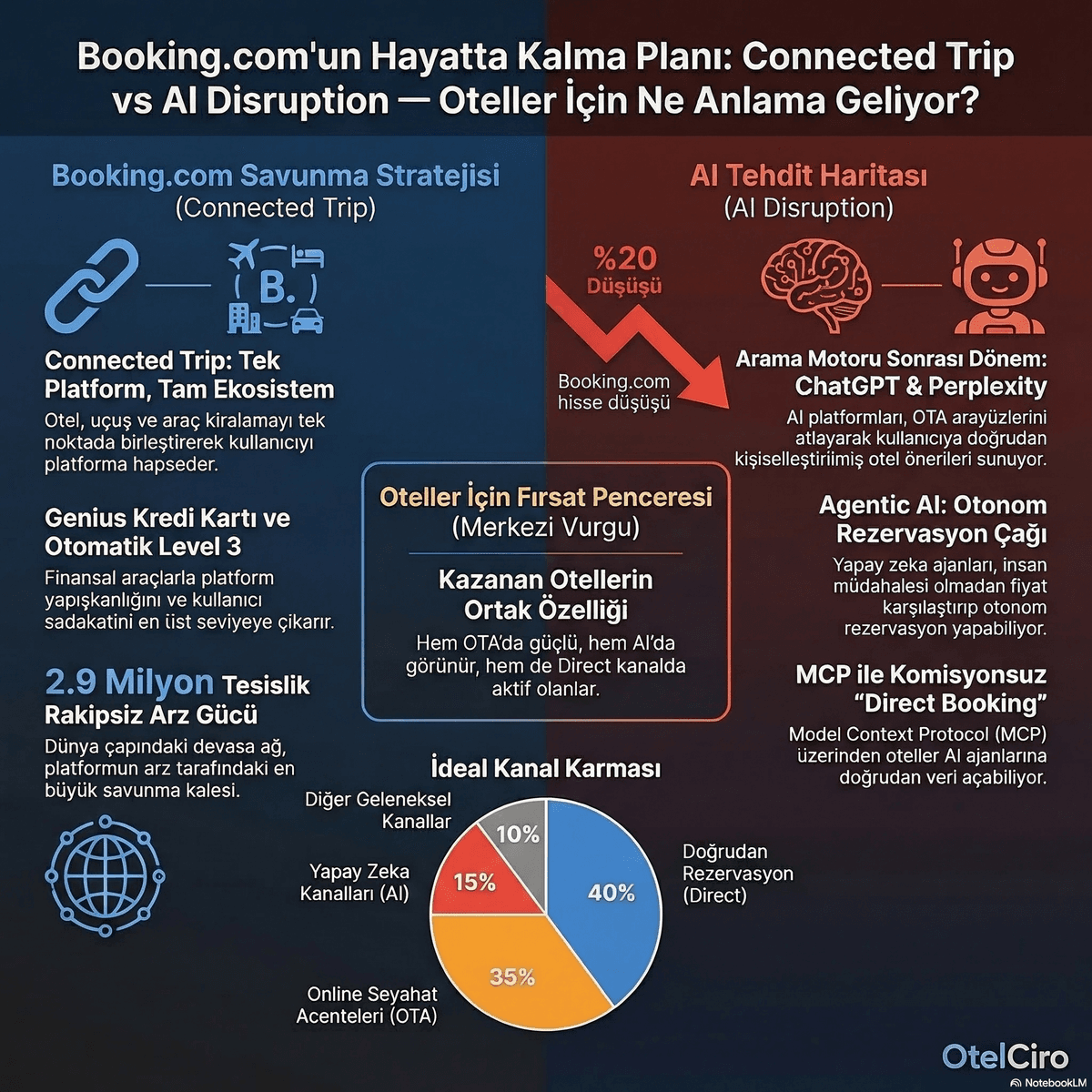
The hospitality industry in 2026 finds itself squeezed between two tectonic forces. On one side, Booking.com's Connected Trip vision keeps guests on-platform from flights and accommodation to car rentals and activities — all under one roof. On the other, ChatGPT, Perplexity, and autonomous AI agents bypass search engines entirely, recommending hotels directly to travelers.
Embed this image on your site
<a href="https://otelciro.com/en/news/booking-connected-trip-vs-ai-disruption">
  <img src="https://cdn.sanity.io/images/1la98t0z/production/dd243d26640ae91e776af4289758561720874e6a-1200x1200.png" alt="Booking Connected Trip vs AI Disruption comparison infographic" width="800" />
</a>
<p>Source: <a href="https://otelciro.com">OtelCiro</a> — AI Hotel Revenue Management</p>
Both forces have the potential to fundamentally reshape hotel revenue structures. But with the right strategy, hotels can turn this transformation into a competitive advantage.
Related reading: Booking.com Algorithmic Persuasion and the API Digital Shelf: A Two-Front War
Booking.com's Survival Plan: Connected Trip
Single Platform, Complete Ecosystem
Booking.com is no longer a hotel search engine. With its Connected Trip strategy, the platform aims to control the guest's entire travel lifecycle:
- Hotel + flight + car rental bundles in a single click
- Destination activities and restaurant recommendations within the platform
- Genius credit card payment ecosystem
- Automatic Genius Level 3 financial loyalty tools maximizing platform stickiness
This strategy increases guest dependency on the platform and dramatically reduces the hotel's chance of establishing direct contact with the guest.
The World's Largest Supply Network: A Defense Moat
One of Booking.com's biggest assets is its portfolio of 2.9 million properties. This massive supply network serves as a defense moat protecting the platform's competitive advantage. It would take years for a new competitor to reach this scale — and Booking knows it.
Connected Trip transforms this supply network into a "stickiness" tool. When a guest books hotel, flight, and car rental all in one place, the probability of using the same platform for their next trip rises to 78%.
The Risk for Hotels
As we detailed in our analysis of Connected Trip's impact on hotels, this strategy carries serious risks:
- Guest data loss: Unable to build CRM systems
- Cross-sell restrictions: Spa and restaurant revenue flows to the platform
- Commission pressure increase: Commission visibility decreases within bundled packages
Embed this image on your site
<a href="https://otelciro.com/en/news/booking-connected-trip-vs-ai-disruption">
  <img src="https://cdn.sanity.io/images/1la98t0z/production/e6228ea193af826282c14dcb670db1911d1756ce-1200x669.png" alt="Booking.com Visibility Booster usage guide" width="800" />
</a>
<p>Source: <a href="https://otelciro.com">OtelCiro</a> — AI Hotel Revenue Management</p>
AI Disruption Threat Map
The Post-Search-Engine Era
The biggest paradigm shift of 2026 is consumers searching for hotels not through Google, but directly through AI assistants. ChatGPT and Perplexity bypass OTA interfaces entirely, recommending hotels directly to travelers.
This threatens Booking.com's entire "storefront optimization" strategy. The guest no longer looks at Booking rankings — they tell their AI assistant "recommend a boutique hotel in Istanbul's Sultanahmet for 200 euros" and the AI responds directly.
We previously examined how Booking.com's stock price dropped in response to this threat.
Agentic AI: The Autonomous Reservation Era
The future is not limited to AI recommendation systems. The Agentic AI concept describes AI agents that compare prices and complete reservations without human intervention.
These agents:
- Compare prices across multiple sources
- Analyze availability, location, and review scores
- Complete the entire process autonomously, including payment
- Humans only provide approval
Commission-Free Direct Booking via MCP
The Model Context Protocol (MCP) is an open standard that enables hotels to serve data directly to AI agents. A hotel with MCP integration allows AI agents to access pricing and availability information directly — without OTA commissions.
This is the technical infrastructure behind commission-free bookings through ChatGPT. The AI agent connects directly to the hotel's API, retrieves pricing, checks availability, and completes the reservation.
Related reading: Booking.com Algorithm 2026: How to Rank Higher and Get More Bookings
The Opportunity Window: Be Strong on BOTH Sides
The False Dilemma: OTA vs Direct
Many hotel managers are stuck in the dilemma of "let's abandon Booking entirely and go direct" or "let's skip AI and focus on Booking." Both are wrong.
The winning strategy in 2026 is being strong on both OTA and AI/direct channels. Here is why:
- OTAs still deliver volume: Booking.com still manages over 40% of global hotel searches
- AI channels are growing: Hotel searches through AI increased 340% between 2025 and 2026
- The billboard effect continues: 52% of OTA visitors also check the hotel's direct website
The Ideal 2026 Channel Mix
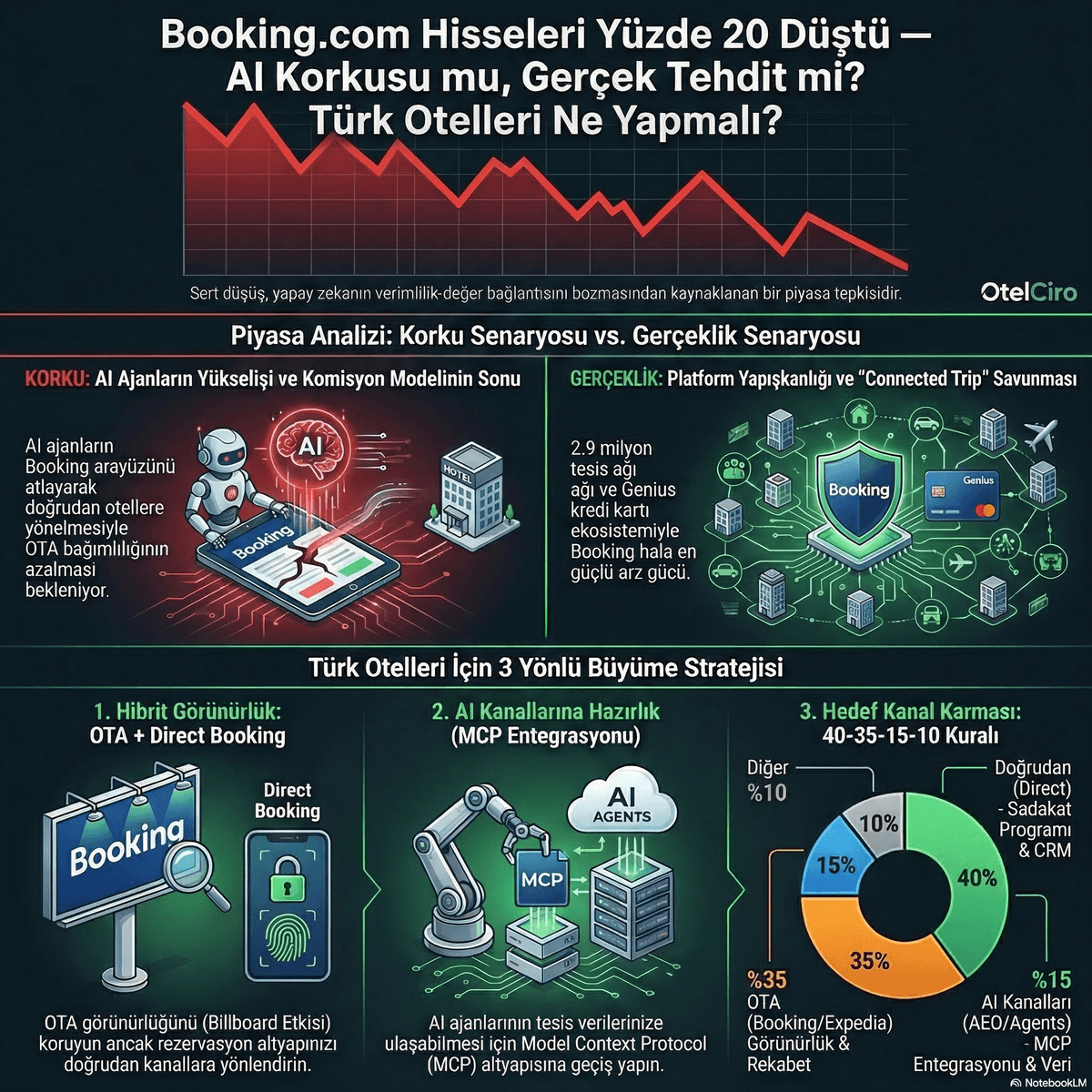
Our data-driven recommendation targets the following distribution:
| Channel | Target Share | Description |
|---|---|---|
| Direct | 40% | Website, phone, email, CRM |
| OTA | 35% | Booking.com, Expedia, others |
| AI Channels | 15% | ChatGPT, Perplexity, Google AI Mode |
| Other | 10% | GDS, tour operators, corporate |
This distribution optimizes commission costs while maximizing visibility.
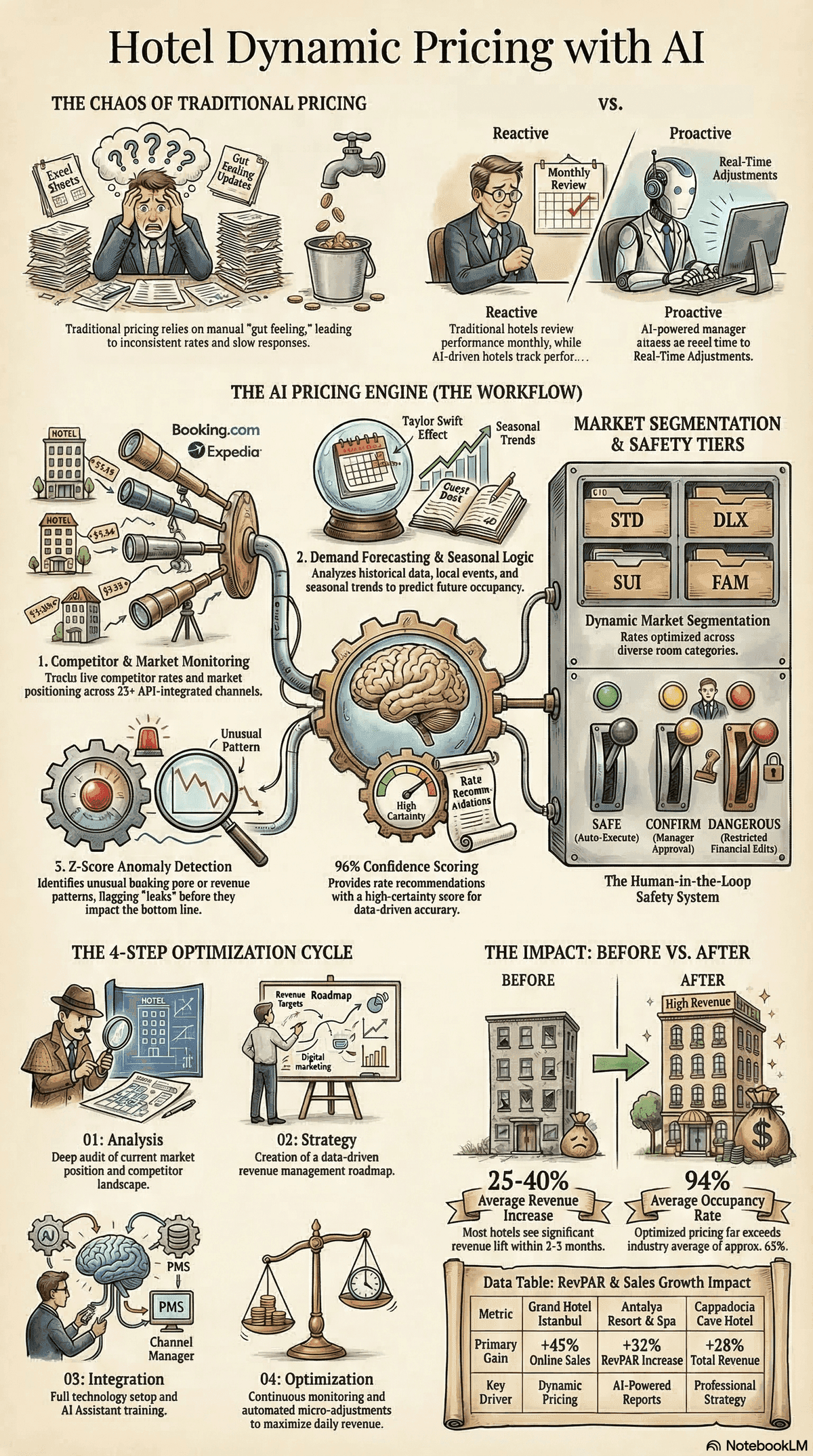
Embed this image on your site
<a href="https://otelciro.com/en/news/booking-connected-trip-vs-ai-disruption">
  <img src="https://cdn.sanity.io/images/1la98t0z/production/e41b7ac3104ad8488f70d83e78d4135e4a401e88-1200x2150.png" alt="AI-driven hotel dynamic pricing model" width="800" />
</a>
<p>Source: <a href="https://otelciro.com">OtelCiro</a> — AI Hotel Revenue Management</p>
The Balance Between Two Forces in Numbers
Seeing the impact of these two forces in concrete data makes strategic decision-making easier:
| Metric | Connected Trip Impact | AI Disruption Impact |
|---|---|---|
| Guest touchpoint | Platform-controlled | AI assistant-controlled |
| Commission rate | 15-25% (hidden in bundles) | 0-5% (direct via MCP) |
| Guest data ownership | At Booking.com | At the hotel (direct channel) |
| Early adopter advantage | Low (everyone is on OTAs) | High (few hotels on AI yet) |
| 2027 growth forecast | 8% annually | 120%+ annually |
This table clearly demonstrates why the AI channel should be a strategic priority. However, abandoning OTA volume is not wise either — finding the balance is essential.
Real-World Scenario
Consider an Istanbul boutique hotel: 45 rooms, Sultanahmet location, 4.2 Booking score. Its current channel mix is 65% OTA, 25% direct, 10% other.
Connected Trip impact: Booking.com will include this hotel in flight-plus-hotel bundles. Instead of the guest finding the hotel through a separate search, they will arrive through Booking's package recommendation. The hotel may get more bookings — but commission is buried in the bundle and guest data belongs entirely to Booking.
AI disruption impact: If the same hotel has MCP integration, when a traveler tells ChatGPT "boutique hotel in Sultanahmet for 150 euros," the AI can recommend this hotel directly. Zero commission, guest data stays with the hotel.
The ideal strategy: exist on both channels, but gradually increase the direct channel share.
Related reading: 2026 Travel Trends: The AI Assistant Era Begins
Action Plan: 5-Step Dual-Wing Strategy
1. Make Your OTA Profile AI-Compatible
Your Booking.com profile must now work not only for human eyes but also for AI algorithms. Use structured descriptions, clear feature lists, and maintain regular updates. Specifically, using Q&A format in facility descriptions helps AI systems process the information more efficiently.
2. Launch MCP Integration
For AI agents to find your hotel, you need to set up MCP infrastructure. This is the most effective way to increase your direct channel revenue. MCP integration delivers your hotel's pricing and availability to ChatGPT, Perplexity, and Google AI Mode in real time.
3. Value Differentiation Instead of Price Parity
Maintain the same price on Booking while offering additional value on your direct channel: complimentary breakfast, room upgrade, early check-in, late check-out. Differentiate the offer, not the price. This approach satisfies the Booking algorithm while increasing direct channel conversion.
4. Measure the Billboard Effect
Track how your OTA visibility contributes to direct sales. Use UTM parameters, Google Analytics segments, and comparative period analyses. Establish weekly reporting to clarify the correlation between OTA ranking and direct traffic.
5. Monitor Your AI Visibility Score
Regularly check how frequently your hotel is recommended on ChatGPT, Perplexity, and Google AI Mode. This is the "ranking" metric of the future. Test your hotel's AI visibility with at least 5 different queries each week and record the results.
Conclusion: Single-Channel Dependency Is Over
While Booking.com tries to keep guests on-platform with Connected Trip, AI disruption tries to pull guests off OTAs entirely. These two forces balance each other and open a unique opportunity window for hotels.
The hotels that survive in 2026 will be those investing in both channels, owning their data, and maintaining direct relationships with guests.
With OtelCiro's AI engine and channel manager, be strong in both worlds.
This content was prepared by the OtelCiro revenue management team using 2026 industry data.
![Booking.com Algorithm [2026]: Rank Higher Fast](https://cdn.sanity.io/images/1la98t0z/production/ccb90c2900ebf8f0a53ccc0bd8757bf20f324b7c-1376x768.jpg?w=1920&q=50&auto=format&fit=max)