A Two-Front War: Algorithmic Persuasion and the Digital Shelf
In 2026, hoteliers face two distinct yet interconnected battlefronts. The first is the "soft pressure" created by Booking.com's algorithmic reward-penalty system — you legally have pricing freedom, but the algorithm punishes you for exercising it. The second is the new reality of the AI era: if you do not have an API, you have no place on the digital shelf.
Embed this image on your site
<a href="https://otelciro.com/en/news/booking-algoritmik-ikna-api-dijital-raf">
  <img src="https://cdn.sanity.io/images/1la98t0z/production/7927190433c44db31bbf0567013350c0ece3728e-1200x1200.png" alt="Booking.com Algorithmic Persuasion and API Digital Shelf infographic" width="800" />
</a>
<p>Source: <a href="https://otelciro.com">OtelCiro</a> — AI Hotel Revenue Management</p>
Understanding these two fronts together is a prerequisite for developing the right strategy in 2026.
Related reading: Booking Connected Trip vs AI Disruption: What Hotels Should Do
Part 1: Algorithmic Persuasion
Legal Freedom vs Algorithmic Reality
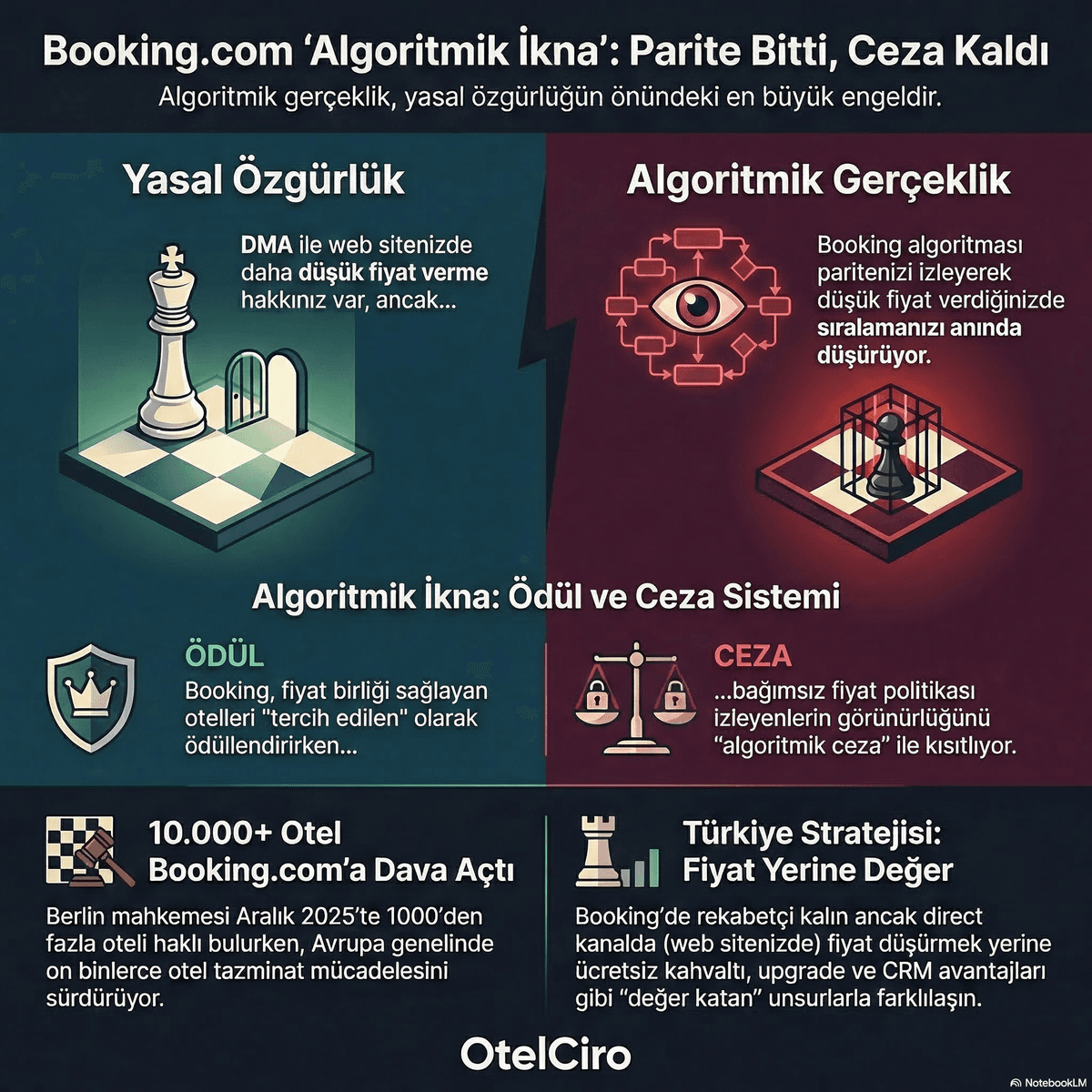
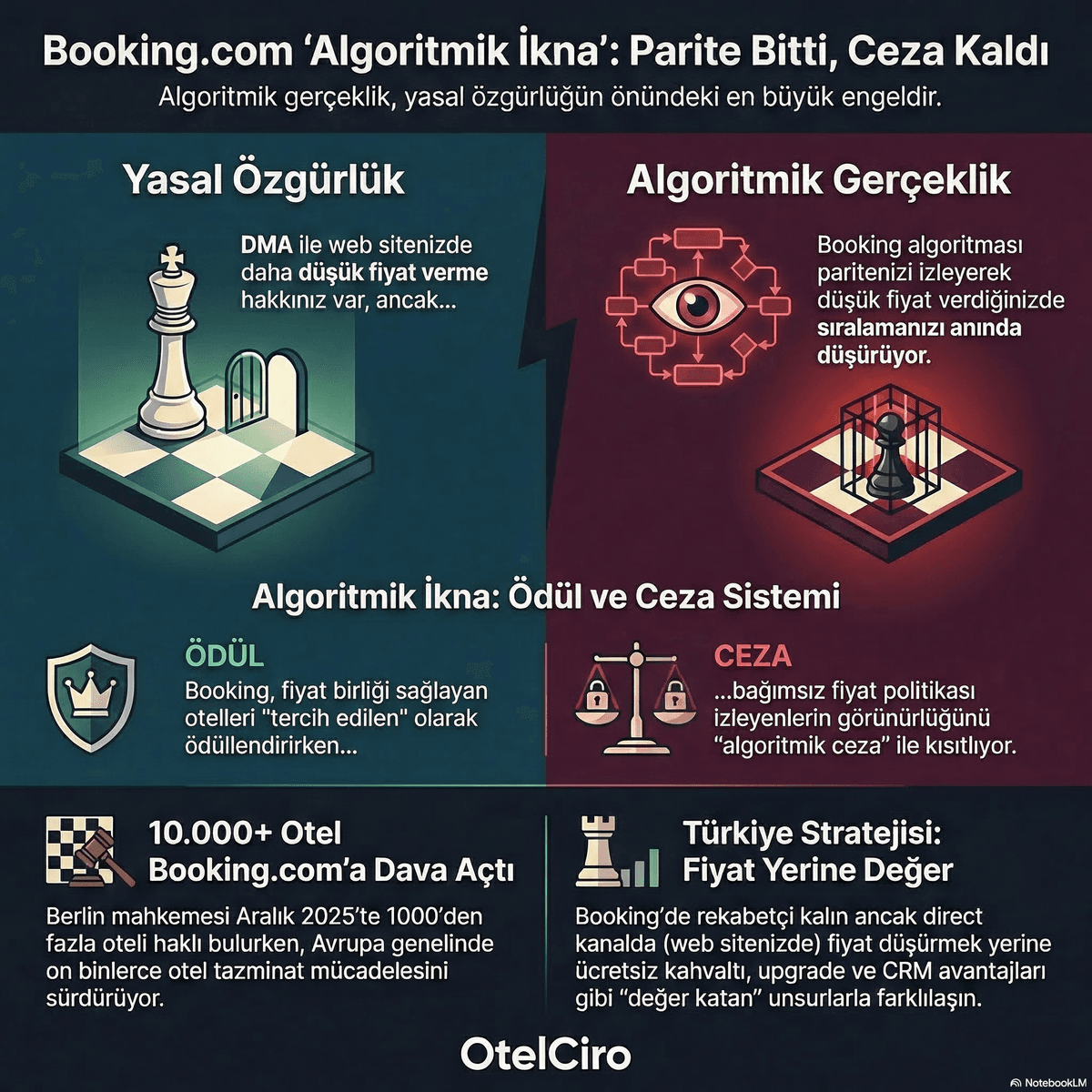
With the European Union's Digital Markets Act (DMA), hotels legally gained the right to set lower prices on their own websites than on Booking.com. DMA price freedom is a revolutionary change on paper.
But reality tells a different story.
Booking.com's algorithm actively monitors price parity. When you set a lower price on your own website, the algorithm detects it and instantly drops your ranking. This is not a legal requirement — it is an algorithmic choice.
The Reward vs Penalty System
Booking.com's algorithm structure uses a sophisticated carrot-and-stick mechanism:
Rewards (for parity-maintaining hotels):
- "Preferred Partner" status and superior ranking
- Blue badge and trust signal in search results
- Priority display in mobile search
- Easy access to the Genius program
Penalties (for independently priced hotels):
- Algorithmic ranking drop
- "Cheaper elsewhere" warning on your profile
- Loss of Preferred Partner status
- Organic decrease in conversion rate
This system is not legal but algorithmic — and this distinction matters enormously. Booking.com does not tell you "you cannot lower prices," but when you do, it penalizes you algorithmically.
10,000+ Hotels Filed Lawsuits
A growing legal resistance against this algorithmic pressure is underway. Over 10,000 hotels across Europe have sued Booking.com. The Berlin Court ruled in favor of 1,000+ hotels in December 2025, confirming that Booking.com's algorithmic price pressure violates competition law.
The full impact of this ruling has yet to materialize, but it sets an important precedent that exposes Booking.com's hidden penalties.
Turkey Strategy: Value Differentiation
Our recommendation for Turkish hotels: differentiate on value, not price.
What to do:
- Maintain competitive pricing on Booking.com
- Maintain price parity on your direct channel
- But offer additional value on the direct channel:
- Complimentary breakfast upgrade
- Guaranteed room upgrade
- Early check-in / late check-out
- Loyalty points
- Personalized offers via CRM
This strategy satisfies the Booking.com algorithm while increasing direct channel conversion.
Embed this image on your site
<a href="https://otelciro.com/en/news/booking-algoritmik-ikna-api-dijital-raf">
  <img src="https://cdn.sanity.io/images/1la98t0z/production/4e1321089f9b1bc72258dde2b96e9760249756e6-1200x669.png" alt="Booking.com room type optimization" width="800" />
</a>
<p>Source: <a href="https://otelciro.com">OtelCiro</a> — AI Hotel Revenue Management</p>
Part 2: API = Digital Shelf
"If You're Not an API, You Don't Exist"
HFTP's (Hospitality Financial and Technology Professionals) rule for 2026 is clear: "If you're not an API, you don't exist."
This rule reflects the fundamental reality of the AI era. Google AI, ChatGPT, Perplexity, and other AI assistants can only read structured data. This data is delivered in two ways:
- Schema.org markup: Structured data on your website (JSON-LD)
- API access: Programmatic access to pricing, availability, and property information
Without either, AI agents cannot find your hotel. If they cannot find it, they cannot recommend it. If they cannot recommend it, they cannot sell it.
Hotel Rooms = SKUs
An analogy from the e-commerce world: for a product to appear on Amazon's digital shelf, it needs a SKU, price, stock, and description. In 2026, hotel rooms have similarly become individual SKUs.
Each room type is now a digital product:
- SKU: Room type code (STD-DBL, SUP-TWN, DLX-STE)
- Price: Real-time, channel-specific
- Stock: Instant availability
- Description: Structured feature list
- Rating: Guest scores and reviews
When this data is served via API, AI agents can see your hotel on the "digital shelf."
API Exists = Sales Possible. No API = Invisible
The equation is simple:
- API exists → AI agents can find you → Included in price comparison → Sales possible
- No API → AI agents cannot find you → Excluded from comparison → Invisible
A user making a hotel booking via Google AI Mode will only see hotels that serve data through APIs. The rest will not exist in the AI world.
OtelCiro MCP: Connecting Hotels to AI Agents
The Model Context Protocol (MCP) is the standardized version of this API infrastructure. OtelCiro MCP integration:
- Serves hotel pricing and availability to AI agents in real time
- Works compatibly with ChatGPT, Perplexity, Google AI, and other AI assistants
- Enables direct bookings without OTA commission
- Makes your hotel visible on the "digital shelf"
Hotel Departments' AI Perception
Each hotel department is perceived by AI at different levels:
| Department | API Integration | AI Perception |
|---|---|---|
| Rooms/Accommodation | Real-time API (PMS + Channel Manager) | High — pricing and availability fully visible |
| Restaurant/Menu | Selective (PDF/web, some API) | Medium — menu information usually incomplete |
| SPA/Activities | Mostly invisible | Low — most hotels do not bring SPA data to API |
| Reservation System | Variable | Medium-High — depends on PMS integration |
This table shows why revenue streams beyond room sales are disappearing in the AI world. For total revenue management, all departments must be brought onto the digital shelf.
Google Hotel Ads + PMS API = Complete Digital Shelf
To build a complete digital shelf:
- Google Hotel Ads integration: Visibility on Google's price comparison platform
- PMS API connection: Real-time pricing and availability flow
- Schema.org markup: Structured data on your website
- MCP integration: Direct access for AI agents
These four layers together ensure your hotel appears fully across traditional search engines, AI assistants, and OTAs.
Related reading: Booking.com 2025 vs. 2026: 6 Rules Changed — Hotels Sticking to Old Strategies Are Losing
Where the Two Fronts Intersect
Algorithmic persuasion and the digital shelf are not independent topics. Both answer the same fundamental question: How visible is your hotel in the digital world, and how much control do you have?
- If you are fully dependent on Booking.com's algorithm, you have no pricing freedom
- If you lack API infrastructure, you are invisible in the AI world
- If you solve both, you are strong on both OTA and AI
The SEO to GEO transformation process provides the strategic framework that unites these two fronts.
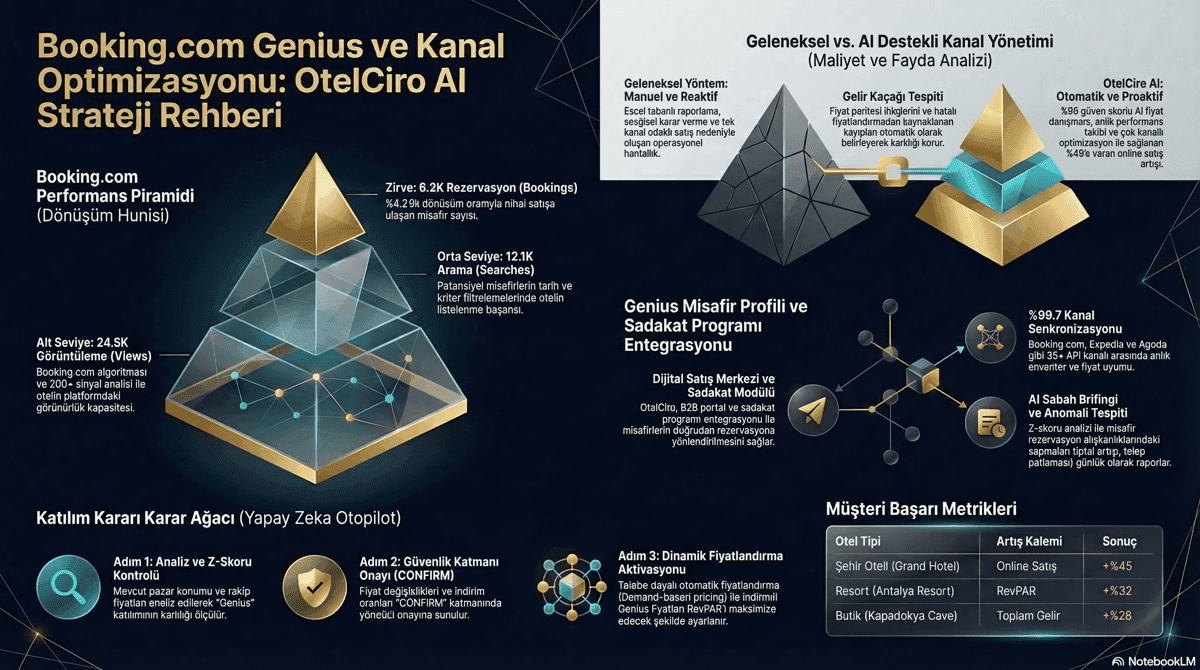
Embed this image on your site
<a href="https://otelciro.com/en/news/booking-algoritmik-ikna-api-dijital-raf">
  <img src="https://cdn.sanity.io/images/1la98t0z/production/9e1392b05b1b69f2ed494b62433b779e2c809048-1200x670.png" alt="Booking.com Genius Level 3 strategy guide" width="800" />
</a>
<p>Source: <a href="https://otelciro.com">OtelCiro</a> — AI Hotel Revenue Management</p>
Action Plan
This Week
- Check (or add) Schema.org Hotel markup on your website
- Review your price parity status on Booking.com
This Month
- Start a technical assessment for MCP integration
- Develop your direct channel value differentiation strategy
This Quarter
- Complete API infrastructure (PMS + Channel Manager + MCP)
- Launch Google Hotel Ads integration
- Complete department-level digital shelf analysis
Conclusion: Invisibility Does Not Forgive
While Booking.com's algorithmic persuasion forces you toward price parity, the AI era erases API-less hotels from the digital shelf. The solution to both threats is the same: take control of your data.
With structured data, API access, and MCP integration, stay competitive in the Booking.com algorithm while remaining visible to AI agents. OtelCiro's ecosystem lets you manage both fronts from a single platform.
This content was prepared by the OtelCiro revenue management team based on 2026 industry data and the Berlin Court ruling.
![7 Advanced OTA Sales Tactics That Work [2026]](https://cdn.sanity.io/images/1la98t0z/production/0d8634b7f4d9033b08b65800012ec64261df48bc-1200x1200.png?w=1920&q=50&auto=format&fit=max)
![Booking.com Genius [2026]: Join, Leave or Optimize?](https://cdn.sanity.io/images/1la98t0z/production/fabaf8b8918404681f00de3f00e368aac91c9744-1200x1200.png?w=1920&q=50&auto=format&fit=max)