![Booking.com [2026]: 6 Rules That Changed Everything](https://cdn.sanity.io/images/1la98t0z/production/23ca109b49907176062cdf7986208839b481e68e-1200x1200.png?w=1920&q=65&auto=format&fit=max)
Your 2025 Strategy Is Sinking You in 2026
Booking.com made 6 fundamental changes to the platform's core operations in the transition from 2025 to 2026. Most of these changes were gradual, but their cumulative impact is massive. Hotels continuing with their 2025 strategy are losing rankings without realizing it, watching conversion rates fall, and seeing OTA costs rise.
Related reading: Booking.com Classifies Your Hotel into 4 Tiers — Which One Are You In?
Change 1: Static Scoring to Dynamic Scoring
2025: Booking.com's ranking algorithm updated on approximately 8-month cycles. A hotel that achieved strong performance once could hold that position for months.
2026: The algorithm now updates on 15-day cycles — and for some metrics, in real time. Your hotel's ranking is recalculated every 2 weeks.
What you should do:
- Weekly performance tracking is mandatory
- One-time optimization is not enough; continuous improvement is required
- Monitor cancellation rate, review score, and conversion rate in real time
- Deeply understand how the Booking.com algorithm works
Embed this image on your site
<a href="https://otelciro.com/en/news/booking-2025-vs-2026">
  <img src="https://cdn.sanity.io/images/1la98t0z/production/7d13d07317ea3f459866ba0afb2b311a8c722264-1200x670.png" alt="Seasonal pricing strategies for hotels" width="800" />
</a>
<p>Source: <a href="https://otelciro.com">OtelCiro</a> — AI Hotel Revenue Management</p>
Change 2: Google to Booking.com as Search Starting Point
2025: Google was the clear leader as the starting point for hotel searches (28%). Hotels invested heavily in SEO.
2026: Booking.com has surpassed Google for hotel search — 26% vs. 21%. More than a quarter of travelers now start their hotel search directly on Booking.com.
What you should do:
- Booking.com on-platform optimization must be prioritized alongside Google SEO
- Push your Content Score to 100%
- Regularly update Booking.com photos and descriptions
- Actively participate in platform promotions (Genius, mobile discount)
- Follow Booking.com's 2026 rules with full compliance
Related reading: Booking.com Algorithmic Persuasion and the API Digital Shelf: A Two-Front War
Change 3: 60% to 75% Mobile Share
2025: Mobile traffic share was around 60%. Desktop was still considered an important channel.
2026: Mobile share has risen to 75%. Desktop traffic has become marginal. Three out of every four bookings are made from mobile devices.
What you should do:
- A mobile discount must be active (minimum 10%)
- Photos must be optimized for mobile screens
- Descriptions should be mobile-readable (short paragraphs)
- Offer mobile payment options
- Participate in Booking.com mobile app promotions
Embed this image on your site
<a href="https://otelciro.com/en/news/booking-2025-vs-2026">
  <img src="https://cdn.sanity.io/images/1la98t0z/production/9e1392b05b1b69f2ed494b62433b779e2c809048-1200x670.png" alt="Booking.com Genius Level 3 strategy guide" width="800" />
</a>
<p>Source: <a href="https://otelciro.com">OtelCiro</a> — AI Hotel Revenue Management</p>
Change 4: Manual Search to ChatGPT/GPT-5 Bookings
2025: Guests searched manually, set their own filters, and reviewed hotels one by one.
2026: Chat-based booking through ChatGPT and GPT-5 has become mainstream. Natural language commands like "Find a hotel in Taksim for 2 people with breakfast, under 300 EUR, June 16-20" are handled end-to-end by AI.
What you should do:
- Prepare structured data for AI compatibility
- Create detailed and consistent room descriptions that AI can parse
- Share live pricing and availability through MCP integration
- Complete every amenity and feature field on your Booking.com profile
Related reading: How Booking.com's Content Score System Works — 90% of Hotels Don't Know This
Change 5: Standard Room to Premium Rooms (58%)
2025: Standard rooms made up the majority of sales. Price competition primarily happened at the standard room level.
2026: 58% of guests prefer premium room categories (suites, deluxe, sea-view, personalized service). Standard room share has dropped dramatically.
What you should do:
- Diversify your room portfolio
- Renovate standard rooms to create premium categories
- Upload a separate, detailed photo set for each room type
- Highlight the unique features of premium rooms in descriptions
- Use upsell strategies to upgrade standard bookings to premium
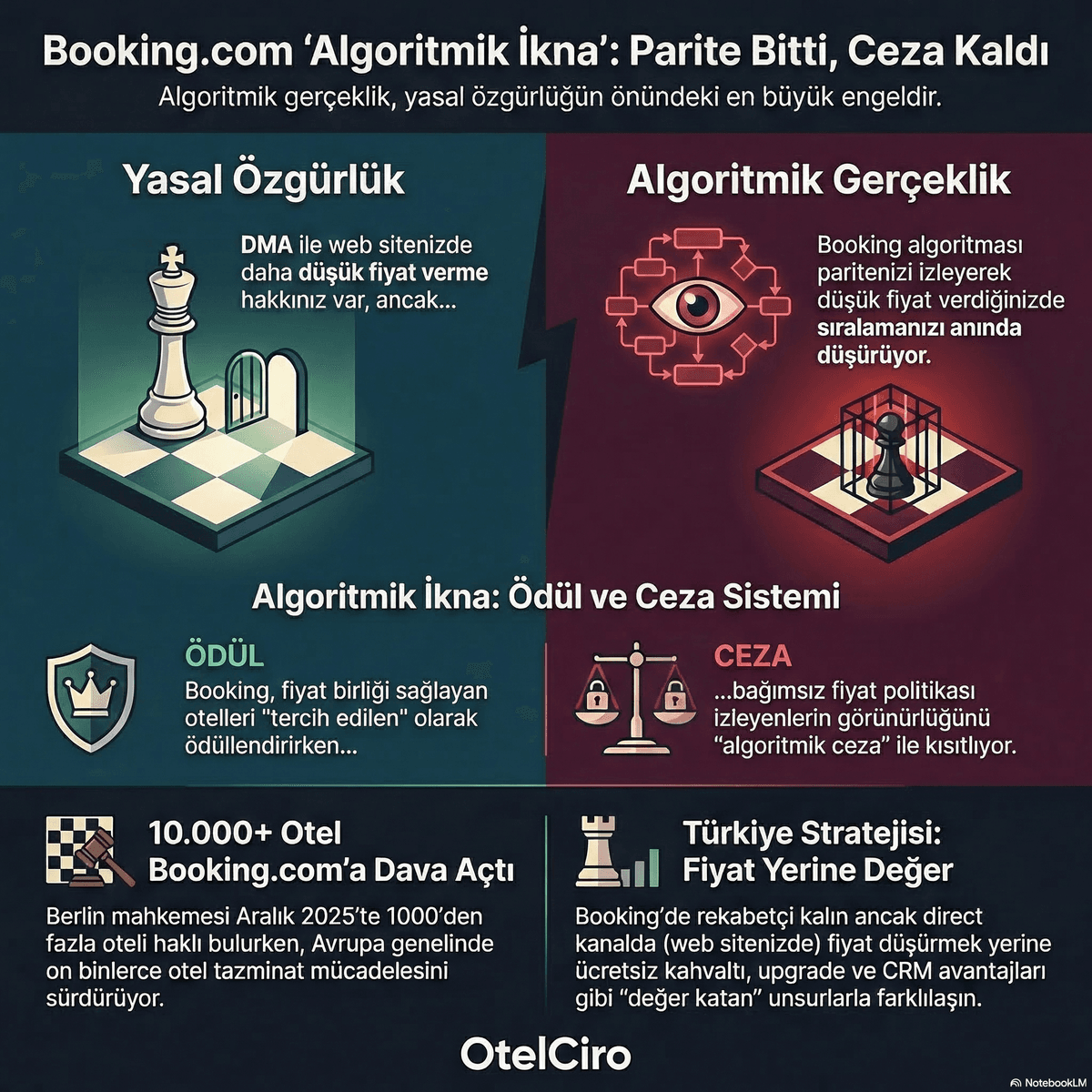
Change 6: Price Freedom to Algorithmic Penalty
2025: Hotels had relatively free rein in pricing. Setting prices far from competitors did not trigger significant penalties.
2026: Booking.com's algorithm algorithmically penalizes prices that deviate from market averages. Both excessively high and excessively low prices lead to ranking losses.
What you should do:
- Track competitor prices daily
- Use dynamic pricing — AI-powered price optimization is essential
- Avoid deviating more than 15% from market averages
- Make price changes gradual, not abrupt
- Align your pricing strategy with the 2026 mega trends
2025 vs. 2026 Comparison Table
| Criterion | 2025 | 2026 | Impact |
|---|---|---|---|
| Scoring cycle | 8 months | 15 days | Continuous optimization required |
| Search starting point | Google (28%) | Booking (26%) | On-platform SEO is critical |
| Mobile share | 60% | 75% | Mobile discount mandatory |
| Booking method | Manual search | ChatGPT/GPT-5 | AI compatibility required |
| Room preference | Standard-dominant | Premium 58% | Portfolio diversification |
| Pricing | Flexible | Algorithmic control | Dynamic pricing essential |
Losses for Hotels That Have Not Transitioned
Typical losses for hotels continuing with their 2025 strategy:
- Ranking loss: Average 12-18 position drop
- Conversion loss: 15-25% decrease
- ADR loss: 8-12% decline
- Cancellation increase: 10-15% rise
- Total revenue impact: 20-35% reduction
These losses do not happen overnight — they accumulate gradually over 3-6 months. This makes them difficult to detect and increasingly expensive to recover from.
6 Actions to Implement Immediately
- Switch to dynamic pricing — Manual price updates are incompatible with 15-day cycles
- Push Content Score to 100% — Leave no field incomplete
- Activate mobile discount — Set a 10-15% mobile discount
- Prepare structured data — Mandatory for AI compatibility
- Expand premium room portfolio — Break free from standard room dependency
- Automate competitor price tracking — Avoid algorithmic penalties
Frequently Asked Questions
Has the 2025 strategy become entirely invalid?
Not entirely, but it is insufficient. The core principles that worked in 2025 (quality content, good reviews, competitive pricing) still apply. However, the way and frequency of applying these principles have changed fundamentally. A static approach no longer works; continuous, dynamic optimization is required.
How long does it take to adapt to these changes?
Technical adjustments (mobile discount, Content Score, structured data) can be completed within 1-2 weeks. However, algorithmic effects on performance take 4-8 weeks to materialize. Deeper changes like dynamic pricing and AI integration may require 1-3 months. The important thing is to start immediately.
Do these changes only affect Booking.com?
Similar trends are visible across all OTAs. Expedia has also shifted to dynamic scoring, and Google Hotels has strengthened its AI integration. However, since Booking.com is the largest OTA in many markets, its impact is most pronounced. Track changes across all channels in parallel.
To make a smooth transition from 2025 to 2026 and fully adapt to the new rules, contact OtelCiro. Leave old strategies behind with our AI-powered analysis and optimization tools.
![7 Advanced OTA Sales Tactics That Work [2026]](https://cdn.sanity.io/images/1la98t0z/production/0d8634b7f4d9033b08b65800012ec64261df48bc-1200x1200.png?w=1920&q=50&auto=format&fit=max)
![Booking.com Genius [2026]: Join, Leave or Optimize?](https://cdn.sanity.io/images/1la98t0z/production/fabaf8b8918404681f00de3f00e368aac91c9744-1200x1200.png?w=1920&q=50&auto=format&fit=max)