![7 Advanced OTA Sales Tactics That Work [2026]](https://cdn.sanity.io/images/1la98t0z/production/0d8634b7f4d9033b08b65800012ec64261df48bc-1200x1200.png?w=1920&q=65&auto=format&fit=max)
Move Beyond Basic Optimization
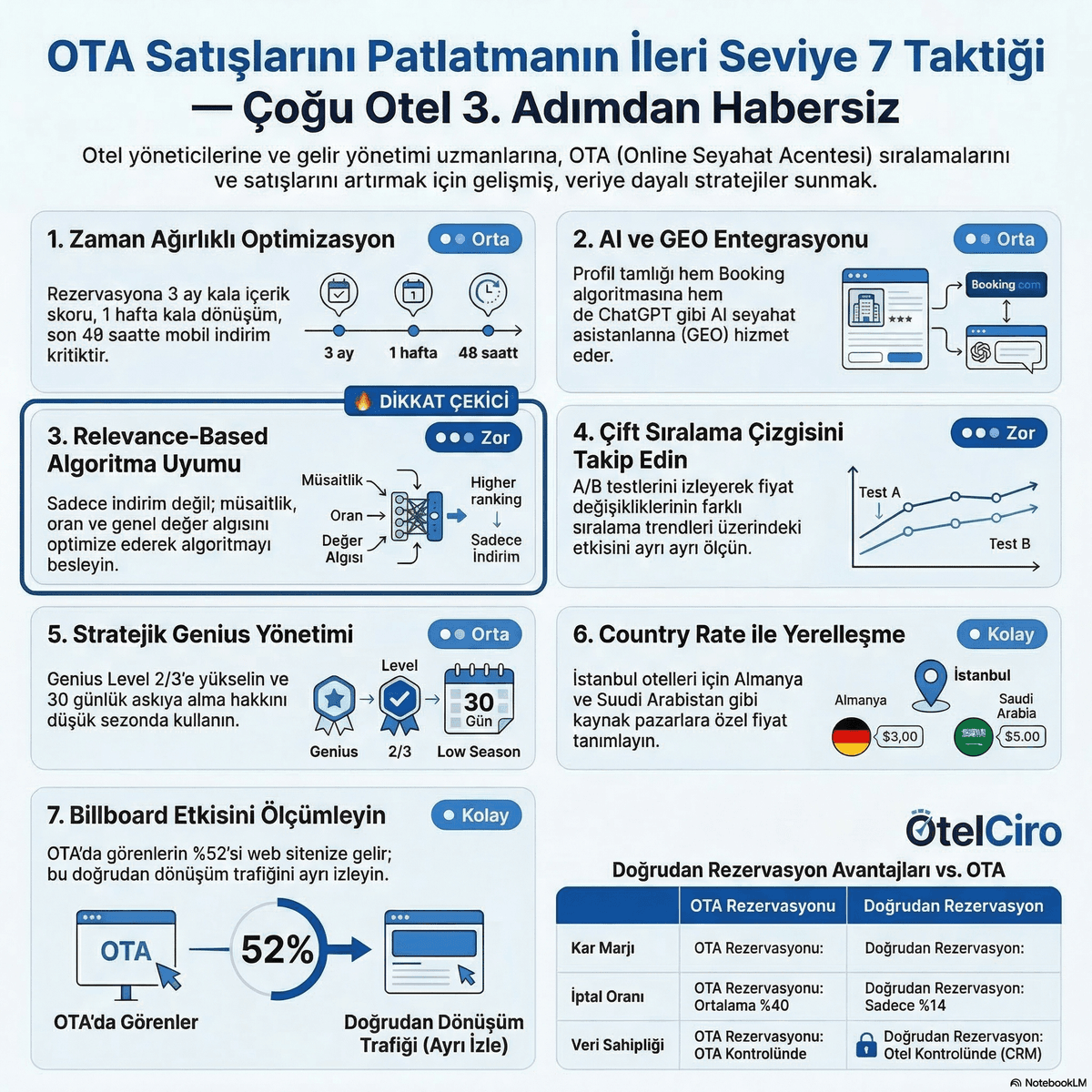
The vast majority of hotels get stuck at step three of OTA optimization: updating profile photos, editing descriptions, and adjusting prices. These are necessary but insufficient. In 2026, the hotels creating real differentiation on OTAs are those implementing advanced tactics.
Embed this image on your site
<a href="https://otelciro.com/en/news/ota-satislari-7-ileri-taktik">
  <img src="https://cdn.sanity.io/images/1la98t0z/production/0d8634b7f4d9033b08b65800012ec64261df48bc-1200x1200.png" alt="7 Advanced OTA Sales Optimization Tactics infographic" width="800" />
</a>
<p>Source: <a href="https://otelciro.com">OtelCiro</a> — AI Hotel Revenue Management</p>
In this guide, we present 7 advanced tactics designed for experienced revenue managers. Each includes a difficulty rating and expected impact assessment.
Related reading: How Booking.com's Content Score System Works — 90% of Hotels Don't Know This
Tactic 1: Time-Weighted Optimization (Medium Difficulty)
Timing Is Everything
Most hotels try to optimize all metrics simultaneously. However, the Booking.com algorithm weighs different signals in different time windows.
The correct timing strategy:
- 3 months before booking: Content Score optimization. Photo quality, description detail, facility information. The algorithm evaluates content quality during this period.
- 1 week before booking: Conversion rate optimization. Cancellation policy flexibility, payment options, instant confirmation.
- 48 hours before booking: Mobile discount activation. Last-minute searchers are 73% mobile users. Activating mobile discounts in this window can dramatically impact rankings.
This three-phase approach ensures you deploy resources most efficiently.
Embed this image on your site
<a href="https://otelciro.com/en/news/ota-satislari-7-ileri-taktik">
  <img src="https://cdn.sanity.io/images/1la98t0z/production/e5fddef69e0e93eb732aa4c4fea76bc1aa03ac99-1200x669.png" alt="Booking.com rate plan types and strategies" width="800" />
</a>
<p>Source: <a href="https://otelciro.com">OtelCiro</a> — AI Hotel Revenue Management</p>
Tactic 2: AI and GEO Integration (Medium Difficulty)
Your Profile Must Serve Both the Algorithm and AI
In 2026, your OTA profile does not work solely for the Booking.com algorithm. ChatGPT, Perplexity, and other AI assistants also pull data from OTA profiles.
Dual-direction optimization:
- Use structured descriptions: Clear information like "200m to Sultanahmet, free Wi-Fi, 24h reception"
- Add facility information in Q&A format (AI assistants prefer this format)
- State your unique value proposition in the first sentence
- Add local context: Reference points like "walking distance to Hagia Sophia"
In the SEO to GEO transformation process, your OTA profile must also adapt to this shift.
Related reading: Booking.com Connected Trip: New Threats and Opportunities for Hotels
Tactic 3: Relevance-Based Algorithm Alignment (High Difficulty)
Beyond Discounts: Value Perception Optimization
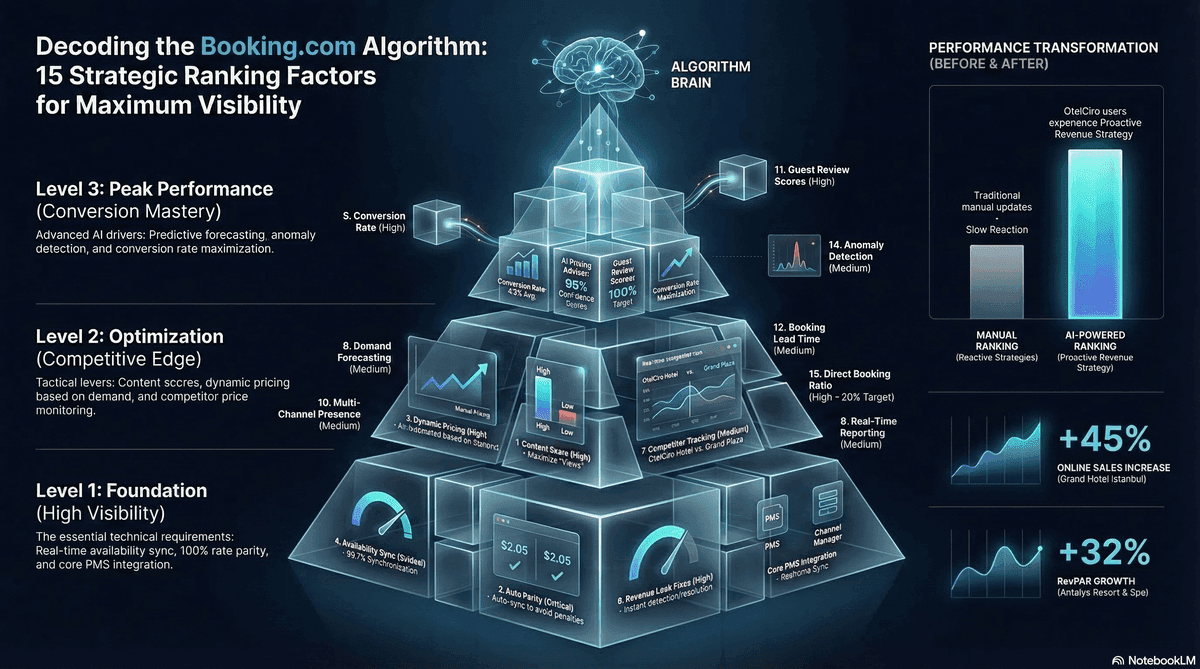
Price alone does not determine your ranking on Booking.com. The algorithm's core logic evaluates three fundamental signals:
- Availability: Inventory depth and restriction count
- Rate: Relative position compared to competitors
- Value Perception: Cancellation flexibility, breakfast-included options, bonus offers
Most hotels try to win rankings by simply lowering prices. But removing availability restrictions (relaxing minimum stay requirements, reducing close-out dates) and enhancing value perception (flexible cancellation + breakfast-included packages) is a far more sustainable strategy.
Implementation Steps
- Keep 95% of inventory open for the next 12 months
- Reduce minimum stay to 1 night on weekdays
- Extend free cancellation from 48 to 72 hours
- Offer breakfast-included package option for every room type
Embed this image on your site
<a href="https://otelciro.com/en/news/ota-satislari-7-ileri-taktik">
  <img src="https://cdn.sanity.io/images/1la98t0z/production/acae4d068a81e17758f103e608a54f376cdac169-1200x669.png" alt="Booking.com ranking algorithm optimization tips" width="800" />
</a>
<p>Source: <a href="https://otelciro.com">OtelCiro</a> — AI Hotel Revenue Management</p>
Tactic 4: Dual Ranking Line Tracking (High Difficulty)
A/B Test Logic for Ranking Analysis
Booking.com Extranet metrics show you a single ranking. But in reality, your hotel's ranking behaves differently across different segments.
Dual-line tracking system:
- Line A: Ranking trend during weeks when price changes were made
- Line B: Ranking trend during weeks when price was held constant but content/availability was changed
By comparing these two lines, you can identify the actual factor driving your rankings. In some markets, price is 80% influential, while in others, content changes create a greater impact.
Recording method: Every Monday morning, record your hotel's rank position using the same search parameters (dates, guest count, filters). Eight weeks of data creates a meaningful trend.
Related reading: Booking.com 2025 vs. 2026: 6 Rules Changed — Hotels Sticking to Old Strategies Are Losing
Tactic 5: Strategic Genius Management (Medium Difficulty)
Seasonal Genius Strategy
Keeping the Genius program at the same level year-round is inefficient from a revenue optimization perspective. The strategic approach:
- In high season: Activate Genius Level 2/3. During peak demand periods, Genius discounts maximize ranking impact. Occupancy is already high, so even discounted sales remain profitable.
- In low season: Use your 30-day suspension right. During low demand periods, Genius discounts erode your margins unnecessarily.
- In transition periods: Keep only Level 1 active. Maintain visibility with minimal discounting.
This strategy can increase net revenue by 8-12% on an annual basis.
Tactic 6: Country Rate Localization (Easy)
Source Market Strategy
Booking.com's country-based pricing feature is a powerful tool that many hotels leave unused.
Example strategy for Istanbul hotels:
| Source Market | Price Strategy | Rationale |
|---|---|---|
| Germany | +5-10% premium | High spending capacity, longer stays |
| Saudi Arabia | +10-15% premium | High ADR expectations, suite preference |
| Domestic (Turkey) | Standard rate | High price sensitivity |
| Russia | -5-10% discount | Volume-focused, early booking |
This strategy lets you optimize different revenue from different markets for the same room. Our OTA profile anatomy article provides details on source market analysis.
Tactic 7: Billboard Effect Measurement (Easy)
OTA Visibility's Contribution to Direct Sales
Billboard effect research shows that 52% of visitors who see a hotel on OTAs subsequently check the hotel's own website. This means a portion of OTA commission is effectively an "advertising cost."
Measurement method:
- Separate "booking.com" referral traffic in Google Analytics
- Record ranking changes on Booking.com weekly
- Compare direct website traffic and bookings during the same weeks
- Run correlation analysis: When OTA ranking rises, does direct sales increase too?
Direct Channel Advantages
The comparison between OTA and direct channels reveals a clear picture:
| Metric | OTA | Direct Channel |
|---|---|---|
| Profit margin | 75-82% (after commission) | 95-100% |
| Cancellation rate | 40% | 14% |
| Guest ownership | None | Full CRM access |
| Cross-sell opportunity | Limited | Unlimited |
| Repeat visit rate | 12% | 34% |
How to Implement These Tactics
Advanced OTA optimization requires the right tools and data infrastructure. Sustaining all 7 tactics through manual tracking is practically impossible.
OtelCiro's AI engine automates most of these tactics, giving revenue managers the freedom to focus on strategic decisions. With the channel manager, you can manage country-based pricing and Genius strategy from a centralized dashboard.
Conclusion: Advanced Players Win
Basic optimization is now table stakes. In 2026, real competitive advantage on OTAs belongs to hotels implementing these 7 advanced tactics systematically. From time-weighted optimization to AI integration, from billboard effect measurement to strategic Genius management — each tactic creates a cumulative effect.
Starting point: Begin with the two easiest tactics (Tactic 6 and 7), measure results, and gradually move to advanced tactics.
This content was prepared by the OtelCiro revenue management team using 2026 industry data.
![Booking.com Genius [2026]: Join, Leave or Optimize?](https://cdn.sanity.io/images/1la98t0z/production/fabaf8b8918404681f00de3f00e368aac91c9744-1200x1200.png?w=1920&q=50&auto=format&fit=max)