
![Voice Search for Hotels: Future of Booking [2026]](https://cdn.sanity.io/images/1la98t0z/production/8767dc5eeda140b181165bfc209e699c9b5ff698-1200x1200.png?w=1920&q=65&auto=format&fit=max)
Search Revolutions: From Typing to Talking
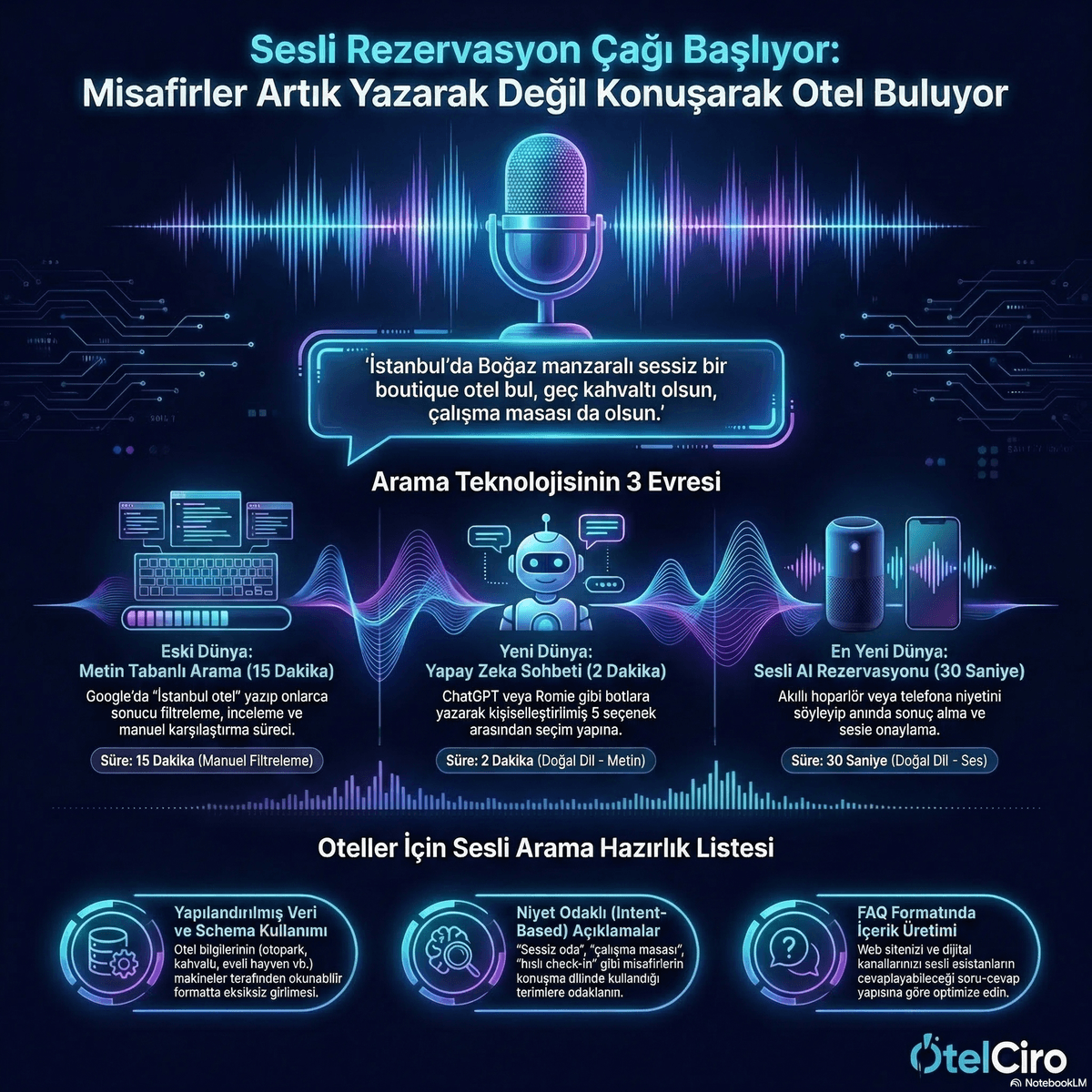
The evolution of hotel search is undergoing one of the fastest transformations in technology history. When we compare three generations of the search experience, the speed and depth of change are striking:
Embed this image on your site
<a href="https://otelciro.com/en/news/sesli-arama-otel-rezervasyon">
  <img src="https://cdn.sanity.io/images/1la98t0z/production/8767dc5eeda140b181165bfc209e699c9b5ff698-1200x1200.png" alt="Voice search and hotel reservation evolution infographic" width="800" />
</a>
<p>Source: <a href="https://otelciro.com">OtelCiro</a> — AI Hotel Revenue Management</p>
Generation 1: Text-Based Search (Traditional)
Duration: ~15 minutes
The guest types "Istanbul hotel" into Google. They scroll through dozens of results, apply filters, examine photos, read reviews. They compare across multiple tabs. Eventually they make a selection — or give up entirely.
During this process the guest:
- Visits an average of 8-12 different hotel pages
- Spends 15-25 minutes actively searching
- Experiences decision fatigue
- Often gravitates toward the top results (seeking quality assurance, not just proximity)
Generation 2: AI Chat Search (Current)
Duration: ~2 minutes
The guest asks an AI assistant like ChatGPT or Romie in natural language: "Recommend a quiet, clean boutique hotel in a central Istanbul location." The AI presents a few options with reasoning.
In our article examining ChatGPT's impact on commission-free reservations, we explored what this shift means for OTAs in detail.
Generation 3: Voice AI Reservation (Emerging)
Duration: ~30 seconds
The guest speaks to a smart speaker or phone: "Find me a quiet boutique hotel in Istanbul with a Bosphorus view, late breakfast, and a work desk."
The AI assistant instantly analyzes preferences, presents the best matches, and completes the reservation with a single confirmation.
From 15 minutes to 30 seconds. This is not merely a speed difference — it is an entirely new search paradigm.
Related reading: 2026 Hospitality Trend Map: 8 Mega Trends at a Glance
Why Voice Search Is Fundamentally Different from Text Search
The difference between voice and text search is not simply the input method. They are two fundamentally different forms of communication:
Text Search: Keyword-Oriented
Users adapt to the search engine's language:
- "istanbul hotel central quiet"
- "boutique hotel istanbul bosphorus view"
- "hotel spa hammam istanbul"
Short, fragmented, keyword-based expressions.
Voice Search: Conversational Language
Users employ natural speech:
- "We are going to Istanbul this weekend with my spouse, looking for a quiet place with a Bosphorus view"
- "We are traveling with kids, need a hotel with a pool that is family-friendly"
- "Find me a centrally located hotel where I can do a fast check-in for a business meeting"
This distinction fundamentally changes how hotels must structure their digital presence.
Embed this image on your site
<a href="https://otelciro.com/en/news/sesli-arama-otel-rezervasyon">
  <img src="https://cdn.sanity.io/images/1la98t0z/production/d36123c644ddc3c115453411f9a55397cf34970b-1200x2150.png" alt="AI-powered revenue management platform architecture" width="800" />
</a>
<p>Source: <a href="https://otelciro.com">OtelCiro</a> — AI Hotel Revenue Management</p>
3 Core Strategies to Prepare Hotels for the Voice Search Era
In the SEO to GEO transformation process, voice search optimization is a critical component. Three essential areas hotels must address:
1. Structured Data and Schema Markup
Voice assistants rely on structured data to understand hotel information. Your hotel's details must be in a machine-readable format:
Essential Schema Markup requirements:
- Hotel Schema: Name, address, star rating, price range
- Room Schema: Room types, capacity, bed configuration, view
- Amenity Schema: Wi-Fi, spa, restaurant, pool, parking
- Review Schema: Rating, review count, category-specific scores
- FAQ Schema: Frequently asked questions and answers
- Event Schema: Hotel events and meeting capabilities
Without schema markup, voice assistants cannot identify your hotel. In our Google Hotels visibility guide, we explained this technical infrastructure in detail.
Practical example:
When a voice assistant receives the query "room with Bosphorus view," your hotel matches if your schema markup contains "view": "Bosphorus". Without it, you are digitally invisible even if you physically have the view.
2. Intent-Based Descriptions
Traditional hotel descriptions are filled with marketing jargon:
- "Unparalleled comfort experience"
- "Rooms adorned with luxurious touches"
- "An unforgettable stay"
These phrases are useless for voice search. Instead, hotels should use language that mirrors how guests actually speak:
| Marketing Jargon | Intent-Based Phrase |
|---|---|
| "Unparalleled comfort" | "Quiet room, queen-size bed" |
| "Luxury amenities" | "Work desk, fast Wi-Fi, minibar" |
| "Premium location" | "5-minute walk to Taksim Square" |
| "Unique gastronomy" | "Late breakfast, Turkish breakfast, gluten-free options" |
| "Wellness experience" | "Hammam, massage, sauna — open daily" |
Voice search algorithms match far more effectively with intent-based phrases. When a guest says "a quiet room with a work desk," those exact words should appear in your hotel's descriptions.
3. FAQ-Format Content Optimization
Voice assistants frequently pull their answers from question-and-answer formatted content. A comprehensive FAQ section on your hotel website dramatically increases voice search visibility:
Effective FAQ examples:
-
Q: Does the hotel include free breakfast? A: Yes, we offer an open-buffet Turkish breakfast daily from 07:00 to 10:30. Weekend brunch extends until 11:00.
-
Q: Do you offer airport transfers? A: Yes, 24-hour transfer service from Istanbul Airport is available. One-way is €35, round-trip is €60.
-
Q: Do you accept pets? A: Pets under 10 kg are welcome. The additional fee is €15 per night.
-
Q: What are check-in and check-out times? A: Check-in is at 14:00, check-out at 12:00. Early check-in (11:00) and late check-out (15:00) are available upon request, subject to availability.
This format provides structured answers that voice assistants can directly extract and present.
Related reading: 2026 Hospitality Vision: Smart Transformation Through Artificial Intelligence
Conversational SEO: The New Rules
Voice search optimization demands different rules from traditional SEO:
Long-Tail Keywords
In text search, "Istanbul hotel" suffices. In voice search:
- "Family-friendly hotel in Istanbul with a pool"
- "Quiet boutique hotel near Sultanahmet"
- "Hotel with Bosphorus view and breakfast included"
These long-tail phrases must sit at the center of the content strategy.
Local Language and Speech Patterns
Voice search uses local language and conversational patterns. In Turkish voice search:
- Instead of formal "Oteliniz ne kadar?" → natural "Bir gece kaç para?"
- Instead of "Rezervasyon yapabilir miyim?" → "Yer var mı?"
Content must reflect the guest's natural speech patterns — and this applies to every language your hotel targets.
Question-Based Content Structure
The vast majority of voice queries are in question format. Structure your content accordingly:
- What: "What can we do in this area?"
- Where: "Where is the nearest restaurant?"
- How: "How do I get to the hotel?"
- How much: "How much is a spa massage?"
- When: "When is the pool open?"
Embed this image on your site
<a href="https://otelciro.com/en/news/sesli-arama-otel-rezervasyon">
  <img src="https://cdn.sanity.io/images/1la98t0z/production/da74ada1fc52f9117feba80e7a351a475db19a5f-1200x2150.png" alt="OtelGPT AI hotel assistant features" width="800" />
</a>
<p>Source: <a href="https://otelciro.com">OtelCiro</a> — AI Hotel Revenue Management</p>
The Convergence of Voice Search and Agentic AI
The next stage of voice search is not just delivering information — it is taking action. With the MCP AI revolution, voice assistants can now:
- Search for and recommend hotels
- Check availability
- Present price comparisons
- Complete the reservation
- Process the payment
This is fundamentally changing the role of AI in hospitality. A guest can complete the entire search-compare-book journey in 30 seconds with a single voice command.
Opportunity and Risk for Hotels
This transformation carries enormous opportunity for prepared hotels and serious risk for those unprepared:
Opportunity:
- Hotels featured in voice search results can receive direct bookings — bypassing OTA commissions
- Hotels with strong structured data infrastructure rank higher in AI recommendations
- Intent-based content drives higher conversion rates
Risk:
- Hotels not optimized for voice search become invisible to next-generation guests
- Missing schema markup means AI assistants cannot identify you
- Marketing jargon-heavy content fails to match voice search algorithms
Related reading: 2026 Travel Trends: The AI Assistant Era Begins
Technical Infrastructure Checklist
A technical checklist to prepare your hotel for the voice search era:
Schema Markup
- Hotel schema (name, address, star rating, price range)
- Room schema (types, capacity, features)
- LocalBusiness schema (operating hours, contact)
- FAQ schema (minimum 15-20 Q&A pairs)
- Review schema (aggregate rating, review count)
- Offer schema (packages, promotions)
Content Optimization
- Intent-based room descriptions (no jargon)
- FAQ page (minimum 30 Q&A pairs)
- Local information content (neighborhood, transportation, venues)
- Conversational language blog posts
- Detailed feature list for each room type
Technical SEO
- Page speed optimization (Core Web Vitals)
- Mobile compatibility (responsive design)
- HTTPS security
- Up-to-date XML sitemap
- Hreflang tags (for multilingual sites)
Industry Examples: Hotels Getting Voice Search Right
Hotels that have successfully implemented voice search optimization are achieving tangible results:
Boutique Hotel Example
An Istanbul boutique hotel rewrote all room descriptions to be intent-based and added comprehensive FAQ schema. Within 6 months:
- Google featured snippet appearances increased by 340%
- Direct website traffic rose 45%
- Ranked in the top 3 of voice assistant recommendations
Chain Hotel Example
A hotel chain group applied standardized schema markup across all properties and optimized FAQ content in 5 languages:
- Organic search traffic increased 28%
- International guest ratio rose 18%
- OTA dependence decreased 12%
The Future of Voice Search: 2026-2030
Voice search technology is advancing rapidly. In the coming years:
- Multilingual voice search: Guests ask in their own language, AI can recommend hotels in any language
- Contextual understanding: AI factors in travel history, preferences, and current location for recommendations
- Proactive suggestions: "It is going to rain in Istanbul tomorrow — shall I suggest a hotel with indoor activities?"
- Voice-completed reservations: Search → compare → book → pay in a single spoken conversation
Prepare Your Hotel for the Future
Voice search is opening a new era in hospitality. The shift from 15-minute manual searches to 30-second voice commands is not just a technology change — it is a fundamental transformation of guest expectations.
OtelCiro's AI engine prepares your hotel's digital presence for the voice search era. Through structured data infrastructure, intent-based content optimization, and an AI-compatible hotel profile, it ensures your hotel is found and recommended by voice assistants. Manage all your digital channels from a single point with our operations tools.
Start thinking about how guests speak about their needs — not how they type them. Contact us and let us prepare your hotel for the voice search revolution.
![Hotel Tech Migration: Digital Roadmap [2026]](https://cdn.sanity.io/images/1la98t0z/production/50a2b86a9575f2987a5b57d8743f5a6f652fba79-1200x670.png?w=1920&q=50&auto=format&fit=max)
![AI Revenue Forecasting for Hotels: 96% Accuracy [2026]](https://cdn.sanity.io/images/1la98t0z/production/d80e97054b7f8f32d0a70fcb817542a82e585ac4-1200x1200.png?w=1920&q=50&auto=format&fit=max)
![[2026] Travel Trends: The AI Assistant Era Begins](https://cdn.sanity.io/images/1la98t0z/production/83f63d085ace864d32cad66bbd019cc5e62d1461-1200x1200.png?w=1920&q=50&auto=format&fit=max)