
![8 Mega Hospitality Trends Shaping [2026]](https://cdn.sanity.io/images/1la98t0z/production/0eb1e5bd7d2acac7c57d46ac18f1cb2a85f15bb7-1200x1200.png?w=1920&q=65&auto=format&fit=max)
2026: The Year of Hospitality Transformation
2026 stands out as one of those rare years when multiple paradigm shifts converge simultaneously in the hospitality industry. Digitalization, artificial intelligence, evolving guest behaviors, and platform dynamics are all reshaping the sector at the same time. Here are the 8 mega trends defining 2026.
Related reading: 2026 Travel Trends: The AI Assistant Era Begins
Trend 1: Direct Bookings Are Eroding OTA Market Share
OTA share of total bookings has dropped from 30% to 22%. Hotels' direct booking channels are gaining strength, driven by several factors:
- ChatGPT and AI assistants are directing travelers to hotel booking engines
- Hotels are increasing their metasearch investments
- Loyalty programs are pulling guests toward direct channels
- Travelers are increasingly aware that OTA commissions inflate room rates
Within the 2026 hospitality vision framework, a direct booking strategy is no longer a nice-to-have — it is a survival imperative.
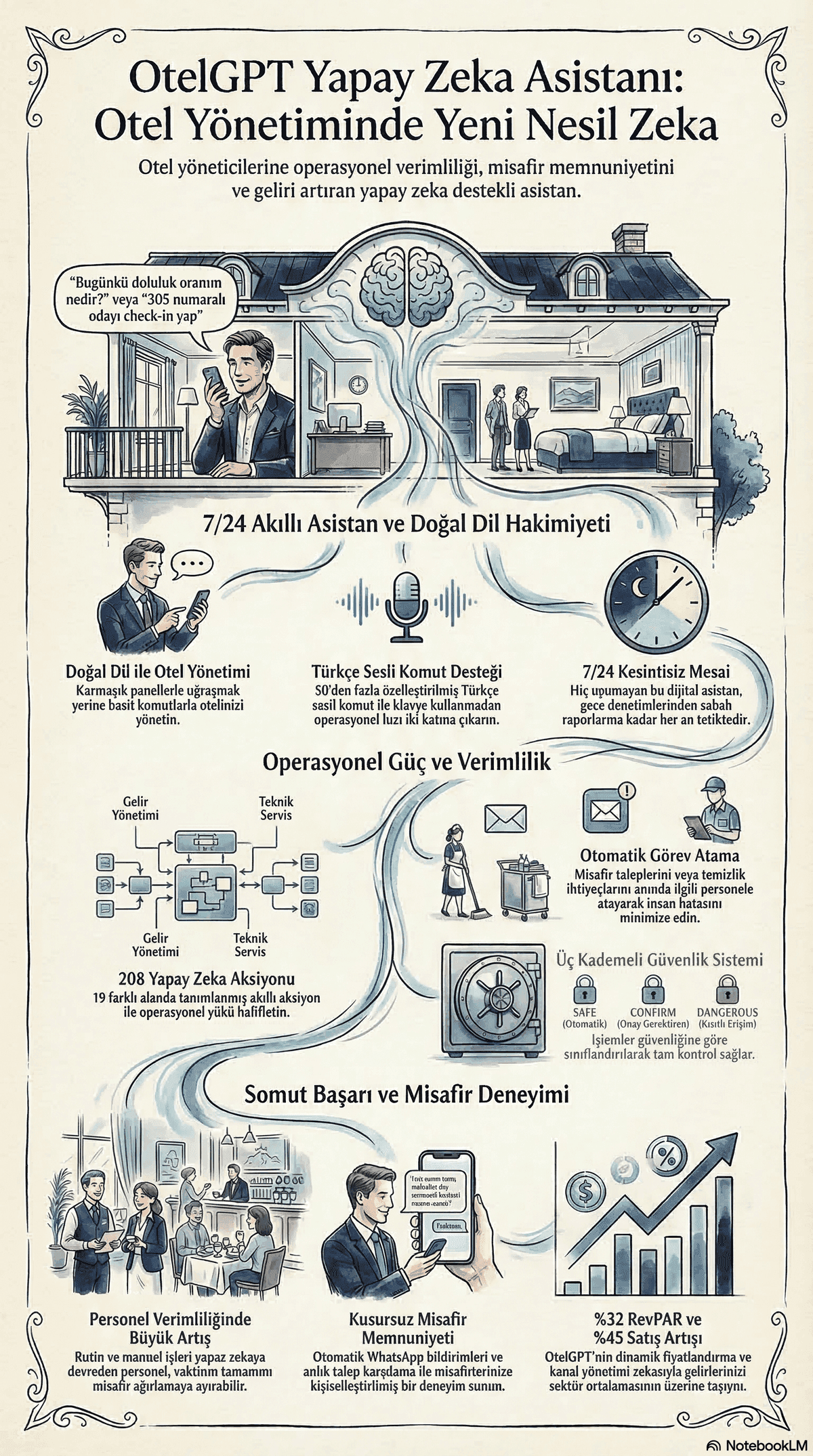
Embed this image on your site
<a href="https://otelciro.com/en/news/2026-8-mega-trend">
  <img src="https://cdn.sanity.io/images/1la98t0z/production/da74ada1fc52f9117feba80e7a351a475db19a5f-1200x2150.png" alt="OtelGPT AI hotel assistant features" width="800" />
</a>
<p>Source: <a href="https://otelciro.com">OtelCiro</a> — AI Hotel Revenue Management</p>
Trend 2: The Mobile Era — 75% of Traffic Is on Smartphones
Hotel searches and bookings from mobile devices have reached 75% of total traffic. This figure was 60% in 2024 and 52% in 2023. At this growth rate, the 80% threshold will be crossed by 2027.
Mobile optimization is no longer optional — it is mandatory:
- Mobile-friendly photos that load quickly at high quality
- A booking process completable on a single screen
- Mobile payment integrations (Apple Pay, Google Pay)
- Page load times under 3 seconds
Related reading: AI in Hospitality: How Artificial Intelligence is Transforming Hotels
Trend 3: AI Search Delivers 14.2% Conversion
AI-powered searches deliver a conversion rate of 14.2% — compared to just 2.8% from traditional search engine traffic. That is nearly a 5x difference. The reason is straightforward: AI understands the guest's needs and delivers personalized recommendations. When a traveler says "family-friendly hotel in Istanbul with pool and Bosphorus view," AI presents 3-5 perfectly matched options instead of hundreds of irrelevant results.
The ChatGPT commission-free booking model combines this high conversion rate with zero commission, creating an unparalleled opportunity for hotels.
Embed this image on your site
<a href="https://otelciro.com/en/news/2026-8-mega-trend">
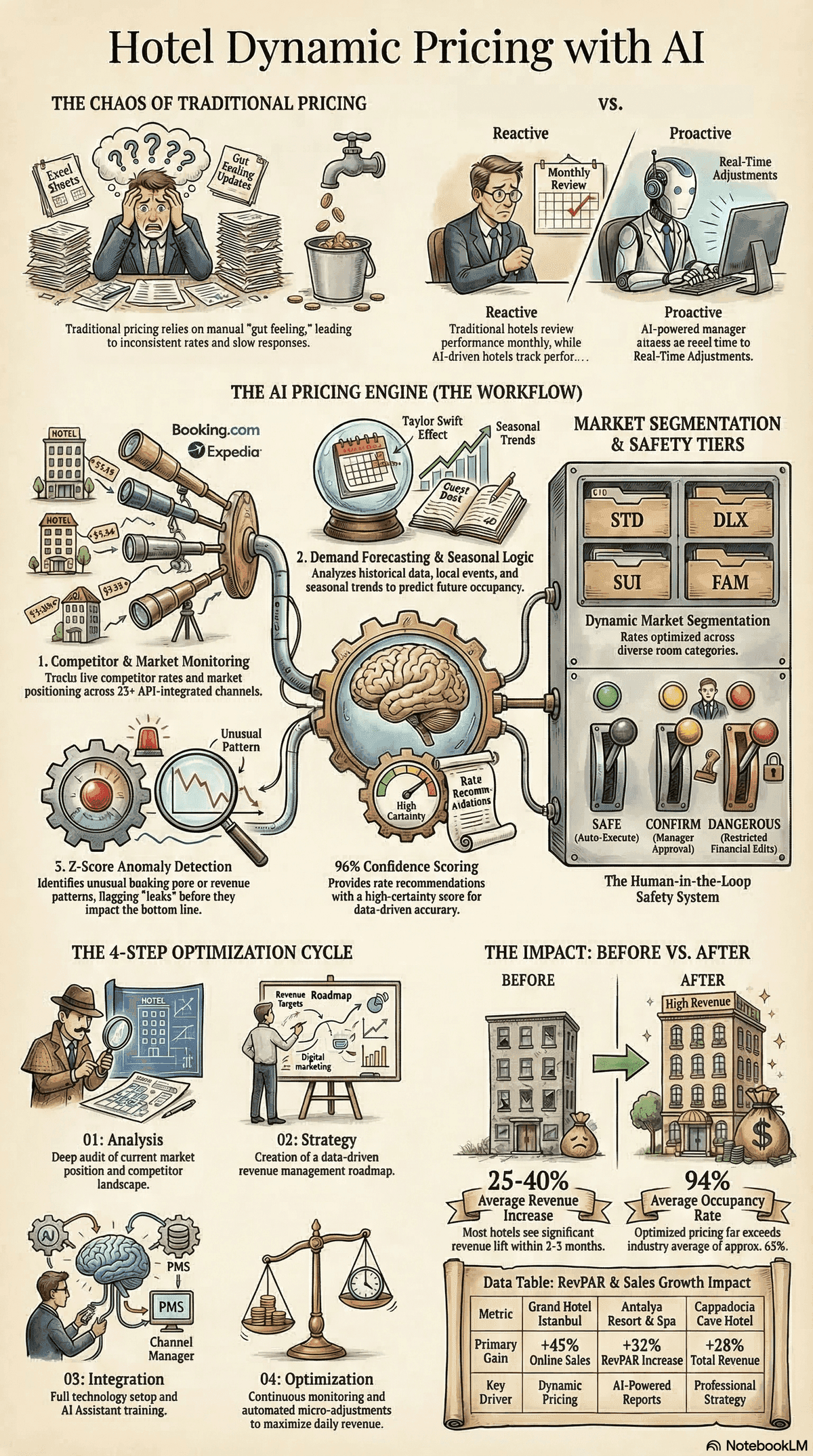
  <img src="https://cdn.sanity.io/images/1la98t0z/production/e41b7ac3104ad8488f70d83e78d4135e4a401e88-1200x2150.png" alt="AI-driven hotel dynamic pricing model" width="800" />
</a>
<p>Source: <a href="https://otelciro.com">OtelCiro</a> — AI Hotel Revenue Management</p>
Trend 4: ChatGPT — The Zero Commission Revolution
With 800 million users, ChatGPT offers a 0% commission model for hotel bookings. This development strikes at the very foundations of the OTA business model. When ChatGPT directs a traveler to a hotel's own booking engine, it charges no intermediary fee.
Comparison:
- Booking.com: 15-25% commission
- Expedia: 15-25% commission
- ChatGPT: 0% commission
For a 100-room hotel, annual commission savings could range between $5,000 and $15,000 or more, depending on volume.
Related reading: 2026: The MCP Revolution — AI Integration for Hotels
Trend 5: Dynamic Scoring Has Replaced Static Rankings
Led by Booking.com, all major OTAs have transitioned from static ranking algorithms to dynamic scoring systems. Algorithms that once updated every 8 months now operate on 15-day cycles — and in some cases, in real time.
What this means for hoteliers:
- Past performance alone is no longer sufficient
- Metrics from the last 30 days drive rankings
- Continuous optimization is required
- Real-time data monitoring is critically important
Trend 6: Booking.com Surpassed Google — 26% vs. 21%
As the starting point for hotel searches, Booking.com (26%) has overtaken Google (21%). This is the most significant shift in search behavior in the last 20 years.
The implications:
- Booking.com on-platform optimization is now as important as Google SEO
- Content Score is as critical as meta descriptions
- Booking.com photos are as valuable as Google Images
- Platform advertising budgets can be as efficient as Google Ads
Trend 7: The Standard Room Era Is Ending — 58% Prefer Premium
58% of guests now choose premium categories over standard rooms. Suites, deluxe rooms, sea-view rooms, and rooms with personalized services are experiencing a demand surge.
Drivers behind this trend:
- Post-pandemic shift toward "experience-first" travel
- Remote work fueling longer stays
- Social media influence (Instagrammable rooms)
- Growing purchasing power in the premium segment
The takeaway for hotels: diversify your room portfolio, upgrade standard rooms to premium categories, and raise ADR through room differentiation.
Trend 8: OTA Optimization Outweighs Traditional SEO
In 2026, while traditional SEO remains relevant for hotels, OTA optimization delivers a higher ROI. The reason is simple: the majority of travelers now begin their hotel search on OTA platforms.
OTA optimization includes:
- Booking.com Content Score management
- Expedia package and pricing strategy
- Google Hotels free listing optimization
- Review management and response strategy
- Dynamic pricing and rate parity
- Supplying data to AI platforms (MCP)
Where the 8 Trends Converge
These 8 trends are not independent of each other — they all converge at a single point: data-driven, AI-native revenue management. The rise of mobile traffic, the growth of AI search, dynamic scoring, and platform diversity all demand that hotels perform real-time data analysis and multi-channel optimization.
Managing all 8 trends simultaneously through manual methods is simply not feasible. AI-powered revenue management platforms enable hotels to tame this complexity and turn it into competitive advantage.
Frequently Asked Questions
Do all of these trends affect every type of hotel?
Yes, but the degree of impact varies. For city hotels, ChatGPT and Booking.com optimization are more critical, while for resort properties, premium room demand and the mobile trend carry more weight. Every hotel should prioritize based on its own segment.
Does adapting to these trends require a large budget?
No. Most of these trends require strategy, not budget. Content Score optimization, mobile discount settings, and review management can be implemented at no additional cost. For MCP integration and AI optimization, platforms like OtelCiro offer cost-effective solutions.
How will these trends evolve in 2027?
AI's share will grow further, mobile will surpass 80%, and direct booking share will approach 30%. However, the biggest shift will come from voice search and wearable devices — commands like "Hey Siri, book me a hotel in Istanbul for tomorrow" will become commonplace.
To build a revenue management strategy aligned with the 8 mega trends of 2026, partner with OtelCiro. Manage all trends from a single dashboard with our AI-native platform.
![Voice Search for Hotels: Future of Booking [2026]](https://cdn.sanity.io/images/1la98t0z/production/8767dc5eeda140b181165bfc209e699c9b5ff698-1200x1200.png?w=1920&q=50&auto=format&fit=max)
![Hotel Tech Migration: Digital Roadmap [2026]](https://cdn.sanity.io/images/1la98t0z/production/50a2b86a9575f2987a5b57d8743f5a6f652fba79-1200x670.png?w=1920&q=50&auto=format&fit=max)
![AI Revenue Forecasting for Hotels: 96% Accuracy [2026]](https://cdn.sanity.io/images/1la98t0z/production/d80e97054b7f8f32d0a70fcb817542a82e585ac4-1200x1200.png?w=1920&q=50&auto=format&fit=max)