
![Hotel Tech Migration: Digital Roadmap [2026]](https://cdn.sanity.io/images/1la98t0z/production/50a2b86a9575f2987a5b57d8743f5a6f652fba79-1200x670.png?w=1920&q=65&auto=format&fit=max)
The Hotel Technology Migration Has Begun
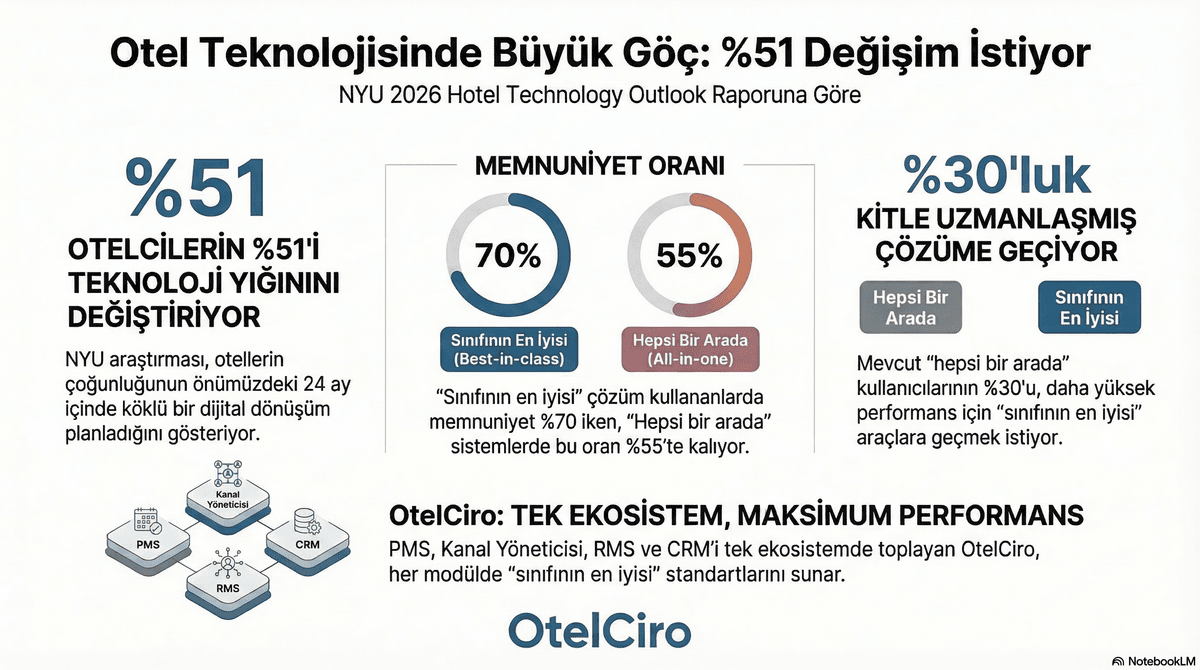
NYU's 2026 Hotel Technology Outlook Report reveals a quiet but powerful earthquake in the industry: 51% of hotels plan to change their technology infrastructure within the next 24 months. This means one in every two hotels is dissatisfied with their current PMS, channel manager, or revenue management system.
Embed this image on your site
<a href="https://otelciro.com/en/news/otel-teknoloji-dijital-donusum-2026">
  <img src="https://cdn.sanity.io/images/1la98t0z/production/50a2b86a9575f2987a5b57d8743f5a6f652fba79-1200x670.png" alt="Hotel technology great migration 51 percent want change infographic" width="800" />
</a>
<p>Source: <a href="https://otelciro.com">OtelCiro</a> — AI Hotel Revenue Management</p>
This migration is not a random trend. Post-pandemic digitalization pressure, AI becoming an operational necessity, and fundamental shifts in guest expectations are forcing hotels to re-evaluate their technology infrastructure.
The role of AI in hospitality is no longer a "nice to have" — it's a survival issue. And the vast majority of existing technology infrastructure is not prepared for this new reality.
Related reading: 2026 Hospitality Vision: Smart Transformation Through Artificial Intelligence
"Best-in-Class" vs. "All-in-One": The Great Debate
The most critical question facing hotels planning a technology migration is: One platform for everything, or the best tool for each function?
All-in-One Platforms
Definition: PMS, channel manager, RMS, CRM, website — all from a single vendor.
Advantages:
- Single vendor relationship, single invoice
- Guaranteed inter-module integration
- Training and support from one source
- Initial cost is generally lower
Disadvantages:
- Each module is "good enough" but none is "the best"
- Slow innovation pace (large monolithic structure)
- If you're unhappy with one module, you must change everything
- High vendor lock-in risk
Satisfaction rate: 55%
Best-in-Class Solutions
Definition: Choose the best tool for each area and integrate them: A for PMS, B for channel manager, C for RMS.
Advantages:
- Highest performance in each module
- Fast innovation (specialized teams)
- Easy to swap out a single module
- Flexibility and customization capacity
Disadvantages:
- Multi-vendor relationship management
- Integration issue risks
- Total cost can be higher
- Data consistency challenges
Satisfaction rate: 70%
What the Numbers Say
The gap is striking: hotels using best-in-class solutions report 70% satisfaction, while all-in-one platform users sit at 55%. More importantly, 30% of all-in-one users want to switch to best-in-class tools.
These data points show that hoteliers are trending toward choosing "performance" over "convenience."
Embed this image on your site
<a href="https://otelciro.com/en/news/otel-teknoloji-dijital-donusum-2026">
  <img src="https://cdn.sanity.io/images/1la98t0z/production/213b3b1fc5afe459c03c8d691a6983147d790b17-1200x2150.png" alt="MCP Server AI integration architecture" width="800" />
</a>
<p>Source: <a href="https://otelciro.com">OtelCiro</a> — AI Hotel Revenue Management</p>
The OtelCiro Approach: One Ecosystem, Maximum Performance
OtelCiro offers a third path that combines the best aspects of both approaches: "One Ecosystem, Maximum Performance."
Philosophy
- Each module (PMS, Channel Manager, RMS, CRM) is developed to best-in-class standards
- All modules operate within a single ecosystem — no integration issues
- Data flows from a single layer — consistency and real-time synchronization
- Use the modules you want, skip the ones you don't — modular flexibility
Practical Differences
| Criteria | All-in-One | Best-in-Class (Separate) | OtelCiro Ecosystem |
|---|---|---|---|
| Module quality | Medium | High | High |
| Integration | Easy | Difficult | Easy |
| Flexibility | Low | High | High |
| Data consistency | Good | Risky | Excellent |
| Innovation speed | Slow | Fast | Fast |
| Total cost of ownership | Low-Medium | High | Medium |
This approach aligns perfectly with the agentic AI 2026 vision: each module is independently intelligent, but exponentially powerful when working together.
Related reading: 2026 Travel Trends: The AI Assistant Era Begins
Technology Migration Roadmap: 6-Phase Plan
Changing technology infrastructure is one of the most stressful operational decisions for hotels. Here is a proven 6-phase migration plan:
Phase 1: Situation Analysis (2-4 Weeks)
Objectively assess your current state:
- Which modules meet your needs and which don't?
- Where are the operational bottlenecks? (Manual data entry, reporting delays, integration errors)
- What is your team's technology proficiency level?
- What are the existing contract and data migration conditions?
Output: Technology needs matrix and prioritization
Phase 2: Market Research (3-4 Weeks)
Systematically evaluate alternatives:
- Watch demos of at least 3-5 different solutions
- Visit reference hotels or collect online references
- Use comparison frameworks like the AI race scorecard
- Calculate total cost of ownership (TCO) over a 3-year horizon
Phase 3: Data Cleanup and Preparation (4-6 Weeks)
The most critical pre-migration phase:
- Clean guest data (deduplication, missing fields)
- Export historical data
- Document rate plan and room type structure
- Map integration points (OTA connections, payment systems, POS)
Phase 4: Parallel Operation (4-8 Weeks)
Old and new systems run simultaneously:
- Data transfer to the new system
- Team training (hands-on, with real scenarios)
- Testing critical workflows in the new system
- Comparing reports (old vs. new)
Phase 5: Go-Live and Stabilization (2-4 Weeks)
Go-live strategy:
- Choose low season if possible
- Ensure 24/7 support access
- Increase manual check intensity for the first 2 weeks
- Hold daily check-in meetings
Phase 6: Optimization (Ongoing)
Go-live is the beginning, not the end:
- First 90 days performance benchmarks
- Gradual activation of automation rules
- Exploration of advanced features
- ROI measurement and reporting
Embed this image on your site
<a href="https://otelciro.com/en/news/otel-teknoloji-dijital-donusum-2026">
  <img src="https://cdn.sanity.io/images/1la98t0z/production/e7bafa9293f887b24a2d4d0d26684221705d0113-1200x669.png" alt="Cloud-based PMS advantages and comparison" width="800" />
</a>
<p>Source: <a href="https://otelciro.com">OtelCiro</a> — AI Hotel Revenue Management</p>
7 Critical Questions for Technology Selection
Questions every hotel manager must ask before a technology change:
-
Is the API open? An open API is mandatory for future integrations. Closed systems force another migration in 3-5 years.
-
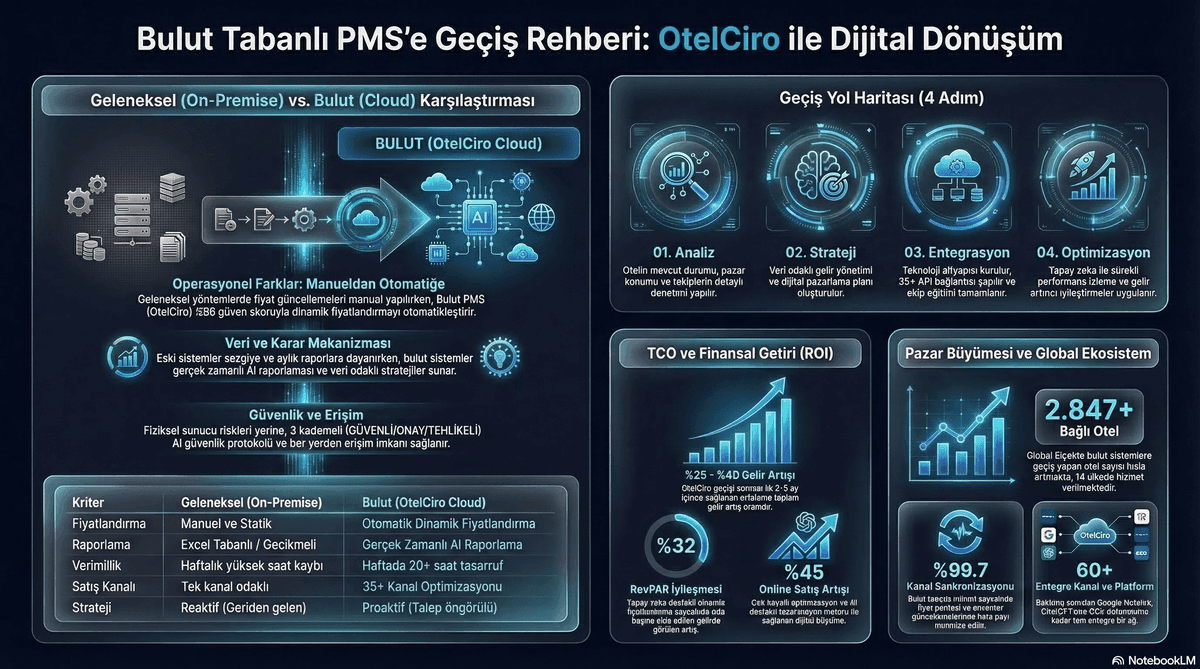
Is it cloud-based? On-premise systems are outdated in 2026. Cloud = access from anywhere, automatic updates, scalability.
-
Does it have AI capabilities? A PMS or RMS without AI support will become obsolete within 2-3 years. Don't miss the GDS to AI transformation momentum.
-
Is it mobile-friendly? Both the management dashboard and guest interface should be mobile-first.
-
Is data migration guaranteed? Complete and secure transfer of your existing data should be written into the contract.
-
What is the training and support model? Online training, local language support, and SLA guarantees are critical.
-
Is the pricing model transparent? Hidden fees, per-transaction charges, mandatory modules — line items that inflate TCO should be clear.
Hotel Robots: 2026's Surprise Technology
Technology migration isn't just about software. In 2026, hotel robots are opening a new chapter in operational efficiency.
Linen and Waste Management Robots
- 30% reduction in walking distance: Staff physical burden decreases significantly
- 24/7 non-stop logistics: Robots operate even during night shifts
- Lower error rates: Loss/damage rates from manual transport drop to minimums
- 30% more rooms per hour: Robotic systems shorten room turnaround time
Human + Robot Hybrid Model
Robot technology doesn't replace staff — it empowers them:
- Robots: Physical transport, repetitive logistics tasks
- Staff: Guest relations, personalized service, problem-solving
- Result: Staff satisfaction increases (physical burden decreases), guest satisfaction increases (more face-to-face attention)
The Turkey Market and Robot Pilots
Rising staff costs in Turkey are making hotel robots economically attractive:
- Istanbul's large hotels: Pilot programs have launched in 200+ room properties
- ROI calculation: Robot investment pays for itself in 18-24 months (staff cost savings)
- Guest perception: An additional attraction point for tech-savvy guests
- Operational metrics: Lower staff fatigue, lower error rates, faster room delivery
Alignment with 2026's Mega Trends
Among 2026's 8 mega trends, technology migration is the enabler of all other trends:
- AI revenue management: A modern AI engine requires modern infrastructure
- Channel optimization: Real-time price synchronization requires a robust channel manager
- Guest experience personalization: CRM and PMS integration is critical
- Sustainability: Energy and resource management data feeds from smart infrastructure
Legacy technology cannot fully align with any of these trends.
5 Mistakes to Avoid for a Successful Migration
1. The "Big Bang" Approach
Changing everything at once can end in disaster. Gradual migration minimizes risk.
2. Underestimating Team Training
No matter how good the technology, if the team using it is inadequately trained, performance stays low. Allocate at least 15-20% of the technology budget to training.
3. Skipping Data Cleanup
The "garbage in, garbage out" principle applies here. A new system built on dirty data won't outperform the old one.
4. Deciding on Price Alone
The cheapest solution may be the most expensive over a 3-year TCO. Hidden costs, integration fees, and scaling costs should not be ignored.
5. Not Considering Future Needs
A system chosen for today's needs may become insufficient within 2-3 years. AI capability, API openness, modularity — invest in the future.
Technology Migration ROI Calculation Framework
To support the migration decision with concrete data:
Cost Items
- New system license/subscription fees
- Data migration costs
- Training costs
- Parallel operation period costs
- Integration costs
Return Items
- Operational efficiency gains (staff hour savings)
- Revenue increase (better pricing, channel optimization)
- Guest satisfaction improvement (repeat visits, positive reviews)
- Reporting and decision-making speed
- Error rate reduction
Typical ROI Timeline
- 3-6 months: Break-even point (operational efficiency gains)
- 6-12 months: Positive ROI (revenue increase effect)
- 12-24 months: Full ROI (all return items mature)
Conclusion: The Cost of Delaying Migration
The 51% figure in the NYU report shows the industry's awareness. But the gap between awareness and action determines competitive advantage. Among the 5 historic turning points, digital transformation is perhaps the most urgent.
Postponing technology migration to 2027 doesn't just mean losing one year — it means delaying all opportunities in AI revenue management, real-time channel optimization, and personalized guest experiences.
OtelCiro's smart PMS ecosystem delivers best-in-class standard modules while maintaining the integrity of a single ecosystem. PMS, channel manager, RMS, and CRM — each at the highest quality, all in perfect harmony. Plan your technology migration right — reach out to us.
![Voice Search for Hotels: Future of Booking [2026]](https://cdn.sanity.io/images/1la98t0z/production/8767dc5eeda140b181165bfc209e699c9b5ff698-1200x1200.png?w=1920&q=50&auto=format&fit=max)
![AI Revenue Forecasting for Hotels: 96% Accuracy [2026]](https://cdn.sanity.io/images/1la98t0z/production/d80e97054b7f8f32d0a70fcb817542a82e585ac4-1200x1200.png?w=1920&q=50&auto=format&fit=max)
![[2026] Travel Trends: The AI Assistant Era Begins](https://cdn.sanity.io/images/1la98t0z/production/83f63d085ace864d32cad66bbd019cc5e62d1461-1200x1200.png?w=1920&q=50&auto=format&fit=max)