

Hospitality's Silent Crisis: Cancellations and No-Shows
Cancellations and no-shows have been quietly growing into one of the hotel industry's most damaging problems — yet most managers never grasp the full scale. Globally, this leakage exceeds $6 billion per year. That figure dwarfs the total revenue of many hotel chains.

Embed this image on your site
<a href="https://otelciro.com/en/news/otel-iptal-noshow-cozumleri">
  <img src="https://cdn.sanity.io/images/1la98t0z/production/a94ec4d2e58ec526503a81b3bd9aca86832a6b01-1200x1200.png" alt="Hotel cancellation and no-show epidemic 6 billion dollar global loss infographic" width="800" />
</a>
<p>Source: <a href="https://otelciro.com">OtelCiro</a> — AI Hotel Revenue Management</p>
To put it in concrete terms: consider a 50-room hotel in Istanbul. With just 5 no-shows per week, the net revenue loss by year-end reaches €45,000. That is a significant chunk of the hotel's annual payroll budget.
Can these losses be prevented? Yes — but not with traditional methods. The answer lies in AI-powered predictive modeling and smart overbooking strategies.
Related reading: Dynamic vs. Static Pricing: How the Taylor Swift Effect Can Skyrocket Your Revenue
OTA vs Direct Bookings: Why Cancellation Rates Differ So Dramatically
Understanding where cancellations originate is the first step toward solving them. The data tells a striking story:
- OTA channel cancellation rate: 45%
- Direct booking cancellation rate: 10-18%
This gap is no coincidence. Free cancellation policies have become virtually standard on OTAs. Guests have developed the habit of booking multiple hotels and deciding at the last minute. In our analysis of Booking.com's hidden penalties, we explored the cost of this dynamic from the hotel's perspective in detail.
How Price Increases Drive Cancellation Risk
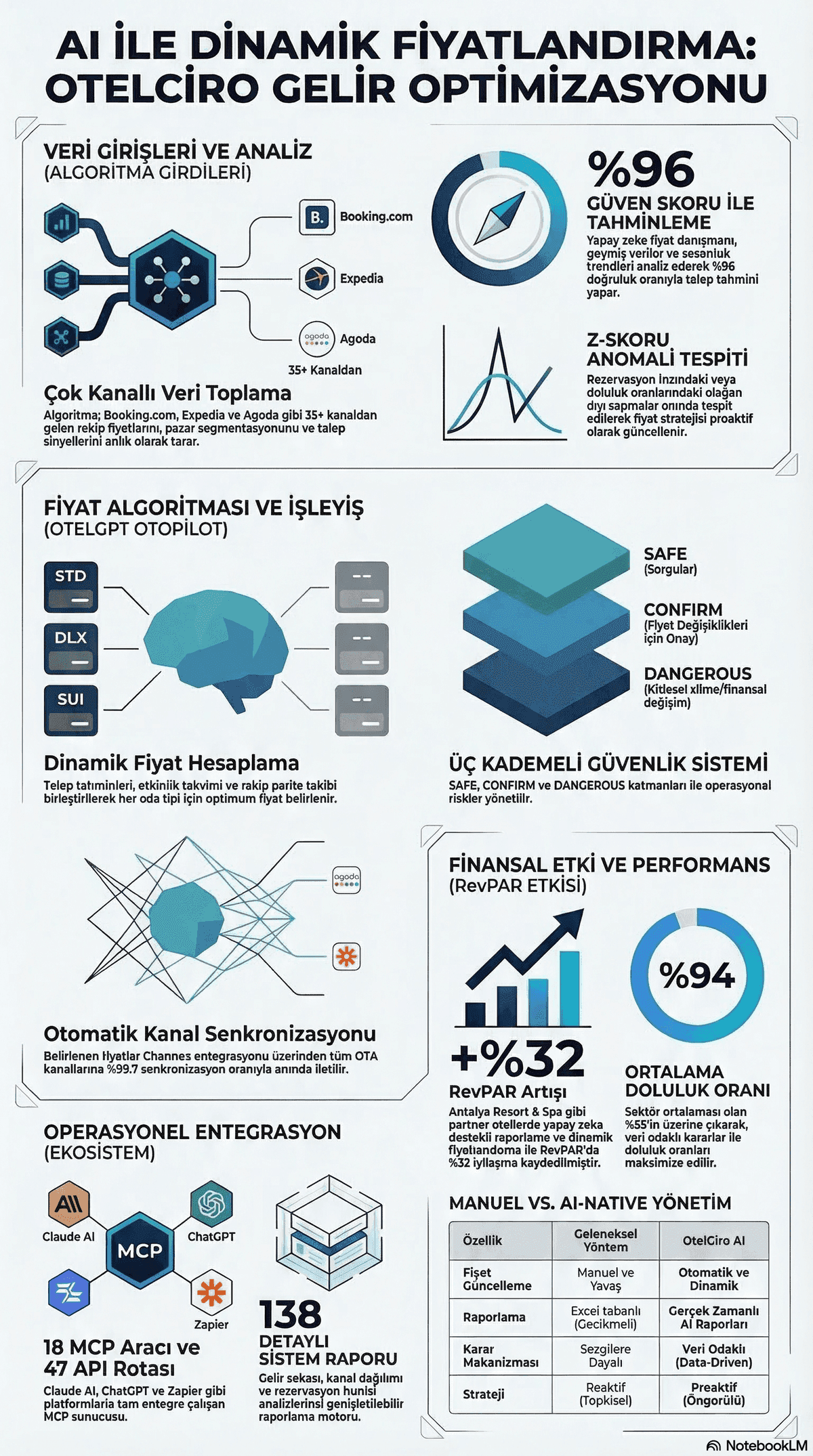
Research shows a linear relationship between price and cancellation risk: every $50 price increase raises cancellation risk by 16%. This means dynamic pricing strategies must account for cancellation risk — not just revenue potential.
When a hotel aggressively raises prices during high-demand periods, it simultaneously faces greater cancellation exposure. This paradox is one of revenue management's most nuanced challenges.
Embed this image on your site
<a href="https://otelciro.com/en/news/otel-iptal-noshow-cozumleri">
  <img src="https://cdn.sanity.io/images/1la98t0z/production/6a97229e7f35d7df9e4e8a2cd6f4cfebc97cdc5b-1200x2150.png" alt="AI-powered dynamic pricing process" width="800" />
</a>
<p>Source: <a href="https://otelciro.com">OtelCiro</a> — AI Hotel Revenue Management</p>
The Hidden Cost of Empty Rooms
The greatest damage from cancellations and no-shows is not the direct revenue loss. The real destruction emerges when opportunity cost and fixed expense burden combine.
As we demonstrated in our comprehensive analysis of the true cost of empty rooms, an unsold room is not just lost revenue — it also means wasted energy, staffing, maintenance, and depreciation costs.
For a 50-room hotel, the annual empty room cost ranges from €45,000 to €80,000. This directly erodes the hotel's profit margin and often goes unnoticed by management.
The Cancellation Chain Reaction
A cancellation does not only affect that one night. It triggers a cascade:
- Last-minute gap: The cancelled room loses its chance of being resold
- Price pressure: Last-minute discounts are needed to fill the gap
- Revenue management drift: Forecasts fail, strategy breaks down
- Operational inefficiency: Prepared rooms go unused, staffing plans falter
Related reading: 65% of Travelers Accept Dynamic Pricing: Transparency Builds Trust
Traditional Overbooking: Courage or Mathematics?
Overbooking — accepting reservations beyond the hotel's physical capacity — has been practiced for decades. But traditional overbooking typically relies on gut instinct: "We had this many cancellations last year, so we will again" reasoning.
The problems with this approach are clear:
- Every night is different: A Monday at a business hotel and a Friday at a resort hotel have entirely different dynamics
- Every room type is different: The cancellation profile for a suite versus a standard room varies dramatically
- Every season is different: Cancellation behavior shifts between summer and winter
- Every channel is different: There is a chasm between OTA and direct booking cancellation rates
Traditional overbooking ignores these variables and sets a single flat rate. The result: either too little overbooking (empty rooms remain) or too much (guests get walked to another hotel, incurring "walk" costs).
Embed this image on your site
<a href="https://otelciro.com/en/news/otel-iptal-noshow-cozumleri">
  <img src="https://cdn.sanity.io/images/1la98t0z/production/d36123c644ddc3c115453411f9a55397cf34970b-1200x2150.png" alt="AI-powered revenue management platform architecture" width="800" />
</a>
<p>Source: <a href="https://otelciro.com">OtelCiro</a> — AI Hotel Revenue Management</p>
Smart Overbooking: Mathematics, Not Courage
AI-powered smart overbooking addresses every shortcoming of the traditional approach. The core philosophy is simple: different mathematics for every night and every room type.
Night-Level No-Show Predictions
AI models calculate separate no-show expectations for each night:
- Monday, business hotel: 12% no-show expectation — business trips frequently get cancelled
- Friday, resort hotel: 5% no-show expectation — vacation plans are more committed
- Special event night: 3% no-show expectation — concerts and conferences are binding
- Pre-holiday period: 8% no-show expectation — plans can shift at the last moment
These predictions are built from historical data, weather forecasts, event calendars, channel distribution, and dozens of additional variables.
3-Tier Risk Indicator
The smart overbooking system provides a three-tier risk indicator for each night:
| Tier | No-Show Risk | Overbooking Strategy |
|---|---|---|
| Safe | 2-5% | Comfortable overbooking, minimal walk risk |
| Careful | 5-8% | Measured overbooking, backup hotel agreements ready |
| Risky | 8%+ | Minimal overbooking, strong deposit policy |
This indicator provides real-time decision support for revenue managers. As the arrival date approaches, the AI updates the risk level dynamically.
Real-Time AI Risk Panel
Instead of a static overbooking rate, the AI-powered system dynamically adjusts overbooking limits as the arrival date draws closer:
- 30 days out: Initial overbooking limit based on general forecast
- 14 days out: Channel-specific cancellation trends analyzed, limit updated
- 7 days out: Individual reservation risk scores activated
- 3 days out: Final adjustments with weather, event, and market data
- Arrival day: Real-time cancellation and check-in data drive the final call
This dynamic approach produces far more accurate results than fixed overbooking ratios.
Related reading: Hotel Dynamic Pricing with AI: Rate Optimization That Maximizes RevPAR
Financial Balance: Empty Room or Walk?
The most critical decision in smart overbooking is finding the balance between two costs:
Empty Room Cost vs Walk Cost
| Cost Item | Empty Room (Annual) | Walk (Annual) |
|---|---|---|
| Direct cost | €45,000-80,000 | €15,000-40,000 |
| Reputation impact | Low (guests unaware) | High (negative experience) |
| OTA ranking impact | Lower occupancy, lower ranking | Short-term negative |
| Long-term effect | Ongoing revenue loss | Recoverable |
The numbers speak clearly: empty room costs can be 2-5 times higher than walk costs. However, the reputational cost of walking guests must not be overlooked.
AI's Golden Balance
AI-powered systems can keep the walk rate below 0.5% while preventing up to €80,000 in annual empty room losses. This means a handful of walk incidents per year in exchange for tens of thousands of euros saved.
When combined with a 5-channel optimization strategy, different overbooking strategies can be applied based on each channel's cancellation profile. Factoring in the billboard effect, OTA visibility can help drive guests toward the direct channel, naturally lowering cancellation rates.
AI's No-Show Prevention Toolkit
AI does far more than optimize overbooking. It deploys a multi-layered strategy to reduce no-show rates at the source:
1. Predictive Risk Scoring
Every reservation receives a risk score from 0 to 100. Tailored policies are triggered for high-risk bookings:
- Low risk (0-30): Standard policy, free cancellation
- Medium risk (31-60): Reminder messages, flexible modification options
- High risk (61-100): Deposit request, prepayment incentives
2. Smart Deposit Automation
Requesting deposits from all guests lowers conversion rates. AI targets deposit requests only at high-risk reservations, reducing cancellation rates while minimizing conversion loss.
3. Dynamic Cancellation Policy
Cancellation policy adjusts automatically based on demand levels:
- Low demand period: Flexible cancellation — boost occupancy
- High demand period: Strict cancellation — protect revenue
- Last minute: Non-refundable rate — eliminate no-show risk
4. Proactive Communication
Personalized messages are sent 72, 48, and 24 hours before arrival. These are not mere reminders — they also carry upsell opportunities: early check-in, room upgrades, restaurant reservations.
The Result: 50% Reduction in No-Show Rate with AI
When all these strategies converge, AI-powered systems can reduce no-show rates by up to 50%. For a 50-room hotel, this translates to €22,500 in additional net revenue per year.
Implementation Roadmap: Smart Overbooking in 90 Days
Transitioning to smart overbooking does not happen overnight. A phased approach is essential:
Month 1: Data Foundation
- Analyze 24 months of historical cancellation and no-show data
- Extract cancellation patterns by channel, night, and room type
- Calculate the cost of the current overbooking policy
Month 2: Pilot Launch
- Test the AI risk scoring model
- Launch smart overbooking for selected room types
- Establish backup hotel agreements for walk scenarios
Month 3: Full Integration
- AI-powered overbooking across all room types and nights
- Activate the real-time risk panel
- Begin performance measurement and optimization cycles
From Cancellation Epidemic to Revenue Opportunity
Cancellations and no-shows are an inescapable reality of hospitality. But how you handle that reality determines your hotel's profitability. You can continue losing tens of thousands of euros annually with traditional methods — or you can turn that leakage into revenue with AI-powered smart strategies.
OtelCiro's AI engine minimizes your hotel's cancellation losses through dynamically calculated overbooking limits for every night and room type, predictive risk scoring, and smart deposit automation. Working in tandem with the channel manager, it applies the right strategy for each channel's cancellation profile.
Do not accept the silent cost of empty rooms. Get in touch and discover the smart overbooking strategy for your hotel.
![Hotel Upselling: AI-Driven Revenue Growth [2026]](https://cdn.sanity.io/images/1la98t0z/production/9850350573fc466b95b1490c7f689e8ac39c4f11-1200x669.png?w=1920&q=50&auto=format&fit=max)