
![5 Disruptions Shaking Hospitality in [2026]](https://cdn.sanity.io/images/1la98t0z/production/f52b19c141086c853972f7fe30f839de7de921be-1200x1200.png?w=1920&q=65&auto=format&fit=max)
2026: The Year of Five Disruptions
The hospitality industry experiences major disruption points every few years. But 2026 will go down in history as one of those rare years when five different disruptions struck simultaneously. Hotels that recognized these shifts early and adapted their strategy are thriving, while latecomers are facing serious revenue losses.
Related reading: 2026 Hospitality Vision: Smart Transformation Through Artificial Intelligence
Disruption 1: Booking.com Overtook Google as the Default Search Engine
What happened: Booking.com (26%) surpassed Google (21%) as the starting point for hotel searches.
This is the most significant search behavior shift in the last 20 years. Google had been the undisputed leader in hotel search for years. But Booking.com's aggressive mobile strategy, powerful app ecosystem, and AI-powered search features fundamentally changed traveler habits.
Why it matters:
- ROI on Google SEO investments is declining
- On-platform Booking.com optimization is now as critical as SEO
- Content Score is as important as — if not more important than — meta descriptions
What you should do:
- Optimize your Booking.com profile like a website
- Perfect your photo quality, description detail, and amenity listings
- Actively participate in platform promotions
- Monitor Booking.com Analytics regularly
Embed this image on your site
<a href="https://otelciro.com/en/news/5-tarihi-kirilma">
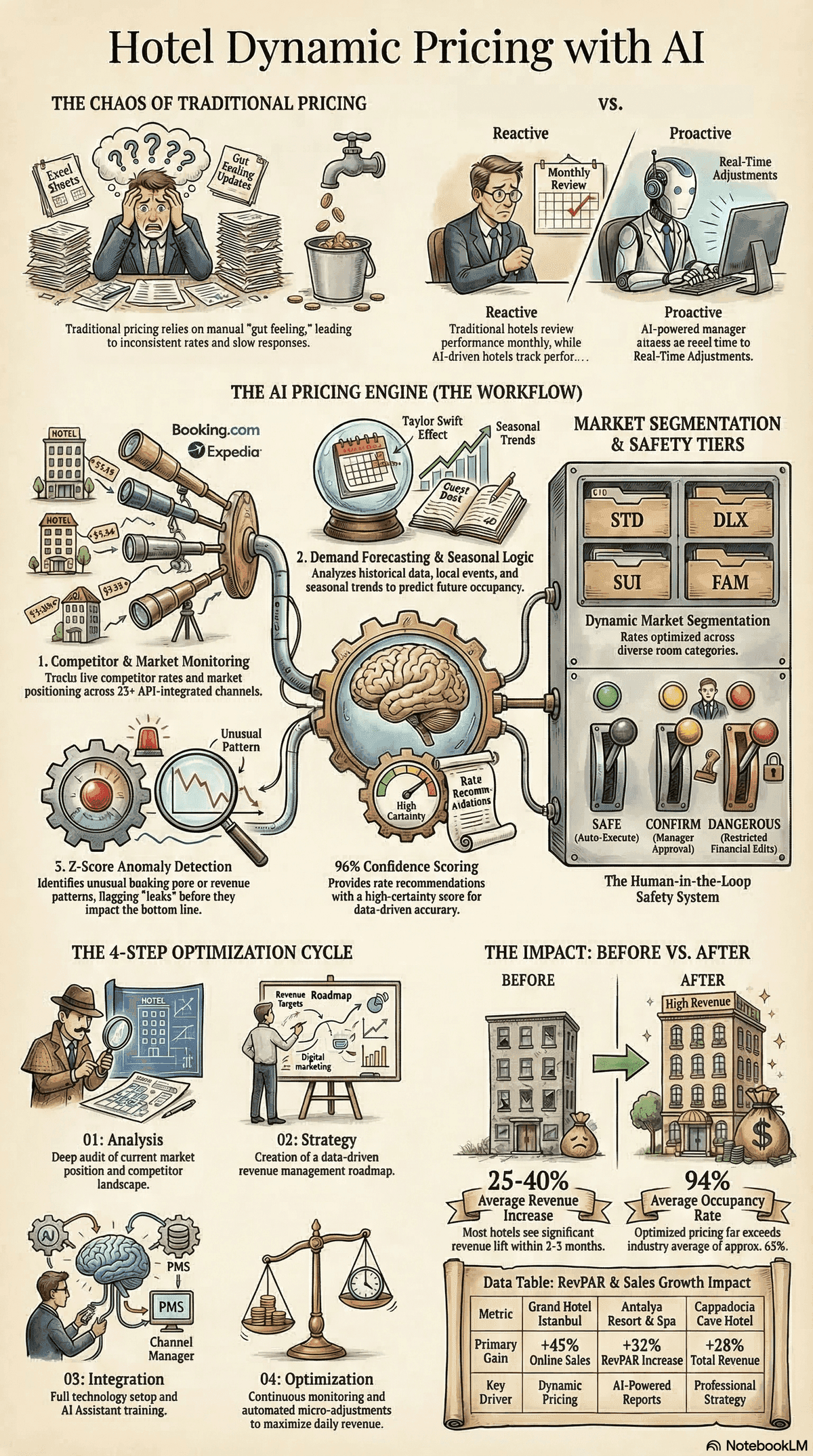
  <img src="https://cdn.sanity.io/images/1la98t0z/production/e41b7ac3104ad8488f70d83e78d4135e4a401e88-1200x2150.png" alt="AI-driven hotel dynamic pricing model" width="800" />
</a>
<p>Source: <a href="https://otelciro.com">OtelCiro</a> — AI Hotel Revenue Management</p>
Disruption 2: The "Freshness Revolution" in Review Algorithms
What happened: Booking.com fundamentally changed its review algorithm — only data from the last 968 days (approximately 2.5 years) is actively evaluated. In practice, reviews from the last 12 months carry far more weight.
This change dramatically reduced the impact of high-scoring reviews you accumulated years ago. A 9.8-rated review from 2020 now contributes virtually nothing to your ranking.
Why it matters:
- The era of resting on historically accumulated scores is over
- A continuous review collection strategy is mandatory
- Negative reviews from the last 12 months are far more damaging
- Review response speed and quality have become ranking factors
What you should do:
- Implement post-checkout review solicitation
- Respond to negative reviews professionally within 24 hours
- Proactively identify and resolve guest experience issues
- Conduct monthly review analysis to track trends
Related reading: 2026: The MCP Revolution — AI Integration for Hotels
Disruption 3: Direct Bookings Reduced OTA Share from 30% to 22%
What happened: Hotels' direct booking channels strengthened, reducing OTA market share from 30% to 22%.
Multiple dynamics drive this decline: ChatGPT's commission-free booking model, increased metasearch investment, stronger loyalty programs, and heightened guest awareness.
Why it matters:
- OTAs are no longer the only lifeline
- Direct channel investment ROI is now proven
- Commission savings directly impact the bottom line
- Guest data ownership provides strategic advantage
What you should do:
- Offer a "best price guarantee" on your website
- Provide extra perks for direct bookings (free breakfast, room upgrade)
- Use email marketing to encourage repeat bookings
- Supply data to ChatGPT and AI platforms to attract commission-free traffic
Embed this image on your site
<a href="https://otelciro.com/en/news/5-tarihi-kirilma">
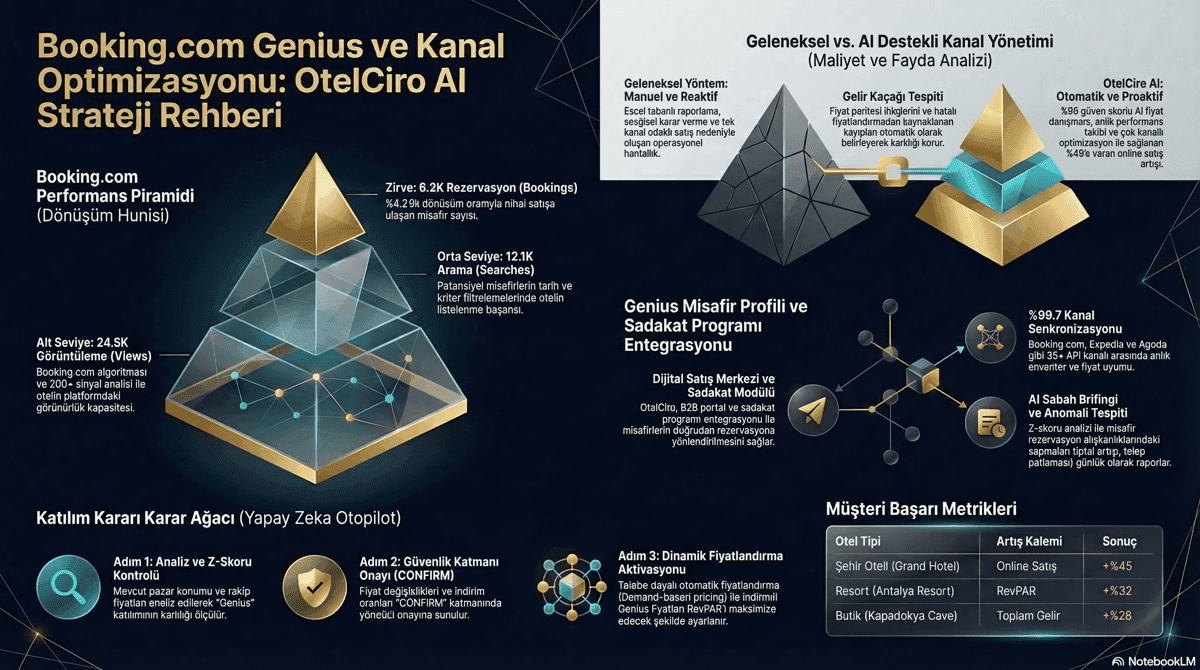
  <img src="https://cdn.sanity.io/images/1la98t0z/production/9e1392b05b1b69f2ed494b62433b779e2c809048-1200x670.png" alt="Booking.com Genius Level 3 strategy guide" width="800" />
</a>
<p>Source: <a href="https://otelciro.com">OtelCiro</a> — AI Hotel Revenue Management</p>
Disruption 4: The Standard Room Era Is Ending — 58% Prefer Premium
What happened: 58% of guests now prefer premium categories (suites, deluxe, sea-view, personalized service) over standard rooms.
The post-pandemic "experience economy" mindset, remote work driving longer stays, and social media's demand for Instagrammable spaces are all challenging the standard room concept.
Why it matters:
- Escape from standard room price competition is possible
- Room diversification is the most effective path to ADR growth
- Premium segment guests have lower cancellation rates
- Upsell revenue is becoming a significant share of total revenue
What you should do:
- Renovate standard rooms to convert them into premium categories
- Add unique experience elements to each room type
- Enrich premium room photos and descriptions on Booking.com and other OTAs
- Deploy upsell strategies offering room upgrades at check-in
Related reading: 5 Channels, 5 Different Rules: How Hotels Should Optimize Each One
Disruption 5: ChatGPT Direct Booking — 800M Users, 0% Commission
What happened: ChatGPT, with 800 million users, disrupted the commission model by enabling direct hotel bookings. Lighthouse announced its MCP-based integration in March 2025, completing the technological foundation.
This is not just a new channel — it challenges the distribution model itself. In the OTA model, hotels pay commissions and lose guest data. In the ChatGPT model, hotels connect directly and retain all revenue and data.
Why it matters:
- 0% commission — annual savings of thousands of dollars for a 100-room hotel
- 14.2% conversion rate — 5x that of traditional search
- Guest data stays with the hotel — enabling remarketing
- AI recommends hotels that precisely match guest needs
What you should do:
- Complete your MCP integration
- Make your booking engine ChatGPT-compatible
- Ensure visibility in AI searches through structured data
- Continuously update your strategy by tracking the 2026 mega trends
Unite All Five Disruptions in One Strategy
These 5 disruptions are not independent — they all point in the same direction: data-driven, multi-channel, AI-native revenue management. Focusing on a single disruption is not enough; all five must be managed together.
| Disruption | Key Action | Priority |
|---|---|---|
| Booking > Google | On-platform SEO | Urgent |
| Review freshness | Continuous review management | Urgent |
| Direct booking growth | Booking engine strengthening | High |
| Premium room demand | Portfolio diversification | Medium-High |
| ChatGPT booking | MCP integration | High |
Frequently Asked Questions
Should we focus on all 5 disruptions at once?
Ideally yes, but prioritize if resources are limited. Start with the most immediately impactful areas: Booking.com on-platform optimization and review management. Then move to MCP integration and premium room strategy. Knowing Booking.com's 2026 rules is a good starting point for prioritization.
Do these disruptions only affect big-city hotels?
No. ChatGPT and AI search affect every destination. A boutique hotel in Cappadocia is impacted just as much as a resort in Antalya. The difference lies in which disruption affects each destination most strongly. For city hotels, the Booking.com search shift is more critical; for resort properties, premium room demand may be more decisive.
What is the cost of not adapting?
Historical data shows that hotels that fail to adapt to distribution disruptions lose 40-60% of market share. While the total impact of the 2026 disruptions has not been fully measured yet, early signals point to a similar loss range. The cost of acting early is minimal compared to the cost of acting late.
To fortify your hotel against the 5 historic disruptions of 2026, partner with OtelCiro. Turn every disruption into an opportunity with our AI-native revenue management platform.
![Voice Search for Hotels: Future of Booking [2026]](https://cdn.sanity.io/images/1la98t0z/production/8767dc5eeda140b181165bfc209e699c9b5ff698-1200x1200.png?w=1920&q=50&auto=format&fit=max)
![Hotel Tech Migration: Digital Roadmap [2026]](https://cdn.sanity.io/images/1la98t0z/production/50a2b86a9575f2987a5b57d8743f5a6f652fba79-1200x670.png?w=1920&q=50&auto=format&fit=max)
![AI Revenue Forecasting for Hotels: 96% Accuracy [2026]](https://cdn.sanity.io/images/1la98t0z/production/d80e97054b7f8f32d0a70fcb817542a82e585ac4-1200x1200.png?w=1920&q=50&auto=format&fit=max)