
![[2026] Travel Trends: The AI Assistant Era Begins](https://cdn.sanity.io/images/1la98t0z/production/83f63d085ace864d32cad66bbd019cc5e62d1461-1200x1200.png?w=1920&q=65&auto=format&fit=max)
80% of Travelers Want AI Assistance
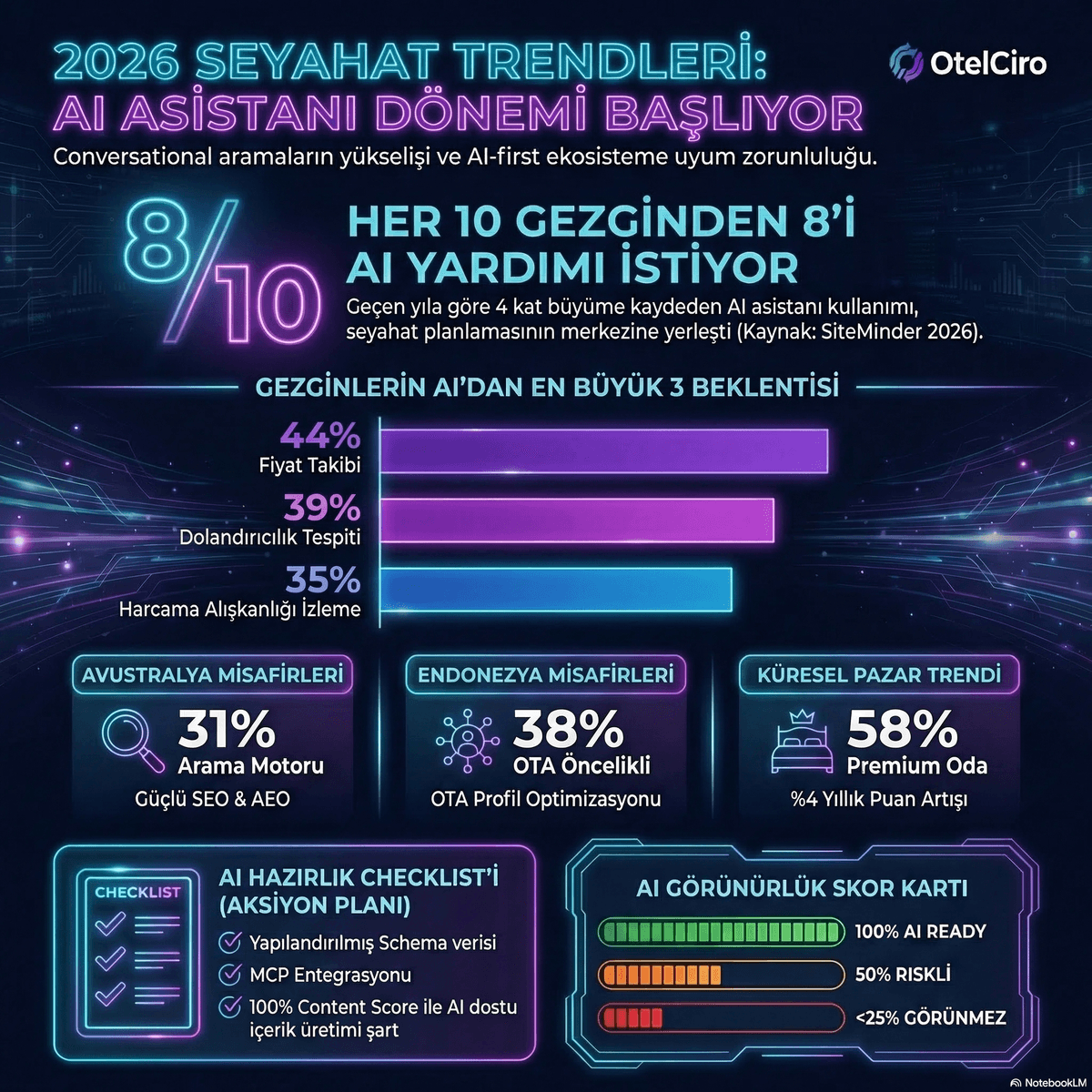
SiteMinder's 2026 global travel study reveals a striking reality: 8 out of 10 travelers want AI assistance in their travel planning. This represents a dramatic increase over the previous year and marks a turning point for the industry.
Embed this image on your site
<a href="https://otelciro.com/en/news/2026-seyahat-trendleri-ai-asistan">
  <img src="https://cdn.sanity.io/images/1la98t0z/production/83f63d085ace864d32cad66bbd019cc5e62d1461-1200x1200.png" alt="2026 Travel Trends and the AI Assistant Era Infographic" width="800" />
</a>
<p>Source: <a href="https://otelciro.com">OtelCiro</a> — AI Hotel Revenue Management</p>
The 4x growth in AI assistant usage is fundamentally changing what travelers expect from the travel experience. But are hotels ready for this shift?
Related reading: 2026 Hospitality Trend Map: 8 Mega Trends at a Glance
Top 3 Traveler Expectations from AI
According to SiteMinder's research, the three features travelers want most from artificial intelligence:
1. Price Tracking (44%)
Nearly half of all travelers want AI to monitor price changes and notify them of the optimal booking time. For hotels that practice dynamic pricing, this is both opportunity and threat:
- Opportunity: Build trust through transparent pricing
- Threat: AI agents will detect hotels that engage in price optimization — inconsistent or manipulative pricing will be penalized
2. Fraud Detection (39%)
39% of travelers expect AI to identify fake listings, deceptive pricing, and scam attempts. For hoteliers, this is an indirect quality signal: trustworthy, verifiable, transparent content will rank higher in AI algorithms.
3. Spending Habits Tracking (35%)
More than a third of travelers want AI to manage their travel budget and analyze spending patterns. This requires hotels to calibrate their price-value proposition correctly and present ancillary services intelligently.
Embed this image on your site
<a href="https://otelciro.com/en/news/2026-seyahat-trendleri-ai-asistan">
  <img src="https://cdn.sanity.io/images/1la98t0z/production/d36123c644ddc3c115453411f9a55397cf34970b-1200x2150.png" alt="AI-powered revenue management platform architecture" width="800" />
</a>
<p>Source: <a href="https://otelciro.com">OtelCiro</a> — AI Hotel Revenue Management</p>
Regional Differences: One Strategy Does Not Fit All
Australia: Search Engine Priority (31%)
31% of Australian travelers begin their travel research with a search engine. This is an important signal for hotels targeting this market:
- English-language SEO quality is critical
- A SEO-to-GEO transformation strategy must be implemented
- Google Hotels visibility must be maximized
- AEO (Answer Engine Optimization) is now as important as SEO
Indonesia: OTA Priority (38%)
In the Indonesian market, OTAs remain the primary research channel. Hotels targeting Southeast Asian markets must treat Booking.com and Agoda optimization as non-negotiable.
Global Trend: Premium Room Demand (58%, +4% annually)
Globally, 58% of travelers prefer premium rooms — and this rate grows by 4% annually. This signals that hotels need to rethink their room category strategy:
- Personalize room upgrade suggestions with AI
- Apply experience-focused pricing for premium categories
- Strengthen the digital presentation of suites and upper categories
Related reading: 2026 Hospitality Vision: Smart Transformation Through Artificial Intelligence
How AI Assistants Are Changing Travel
Traditional Travel Planning
- Search on Google
- Compare on OTAs
- Read review sites
- Track prices
- Book
AI-Powered Travel Planning
- Tell an AI assistant: "3 days in Istanbul in April, 2 people, boutique hotel, mid-to-high budget"
- AI delivers options instantly based on structured data
- Price comparison, review analysis, and availability checks happen automatically
- Book with a single click or voice command
This transition, combined with the rise of voice search for hotel booking, is fundamentally changing how hotels must approach visibility.
Embed this image on your site
<a href="https://otelciro.com/en/news/2026-seyahat-trendleri-ai-asistan">
  <img src="https://cdn.sanity.io/images/1la98t0z/production/46982eee55bf4225dd55170e11b536c3dcd9b3f4-1200x669.png" alt="Modern hotel API integration ecosystem" width="800" />
</a>
<p>Source: <a href="https://otelciro.com">OtelCiro</a> — AI Hotel Revenue Management</p>
AI Readiness Checklist
Evaluate whether your hotel is ready for the AI era with this checklist:
1. Structured Schema Data
- Is schema.org/Hotel markup in place?
- Are room types, prices, and photos structured?
- Is FAQ schema present?
- Is local business information (address, phone, coordinates) accurate?
2. MCP Integration
- Can price and availability data be shared via API?
- Has MCP protocol integration been planned?
- Is real-time data updating possible?
3. Content Score (100% Target)
- Are all room descriptions complete and up to date?
- Are photos professional and high-resolution?
- Are hotel amenities listed in detail?
- Is AI-friendly content format being used? (clear, factual, answer-oriented)
4. Conversational Search Optimization
- Does content exist that answers natural language queries?
- Are search intents like "best," "near," "budget-friendly" being addressed?
- Is multilingual content (at minimum Turkish + English) available?
Related reading: 2026 Sales Revolution: Agentic AI and Autonomous Workflows
AI Visibility Scorecard
Rate your hotel's visibility in the AI ecosystem from 0 to 100:
| Score Range | Status | Action |
|---|---|---|
| 80-100 | AI Ready | Continue optimizing — you are ahead of competitors |
| 50-79 | At Risk | Urgent improvement needed — AI agents may skip you |
| 25-49 | In Danger | Structural changes required — visibility declining rapidly |
| 0-24 | Invisible | Not included in the AI ecosystem — immediate intervention needed |
Scoring Criteria
- Structured data: 25 points
- MCP/API accessibility: 25 points
- Content quality and completeness: 25 points
- Conversational search compatibility: 25 points
Examining the impact of Google AI Mode on hotel bookings helps clarify why this score is so critical.
AI-First Ecosystem Compliance: Now Mandatory
In 2026, AI compliance has moved from the "nice to have" category to a requirement. The reason is simple: AI assistants cannot recommend hotels whose structured data they cannot access.
How AI Assistants Make Decisions
- Data access: Is there structured, current, verifiable data about the hotel?
- Quality signals: Are review scores, content completeness, and photo quality sufficient?
- Price competitiveness: Is the price-value balance consistent with market averages?
- Reliability: Is there inconsistent pricing, fake reviews, or missing information?
Hotels that cannot answer these four questions affirmatively will not appear in AI assistant recommendations — just as hotels not on Google's first page are effectively invisible today.
Special Notes for Turkey
Turkey continues to be one of the fastest-growing destinations in global tourism in 2026. However, the industry lags behind in AI readiness:
- Most hotels lack structured schema data
- The number of hotels with MCP integration is negligible
- English content quality is generally insufficient
- Conversational search optimization is not yet on the agenda
This situation creates a significant competitive advantage opportunity for early-adopting Turkish hotels.
Conclusion: Those Unprepared Will Become Invisible
If you could summarize the common thread of 2026 travel trends in one sentence: AI assistants are the new search engine. 80% of travelers are heading this direction, AI assistant usage is growing 4x, and premium demand increases every year.
Hotels that do not prepare for these trends will suffer the same fate as those that failed to go online in the 2010s — they will become invisible.
OtelCiro's AI engine and ecosystem integrations provide the comprehensive infrastructure to prepare your hotel for this new era. From structured data to MCP integration, channel optimization to conversational search compatibility, it covers all AI readiness layers.
Want to learn your hotel's AI readiness score? Get in touch for a free AI compatibility assessment.
![Voice Search for Hotels: Future of Booking [2026]](https://cdn.sanity.io/images/1la98t0z/production/8767dc5eeda140b181165bfc209e699c9b5ff698-1200x1200.png?w=1920&q=50&auto=format&fit=max)
![Hotel Tech Migration: Digital Roadmap [2026]](https://cdn.sanity.io/images/1la98t0z/production/50a2b86a9575f2987a5b57d8743f5a6f652fba79-1200x670.png?w=1920&q=50&auto=format&fit=max)
![AI Revenue Forecasting for Hotels: 96% Accuracy [2026]](https://cdn.sanity.io/images/1la98t0z/production/d80e97054b7f8f32d0a70fcb817542a82e585ac4-1200x1200.png?w=1920&q=50&auto=format&fit=max)