
![Hotel Revenue Management: Strategies & Metrics [2026]](https://cdn.sanity.io/images/1la98t0z/production/3589015b1344dd63ff9c4331f88c81202d9fd915-1376x768.jpg?w=1920&q=65&auto=format&fit=max)
What Is Hotel Revenue Management?
Hotel revenue management is the discipline of selling the right room, to the right guest, at the right time, at the right price, through the right channel. Born in the airline industry in the 1980s, it has evolved into the single most important competitive advantage in modern hospitality.
At its core, revenue management is the science of maximizing the revenue potential of a finite, perishable inventory — hotel rooms. But in 2026, the definition extends far beyond simple pricing. Modern hotel revenue management encompasses dynamic pricing, distribution channel optimization, demand forecasting, customer segmentation, and competitive analysis as an integrated strategic discipline.
Why Revenue Management Matters More Than Ever
The hotel industry operates under a unique set of economic constraints:
- Perishable inventory: An unsold room loses 100% of its value at midnight. Unlike a manufacturer who can sell leftover stock tomorrow, a hotelier cannot recover last night's empty room.
- High fixed costs: Whether a room is occupied or vacant, payroll, utilities, insurance, and mortgage payments continue unchanged.
- Demand volatility: Massive swings occur between weekday and weekend, peak and off-season, event days and normal days.
- Price transparency: OTAs and metasearch engines enable instant comparison shopping, making every pricing decision visible to competitors and consumers alike.
These four factors combined make systematic revenue management not just helpful but essential for profitable hotel operations.
Related reading: How to Increase RevPAR: 8 Proven Strategies (2026)
Related reading: Dynamic vs. Static Pricing: How the Taylor Swift Effect Can Skyrocket Your Revenue
The Essential Revenue Management Metrics
Without clear KPIs, revenue strategy is guesswork. These are the metrics every hotel operator must track, understand, and optimize.
1. RevPAR (Revenue Per Available Room)
RevPAR is the cornerstone metric of hotel revenue management. It measures revenue generated per available room and is calculated as:
RevPAR = Total Room Revenue / Total Available Rooms
or equivalently:
RevPAR = ADR × Occupancy Rate
For example, a 100-room hotel with an ADR of $180 and 72% occupancy would have:
RevPAR = $180 × 0.72 = $129.60
RevPAR's strength lies in capturing both pricing power and demand generation in a single number. A hotel charging $250/night at 50% occupancy (RevPAR: $125) is underperforming compared to one charging $180 at 72% occupancy (RevPAR: $129.60).
2. ADR (Average Daily Rate)
Average Daily Rate reflects the average revenue earned per sold room:
ADR = Total Room Revenue / Number of Rooms Sold
ADR directly reflects your pricing strategy's effectiveness. In 2025, the global average ADR for upper-midscale hotels was approximately $155, with significant regional variations — urban markets averaging $185 and resort properties reaching $220+.
3. Occupancy Rate
Occupancy Rate = Rooms Sold / Total Available Rooms × 100
Occupancy alone can be misleading. A hotel achieving 100% occupancy through deep discounting may actually generate less profit than one at 75% occupancy with premium rates. The key is finding the optimal balance between occupancy and rate.
4. GOPPAR (Gross Operating Profit Per Available Room)
GOPPAR goes beyond RevPAR by factoring in operating costs:
GOPPAR = Gross Operating Profit / Total Available Rooms
This metric reveals true profitability. High RevPAR from commission-heavy OTA channels can result in disappointing GOPPAR. Understanding this distinction is crucial for sustainable revenue growth.
5. TRevPAR (Total Revenue Per Available Room)
TRevPAR captures all revenue streams — not just rooms, but also F&B, spa, meeting space, parking, and ancillary services. As the industry moves toward Total Revenue Management, this metric becomes increasingly central.
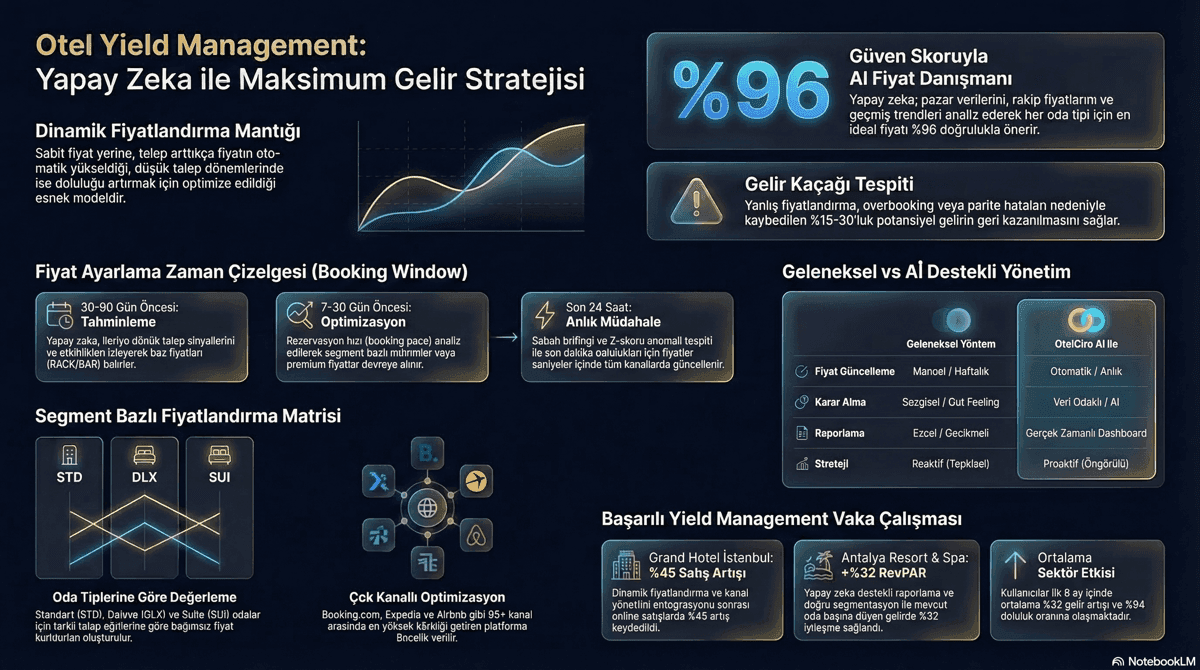
Embed this image on your site
<a href="https://otelciro.com/en/news/hotel-revenue-management-guide">
  <img src="https://cdn.sanity.io/images/1la98t0z/production/da26d752409e6c710074b7383f0e399056ae3119-1200x670.png" alt="Hotel yield management process" width="800" />
</a>
<p>Source: <a href="https://otelciro.com">OtelCiro</a> — AI Hotel Revenue Management</p>
7 Proven Revenue Management Strategies
Strategy 1: Demand Forecasting and Predictive Pricing
Accurate demand forecasting is the foundation of effective revenue management. Modern systems analyze:
- 3-5 years of historical booking patterns
- Local event calendars (conventions, festivals, sporting events)
- Flight data and airport traffic volumes
- Economic indicators and currency exchange rates
- Weather forecasts and seasonal patterns
- Competitor pricing movements in real-time
AI-powered revenue management engines process these data streams in real-time, generating optimal price recommendations for every room type, every night. Manual analysis simply cannot handle this volume and velocity of data.
Strategy 2: Customer Segmentation
Not all guests are created equal. Effective revenue management segments customers by behavior patterns and price sensitivity:
| Segment | Price Sensitivity | Booking Window | Preferred Channel |
|---|---|---|---|
| Business travel | Low | Short (1-7 days) | Corporate/Direct |
| Leisure family | Medium | Long (30-90 days) | OTA/Direct |
| Last-minute | Low-Medium | Very short (0-3 days) | Mobile OTA |
| Group/MICE | Low | Very long (90+ days) | Direct sales |
| Digital nomad | Medium | Medium (7-30 days) | Direct/Meta |
Developing differentiated pricing, room type assignments, and package offers for each segment can increase total revenue by 15-25%.
Strategy 3: Dynamic Pricing
Replacing static rate sheets with continuously optimized pricing is the hallmark of modern revenue management. Three critical components:
- Floor price: The minimum rate that covers variable costs and maintains brand positioning
- Ceiling price: The maximum rate that the market will bear without damaging demand
- Optimal price: The real-time calculated sweet spot based on current supply-demand dynamics
Hotels using AI-powered dynamic pricing achieve 18-28% higher RevPAR on average compared to those using static seasonal rates.
Strategy 4: Channel Management and Distribution Optimization
Each booking channel carries a different cost structure:
- Direct website: 0-5% cost (payment processing only)
- Booking.com: 15-25% commission
- Expedia: 18-25% commission
- GDS (corporate): 8-15% commission
- Metasearch (Google Hotels): CPC-based, averaging 8-12%
Effective channel management focuses on increasing the proportion of bookings from lower-cost channels while maintaining visibility across all relevant platforms. The OtelCiro Sales & Distribution Module manages all channels from a single dashboard, providing real-time profitability tracking per channel.
Strategy 5: Length-of-Stay Pricing
Manipulating length of stay is a powerful but often underutilized revenue optimization lever:
- Minimum Length of Stay (MinLOS): Requiring 2-3 night minimums on high-demand dates prevents short stays from blocking longer, more profitable bookings.
- Extended stay discounts: Offering 10-15% discounts for 5+ night stays increases total room nights and reduces turnover costs.
- Closed to Arrival (CTA): Strategically closing arrivals on specific dates to encourage longer booking patterns.
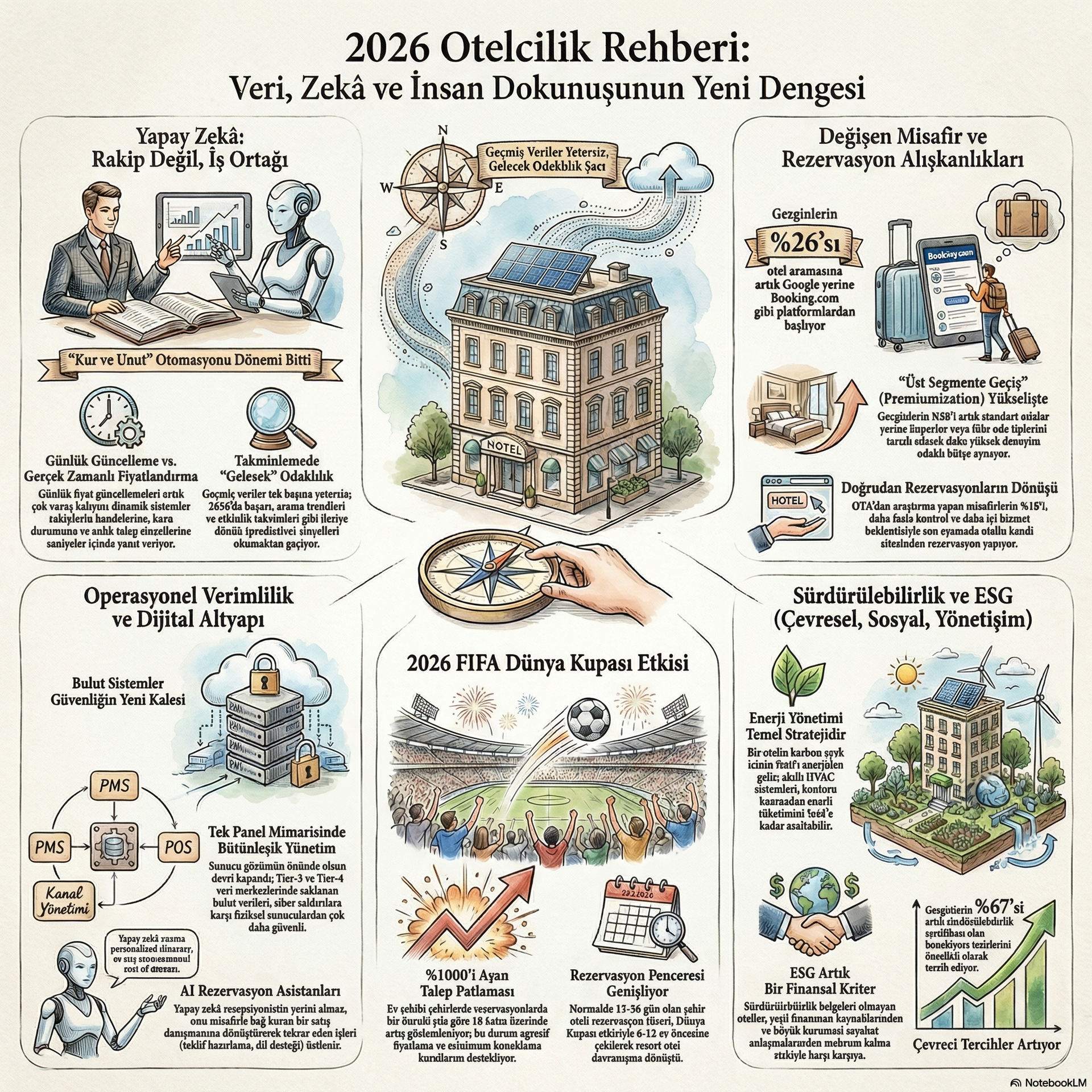
Strategy 6: Upselling and Cross-selling
Revenue management must extend beyond room sales:
- Room upgrades (upselling): Offers to move from standard to superior or suite categories. Check-in upselling achieves 20-30% acceptance rates when properly executed.
- Ancillary services (cross-selling): Spa treatments, restaurant reservations, airport transfers, local tours.
- Package bundling: Room + breakfast + spa packages increase perceived value and drive higher ADR.
The OtelCiro Smart PMS automatically generates personalized upselling and cross-selling recommendations based on guest profiles, increasing non-room revenue by an average of 22%.
Strategy 7: Overbooking Management
Controlled overbooking remains one of the most effective — and most debated — revenue management tactics. By selling 3-8% above physical capacity based on historical cancellation and no-show rates, hotels capture revenue that would otherwise be lost to empty rooms.
The critical success factor is having a robust walk protocol: confirmed arrangements with a comparable or higher-tier partner property, transportation assistance, and compensation packages that protect the guest experience.
Related reading: Hotel Revenue Metrics & KPI Guide: From RevPAR to GOPPAR
Related reading: 65% of Travelers Accept Dynamic Pricing: Transparency Builds Trust
Technology's Role in Revenue Management
From Spreadsheets to AI: The 4 Stages of Evolution
Stage 1 — Manual (pre-2000): Intuition-based pricing. Competitor rates learned via phone calls. Prices updated 2-3 times per season.
Stage 2 — Basic tools (2000-2010): Simple PMS reports and Excel analysis. Historical data reviewed but predictive capability minimal.
Stage 3 — Rule-based RMS (2010-2022): Automated pricing based on predefined rules and thresholds. A significant improvement but still limited to deterministic logic.
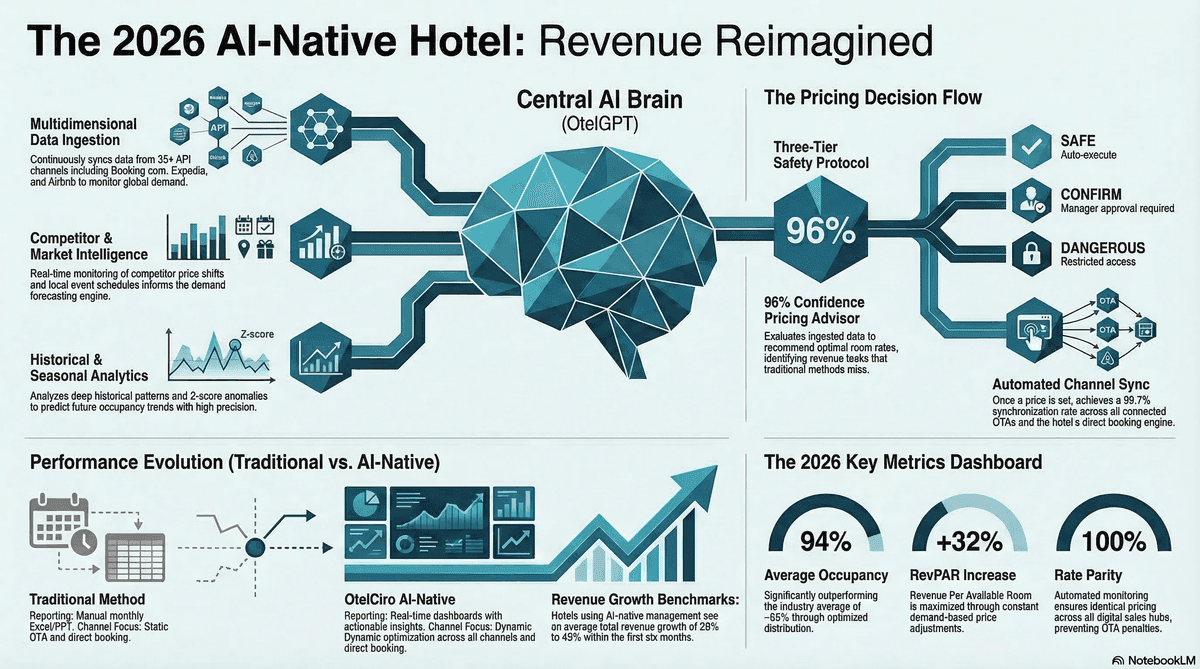
Stage 4 — AI-native systems (2022-present): Machine learning and deep learning models analyzing thousands of variables simultaneously. Forecast accuracy reaches 85-95%.
What AI Changes — In Numbers
The performance gap between traditional and AI-native revenue management is substantial:
| Parameter | Traditional RMS | AI-Native RMS |
|---|---|---|
| Data sources | 5-10 | 50-200+ |
| Price update frequency | Daily | Hourly/Real-time |
| Forecast accuracy | 60-75% | 85-95% |
| Segment granularity | 3-5 segments | 20-50+ micro-segments |
| Decision speed | Minutes | Milliseconds |
| RevPAR improvement | 8-15% | 18-35% |
The OtelCiro AI Engine uses machine learning models specifically trained on Turkish and regional market dynamics — holiday patterns, currency fluctuations, domestic travel behaviors, and seasonal shifts unique to the region.
Embed this image on your site
<a href="https://otelciro.com/en/news/hotel-revenue-management-guide">
  <img src="https://cdn.sanity.io/images/1la98t0z/production/0fde5a7ccfdfdadcbcaecd74553f2fb8fcb01270-1200x669.png" alt="2026 AI-powered hotel revenue management" width="800" />
</a>
<p>Source: <a href="https://otelciro.com">OtelCiro</a> — AI Hotel Revenue Management</p>
Revenue Management Success Stories
Case Study 1: Antalya Boutique Hotel (48 rooms)
Starting point: Fixed seasonal rates, 55% annual average occupancy, annual RevPAR $52
Strategies implemented:
- Transition to daily dynamic pricing
- Direct booking website optimization
- Segment-based packaging
Results after 12 months:
- Occupancy: 55% → 68% (+24%)
- ADR: $95 → $124 (+31%)
- RevPAR: $52 → $84 (+62%)
- Direct booking share: 12% → 28%
Case Study 2: Istanbul City Hotel (120 rooms)
Starting point: Manual pricing, 70% Booking.com dependency
Strategies implemented:
- AI-based revenue management system deployment
- Multi-channel distribution strategy
- Corporate segment development
- Systematic upselling program
Results after 12 months:
- RevPAR: $112 → $168 (+50%)
- OTA dependency: 70% → 45%
- GOPPAR: +38%
- Non-room revenue share: 8% → 15%
Getting Started: 5 Steps to Revenue Management Excellence
Step 1: Audit Your Current Performance
Collect 12-24 months of data: daily occupancy, ADR, RevPAR, channel mix, segment breakdown. Without data, there is no strategy — only guessing.
Step 2: Define Your Competitive Set
Identify 5-8 properties for benchmarking using criteria like star rating, location proximity, similar target demographics, and comparable facilities.
Step 3: Build Your Segmentation Framework
Define at least 3 core customer segments with distinct pricing strategies, booking windows, and channel preferences for each.
Step 4: Invest in the Right Technology
Technology infrastructure determines how effectively you can scale revenue management. An integrated property management system, channel manager, and revenue management engine form the minimum technology stack.
Step 5: Establish a Continuous Optimization Cycle
Revenue management is an ongoing process, not a one-time project. Weekly performance reviews, monthly strategy sessions, and quarterly goal adjustments create the improvement loop that drives sustained growth.
Related reading: How Many Hours a Year Does Your Hotel Run Empty? The True Cost of Unsold Rooms
Common Revenue Management Mistakes
- Obsessing over occupancy alone: High occupancy does not guarantee high profit. Track GOPPAR alongside RevPAR.
- Single-channel dependency: Heavy OTA reliance erodes margins. Channel diversification is essential.
- Ignoring historical data: Intuition matters, but data is more reliable and scalable.
- Copying competitor pricing: Without knowing a competitor's cost structure, price matching can be destructive.
- Delaying technology adoption: The gap between manual and AI-powered revenue management widens every quarter.
Conclusion: Revenue Management Is No Longer Optional
In 2026, the global hotel industry faces intensifying competition, rising costs, and rapidly evolving guest expectations. Hotels without systematic revenue management are leaving significant money on the table — typically 15-30% of their potential revenue.
The good news: revenue management technology is no longer reserved for large chains. The OtelCiro platform delivers AI-powered revenue management solutions scaled for every property size, from boutique hotels to major chains.
To begin your revenue management journey or elevate your existing strategy, start a conversation with the OtelGPT AI assistant for personalized recommendations tailored to your property.
Remember: Every unsold room is revenue that will never come back. The best time to start optimizing was yesterday. The second-best time is today.

![Hotel Upselling: AI-Driven Revenue Growth [2026]](https://cdn.sanity.io/images/1la98t0z/production/9850350573fc466b95b1490c7f689e8ac39c4f11-1200x669.png?w=1920&q=50&auto=format&fit=max)