
![10 Proven Hotel Dynamic Pricing Strategies [2026]](https://cdn.sanity.io/images/1la98t0z/production/e4a81170ea23bc3464834633cf98f17b6e55f514-1200x669.png?w=1920&q=65&auto=format&fit=max)
Why Static Pricing Is Leaving Money on the Table
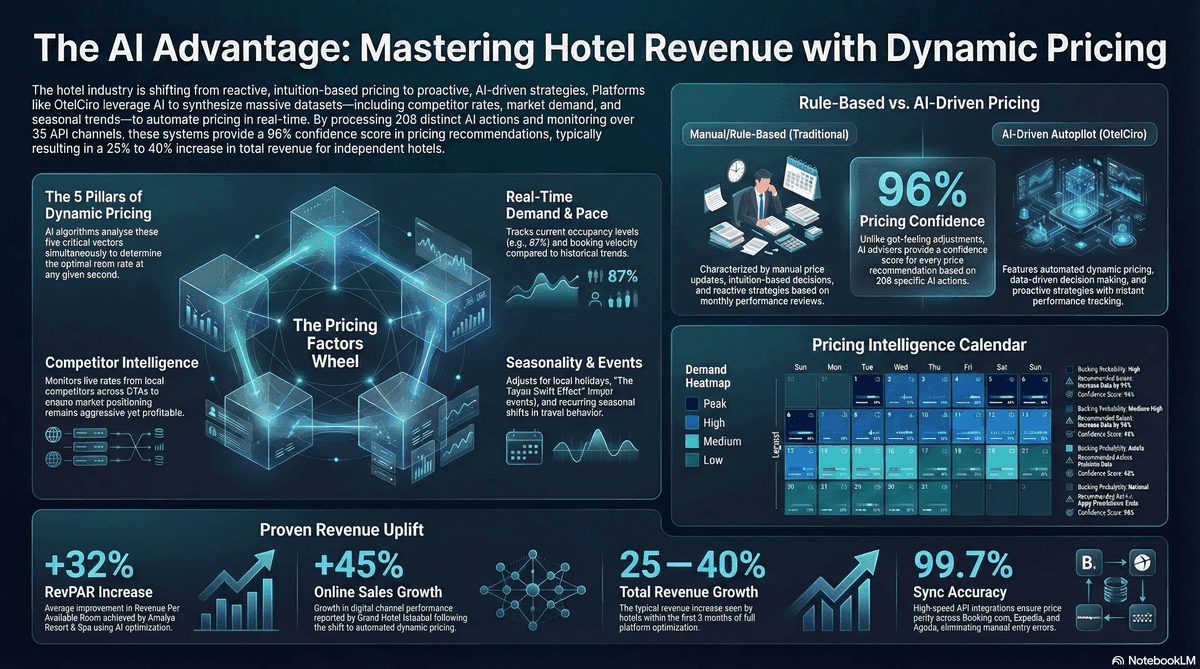
Every unsold hotel room at midnight represents 100% lost revenue — it cannot be inventoried, stored, or sold tomorrow. This perishability makes hotels uniquely suited to dynamic pricing, yet a surprising number of properties still operate with static or semi-static rate structures. According to STR data, hotels using advanced dynamic pricing achieve 12-18% higher RevPAR than those using fixed seasonal rates.
Dynamic pricing is not simply "raising rates when demand is high." In 2026, it has evolved into a multi-dimensional discipline incorporating real-time competitive intelligence, micro-segmentation, price elasticity modeling, and AI-powered demand forecasting. The question is no longer whether to use dynamic pricing, but how sophisticated your approach needs to be.
Embed this image on your site
<a href="https://otelciro.com/en/news/hotel-dynamic-pricing-strategies">
  <img src="https://cdn.sanity.io/images/1la98t0z/production/e4a81170ea23bc3464834633cf98f17b6e55f514-1200x669.png" alt="Hotel dynamic pricing strategies infographic" width="800" />
</a>
<p>Source: <a href="https://otelciro.com">OtelCiro</a> — AI Hotel Revenue Management</p>
Related reading: AI Revenue Management Platform: The Complete Hotel Solution for 2026
Related reading: 65% of Travelers Accept Dynamic Pricing: Transparency Builds Trust
The Dynamic Pricing Maturity Model
Hotels typically progress through five levels of pricing sophistication:
Level 1: Fixed Seasonal Rates
- Two or three rate seasons (high, low, shoulder)
- Same rate for all channels
- Manual adjustments only for extreme demand
- RevPAR impact: Baseline
Level 2: Demand-Based Manual Pricing
- Revenue manager adjusts rates based on occupancy
- Rule-based: "If occupancy > 80%, raise rate by 15%"
- Competitive rate checks 1-2x daily
- RevPAR impact: +5-8% vs Level 1
Level 3: Rule-Based Automation
- Automated rules trigger rate changes
- Multiple rate tiers based on demand indicators
- Channel-specific pricing strategies
- RevPAR impact: +10-15% vs Level 1
Level 4: AI-Driven Dynamic Pricing
- Machine learning models predict demand
- Prices adjust automatically every 15-60 minutes
- Segment-level price optimization
- RevPAR impact: +15-22% vs Level 1
Level 5: Autonomous Revenue Optimization
- AI manages entire pricing strategy autonomously
- Cross-channel, cross-segment, cross-date optimization
- Real-time competitive response
- RevPAR impact: +20-30% vs Level 1
Embed this image on your site
<a href="https://otelciro.com/en/news/hotel-dynamic-pricing-strategies">
  <img src="https://cdn.sanity.io/images/1la98t0z/production/babd172d5d4e9762f3e1ec208c24dd03a431041a-1200x670.png" alt="Segment-based hotel pricing strategy" width="800" />
</a>
<p>Source: <a href="https://otelciro.com">OtelCiro</a> — AI Hotel Revenue Management</p>
Core Dynamic Pricing Strategies
1. Demand-Based Pricing
The foundation of hotel dynamic pricing is aligning rates with demand signals:
Leading indicators to monitor:
- Pick-up pace vs. same period last year
- Search volume for your destination
- Flight booking data for inbound routes
- Event calendar impact assessment
- Competitor occupancy estimates
Practical application: If your 60-day pick-up pace is 25% ahead of last year for a specific date, your pricing should reflect proportionally higher rates — not your standard seasonal rate.
2. Competitive Position Pricing
Your rate relative to competitors directly impacts booking probability:
| Position | When to Use | Expected Impact |
|---|---|---|
| Below comp set | Low occupancy, need volume | Higher occupancy, lower ADR |
| At parity | Normal demand, mid-week | Balanced performance |
| 10-15% above | Strong demand, event dates | Premium ADR, stable occupancy |
| 20%+ above | Very high demand, sold-out market | Maximum ADR, slight occupancy trade-off |
The key is not to be the cheapest — it is to be correctly positioned for the demand level.
3. Length-of-Stay Optimization
Sophisticated dynamic pricing extends beyond nightly rates to length-of-stay management:
- Minimum stay requirements on high-demand dates prevent cherry-picking of peak nights
- Extended stay discounts fill shoulder dates around peak periods
- Closed-to-arrival restrictions on specific dates optimize total revenue
- Day-of-week pricing addresses demand disparities (Sunday vs. Saturday)
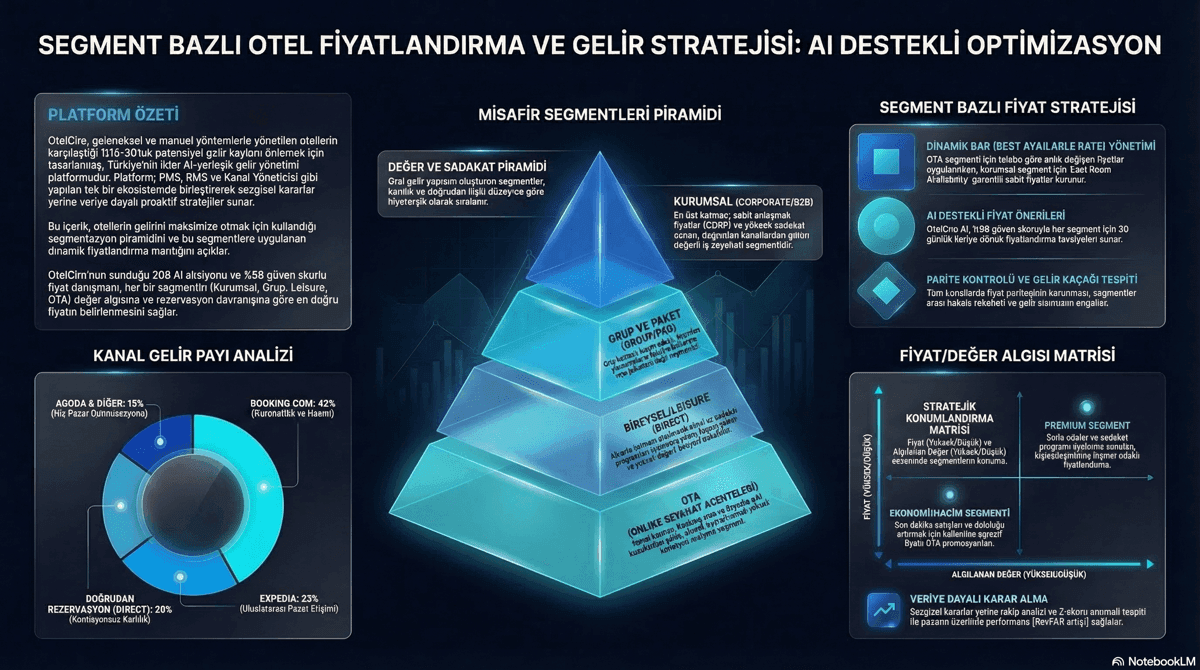
4. Segment-Based Pricing
Different guest segments have different price elasticities:
- Business travelers: Lower price sensitivity, shorter lead time, weekday demand
- Leisure couples: Moderate sensitivity, 30-60 day lead time, weekend demand
- Families: Higher sensitivity, 60-120 day lead time, holiday peaks
- Groups: Variable, long lead time, negotiated rates
AI-powered systems can identify micro-segments within these categories and price accordingly — for example, distinguishing between a business traveler from a Fortune 500 company and a freelancer attending a conference.
5. Channel-Specific Pricing
Not all channels have equal cost or conversion profiles:
- Direct website: Lowest cost (2-5%), highest margin — offer best rate guarantee
- OTA standard: Medium cost (15-18%), high visibility — standard rate
- OTA promoted: High cost (18-25%), premium visibility — higher rates to offset
- Meta search: Variable cost (8-15%), quality traffic — competitive rates
- GDS/Corporate: Negotiated fixed rates — honor commitments
Related reading: How Many Hours a Year Does Your Hotel Run Empty? The True Cost of Unsold Rooms
Related reading: Hotel Ancillary Revenue: Unlock Hidden Profit Centers
Advanced Tactics for 2026
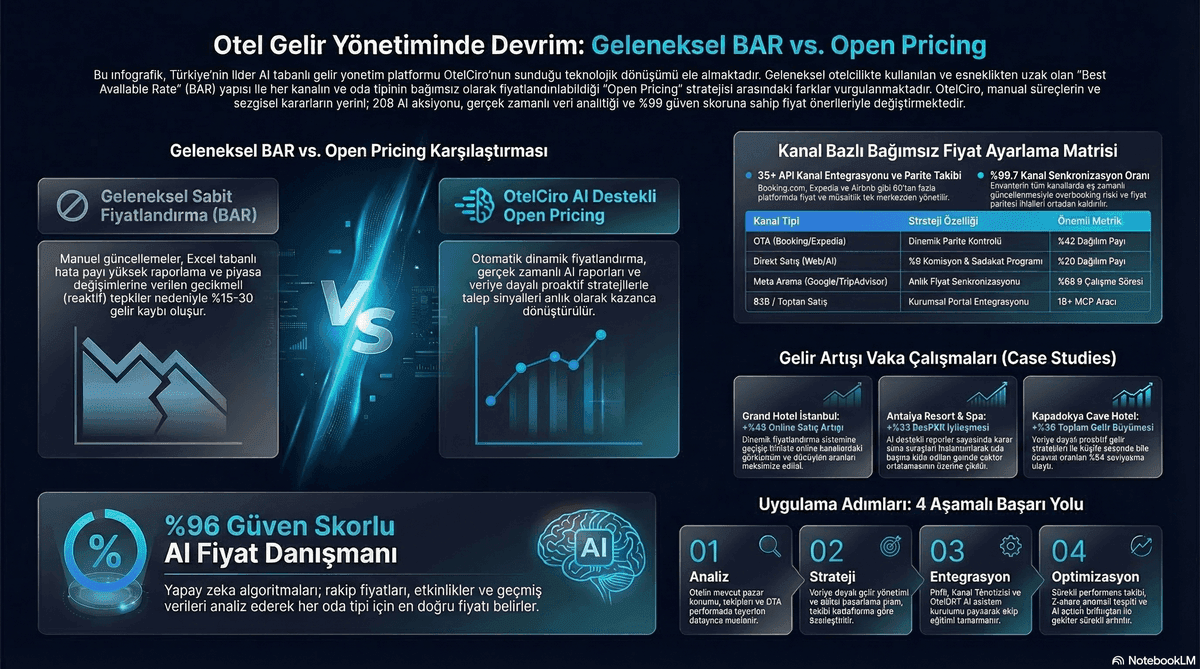
Open Pricing
Move beyond traditional BAR (Best Available Rate) to open pricing, where each room type, date, segment, and channel combination has independently optimized rates. This eliminates the constraint of fixed rate fences between room types.
AI-Powered Price Testing
Use A/B testing principles to continuously test pricing strategies. Show different rates to different user cohorts and measure conversion differences to find optimal price points.
Predictive Cancellation Pricing
Factor predicted cancellation rates into pricing decisions. For dates with historically high cancellation rates, consider overbooking strategies combined with higher initial pricing on flexible rates.
Embed this image on your site
<a href="https://otelciro.com/en/news/hotel-dynamic-pricing-strategies">
  <img src="https://cdn.sanity.io/images/1la98t0z/production/38381e0dd477a4816db7ad9b1359befc08268365-1200x669.png" alt="Open pricing strategy for hotels" width="800" />
</a>
<p>Source: <a href="https://otelciro.com">OtelCiro</a> — AI Hotel Revenue Management</p>
Common Mistakes
Chasing occupancy at all costs: 100% occupancy at discounted rates often generates less profit than 80% occupancy at optimized rates. Always track RevPAR and GOPPAR, not just occupancy.
Reactive instead of proactive pricing: Waiting until occupancy is low to drop rates is reactive. Proactive pricing adjusts rates based on leading indicators weeks in advance.
Ignoring rate parity: Inconsistent pricing across channels confuses consumers and damages trust. Ensure your rates are strategically differentiated but consistently fair.
Related reading: Dynamic vs. Static Pricing: How the Taylor Swift Effect Can Skyrocket Your Revenue
OtelCiro: Dynamic Pricing Intelligence
OtelCiro's AI Engine implements Level 4-5 dynamic pricing for hotels of all sizes. The platform analyzes competitive rates, demand signals, and historical patterns to deliver pricing recommendations every 15 minutes — with full transparency into the reasoning behind each decision.
Explore our hotel revenue management guide for the foundational metrics that dynamic pricing optimizes, and our Booking.com algorithm analysis for channel-specific pricing insights.
Conclusion
Dynamic pricing is the single highest-impact revenue management discipline. Moving from static seasonal rates to AI-driven dynamic pricing can unlock 15-30% RevPAR improvement. The technology is accessible, the data is available, and the competitive pressure is mounting. Hotels that master dynamic pricing in 2026 will have a structural advantage that compounds over time.
Discover how OtelCiro's AI Engine can automate your dynamic pricing strategy and deliver measurable RevPAR growth from day one.
![Hotel Upselling: AI-Driven Revenue Growth [2026]](https://cdn.sanity.io/images/1la98t0z/production/9850350573fc466b95b1490c7f689e8ac39c4f11-1200x669.png?w=1920&q=50&auto=format&fit=max)