
![AI Revenue Management Platform for Hotels [2026]](https://cdn.sanity.io/images/1la98t0z/production/d36123c644ddc3c115453411f9a55397cf34970b-1200x2150.png?w=1920&q=65&auto=format&fit=max)
What Is an AI Revenue Management Platform?
An AI revenue management platform is an intelligent software system that automates, optimizes, and continuously refines every pricing and distribution decision a hotel makes. Unlike traditional revenue management systems that rely on rigid rules and manual overrides, an AI-native platform uses machine learning, predictive analytics, and real-time data processing to maximize revenue from every available room, every single night.
The concept is straightforward: instead of a revenue manager spending hours analyzing spreadsheets and adjusting rates across channels, an AI platform processes thousands of data points simultaneously and executes pricing decisions in milliseconds. It does not replace human judgment entirely, but it elevates it — handling the repetitive, data-intensive work while freeing hotel teams to focus on strategy and guest experience.
In 2026, the distinction between hotels that use AI revenue management and those that do not is no longer subtle. Properties running AI-driven pricing report RevPAR improvements of 18-32% on average, while those relying on manual processes are losing ground to competitors who respond to market shifts in real time.
Embed this image on your site
<a href="https://otelciro.com/en/news/ai-revenue-management-platform">
  <img src="https://cdn.sanity.io/images/1la98t0z/production/d36123c644ddc3c115453411f9a55397cf34970b-1200x2150.png" alt="AI Revenue Management Platform Infographic" width="800" />
</a>
<p>Source: <a href="https://otelciro.com">OtelCiro</a> — AI Hotel Revenue Management</p>
Related reading: Hotel Revenue Crisis: Why Hotels Lose 15-30% of Annual Revenue
Related reading: 65% of Travelers Accept Dynamic Pricing: Transparency Builds Trust
How OtelCiro's AI Revenue Management Platform Works
OtelCiro's AI Engine is purpose-built for the hospitality industry. It is not a generic pricing tool adapted for hotels — it is an integrated revenue management ecosystem that understands the unique dynamics of hotel inventory, perishable supply, and multi-channel distribution.
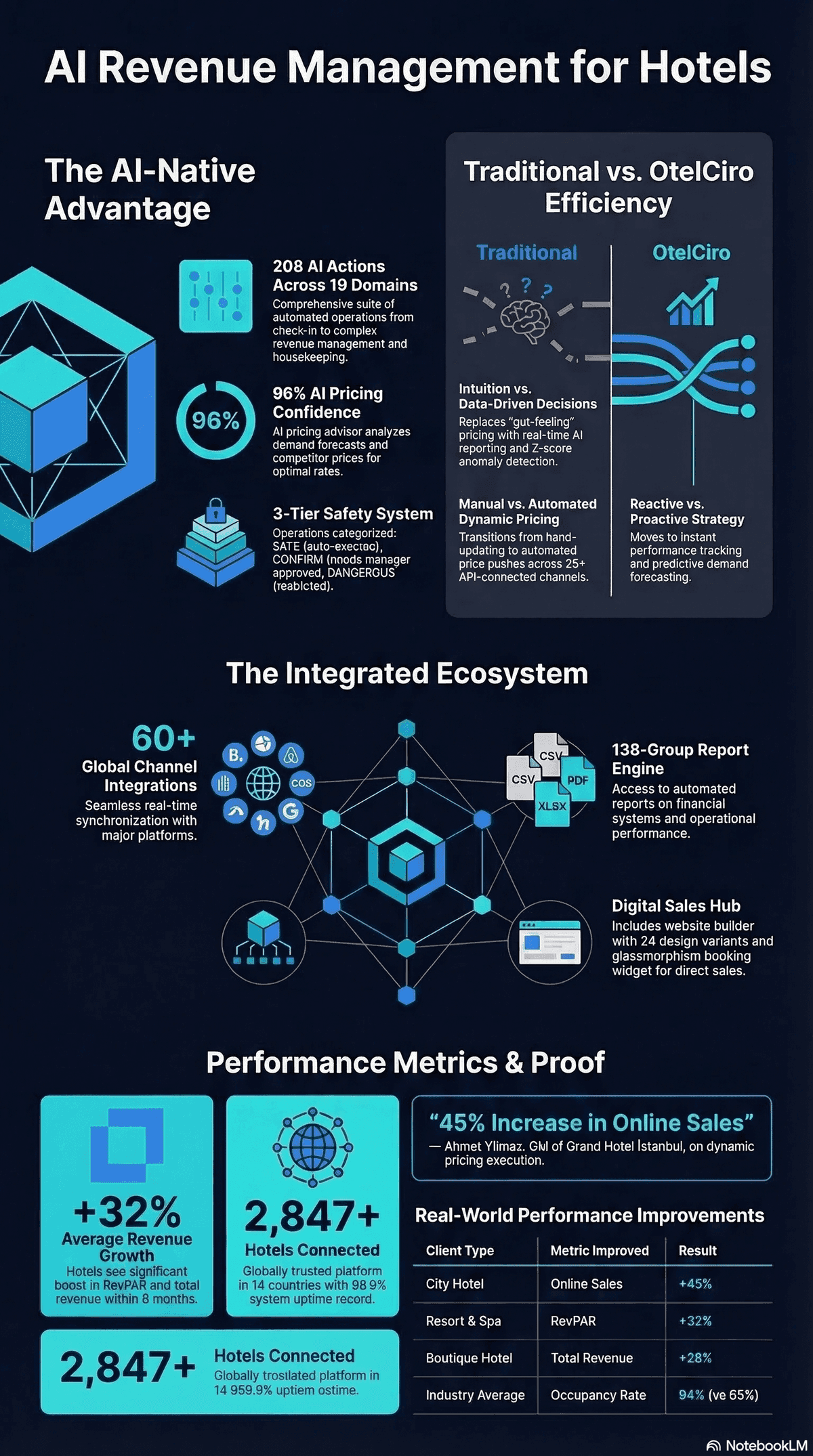
208 Daily AI Actions
Every day, OtelCiro's AI Engine executes an average of 208 autonomous actions per property. These are not passive recommendations sitting in a dashboard waiting for approval. They are intelligent, context-aware decisions that include:
- Rate adjustments across all connected channels based on real-time demand signals
- Inventory allocation changes that shift room availability between OTAs and direct channels
- Restriction modifications such as minimum length of stay, closed-to-arrival dates, and advance purchase requirements
- Promotional activations triggered by demand gaps or competitive opportunities
- Overbooking calibration that balances occupancy maximization against walk risk
Each action is logged, explained, and auditable. Hotel managers can review why the AI made a specific decision and override it if local knowledge warrants a different approach.
Demand Forecasting Engine
At the core of any effective revenue management platform is demand forecasting. OtelCiro's forecasting engine analyzes:
- 3-5 years of historical booking data to identify recurring patterns, seasonality, and trend shifts
- Booking pace and pickup velocity — how fast reservations are accumulating compared to the same period in prior years
- Local event calendars including conferences, festivals, concerts, sporting events, and public holidays
- Flight search data and airline capacity as leading indicators of inbound travel demand
- Weather forecasts for the next 14 days, which significantly impact leisure destinations
- Macroeconomic signals such as currency exchange fluctuations, consumer confidence indices, and fuel prices
The system generates a rolling 365-day demand forecast that updates every six hours. This is not a static seasonal calendar — it is a living, breathing prediction that adapts to new information continuously.
Competitor Analysis and Market Intelligence
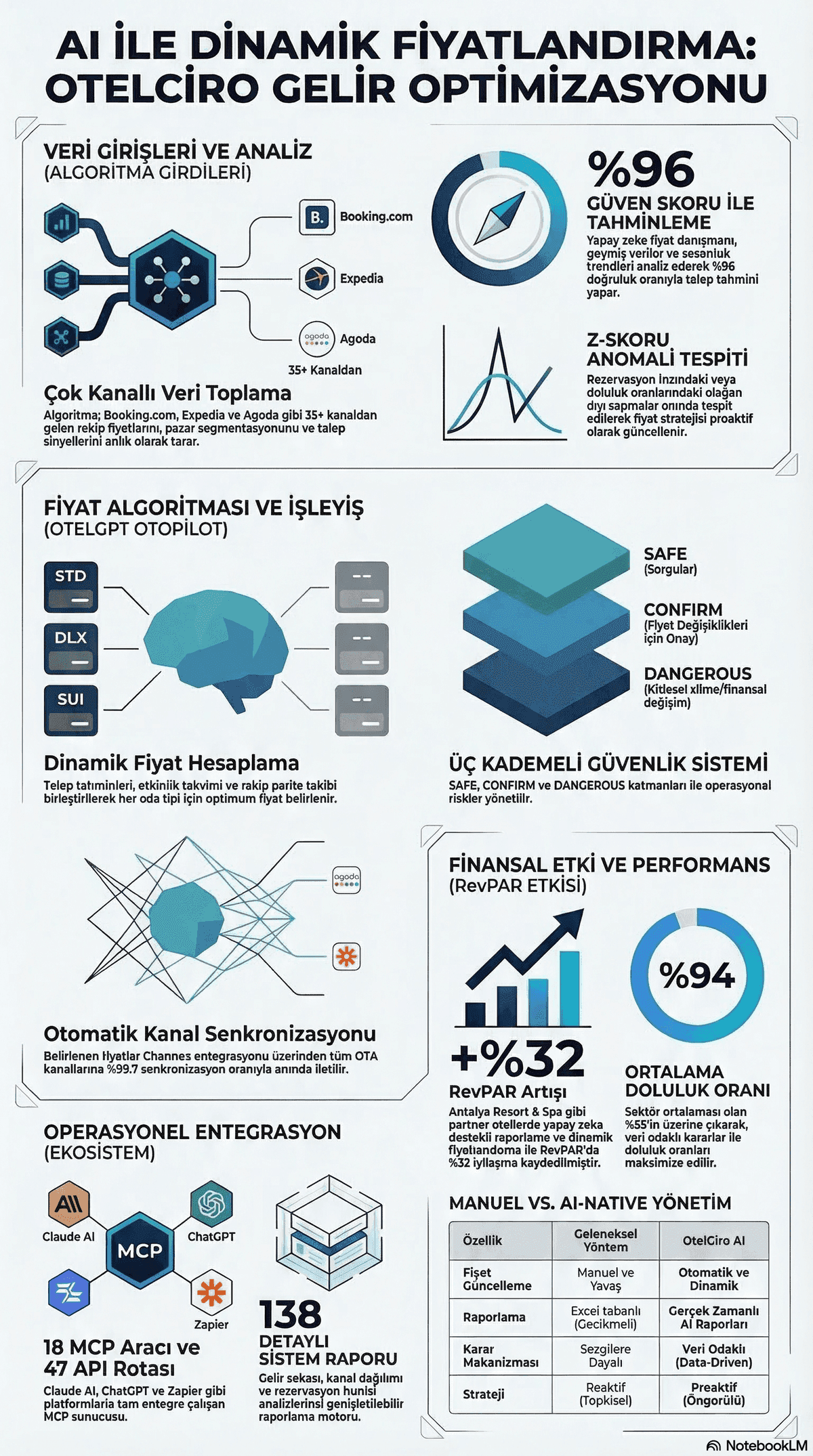
Revenue management does not happen in a vacuum. OtelCiro monitors competitor pricing, availability, and promotional activity across the competitive set in real time. The platform tracks:
- Published rates on Booking.com, Expedia, Google Hotels, and other major channels
- Rate changes and their timing patterns (competitors who always adjust rates on Tuesdays, for example)
- Promotional offers, package deals, and loyalty discounts
- Review score changes that may signal shifts in competitive positioning
- New property openings or renovations that alter the competitive landscape
This intelligence feeds directly into pricing recommendations, ensuring that your hotel is never priced in isolation from its market context.
Embed this image on your site
<a href="https://otelciro.com/en/news/ai-revenue-management-platform">
  <img src="https://cdn.sanity.io/images/1la98t0z/production/6a97229e7f35d7df9e4e8a2cd6f4cfebc97cdc5b-1200x2150.png" alt="AI-powered dynamic pricing process" width="800" />
</a>
<p>Source: <a href="https://otelciro.com">OtelCiro</a> — AI Hotel Revenue Management</p>
Traditional vs. AI Revenue Management: A Direct Comparison
Understanding the gap between traditional and AI-driven approaches is critical for any hotel evaluating a platform investment.
Traditional Revenue Management
- Manual rate updates performed 1-3 times per week
- Spreadsheet-based analysis with limited data inputs (typically historical occupancy and a handful of competitor rates)
- Rule-based pricing with fixed seasonal brackets and manual overrides
- Reactive decision-making — rates change after demand shifts are already visible
- Single-person dependency — the revenue manager becomes a bottleneck and a single point of failure
- Channel-by-channel management requiring separate logins and manual updates
AI-Powered Revenue Management
- Continuous rate optimization with adjustments made multiple times per day
- Multi-dimensional analysis processing thousands of data streams simultaneously
- Pattern recognition that identifies demand signals humans would miss
- Proactive pricing — rates adjust before demand shifts fully materialize
- Team empowerment — the AI handles execution while humans focus on strategy
- Unified channel management with rates pushed to all channels simultaneously from the Smart PMS
The difference is not incremental. It is structural. A revenue manager working manually can realistically analyze 5-10 data points before making a pricing decision. An AI platform analyzes 5,000+ data points in the same timeframe.
Related reading: How Many Hours a Year Does Your Hotel Run Empty? The True Cost of Unsold Rooms
ROI Metrics: What Hotels Actually Achieve
The question every hotel owner asks is: "What will this actually do for my bottom line?" Here are the documented outcomes from properties using AI revenue management platforms:
Revenue Impact
- RevPAR increase: 18-32% within the first 12 months, with the median improvement at 24%
- ADR improvement: 12-22% through better rate positioning and reduced unnecessary discounting
- Occupancy optimization: 5-8 percentage point improvement in shoulder and low-demand periods
- Direct booking share: 15-25% increase when AI-driven pricing is combined with channel optimization
Operational Savings
- Revenue manager hours saved: 15-20 hours per week on rate analysis and manual updates
- Overbooking reduction: 85-95% fewer overbooking incidents through intelligent inventory management
- Commission savings: 8-15% reduction in OTA commission costs by shifting bookings to lower-cost channels
Long-Term Value
- Competitive positioning: Hotels using AI pricing consistently outperform their competitive set within 6 months
- Data accumulation: The AI becomes more accurate over time as it learns property-specific patterns
- Staff retention: Revenue managers report higher job satisfaction when freed from repetitive tasks
OtelCiro's Advanced Reports dashboard provides real-time visibility into all of these metrics, enabling hotel leadership to track ROI from day one.
Embed this image on your site
<a href="https://otelciro.com/en/news/ai-revenue-management-platform">
  <img src="https://cdn.sanity.io/images/1la98t0z/production/7aad3e230cde611ee176402d03b7bcf0a35316f2-1200x2150.png" alt="RevPAR improvement strategies and tactics" width="800" />
</a>
<p>Source: <a href="https://otelciro.com">OtelCiro</a> — AI Hotel Revenue Management</p>
The Five Pillars of AI Revenue Management
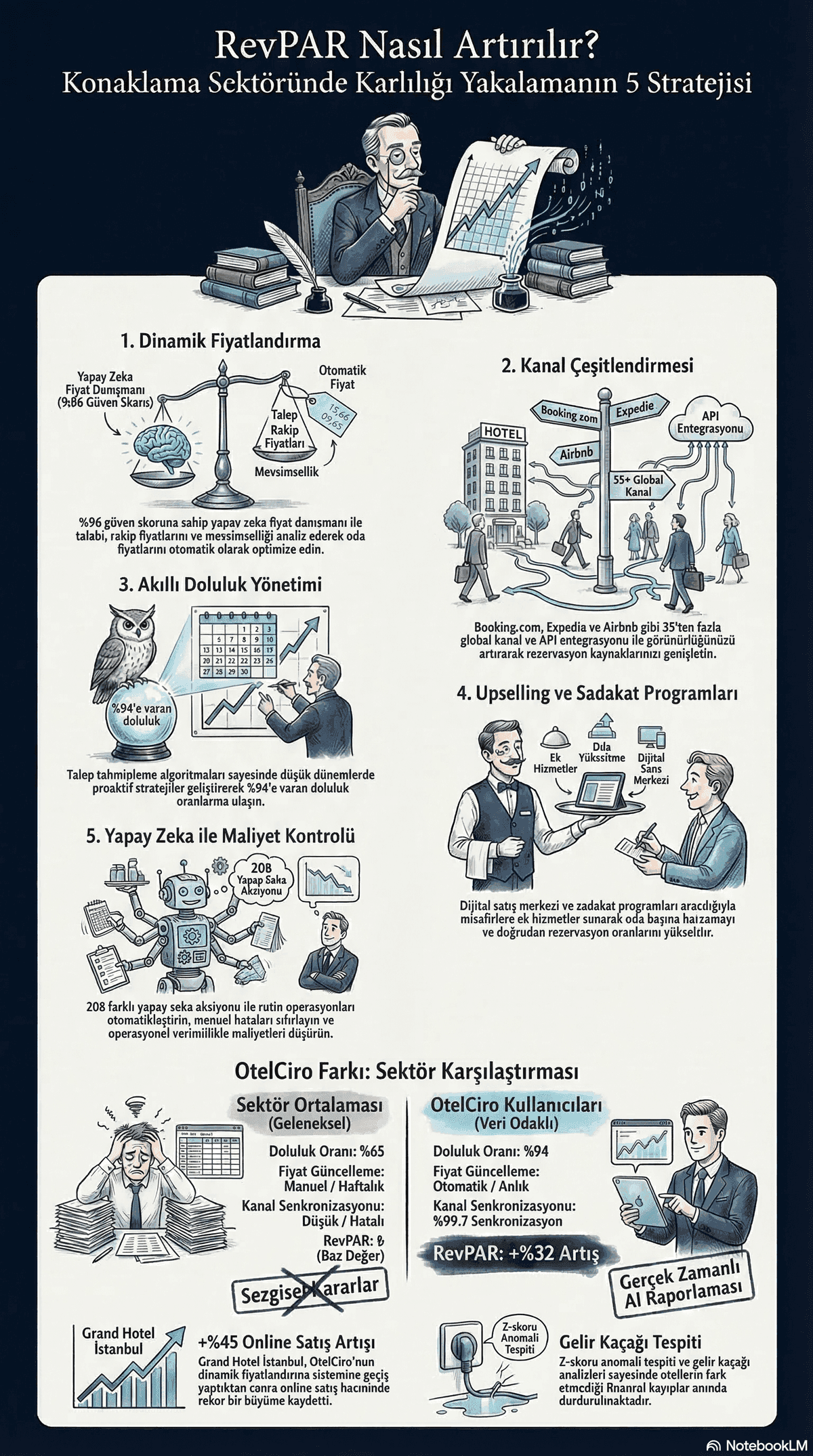
A comprehensive AI revenue management platform does not just adjust prices. It operates across five interconnected pillars:
1. Pricing Intelligence
The most visible function — dynamically setting room rates across all room types and channels based on real-time market conditions. This includes base rate optimization, promotional pricing, length-of-stay pricing, and channel-specific rate strategies.
For a deeper exploration of how dynamic pricing works in practice, see our guide on dynamic pricing in hotels.
2. Demand Forecasting
Predicting future demand with precision enables proactive rather than reactive revenue management. AI models combine dozens of demand signals to generate forecasts that are significantly more accurate than human intuition or simple historical averages.
3. Distribution Optimization
Not all channels are created equal. AI platforms analyze the true net revenue (after commissions, costs, and cancellation rates) from each channel and allocate inventory accordingly. The goal is not just to fill rooms but to fill them through the most profitable channels.
Our detailed hotel channel management guide covers distribution strategy comprehensively.
4. Competitive Intelligence
Continuous monitoring and analysis of the competitive landscape ensures that pricing decisions account for what competitors are doing — and what they are likely to do next.
5. Performance Analytics
AI generates insights, not just actions. Detailed analytics reveal which strategies are working, where revenue leakage occurs, and what opportunities remain untapped.
Implementation Timeline: From Purchase to Full Optimization
Hotels considering an AI revenue management platform often wonder how long the transition takes. Here is a realistic implementation timeline:
Week 1-2: Data Integration and System Setup
- Connect the PMS and channel manager to the AI platform
- Import historical booking data (minimum 12 months recommended, 24+ months ideal)
- Configure room types, rate plans, and competitive set
- Set initial pricing floors, ceilings, and business rules
Week 3-4: Calibration and Shadow Mode
- The AI runs in "shadow mode," generating recommendations without executing them
- Revenue team reviews AI suggestions against their own decisions
- System calibration based on property-specific patterns and preferences
- Staff training on dashboard, overrides, and reporting
Month 2: Supervised Automation
- AI begins executing pricing decisions with human approval required for major changes
- Team monitors outcomes and adjusts parameters as needed
- First performance benchmarks established
Month 3-6: Full Automation with Oversight
- AI operates autonomously within defined guardrails
- Revenue team shifts focus from execution to strategy
- Continuous performance monitoring and optimization
- First measurable ROI typically visible by month 3
Month 6-12: Advanced Optimization
- AI has accumulated enough property-specific data to identify nuanced patterns
- Advanced features activated: predictive overbooking, dynamic minimum stay, and channel-specific strategies
- RevPAR improvements compound as the system learns and refines
Why Hotels Are Moving to AI Revenue Management Now
Several market forces are accelerating the adoption of AI revenue management platforms in 2026:
OTA algorithm complexity. Booking.com, Expedia, and other major OTAs use increasingly sophisticated algorithms to rank properties. Hotels need AI to keep pace with AI. Manual optimization cannot match the speed and complexity of OTA ranking systems.
Guest expectation for fair pricing. Travelers now use metasearch engines and comparison tools routinely. Inconsistent or uncompetitive pricing is punished immediately with lost bookings.
Labor market challenges. Experienced revenue managers are scarce and expensive. AI platforms allow smaller properties to access enterprise-level revenue optimization without a dedicated revenue management team.
Data volume explosion. The amount of data relevant to pricing decisions — competitor rates, flight searches, social media sentiment, weather, events — has grown exponentially. No human can process it all. AI can.
For a broader perspective on how AI is reshaping the hospitality industry, read our overview of AI in hospitality.
Related reading: Dynamic vs. Static Pricing: How the Taylor Swift Effect Can Skyrocket Your Revenue
Choosing the Right AI Revenue Management Platform
Not all platforms are equal. When evaluating options, prioritize these capabilities:
- Native PMS integration — avoid platforms that require complex middleware or manual data transfers
- Multi-channel distribution — the platform should manage pricing across all OTAs, metasearch engines, and direct channels from a single interface
- Transparent AI — you should be able to understand why the AI made each decision, not just what it decided
- Customizable guardrails — the ability to set minimum rates, maximum rate changes, and business rules that the AI respects
- Proven hospitality expertise — choose platforms built specifically for hotels, not generic pricing tools
OtelCiro combines all of these capabilities in a single integrated platform. The AI Engine works seamlessly with the Smart PMS, creating a unified system that manages revenue optimization end-to-end.
For hotels seeking a comprehensive understanding of revenue management fundamentals before implementing AI, our hotel revenue management guide provides the essential foundation.
Conclusion
AI revenue management is no longer an emerging technology — it is the standard for competitive hotel operations in 2026. The hotels that adopt it gain measurable, compounding advantages in RevPAR, profitability, and operational efficiency. The hotels that delay fall further behind with each passing quarter.
The question is not whether to implement AI revenue management, but how quickly you can get started. With implementation timelines measured in weeks rather than months, and ROI visible within the first quarter, the barrier to entry has never been lower.
![Hotel Upselling: AI-Driven Revenue Growth [2026]](https://cdn.sanity.io/images/1la98t0z/production/9850350573fc466b95b1490c7f689e8ac39c4f11-1200x669.png?w=1920&q=50&auto=format&fit=max)