![Boutique Hotel Marketing: 7 Ways to Stand Out [2026]](https://cdn.sanity.io/images/1la98t0z/production/f6dfaa9286d0d7481ac76597978bd5f01acfb0a7-1376x768.jpg?w=1920&q=65&auto=format&fit=max)
The Boutique Hotel Advantage (And the Challenge)
Boutique hotels possess something chain properties spend billions trying to replicate: authentic character. Each property tells a unique story through its design, service philosophy, and connection to its locale. In 2026, this authenticity is exactly what travelers crave — 68% of millennials and Gen Z travelers prefer boutique or independent hotels over chains, according to Skift Research.
Yet authenticity alone does not fill rooms. Boutique hotels face a marketing paradox: they have the best stories to tell but the smallest budgets to tell them. The average boutique hotel marketing budget is 3-5% of revenue, compared to 6-10% for chain brands. Competing against Marriott's $2 billion marketing spend requires a fundamentally different approach — one built on differentiation, storytelling, and digital precision rather than brute-force advertising.

Embed this image on your site
<a href="https://otelciro.com/en/news/boutique-hotel-marketing-strategy">
  <img src="https://cdn.sanity.io/images/1la98t0z/production/f6dfaa9286d0d7481ac76597978bd5f01acfb0a7-1376x768.jpg" alt="Boutique hotel marketing strategy infographic" width="800" />
</a>
<p>Source: <a href="https://otelciro.com">OtelCiro</a> — AI Hotel Revenue Management</p>
The Brand Differentiation Framework
Step 1: Define Your "Only"
Every boutique hotel needs an "only" statement — the one thing that makes it impossible to substitute:
- "The only hotel in [city] designed entirely by local artisans"
- "The only urban retreat with a rooftop apiary and honey-infused cocktail menu"
- "The only historic palazzo in [region] offering private art collection tours"
If your "only" statement could apply to another hotel, it is not specific enough.
Step 2: Identify Your Ideal Guest
Boutique hotels succeed by deeply serving a narrow audience, not broadly serving everyone:
| Guest Archetype | Characteristics | Content Approach |
|---|---|---|
| Design enthusiast | Values aesthetics, follows design publications | Showcase architecture, interiors, design story |
| Culinary explorer | Food-driven travel, experience-seeker | Chef stories, kitchen garden, local food culture |
| Culture seeker | Museum-goer, art lover, history buff | Local cultural connections, curated experiences |
| Wellness traveler | Health-conscious, stress recovery | Calm spaces, wellness programming, nature access |
| Digital nomad | Remote worker, long-stay, community-seeking | Work amenities, neighborhood guide, social spaces |
Step 3: Craft Your Brand Voice
Your brand voice should be as distinctive as your property. Define:
- Tone: Warm and intimate? Playful and irreverent? Serene and minimal?
- Vocabulary: Words that appear in your copy (and words that never do)
- Personality: If your hotel were a person, how would they speak?
Embed this image on your site
<a href="https://otelciro.com/en/news/boutique-hotel-marketing-strategy">
  <img src="https://cdn.sanity.io/images/1la98t0z/production/05f55a66419f5d192a62afa971d35798c4deebda-1200x670.png" alt="Hotel upselling and cross-selling techniques" width="800" />
</a>
<p>Source: <a href="https://otelciro.com">OtelCiro</a> — AI Hotel Revenue Management</p>
Content Marketing Strategy
The 3-Pillar Content Model
Pillar 1: Story Content (40%) The narrative behind your hotel — its history, design philosophy, the people who make it special.
Content formats:
- "Meet our team" profiles with real personality
- Design story: the inspiration behind each space
- Heritage narrative: the building's history and restoration
- Founder's vision: why this hotel exists
Pillar 2: Experience Content (35%) What it feels like to stay — the sensory, emotional, and experiential elements.
Content formats:
- Room tours with atmospheric photography
- "A day at [hotel]" video series
- Guest stories and testimonials (user-generated content)
- Seasonal experience highlights
Pillar 3: Local Authority Content (25%) Position your hotel as the gateway to local culture, making it the expert guide to its destination.
Content formats:
- Neighborhood guides with genuine insider recommendations
- Seasonal event calendars with hotel-curated highlights
- "Chef recommends" local restaurant lists
- Walking tour itineraries
Social Media Strategy
Instagram: The Primary Boutique Channel
Instagram remains the most impactful platform for boutique hotels. Key strategies:
- Aesthetic consistency: Develop a visual identity that is instantly recognizable
- Story content daily: Behind-the-scenes, team moments, guest interactions
- Reels: Short-form video tours, local experiences, atmospheric captures
- UGC curation: Repost guest content (with permission) for social proof
- Instagram Booking: Enable direct booking links in stories and bio
Benchmark: 3-5% engagement rate for boutique hotel accounts (vs. 0.5-1% for chain hotel accounts)
TikTok: The Discovery Engine
TikTok drives hotel discovery for 18-35 year olds:
- Room reveal videos
- "Hotels you didn't know existed" format
- ASMR-style content (room sounds, breakfast preparation)
- Staff personality content
Pinterest: The Planning Platform
Travelers use Pinterest to plan trips. Optimize for:
- Destination-focused boards
- Room and design inspiration pins
- Travel planning guides linking to your blog
- Wedding and event inspiration (if applicable)
Embed this image on your site
<a href="https://otelciro.com/en/news/boutique-hotel-marketing-strategy">
  <img src="https://cdn.sanity.io/images/1la98t0z/production/8a93e1fc60466341571b6624007b4e830262ba56-1200x670.png" alt="OtelCiro ecosystem all-in-one platform overview" width="800" />
</a>
<p>Source: <a href="https://otelciro.com">OtelCiro</a> — AI Hotel Revenue Management</p>
Direct Booking Optimization
The Boutique Booking Engine Advantage
Boutique hotels should convert at a higher direct rate than chains because:
- Guests are buying an experience, not just a room — your website conveys this better than an OTA listing
- Price comparison is less relevant when the product is unique
- Emotional connection drives booking decision more than rate
Optimization checklist:
- Website that reflects your brand story (not a generic template)
- Full-bleed photography that conveys atmosphere
- Transparent pricing with direct-only perks clearly displayed
- Mobile-first design (60%+ of boutique hotel traffic is mobile)
- Fast loading (under 2.5 seconds)
- Social proof integration (reviews, press mentions, awards)
Boutique vs Chain Marketing Budget Comparison
| Channel | Chain Budget % | Boutique Recommended % | Rationale |
|---|---|---|---|
| Paid search (brand) | 25% | 15% | Protect brand terms |
| Paid search (generic) | 20% | 5% | Too expensive to compete |
| Social media (organic) | 5% | 25% | Your authenticity advantage |
| Social media (paid) | 15% | 20% | Targeted, visual platform |
| Content marketing | 10% | 20% | Build authority, SEO value |
| Email marketing | 10% | 15% | Highest ROI channel |
| OTA investment | 15% | 0% | Not a marketing spend |
PR and Earned Media
Boutique hotels have a natural advantage in earned media — journalists and travel writers prefer covering unique properties over chain hotels:
- Build a press kit: Professional photos, brand story, fact sheet, availability for press trips
- Target niche publications: Design magazines, food blogs, lifestyle media in your source markets
- Pitch seasonal stories: "Best new hotels for winter," "Design hotels worth the trip"
- Leverage awards: Submit to boutique hotel award programs (Boutique Hotel Awards, Design Hotels, Mr & Mrs Smith)
- Invite micro-influencers: 10,000-50,000 follower accounts with high engagement deliver better ROI than mega-influencers
Review and Reputation Strategy
For boutique hotels, reviews are the single most powerful marketing asset:
- Every review is a story told by a real guest — more persuasive than any ad
- Target an 8.8+ score on Booking.com and 4.5+ on Google
- Respond to every review personally (not using templates)
- Highlight specific stay details in responses to demonstrate attention
- Proactively collect reviews from visibly satisfied guests
OtelCiro: Technology for Boutique Excellence
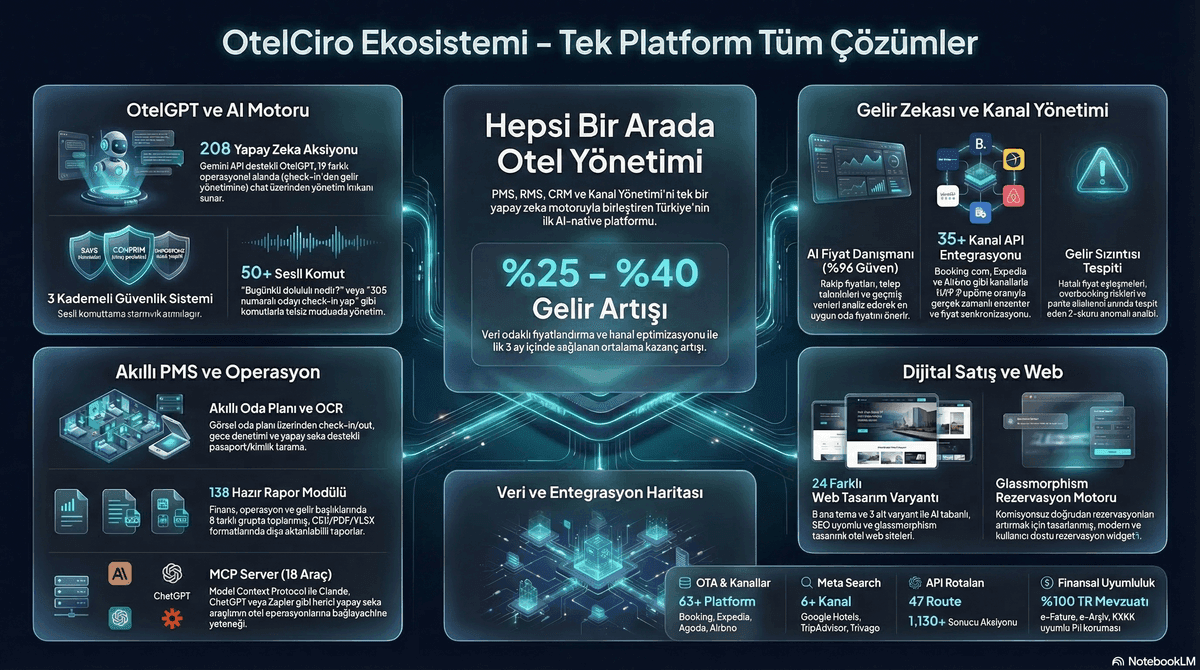
OtelCiro's Sales Ecosystem provides boutique hotels with the distribution and direct booking technology needed to compete with larger brands. The platform's Smart PMS manages operations while preserving the personal touch that defines boutique hospitality, and OtelGPT provides AI-powered guest communication that maintains your unique brand voice.
For marketing-adjacent strategies, read our hotel SEO strategy guide and email marketing automation guide.
Conclusion
Boutique hotel marketing in 2026 is not about outspending the competition — it is about out-storying them. Your authentic character, unique design, and genuine connection to place are marketing assets that no chain can replicate and no budget can buy. The strategy is clear: define what makes you uniquely irreplaceable, tell that story consistently across owned channels, and convert the emotional connection into direct bookings. Boutique hotels that master this formula do not just survive in a crowded market — they define it.
Discover how OtelCiro's Sales Ecosystem can help your boutique hotel reach the right travelers and convert your unique story into direct revenue.