
![AI Hotel Revenue Management: Complete Guide [2026]](https://cdn.sanity.io/images/1la98t0z/production/0fde5a7ccfdfdadcbcaecd74553f2fb8fcb01270-1200x669.png?w=1920&q=65&auto=format&fit=max)
The AI Revolution in Hotel Revenue Management
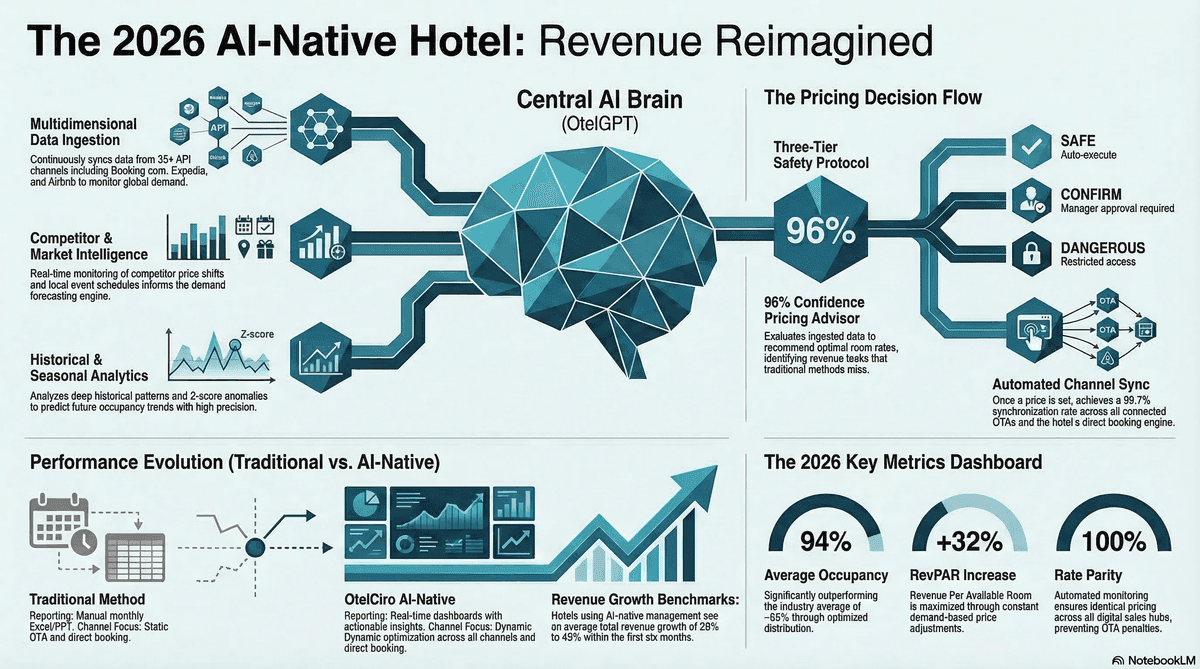
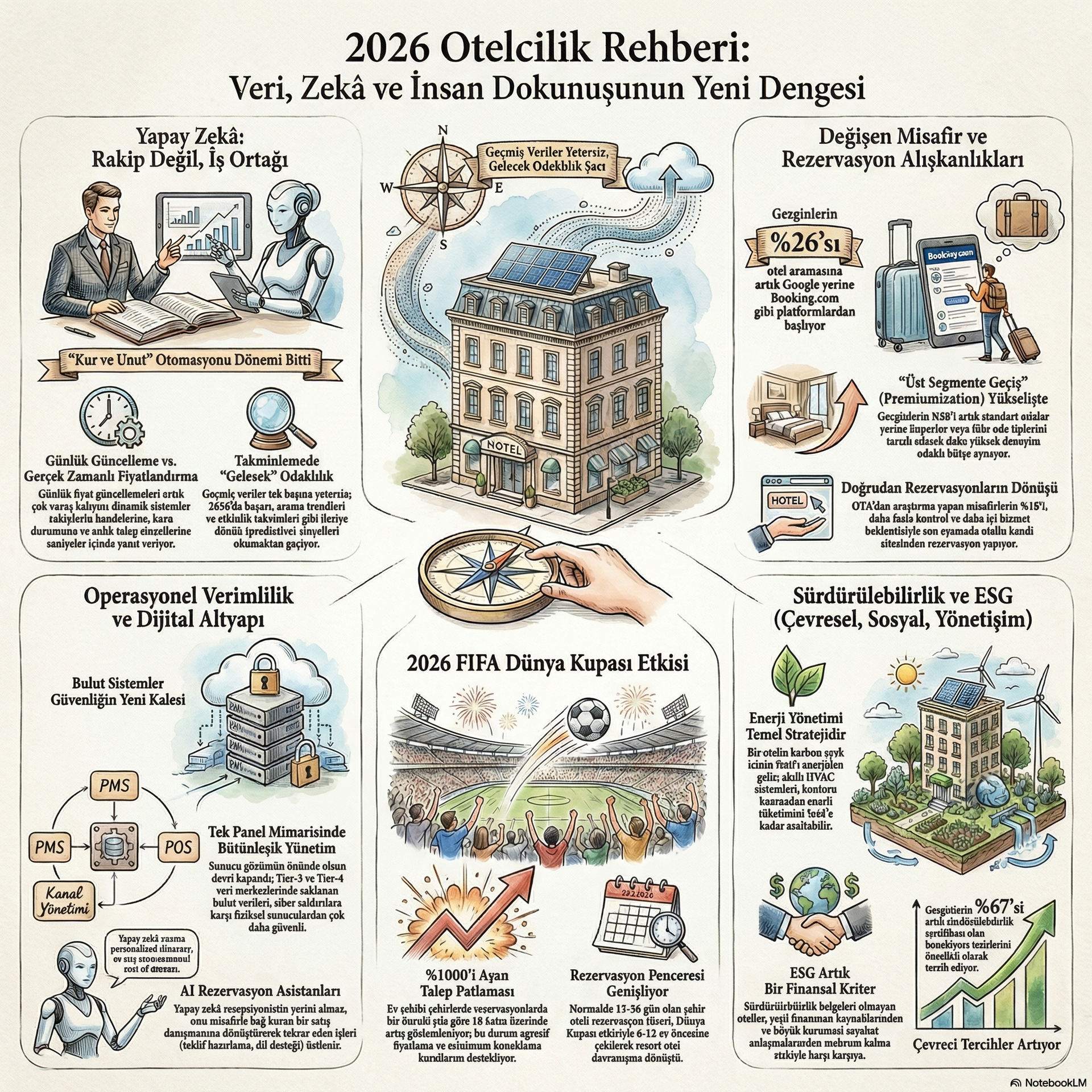
Hotel revenue management has entered a new era. What was once a discipline built on spreadsheets, gut instinct, and last year's data has been transformed by artificial intelligence into a real-time, predictive, and increasingly autonomous function. In 2026, hotels using AI-powered revenue management systems report an average RevPAR increase of 8-15% compared to those relying on traditional methods.
The shift is not incremental — it is foundational. AI does not just do the same job faster; it fundamentally changes what is possible in hotel pricing. A human revenue manager can evaluate perhaps 50-100 data points before making a pricing decision. An AI system processes 10,000+ variables in milliseconds, identifying patterns invisible to even the most experienced professional.
Embed this image on your site
<a href="https://otelciro.com/en/news/hotel-revenue-management-ai-2026">
  <img src="https://cdn.sanity.io/images/1la98t0z/production/0fde5a7ccfdfdadcbcaecd74553f2fb8fcb01270-1200x669.png" alt="AI-powered hotel revenue management infographic" width="800" />
</a>
<p>Source: <a href="https://otelciro.com">OtelCiro</a> — AI Hotel Revenue Management</p>
Related reading: AI Revenue Management Platform: The Complete Hotel Solution for 2026
Related reading: 65% of Travelers Accept Dynamic Pricing: Transparency Builds Trust
How AI Revenue Management Works
The Data Foundation
AI revenue management systems ingest data from multiple streams simultaneously:
- Internal data: Historical bookings, pick-up pace, cancellation patterns, guest segments, length of stay
- Competitive data: Real-time rate shopping across 5-20 competitor properties
- Market data: Flight search volumes, event calendars, convention bookings
- External signals: Weather forecasts, social media sentiment, economic indicators
- Behavioral data: Website browsing patterns, search queries, booking abandonment
Machine Learning Models
Modern AI RMS platforms use ensemble models — combinations of multiple algorithms that outperform any single approach:
| Model Type | Strength | Application |
|---|---|---|
| Time series | Pattern recognition | Seasonal demand forecasting |
| Gradient boosting | Feature importance | Price elasticity modeling |
| Neural networks | Complex patterns | Multi-variable demand prediction |
| Reinforcement learning | Strategy optimization | Dynamic pricing decisions |
| NLP models | Text understanding | Review sentiment and market signals |
The Decision Engine
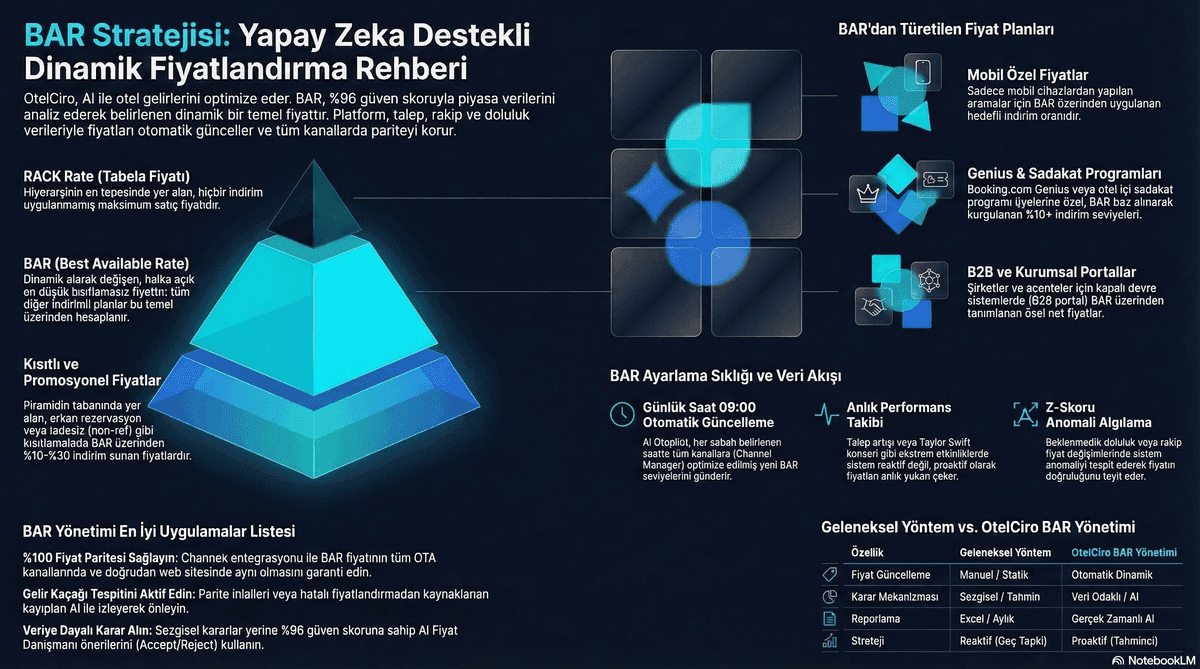
The AI pricing decision follows a continuous loop:
- Sense: Ingest real-time data from all sources
- Predict: Forecast demand by segment, room type, and date
- Optimize: Calculate optimal price for each combination
- Execute: Push prices to all distribution channels
- Learn: Measure outcomes and refine models
This loop runs continuously — every 15-60 minutes — adapting to changes faster than any human team could.
Embed this image on your site
<a href="https://otelciro.com/en/news/hotel-revenue-management-ai-2026">
  <img src="https://cdn.sanity.io/images/1la98t0z/production/d709171e0716efa2509216ec7e4818587f2b5b65-1200x669.png" alt="BAR (Best Available Rate) pricing strategy" width="800" />
</a>
<p>Source: <a href="https://otelciro.com">OtelCiro</a> — AI Hotel Revenue Management</p>
AI vs Traditional Revenue Management
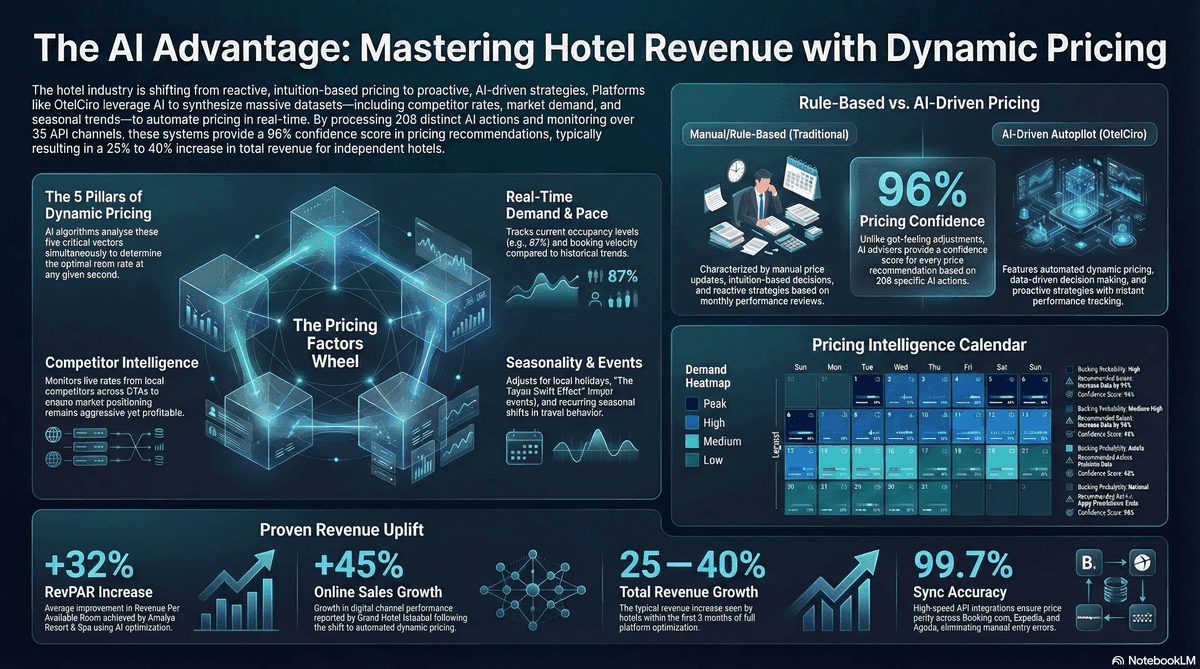
The performance gap between AI-powered and traditional approaches is widening:
| Metric | Traditional RM | AI-Powered RM | Improvement |
|---|---|---|---|
| Pricing updates | 1-2x daily | Every 15-60 min | 24-96x more frequent |
| Data points analyzed | 50-100 | 10,000+ | 100x more comprehensive |
| Forecast accuracy | 65-75% | 85-92% | +15-20 percentage points |
| RevPAR impact | Baseline | +8-15% | Significant uplift |
| Time spent on pricing | 15-20 hrs/week | 2-4 hrs/week | 80% time savings |
| Segmentation depth | 5-10 segments | 50-200 micro-segments | 10-20x granularity |
Where AI Excels
Event impact quantification: AI can measure the exact revenue impact of a local conference, sporting event, or concert — adjusting prices proportionally rather than using blunt seasonal rules.
Cancellation prediction: By analyzing booking patterns, lead time, and guest behavior, AI can predict cancellation probability at the individual reservation level, enabling smarter overbooking strategies.
Length-of-stay optimization: AI identifies the optimal length-of-stay restrictions for each date, maximizing total revenue rather than just nightly rate.
Related reading: How Many Hours a Year Does Your Hotel Run Empty? The True Cost of Unsold Rooms
Related reading: Hotel Ancillary Revenue: Unlock Hidden Profit Centers
Implementation Roadmap
Phase 1: Data Foundation (Month 1-2)
- Audit existing data quality and completeness
- Integrate PMS, channel manager, and booking engine data
- Establish competitor rate shopping feeds
- Clean historical data (minimum 2 years recommended)
Phase 2: System Selection (Month 2-3)
- Evaluate AI RMS platforms against your property's needs
- Key criteria: integration compatibility, model transparency, support quality
- Request pilot programs or proof-of-concept trials
Phase 3: Training and Calibration (Month 3-4)
- Train the system on your property's historical data
- Set business rules and guardrails (floor/ceiling rates, minimum margins)
- Run shadow mode — AI recommends, human decides
Phase 4: Supervised Automation (Month 4-6)
- Enable automated pricing with human oversight
- Monitor performance against benchmarks
- Refine business rules based on results
Phase 5: Full Automation (Month 6+)
- AI manages pricing autonomously
- Revenue manager shifts to strategic oversight
- Focus on ancillary revenue, group pricing, and long-term strategy
Embed this image on your site
<a href="https://otelciro.com/en/news/hotel-revenue-management-ai-2026">
  <img src="https://cdn.sanity.io/images/1la98t0z/production/e4a81170ea23bc3464834633cf98f17b6e55f514-1200x669.png" alt="Hotel dynamic pricing strategies comparison" width="800" />
</a>
<p>Source: <a href="https://otelciro.com">OtelCiro</a> — AI Hotel Revenue Management</p>
Common Pitfalls to Avoid
Over-constraining the AI: Setting too many floor/ceiling rules defeats the purpose of AI flexibility. Start with wide guardrails and tighten only where necessary.
Ignoring data quality: AI is only as good as its data. Inaccurate historical records, uncategorized segments, or missing competitive data undermine model accuracy.
Expecting instant results: AI models need 2-4 months of live data to calibrate effectively. Judging performance in the first 30 days is premature.
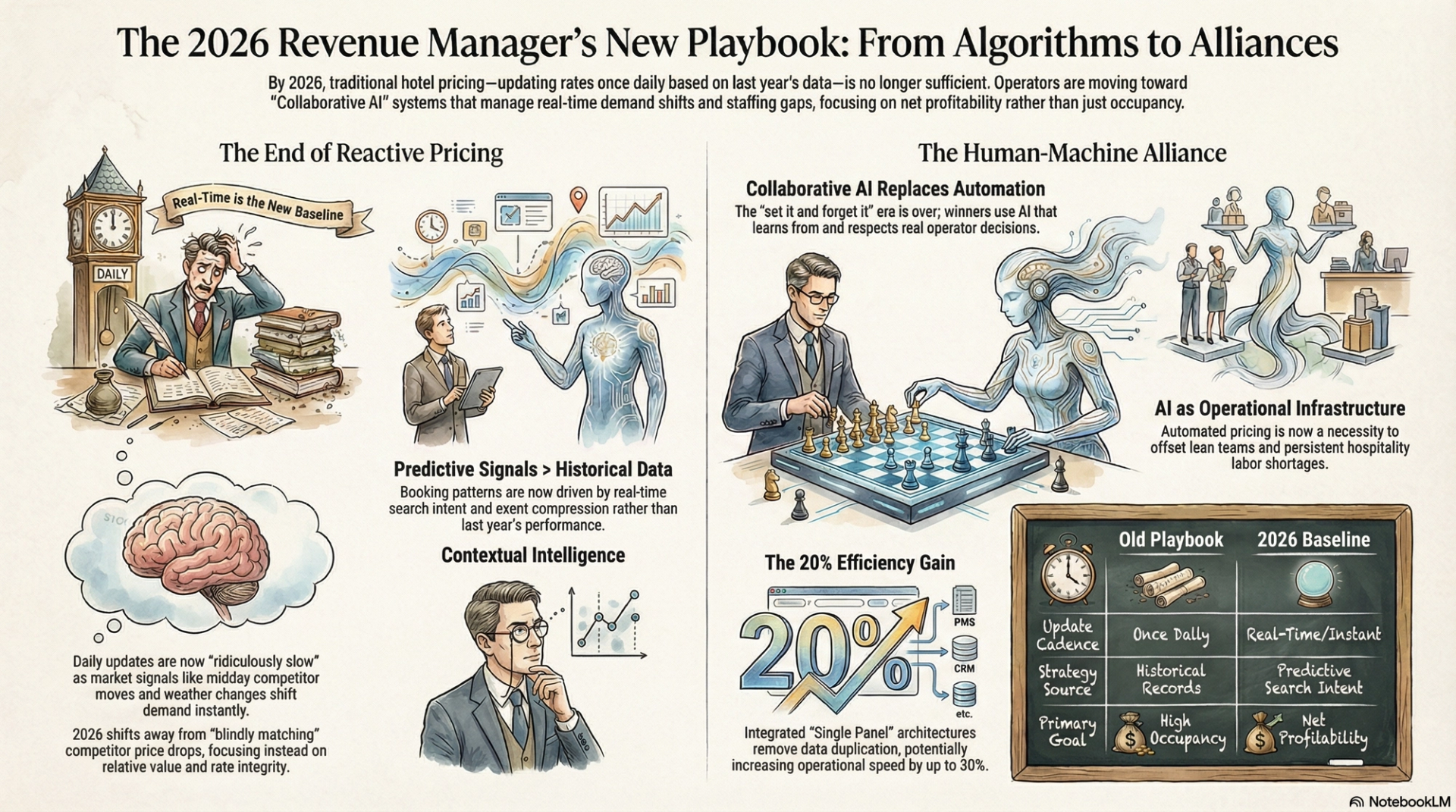
Neglecting the human element: AI handles tactical pricing; humans drive strategic decisions. The best results come from AI-human collaboration, not replacement.
The Future: Agentic AI in Revenue Management
The next evolution is agentic AI — systems that not only recommend and execute pricing decisions but autonomously manage the entire revenue strategy. This includes automatically adjusting distribution channel mix, negotiating group rates, and coordinating with marketing campaigns.
By 2027, early adopters of agentic AI in revenue management are projected to achieve 20-30% higher RevPAR than properties using basic RMS tools.
Related reading: Dynamic vs. Static Pricing: How the Taylor Swift Effect Can Skyrocket Your Revenue
OtelCiro: AI Revenue Management Built for Hotels
OtelCiro's AI Engine brings enterprise-grade AI revenue management to independent hotels. The platform processes thousands of data points in real-time, delivers segment-level pricing optimization, and provides transparent recommendations that revenue managers can understand and trust.
For a deeper dive into dynamic pricing mechanics, read our dynamic pricing guide. For the broader AI landscape in hospitality, explore our AI in hospitality overview.
Conclusion
AI-powered revenue management is no longer a competitive advantage — it is becoming the baseline for professional hotel operations. Properties that delay adoption risk falling behind not just in pricing precision but in the fundamental ability to compete for demand in an increasingly algorithm-driven marketplace.
Discover how OtelCiro's AI Engine can transform your hotel's revenue management with intelligent, automated pricing that learns and improves continuously.
![Hotel Upselling: AI-Driven Revenue Growth [2026]](https://cdn.sanity.io/images/1la98t0z/production/9850350573fc466b95b1490c7f689e8ac39c4f11-1200x669.png?w=1920&q=50&auto=format&fit=max)