![12 Hotel Green Practices That Cut Costs [2026]](https://cdn.sanity.io/images/1la98t0z/production/411751c83639e7c52437bcea19911157646e95bb-1376x768.jpg?w=1920&q=65&auto=format&fit=max)
Sustainability Is No Longer a Choice — It Is a Business Strategy
The debate about whether hotels should invest in sustainability is over. In 2026, it is a revenue driver, a cost reducer, and increasingly a booking requirement. Booking.com's Travel Sustainable badge influences 42% of travelers' booking decisions. Corporate travel programs now require sustainability certifications for approved hotels. And operationally, green practices reduce utility costs by 15-30%.
The global hotel industry generates an estimated 1% of global carbon emissions — roughly equivalent to the emissions of a small country. Regulatory pressure is mounting, with the EU's Corporate Sustainability Reporting Directive (CSRD) extending to hotels above certain revenue thresholds. But the most compelling argument for sustainability is economic: every euro saved on energy, water, and waste goes directly to the bottom line.

Embed this image on your site
<a href="https://otelciro.com/en/news/hotel-sustainability-green-practices">
  <img src="https://cdn.sanity.io/images/1la98t0z/production/411751c83639e7c52437bcea19911157646e95bb-1376x768.jpg" alt="Hotel sustainability and green practices infographic" width="800" />
</a>
<p>Source: <a href="https://otelciro.com">OtelCiro</a> — AI Hotel Revenue Management</p>
The Five Pillars of Hotel Sustainability
Pillar 1: Energy Management
Energy is typically a hotel's second-largest operating cost (after labor), representing 3-6% of total revenue.
Quick wins:
- LED lighting conversion: 50-70% energy reduction for lighting
- Smart thermostats: 15-25% HVAC savings
- Motion sensors in corridors and public areas
- Key card energy management (power cuts when guest leaves room)
Strategic investments:
- Solar panel installation: 10-30% electricity offset
- Heat pump systems: 40-60% heating efficiency improvement
- Building management systems (BMS): Centralized energy optimization
- Green building retrofits: Insulation, window upgrades
Benchmark: Energy cost per occupied room should target $8-12 (currently industry average is $12-18).
Pillar 2: Water Conservation
Hotels consume 100-300 gallons of water per occupied room per day.
Implementation roadmap:
| Initiative | Water Savings | Investment | Payback |
|---|---|---|---|
| Low-flow showerheads | 30-40% shower water | $20/room | 2 months |
| Dual-flush toilets | 40-50% toilet water | $150/room | 8 months |
| Towel reuse program | 15-20% laundry water | $5/room (signage) | 1 month |
| Linen change on request | 20-30% laundry water | $5/room (signage) | 1 month |
| Rainwater harvesting | 15-25% irrigation | $5,000-15,000 | 2-4 years |
| Greywater recycling | 30-40% total water | $10,000-30,000 | 3-5 years |
Pillar 3: Waste Reduction
Hotels produce 1-2 kg of waste per guest per night, with only 20-30% being recycled on average.
Priority actions:
- Eliminate single-use plastics: Replace individual amenity bottles with bulk dispensers
- Implement source separation: Recycling stations in back-of-house and guest areas
- Food waste management: Composting, portion optimization, AI-powered demand forecasting for F&B
- Digital guest communication: Replace paper directories, menus, and forms
Revenue opportunity: Food waste reduction alone can save a 100-room full-service hotel $15,000-30,000 annually.
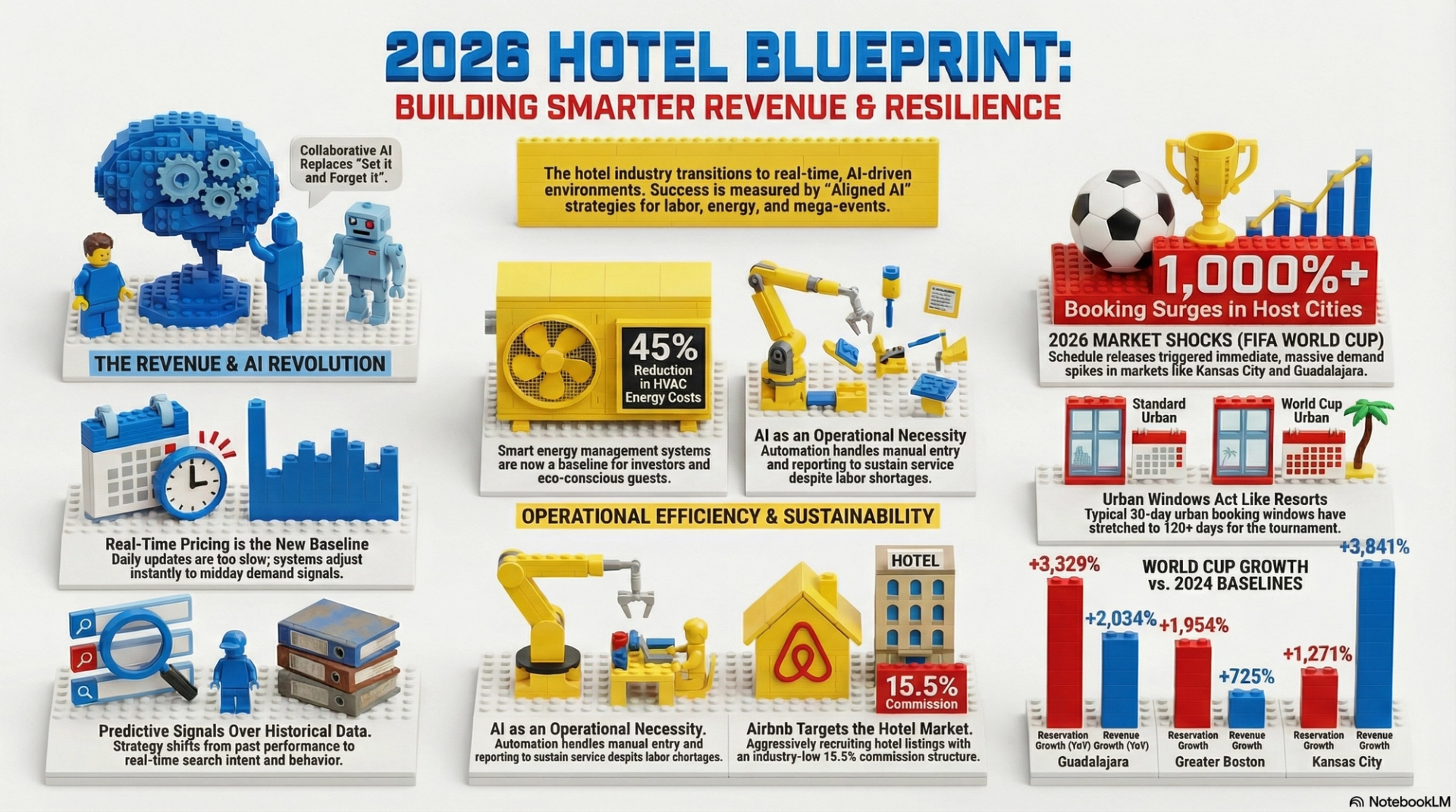
Pillar 4: Sustainable Food and Beverage
F&B operations represent a major sustainability opportunity:
- Source locally: 30% reduction in food miles, fresher ingredients, stronger community ties
- Seasonal menus: Lower procurement costs, reduced waste
- Plant-forward options: Lower carbon footprint, growing guest demand
- Food waste tracking: What gets measured gets managed — track and set reduction targets
Pillar 5: Sustainable Supply Chain
Extend sustainability beyond your four walls:
- Choose suppliers with sustainability credentials
- Prioritize eco-friendly cleaning products
- Select sustainable furniture and textiles during renovations
- Offset remaining carbon through verified programs
Embed this image on your site
<a href="https://otelciro.com/en/news/hotel-sustainability-green-practices">
  <img src="https://cdn.sanity.io/images/1la98t0z/production/ca584d448cd6c3a6150a46c0e1881553f42a99b2-1200x669.png" alt="Hotel automation and business process flow" width="800" />
</a>
<p>Source: <a href="https://otelciro.com">OtelCiro</a> — AI Hotel Revenue Management</p>
Green Certifications: Which One Is Right?
| Certification | Recognition | Cost | Difficulty | Best For |
|---|---|---|---|---|
| Booking.com Travel Sustainable | Very high (visible on platform) | Free | Low-Medium | All hotels |
| Green Key | High (global) | $500-2,000/year | Medium | Mid-range to luxury |
| LEED | Very high (building standard) | $5,000-25,000 | High | New builds/major renovations |
| EarthCheck | High (hospitality-specific) | $1,000-3,000/year | Medium | All hotel types |
| EU Ecolabel | High (Europe) | $500-1,500/year | Medium | European properties |
Recommendation: Start with Booking.com Travel Sustainable (free, immediate visibility impact) and progress to Green Key or EarthCheck for deeper credibility.
The Guest Perspective
Guest attitudes toward sustainable hotels in 2026:
- 78% consider sustainability when choosing a hotel
- 65% are willing to pay 5-10% more for a verified sustainable hotel
- 42% actively use Booking.com's sustainability filter
- 88% expect basic practices (recycling, energy efficiency) as standard
- 34% would leave a negative review if a hotel claims sustainability but visibly wastes resources
The key insight: sustainability must be genuine, not greenwashing. Guests are increasingly sophisticated at detecting performative sustainability.
Embed this image on your site
<a href="https://otelciro.com/en/news/hotel-sustainability-green-practices">
  <img src="https://cdn.sanity.io/images/1la98t0z/production/0fde5a7ccfdfdadcbcaecd74553f2fb8fcb01270-1200x669.png" alt="2026 AI-powered hotel revenue management" width="800" />
</a>
<p>Source: <a href="https://otelciro.com">OtelCiro</a> — AI Hotel Revenue Management</p>
Measuring Sustainability ROI
| Initiative | Annual Cost Savings | Implementation Cost | Payback Period |
|---|---|---|---|
| LED conversion | $8,000-15,000 | $10,000-20,000 | 1-2 years |
| Smart HVAC | $12,000-25,000 | $15,000-30,000 | 1-2 years |
| Water conservation | $5,000-12,000 | $3,000-8,000 | <1 year |
| Waste reduction | $8,000-20,000 | $2,000-5,000 | <6 months |
| Solar panels | $10,000-30,000 | $50,000-150,000 | 3-7 years |
| Booking premium (ADR) | $15,000-40,000 | Varies | Immediate |
Total estimated annual benefit for a 100-room hotel: $58,000-$142,000 in cost savings plus potential ADR premium.
OtelCiro: Sustainable Operations Support
OtelCiro's Operations suite includes energy and resource monitoring tools that help hotels track consumption, identify waste, and measure the impact of sustainability initiatives. The Reports platform provides sustainability KPI dashboards alongside revenue and operational metrics.
For operational efficiency context, read our hotel automation guide and operations digital transformation roadmap.
Conclusion
Hotel sustainability in 2026 is where revenue management was 15 years ago — early adopters are building competitive advantages that late movers will struggle to replicate. The economic case is clear: green practices reduce costs, attract sustainability-conscious guests, enable premium pricing, and future-proof operations against tightening regulations. Start with the quick wins, measure relentlessly, and build toward comprehensive sustainability.
Discover how OtelCiro's Operations suite can help you track and optimize your hotel's sustainability performance alongside revenue and operational KPIs.
![Hotel Digital Transformation: 5-Step Roadmap [2026]](https://cdn.sanity.io/images/1la98t0z/production/340311fa5f6d3a6374d3e71d3cba85cb6186bf3d-1376x768.jpg?w=1920&q=50&auto=format&fit=max)