
![10 Generative AI Use Cases for Hotels [2026]](https://cdn.sanity.io/images/1la98t0z/production/a9b97999291d6c665ccb07c2ce0ca76fd3b8eadd-1376x768.jpg?w=1920&q=65&auto=format&fit=max)
Generative AI Has Arrived in Hospitality
Generative AI — the technology behind ChatGPT, Claude, and Gemini — has moved from Silicon Valley novelty to hotel operations reality in just two years. In 2026, 48% of hotel companies report using generative AI in at least one operational area, up from 12% in 2024. The technology's ability to understand context, generate human-quality text, and process unstructured data makes it uniquely suited to the communication-heavy, service-oriented nature of hospitality.
Unlike traditional software that automates repetitive tasks, generative AI handles creative, nuanced work that previously required human intelligence: writing personalized guest communications, analyzing review sentiment, creating marketing content, and even participating in revenue strategy discussions. Here are 10 use cases that are already delivering measurable value.

Embed this image on your site
<a href="https://otelciro.com/en/news/hotel-generative-ai-use-cases">
  <img src="https://cdn.sanity.io/images/1la98t0z/production/a9b97999291d6c665ccb07c2ce0ca76fd3b8eadd-1376x768.jpg" alt="Generative AI hotel use cases infographic" width="800" />
</a>
<p>Source: <a href="https://otelciro.com">OtelCiro</a> — AI Hotel Revenue Management</p>
Related reading: Hotel Automation: 15 Processes You Should Automate Today
Related reading: Hotel Management System Comparison: 2026 Selection Guide
10 Generative AI Use Cases
1. Guest Communication and Concierge
What it does: AI handles guest inquiries across all channels — email, chat, WhatsApp, voice — with contextual, personalized responses.
Implementation complexity: Low-Medium Expected impact: 40-60% reduction in routine inquiry workload
Example: A guest messages "What's the best way to get from the airport to the hotel?" The AI provides directions specific to the airport and hotel, includes current transportation options with pricing, and offers to arrange a transfer — all personalized to the guest's arrival time.
2. Review Response Generation
What it does: AI drafts personalized responses to guest reviews across all platforms, maintaining the hotel's voice while addressing specific feedback.
Implementation complexity: Low Expected impact: 100% response rate achievable, 3-5 hours/week saved
Example: For a review mentioning "great location but noisy room," the AI drafts a response acknowledging the noise concern, explaining recent soundproofing improvements, offering a quieter room location for their next visit, and thanking them for the location compliment.
3. Dynamic Content Creation
What it does: AI generates and personalizes marketing content — email campaigns, social media posts, website copy, and promotional materials.
Implementation complexity: Low Expected impact: 70% reduction in content creation time
Applications:
- Seasonal email campaigns with destination-specific content
- Social media posts optimized for each platform
- OTA listing descriptions in multiple languages
- Website blog content for SEO
4. Personalized Pricing Communication
What it does: AI explains pricing decisions to guests in natural language, helping front desk and reservations teams communicate value effectively.
Implementation complexity: Medium Expected impact: 15-20% improvement in rate objection handling
Example: When a guest questions why rates are higher for a specific weekend, the AI provides context about local events, seasonal demand, and the value included in the rate — framed positively rather than defensively.
5. Multi-Language Translation and Localization
What it does: Real-time translation of guest communications, marketing materials, and operational documents across 50+ languages.
Implementation complexity: Low Expected impact: Access to international markets without multilingual staff
Beyond translation: Generative AI does not just translate — it localizes. A Japanese guest receives communication in polite Japanese business register, while an Australian guest gets casual, friendly tone. Cultural nuances are preserved.
6. Training Material Generation
What it does: AI creates customized training materials, SOPs, and onboarding documents based on the hotel's specific procedures and standards.
Implementation complexity: Low Expected impact: 60% reduction in training documentation time
Applications:
- New employee orientation guides
- Updated SOPs when procedures change
- Role-specific training modules
- Quiz and assessment generation
7. Revenue Strategy Analysis
What it does: AI analyzes market data, competitive intelligence, and booking patterns to generate narrative strategy reports that complement quantitative dashboards.
Implementation complexity: Medium-High Expected impact: Better strategic decisions, 10-15% improvement in forecast accuracy
Example: "This weekend's demand is 18% ahead of last year, driven primarily by the tech conference at the convention center. Competitor rates have increased 12% on average. Recommended action: increase BAR by 15% for remaining inventory, apply 2-night minimum stay, and disable OTA promotional rates."
8. Guest Sentiment Analysis
What it does: AI analyzes review text, social media mentions, and survey responses to identify trends, emerging issues, and competitive positioning.
Implementation complexity: Medium Expected impact: Proactive issue resolution, +0.2-0.4 review score improvement
Beyond star ratings: AI reads between the lines of reviews to identify:
- Emerging maintenance issues before they become widespread complaints
- Staff members consistently mentioned positively or negatively
- Competitive advantages and disadvantages from guest perspective
- Seasonal patterns in guest satisfaction
9. Forecasting Narrative Reports
What it does: AI transforms numerical forecasts into narrative reports that explain the "why" behind the numbers, making data accessible to non-analytical team members.
Implementation complexity: Medium Expected impact: Better cross-departmental alignment on revenue strategy
Example output: "March occupancy forecast of 72% is 5 points below budget, primarily due to two group cancellations totaling 120 room nights. However, transient demand is 8% ahead of pace. Recommended recovery: activate spring promotion targeting drive-market leisure segment, increase metasearch bids by 20% for March dates."
10. Automated Reporting and Insights
What it does: AI generates daily, weekly, and monthly reports with analysis and recommendations — not just data tables.
Implementation complexity: Medium Expected impact: 5-10 hours/week saved on report preparation
Features:
- Natural language summary of key performance changes
- Automatic anomaly detection and explanation
- Competitive context for all metrics
- Suggested actions based on data patterns
Embed this image on your site
<a href="https://otelciro.com/en/news/hotel-generative-ai-use-cases">
  <img src="https://cdn.sanity.io/images/1la98t0z/production/9b97fc6f7c09833a7eb10112e6784fd5f5970b20-1200x669.png" alt="Hotel cybersecurity and data protection guide" width="800" />
</a>
<p>Source: <a href="https://otelciro.com">OtelCiro</a> — AI Hotel Revenue Management</p>
Implementation Priority Matrix
| Use Case | Impact | Complexity | Priority |
|---|---|---|---|
| Review response | Medium | Low | Start here |
| Guest communication | High | Low-Medium | High |
| Content creation | Medium | Low | High |
| Translation | Medium | Low | Quick win |
| Sentiment analysis | Medium | Medium | Medium |
| Training materials | Low-Medium | Low | Quick win |
| Revenue strategy | High | Medium-High | Strategic |
| Pricing communication | Medium | Medium | Medium |
| Forecasting reports | Medium | Medium | Medium |
| Automated reporting | Medium-High | Medium | Strategic |
Related reading: Hotel Cloud PMS Migration: Step-by-Step Guide
OtelCiro: Generative AI Built for Hotels
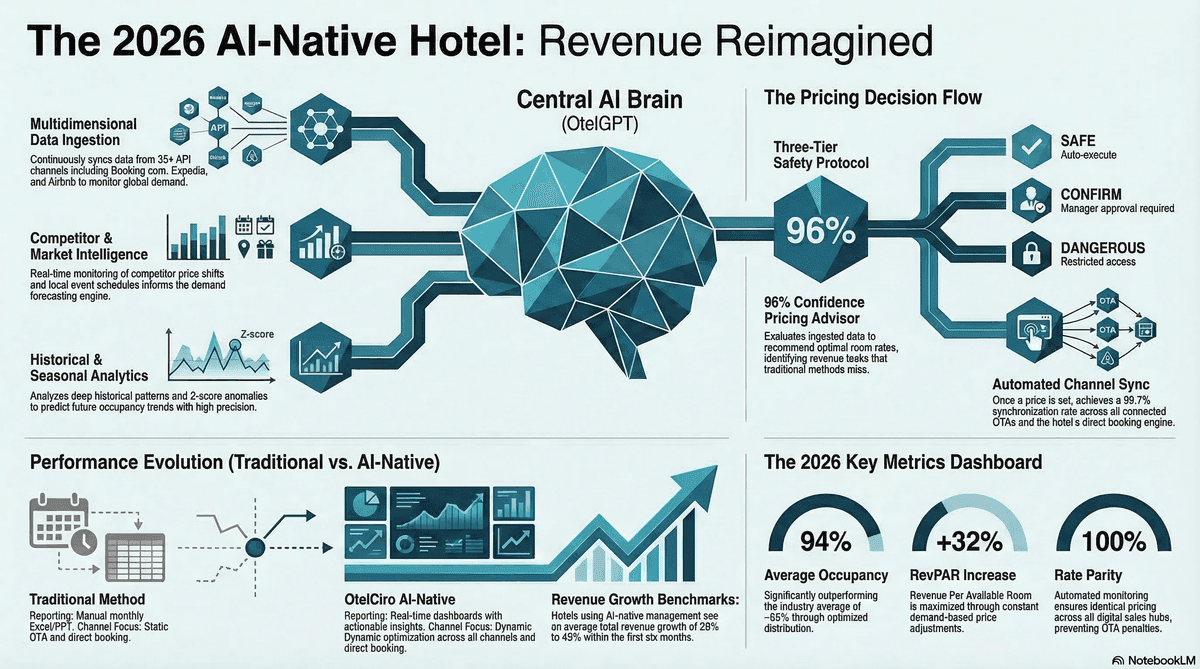
OtelCiro's OtelGPT is a purpose-built generative AI platform for hospitality. Unlike generic AI tools, it is trained on hotel-specific knowledge, integrated with property management systems, and designed for the unique communication patterns of hospitality.
The MCP integration enables OtelGPT to access real-time hotel data — availability, pricing, guest profiles — making its responses accurate, current, and actionable rather than generic.
For related technology insights, explore our AI chatbot guide and AI revenue management guide.
Embed this image on your site
<a href="https://otelciro.com/en/news/hotel-generative-ai-use-cases">
  <img src="https://cdn.sanity.io/images/1la98t0z/production/0fde5a7ccfdfdadcbcaecd74553f2fb8fcb01270-1200x669.png" alt="2026 AI-powered hotel revenue management" width="800" />
</a>
<p>Source: <a href="https://otelciro.com">OtelCiro</a> — AI Hotel Revenue Management</p>
Conclusion
Generative AI in hospitality is not about replacing the human touch — it is about amplifying it. By handling routine communication, content creation, and analytical tasks, AI frees hotel teams to focus on the creative, empathetic, and strategic work that defines great hospitality. The hotels that adopt generative AI thoughtfully in 2026 will operate more efficiently, communicate more effectively, and make better decisions — building advantages that compound over time.
Discover how OtelCiro's OtelGPT can bring the power of generative AI to your hotel's operations and guest experience.
Related reading: Hotel Data Analytics: From Raw Data to Revenue Decisions
![What Is Hotel PMS? Complete Guide [2026]](https://cdn.sanity.io/images/1la98t0z/production/ed8a88dee7e97989449e8ca197f622a21487d33b-1376x768.jpg?w=1920&q=50&auto=format&fit=max)