
![Hotel Cloud PMS Migration: 8-Step Guide [2026]](https://cdn.sanity.io/images/1la98t0z/production/be31393f794513afcf10264e0913e83879fb5fa4-1376x768.jpg?w=1920&q=65&auto=format&fit=max)
Why the Legacy PMS Must Go
Your Property Management System is the nervous system of your hotel — every reservation, check-in, billing transaction, and guest record flows through it. Yet 45% of independent hotels in 2026 still run on-premise PMS solutions that were designed in the pre-smartphone era. These legacy systems create a technology ceiling that limits every aspect of modern hotel operations.
The business case for cloud PMS migration is straightforward: cloud-based properties report 15-20% operational efficiency gains, 8-12% RevPAR improvements (through better integration with revenue management tools), and 90% reduction in IT maintenance overhead. The question is not whether to migrate, but how to do it without disrupting operations.

Embed this image on your site
<a href="https://otelciro.com/en/news/hotel-cloud-pms-migration-guide">
  <img src="https://cdn.sanity.io/images/1la98t0z/production/be31393f794513afcf10264e0913e83879fb5fa4-1376x768.jpg" alt="Hotel cloud PMS migration guide infographic" width="800" />
</a>
<p>Source: <a href="https://otelciro.com">OtelCiro</a> — AI Hotel Revenue Management</p>
Related reading: Hotel AI Chatbots: Transforming Guest Service in 2026
Related reading: Hotel Management System Comparison: 2026 Selection Guide
On-Premise vs. Cloud PMS: The Definitive Comparison
| Factor | On-Premise PMS | Cloud PMS |
|---|---|---|
| Upfront cost | $15,000-50,000 | $0-2,000 |
| Monthly cost | $200-500 + IT support | $300-800 all-inclusive |
| Updates | Manual, infrequent, disruptive | Automatic, continuous |
| Access | On-site server only | Any device, anywhere |
| Integrations | Limited, custom-coded | API-first, 200+ connections |
| Scalability | Hardware-limited | Elastic, unlimited |
| Backup/Recovery | Manual, risky | Automatic, redundant |
| Downtime | Hardware failures = hours/days | 99.9% uptime SLA |
| Security | Property-managed (often weak) | Enterprise-grade, compliant |
| Staff training | Complex interfaces | Modern, intuitive UX |
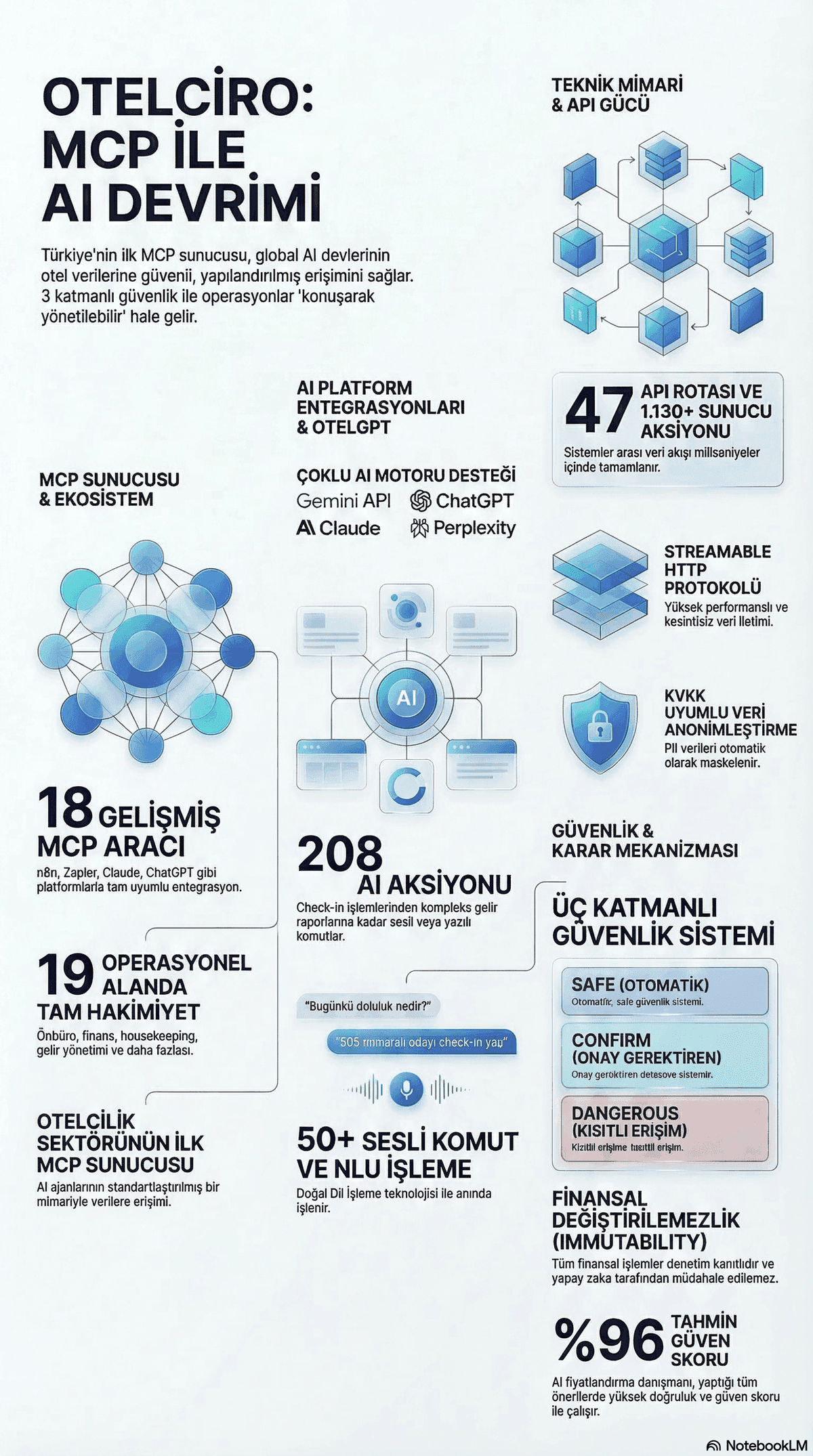
Embed this image on your site
<a href="https://otelciro.com/en/news/hotel-cloud-pms-migration-guide">
  <img src="https://cdn.sanity.io/images/1la98t0z/production/213b3b1fc5afe459c03c8d691a6983147d790b17-1200x2150.png" alt="MCP Server AI integration architecture" width="800" />
</a>
<p>Source: <a href="https://otelciro.com">OtelCiro</a> — AI Hotel Revenue Management</p>
The 8-Step Migration Roadmap
Step 1: Current State Assessment (Week 1-2)
Before selecting a new system, thoroughly audit your current environment:
- Inventory all current PMS functions you actually use (most hotels use less than 50% of their legacy PMS features)
- Map all integrations: Channel manager, POS, key card system, phone system, accounting software
- Assess data quality: Clean, accurate historical data migrates smoothly; messy data creates problems
- Identify pain points: What does your team complain about most? These are migration priorities
- Calculate current total cost: License, maintenance, IT support, lost productivity
Step 2: Requirements Definition (Week 2-3)
Define your must-haves, nice-to-haves, and deal-breakers:
Must-haves for 2026:
- Cloud-native (not just cloud-hosted legacy software)
- Open API for third-party integrations
- Mobile access for management and staff
- Real-time two-way channel manager integration
- Multi-language and multi-currency support
- Automated reporting and KPI dashboards
Evaluation matrix: Rate each vendor 1-5 on every requirement. Weight critical features at 3x, important at 2x, and nice-to-have at 1x.
Step 3: Vendor Selection (Week 3-6)
- Request demos from 3-5 shortlisted vendors
- Ask for references from similar property types
- Test API documentation quality (a proxy for integration philosophy)
- Negotiate pilot programs or trial periods
- Verify data portability (can you export your data if you leave?)
Step 4: Data Preparation (Week 6-8)
The most critical and often underestimated phase:
- Clean guest profiles: Remove duplicates, standardize formats, merge related records
- Validate reservation data: Ensure historical booking data is accurate and complete
- Export financial records: Backup all accounting data before migration
- Document custom configurations: Room types, rate plans, user permissions, report templates
Step 5: Integration Planning (Week 8-10)
Map every system that connects to your PMS and plan the integration sequence:
| System | Migration Priority | Method |
|---|---|---|
| Channel Manager | Critical (first) | Native API integration |
| Booking Engine | Critical (first) | Native integration |
| Payment Gateway | Critical (first) | PCI-compliant integration |
| Key Card System | High (week 1) | Hardware interface or API |
| POS/Restaurant | Medium (week 2) | API or middleware |
| Accounting | Medium (week 2) | Data export/import |
| Housekeeping | Low (week 3+) | New module or API |
Step 6: Staff Training (Week 10-12)
- Train-the-trainer model: Select 2-3 power users who learn the system deeply and then train their teams
- Role-based training: Front desk, housekeeping, management, and accounting each need different training modules
- Create cheat sheets: Quick-reference guides for common daily tasks
- Practice environment: Use a sandbox/test environment for hands-on training before go-live
Step 7: Go-Live Execution (Week 12-13)
Recommended approach: Parallel running
Run both old and new systems simultaneously for 1-2 weeks. This eliminates risk but doubles workload temporarily.
Go-live checklist:
- All integrations tested and verified
- All staff trained and confident
- Data migration complete and validated
- Backup plan documented (rollback procedure)
- Vendor support on standby
- Low-occupancy period selected for go-live
- Guest-facing processes tested end-to-end
Step 8: Post-Migration Optimization (Week 14+)
- Week 1-2: Monitor for issues, collect staff feedback, fix quick problems
- Month 1: Review all automated processes and reports
- Month 2: Optimize workflows based on real usage patterns
- Month 3: Evaluate new features not available in old system
- Ongoing: Continuous improvement based on vendor updates and business needs
Related reading: Hotel Data Analytics: From Raw Data to Revenue Decisions
Risk Mitigation
| Risk | Probability | Impact | Mitigation |
|---|---|---|---|
| Data loss | Low | Critical | Multiple backups, validation checksums |
| Integration failure | Medium | High | Test thoroughly in staging, have manual fallbacks |
| Staff resistance | High | Medium | Involve staff early, highlight benefits, provide extensive training |
| Downtime during migration | Medium | High | Parallel running period, low-occupancy timing |
| Vendor underperformance | Low | High | Contractual SLAs, reference checks |
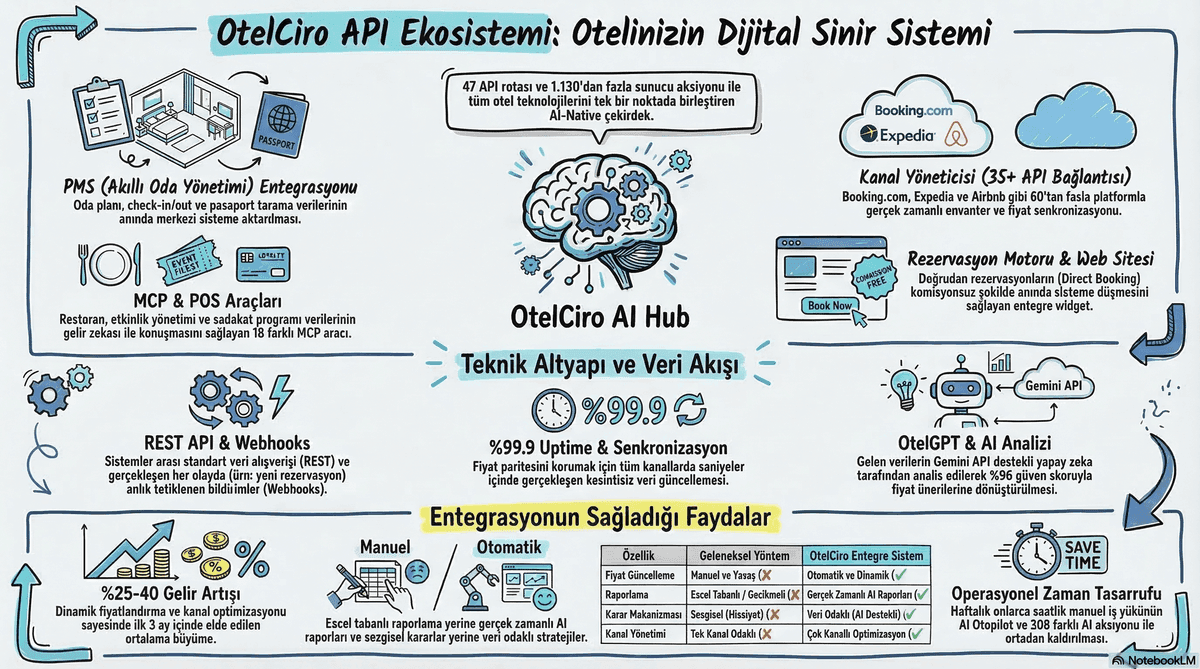
Embed this image on your site
<a href="https://otelciro.com/en/news/hotel-cloud-pms-migration-guide">
  <img src="https://cdn.sanity.io/images/1la98t0z/production/46982eee55bf4225dd55170e11b536c3dcd9b3f4-1200x669.png" alt="Modern hotel API integration ecosystem" width="800" />
</a>
<p>Source: <a href="https://otelciro.com">OtelCiro</a> — AI Hotel Revenue Management</p>
OtelCiro: Cloud PMS Built for Modern Hotels
OtelCiro's Smart PMS was built cloud-native from day one — not a legacy system ported to the cloud. It offers the open API architecture, native integrations, and modern user experience that define the new standard for hotel property management.
The platform includes a structured migration support program that handles data transfer, integration setup, and staff training to minimize disruption during the transition.
For technology strategy context, read our essential hotel tech stack guide and hotel automation guide.
Related reading: Generative AI in Hotels: 10 Use Cases Transforming Hospitality
Conclusion
Cloud PMS migration is the single most impactful technology decision a hotel can make. It unlocks access to modern revenue management, distribution, and guest experience tools that are simply impossible with legacy systems. The migration process, while requiring careful planning, is well-understood and manageable — especially with a vendor committed to supporting the transition.
Discover how OtelCiro's Smart PMS can modernize your hotel operations with a structured, low-risk migration process.
![What Is Hotel PMS? Complete Guide [2026]](https://cdn.sanity.io/images/1la98t0z/production/ed8a88dee7e97989449e8ca197f622a21487d33b-1376x768.jpg?w=1920&q=50&auto=format&fit=max)