
![Hotel Cancellation & No-Show: 5 Proven Fixes [2026]](https://cdn.sanity.io/images/1la98t0z/production/e653b761391abbb1fb194d56a1b0ad5a66962360-1376x768.jpg?w=1920&q=65&auto=format&fit=max)
The $50 Billion Problem
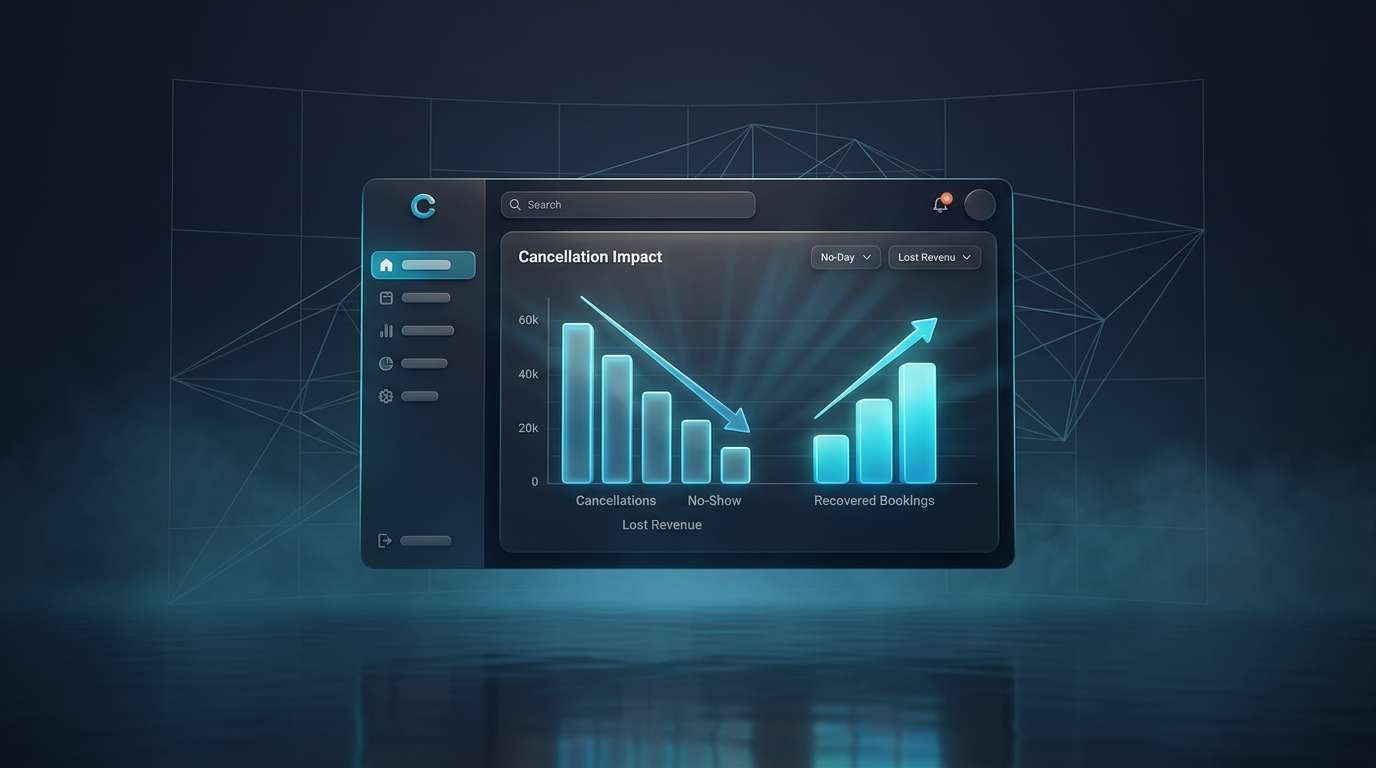
Hotel cancellations and no-shows cost the global industry an estimated $50 billion annually in lost revenue. The average cancellation rate has climbed to 30-40% for flexible bookings on major OTAs, and no-show rates remain stubbornly at 3-8%. For a 100-room hotel, a 35% cancellation rate and 5% no-show rate on the remaining bookings means approximately 20-25 rooms per night are affected — a staggering operational and financial challenge.
The rise of free cancellation as a default booking option — driven largely by OTA policies — has created a generation of travelers who book multiple hotels and cancel all but one. This "tentative booking" behavior fundamentally distorts demand signals and makes forecasting more difficult.
Embed this image on your site
<a href="https://otelciro.com/en/news/hotel-cancellation-no-show-management">
  <img src="https://cdn.sanity.io/images/1la98t0z/production/e653b761391abbb1fb194d56a1b0ad5a66962360-1376x768.jpg" alt="Hotel cancellation and no-show management infographic" width="800" />
</a>
<p>Source: <a href="https://otelciro.com">OtelCiro</a> — AI Hotel Revenue Management</p>
Related reading: AI Revenue Management Platform: The Complete Hotel Solution for 2026
Related reading: 65% of Travelers Accept Dynamic Pricing: Transparency Builds Trust
Understanding Cancellation Patterns
Cancellation Rate by Channel
| Channel | Average Cancellation Rate | Typical Lead Time |
|---|---|---|
| Booking.com (flexible) | 35-45% | 2-14 days |
| Expedia (flexible) | 25-35% | 7-21 days |
| Direct website | 15-25% | 14-30 days |
| GDS/Corporate | 10-15% | 7-14 days |
| Non-refundable (any) | 3-8% | N/A |
Key Cancellation Predictors
AI models have identified the most reliable predictors of cancellation:
- Rate type: Flexible rates cancel 4-5x more than non-refundable
- Lead time: Bookings made 60+ days out cancel 2x more than short lead time
- Booking channel: OTA bookings cancel at higher rates than direct
- Historical pattern: Guests with past cancellation history are 3x more likely to cancel
- Market segment: Leisure bookings cancel more than business
- Price point: Higher-rate bookings cancel less (higher commitment)
- Group size: Solo travelers cancel more than families
- Day of week: Weekend bookings have lower cancellation rates
Embed this image on your site
<a href="https://otelciro.com/en/news/hotel-cancellation-no-show-management">
  <img src="https://cdn.sanity.io/images/1la98t0z/production/2d9c99599d308dc44740f17d18a63ef05a6a3127-1200x669.png" alt="Hotel automated pricing rules engine" width="800" />
</a>
<p>Source: <a href="https://otelciro.com">OtelCiro</a> — AI Hotel Revenue Management</p>
AI-Powered Cancellation Prediction
Modern AI systems assign a cancellation probability score to every reservation at the time of booking and update it continuously:
How it works:
- Model analyzes 30+ variables for each reservation
- Assigns probability score (0-100%) of cancellation
- Updates score as check-in approaches based on new signals
- Feeds predictions into overbooking and pricing models
Accuracy benchmarks:
- Simple models (logistic regression): 70-75% accuracy
- Advanced models (gradient boosting): 82-88% accuracy
- Ensemble models with real-time updates: 85-92% accuracy
Action thresholds:
- 70%+ cancellation probability: High-risk reservation. Consider in overbooking calculations.
- 40-70%: Medium risk. Monitor for changes in booking signals.
- Below 40%: Lower risk. Standard management.
Related reading: How Many Hours a Year Does Your Hotel Run Empty? The True Cost of Unsold Rooms
Related reading: Hotel Ancillary Revenue: Unlock Hidden Profit Centers
Overbooking Strategy
Strategic overbooking is the primary tool for recovering revenue lost to cancellations. The key is precision — overbook enough to offset cancellations but not so much that you walk guests.
The Overbooking Calculation
Optimal overbooking level = Expected cancellations + Expected no-shows - Walk cost buffer
| Factor | Calculation |
|---|---|
| Available rooms | 100 |
| Current bookings | 100 |
| Expected cancellation rate | 30% (30 rooms) |
| Expected no-show rate | 5% of remaining (3.5 rooms) |
| Total expected attrition | 33.5 rooms |
| Walk cost per guest | $250-400 (alternative hotel + compensation) |
| Optimal overbooking | 25-30 rooms (conservative buffer) |
Walk Cost Minimization
When overbooking results in a walk situation, minimize damage:
- Identify walk candidates early: Select based on least revenue impact and most flexibility
- Arrange alternative accommodation: Pre-negotiate rates with nearby comparable properties
- Compensate fairly: Cover the alternative room cost + $50-100 inconvenience payment
- Communicate proactively: Contact the guest before arrival, not at the front desk
- Follow up: Offer a future stay discount or loyalty bonus
Embed this image on your site
<a href="https://otelciro.com/en/news/hotel-cancellation-no-show-management">
  <img src="https://cdn.sanity.io/images/1la98t0z/production/d36123c644ddc3c115453411f9a55397cf34970b-1200x2150.png" alt="AI-powered revenue management platform architecture" width="800" />
</a>
<p>Source: <a href="https://otelciro.com">OtelCiro</a> — AI Hotel Revenue Management</p>
Cancellation Policy Optimization
The Policy Spectrum
| Policy | Booking Impact | Cancellation Rate | Revenue Protection |
|---|---|---|---|
| Free cancellation up to check-in | Highest bookings | 35-45% | Lowest |
| Free cancellation up to 48 hours | High bookings | 25-35% | Moderate |
| Free cancellation up to 7 days | Moderate bookings | 15-25% | Good |
| Non-refundable | Lower bookings | 3-8% | Highest |
| Deposit (first night) | Moderate bookings | 10-20% | High |
Recommended Multi-Policy Strategy
Offer multiple rate plans with different cancellation terms:
- Flexible rate: Full price, free cancellation up to 48 hours (captures commitment-averse travelers)
- Semi-flexible: 5-8% discount, free cancellation up to 7 days (good balance)
- Non-refundable: 10-15% discount, no refund (lowest cancellation, secured revenue)
- Deposit rate: First night non-refundable, remaining nights flexible (hybrid protection)
Dynamic Cancellation Policies
Adjust cancellation terms based on demand:
- High demand dates: Shorter cancellation windows, higher non-refundable discounts
- Low demand dates: More flexible policies to attract bookings
- Event dates: Stricter policies justified by high demand
- Extended stays: Deposit plus progressive cancellation terms
No-Show Management
Prevention Tactics
- Pre-arrival confirmation emails 48 hours before check-in
- SMS reminders on the day of arrival
- Chatbot check-in prompts 24 hours before
- Credit card pre-authorization at time of booking
Recovery Actions
- Charge no-show fee as per policy (first night or full stay depending on terms)
- Release the room for walk-in or same-day OTA sales
- Update the guest profile for future forecasting
- Analyze patterns — repeat no-shows may warrant blacklisting or deposit requirements
Measuring Cancellation Management Performance
| KPI | Current Benchmark | Target |
|---|---|---|
| Overall cancellation rate | 30-40% | 20-30% |
| Non-refundable booking share | 15-20% | 25-35% |
| No-show rate | 5-8% | 2-4% |
| Walk rate (from overbooking) | <1% | <0.5% |
| Revenue recovery from cancellations | 40-50% | 70-80% |
| Forecast accuracy (adjusted for cancellations) | 70-75% | 85-90% |
Related reading: Dynamic vs. Static Pricing: How the Taylor Swift Effect Can Skyrocket Your Revenue
OtelCiro: Intelligent Cancellation Management
OtelCiro's AI Engine includes predictive cancellation modeling that scores every reservation and feeds predictions directly into overbooking and pricing algorithms. The system learns from your property's unique cancellation patterns and improves accuracy over time.
For broader revenue strategies, read our demand forecasting guide and dynamic pricing strategies.
Conclusion
Cancellation and no-show management is a revenue management discipline that deserves the same strategic attention as pricing and distribution. The combination of AI-powered prediction, strategic overbooking, multi-tier cancellation policies, and proactive guest communication can recover 30-50% of currently lost revenue. In an industry where margins are thin and every room night is perishable, that recovery is transformative.
Discover how OtelCiro's AI Engine can predict cancellations, optimize overbooking, and minimize revenue loss from no-shows.

![Hotel Upselling: AI-Driven Revenue Growth [2026]](https://cdn.sanity.io/images/1la98t0z/production/9850350573fc466b95b1490c7f689e8ac39c4f11-1200x669.png?w=1920&q=50&auto=format&fit=max)