What Is Channel Management and Why Does Every Hotel Need It?
Channel management is the strategic process of distributing hotel room inventory, rates, and availability across multiple online sales channels — OTAs, metasearch engines, the direct website, GDS platforms, and wholesale partners — in a coordinated, automated, and profitable manner.
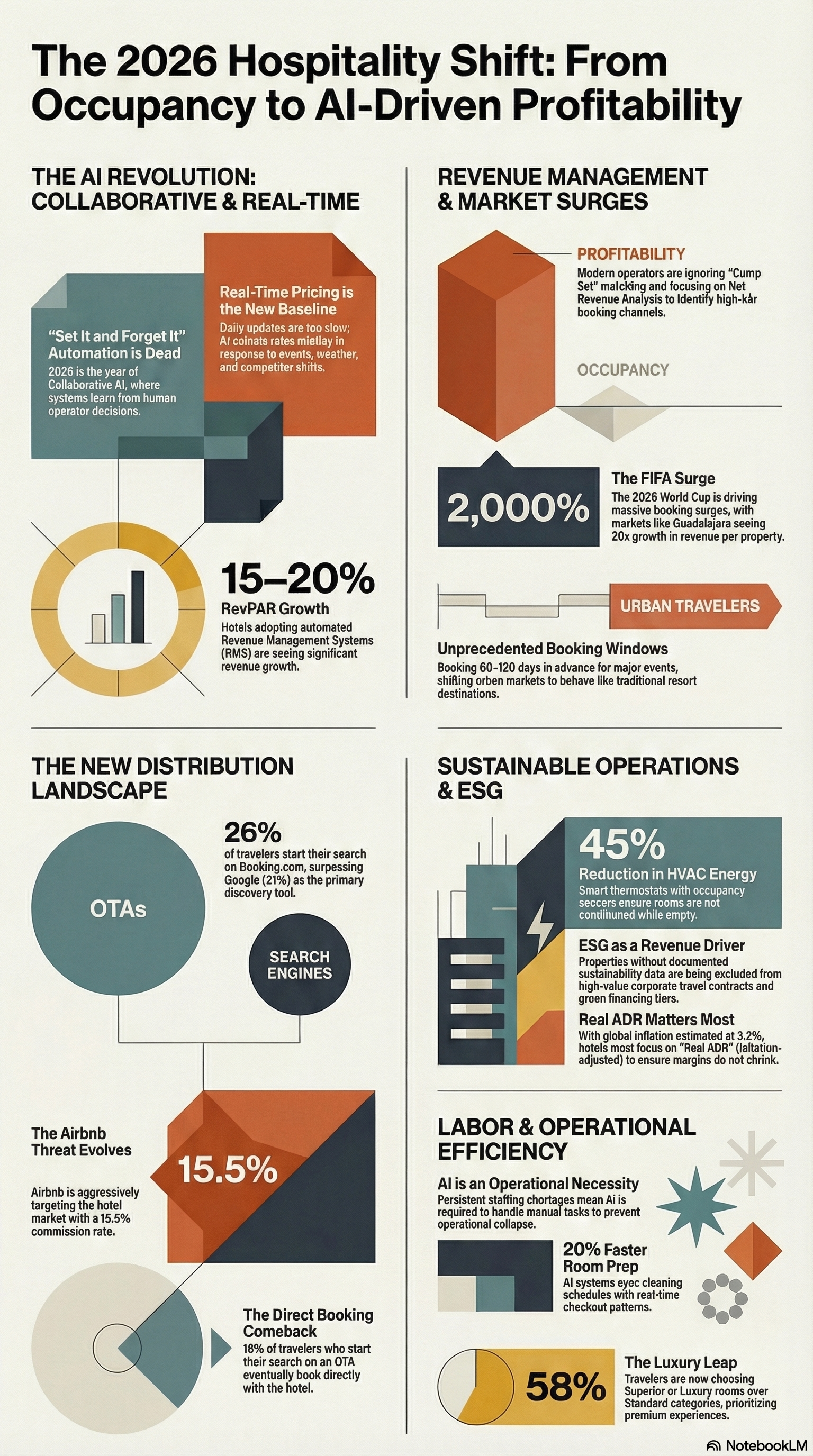
In 2026, the average hotel sells rooms through 8-15 different channels simultaneously. Each channel has its own commission structure, guest demographic, booking patterns, and ranking algorithm. Managing these channels manually is not just inefficient — it is financially destructive. Manual channel management leads to rate inconsistencies, missed revenue opportunities, overbookings, and ranking penalties that compound over time.
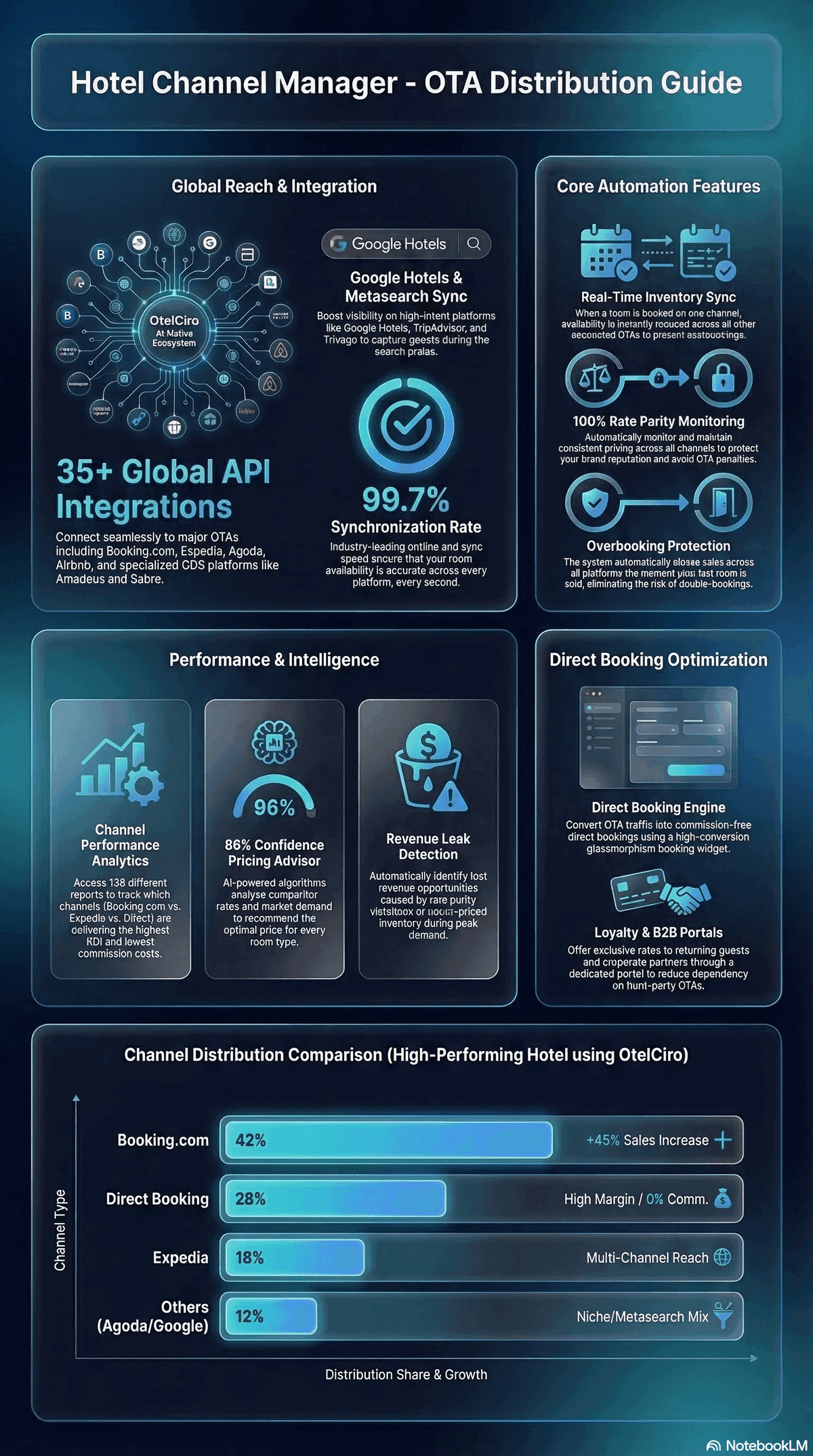
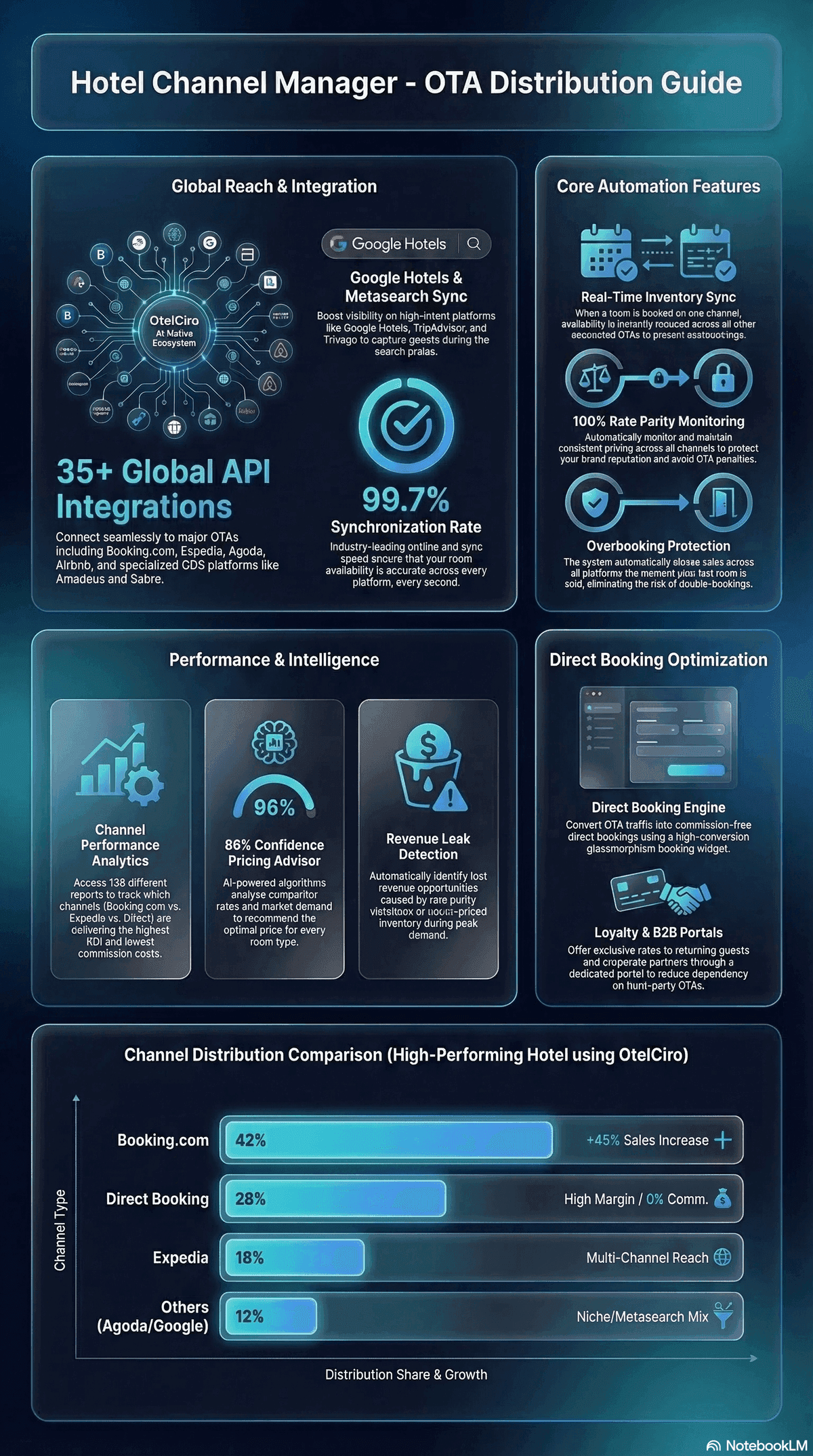
A channel manager is the technology that solves this problem. It sits between the hotel's Property Management System (PMS) and all connected distribution channels, synchronizing inventory in real time, pushing rate updates simultaneously, and importing reservations automatically. When a guest books a room on Booking.com, the channel manager instantly reduces availability across Expedia, Agoda, Google Hotels, and every other connected platform — preventing double bookings and ensuring accurate inventory across the distribution ecosystem.
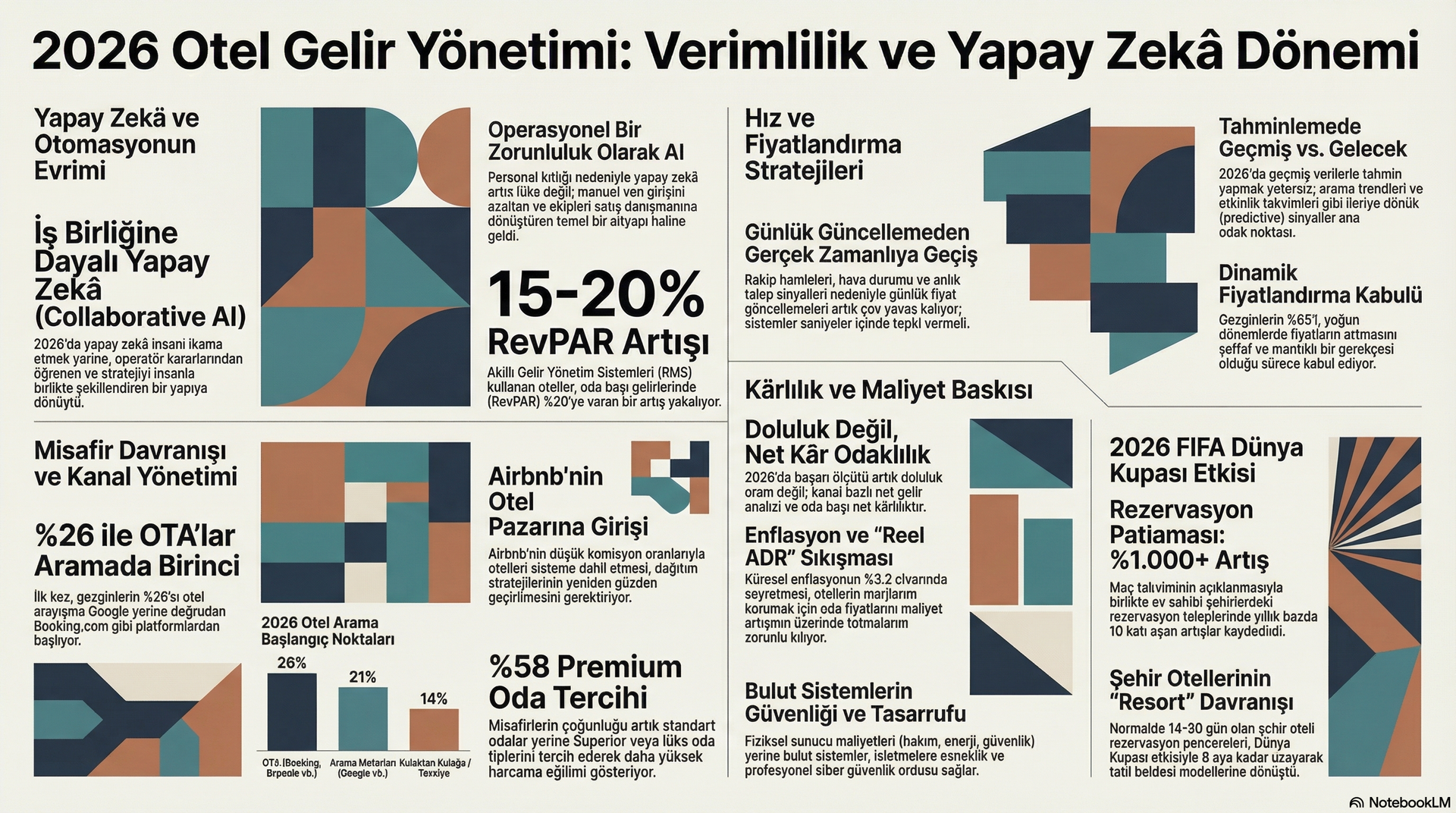
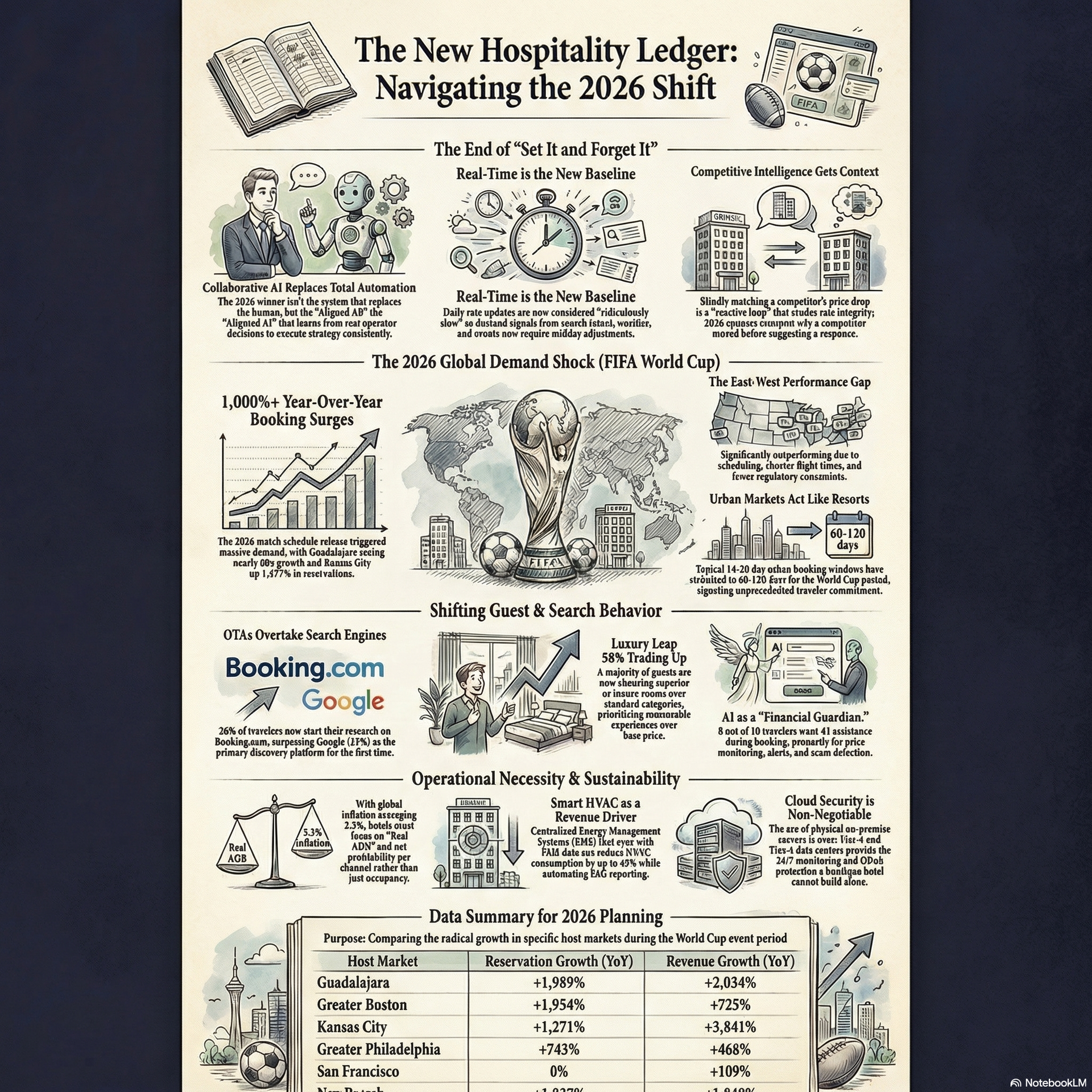
The financial impact of effective channel management is well documented. Hotels with automated channel management achieve 18-25% higher RevPAR compared to those managing channels manually, according to Phocuswright research. For a 100-room property, that difference represents hundreds of thousands of dollars in annual revenue.
Embed this image on your site
<a href="https://otelciro.com/en/news/hotel-channel-management-ota">
  <img src="https://cdn.sanity.io/images/1la98t0z/production/b9cee47e03a0891ad8e615048e78be166bc641de-1200x2150.png" alt="Hotel Channel Manager Infographic" width="800" />
</a>
<p>Source: <a href="https://otelciro.com">OtelCiro</a> — AI Hotel Revenue Management</p>
Related reading: A New Era in Europe: The DMA and Hotel Pricing Freedom
Related reading: 5 Channels, 5 Different Rules: How Hotels Should Optimize Each One
The OTA Ecosystem in 2026: A Strategic Overview
Understanding the current OTA landscape is essential for effective channel management. Each platform serves a different traveler segment and operates under different commercial terms.
Booking.com
Booking.com remains the dominant OTA in most markets outside North America, commanding approximately 38-42% of online hotel bookings in Europe and significant share in Asia-Pacific and the Middle East. Its algorithm rewards properties with high content scores, competitive pricing, flexible cancellation policies, and strong review profiles.
Key strategic considerations:
- Content Score must be maintained at 100% — complete photos, descriptions, amenities, and policies
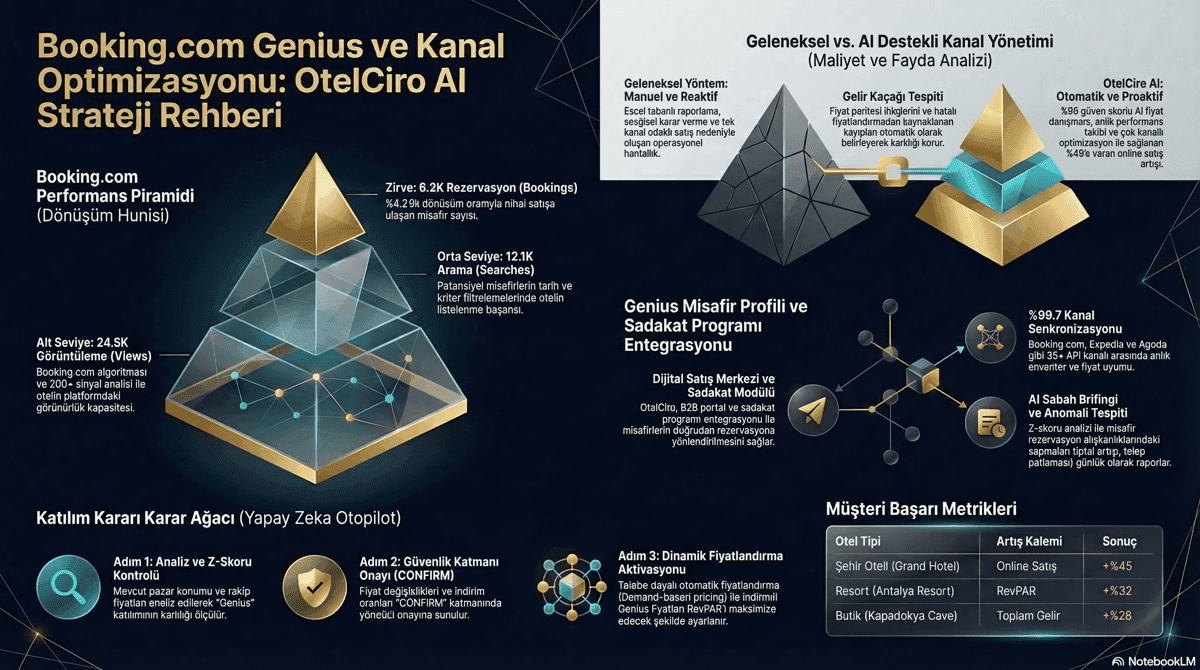
- Genius program participation provides ranking advantages but requires discounted rates for loyalty members
- Mobile-first traffic (75%+ of searches) means mobile-optimized rates and content are critical
- Payment processing options (online vs. property payment) affect cash flow and conversion rates
Expedia Group
Expedia controls a portfolio that includes Hotels.com, Vrbo, Orbitz, and Trivago, making it the primary OTA for North American travelers. Its package bundling capability (flight + hotel) creates unique value.
Key strategic considerations:
- Package deals generate 35% higher conversion rates than standalone room bookings
- Merchant model keeps rate control with the hotel while Expedia manages payment
- Expedia Rewards members receive exclusive rates, creating a loyalty-driven demand stream
- Vrbo integration is essential for properties competing with vacation rentals
Google Hotels
Google has evolved from a metasearch engine into a full distribution channel. Free booking links, Google Business Profile integration, and Google Ads hotel campaigns make it one of the most cost-effective channels available.
Key strategic considerations:
- Free booking links require no commission — hotels only pay the booking engine processing fee
- Google Business Profile optimization directly impacts visibility in Maps and Search
- Price accuracy is critical — Google penalizes properties with rate discrepancies
- Review management on Google Reviews influences ranking alongside OTA reviews
Agoda
Owned by Booking Holdings but operated independently, Agoda is the dominant platform for Asia-Pacific travelers, particularly from Southeast Asia, East Asia, and Oceania.
GDS (Amadeus, Sabre, Travelport)
Global Distribution Systems remain essential for corporate travel and travel agent bookings, delivering an average ADR that is 20-30% higher than OTA bookings. The higher integration complexity and cost are offset by the premium rate and lower cancellation rates of GDS reservations.
Direct Website
Your own website is the only channel with zero commission cost and full control over the guest relationship. Every percentage point shifted from OTA to direct bookings improves profitability dramatically.
Embed this image on your site
<a href="https://otelciro.com/en/news/hotel-channel-management-ota">
  <img src="https://cdn.sanity.io/images/1la98t0z/production/d7d8dd717a0471ca7d480294091db24c1186f694-1200x669.png" alt="2026 hotel channel manager selection guide" width="800" />
</a>
<p>Source: <a href="https://otelciro.com">OtelCiro</a> — AI Hotel Revenue Management</p>
Rate Parity: The Challenge That Defines Channel Management
Rate parity — maintaining consistent pricing across all distribution channels — is simultaneously the most important and most difficult aspect of channel management.
Why Rate Parity Matters
OTAs enforce rate parity contractually and algorithmically. If Booking.com detects that your rates are lower on Expedia or your direct website, the consequences are swift and severe:
- Ranking suppression — your property drops in search results, reducing visibility and bookings
- Tag removal — "Great Value" and similar conversion-boosting tags disappear from your listing
- Reduced promotional eligibility — you lose access to visibility boosters and marketing programs
- Account warnings — repeated violations can result in temporary suspension
The Rate Parity Paradox
Hotels face a fundamental tension: they want to offer the best rate on their direct website to reduce OTA commissions, but OTAs penalize properties that undercut their rates on other channels.
The solution lies in value differentiation rather than rate undercutting. Smart channel management strategies include:
- Bundling direct bookings with complimentary amenities (breakfast, parking, late checkout) rather than lower rates
- Loyalty pricing through member-only rates on the direct website, which most OTA contracts permit
- Package creation that combines room rates with experiences, making direct comparison difficult
- Flexible policies such as free cancellation or guaranteed upgrades exclusively for direct bookers
OtelCiro's Sales module manages rate parity automatically across all channels while implementing these value differentiation strategies to drive direct booking growth.
Related reading: The 'Mirror Trap' on Google Maps: How OTAs Manipulate Hotel Prices
Real-Time Synchronization: Preventing the Overbooking Crisis
Overbooking is the nightmare scenario of channel management. When a hotel sells the same room to two different guests through two different channels, the result is a displaced guest, a negative review, compensation costs, and potential OTA penalties.
The Causes of Overbooking
- Sync delays — manual or slow channel updates leave sold inventory available on other platforms
- Simultaneous bookings — two guests book the last available room at nearly the same moment on different channels
- GDS lag — Global Distribution System reservations sometimes take longer to process than OTA bookings
- Human error — manual inventory management inevitably produces mistakes
How Real-Time Sync Eliminates the Problem
A modern channel manager processes inventory updates in under 3 seconds from the moment a booking is received. The sequence is:
- A reservation arrives from any channel
- The channel manager processes the booking and updates the PMS
- Availability on all other connected channels is reduced simultaneously
- Confirmation is sent to the guest and the originating channel
This sub-3-second sync window makes simultaneous overbookings virtually impossible. OtelCiro's integrated Smart PMS reduces this further by eliminating the middleware layer between the PMS and channel manager — inventory updates happen internally rather than through an external API call.
Hotels using manual channel management experience overbooking rates of 4-7%. Properties with automated real-time sync reduce this to below 0.3% — effectively eliminating the problem.
Embed this image on your site
<a href="https://otelciro.com/en/news/hotel-channel-management-ota">
  <img src="https://cdn.sanity.io/images/1la98t0z/production/9e1392b05b1b69f2ed494b62433b779e2c809048-1200x670.png" alt="Booking.com Genius Level 3 strategy guide" width="800" />
</a>
<p>Source: <a href="https://otelciro.com">OtelCiro</a> — AI Hotel Revenue Management</p>
Direct Booking Optimization: Reducing OTA Dependency
While OTAs provide essential demand generation and visibility, their commission rates of 15-25% per booking make OTA dependency a significant profitability drain. Every hotel's distribution strategy should include a systematic effort to increase direct booking share.
The Billboard Effect
Research consistently shows that OTA listings function as advertising for direct bookings. Between 25-40% of travelers who discover a hotel on an OTA subsequently visit the hotel's direct website before making a final booking decision. This is known as the "billboard effect."
The implication is strategic: OTA presence drives awareness, but your direct booking experience determines whether those aware travelers convert on your website or return to the OTA. For a detailed exploration of this phenomenon, see our analysis of the billboard effect.
Strategies for Direct Booking Growth
Price perception management. Ensure your website displays prices that include all taxes and fees upfront, matching the display format of OTAs. Travelers often perceive OTA prices as lower simply because of different display conventions.
Booking engine optimization. The direct booking process must be as frictionless as the OTA experience. Maximum three clicks from homepage to confirmed reservation. Mobile-optimized with autofill support and multiple payment options.
Exclusive direct benefits. Offer tangible value additions for direct bookers — complimentary breakfast, room upgrades, flexible cancellation, loyalty points, or early check-in. These do not violate rate parity because the room rate remains the same.
Retargeting campaigns. Use pixel-based retargeting to reach travelers who visited your website but did not book. These campaigns convert at 3-5x the rate of cold advertising because the traveler has already expressed intent.
Google Hotels integration. Ensure your direct booking rates appear in Google Hotels free booking links, capturing demand at the point of search without OTA commission.
Channel Performance Analytics: Data-Driven Distribution
Effective channel management requires continuous measurement and optimization. Not all channels deliver equal value, and the optimal channel mix varies by property type, market, and season.
Key Metrics to Track Per Channel
Net RevPAR (after commissions). The true revenue per available room after deducting all channel-specific costs. A channel with a $200 ADR and 20% commission delivers less net revenue than one with a $180 ADR and 10% commission.
Cancellation rate. Channels with high cancellation rates inflate reported bookings and create operational uncertainty. Some OTAs have cancellation rates exceeding 30%, while direct bookings typically cancel at 10-15%.
Average length of stay. Longer stays generate more revenue with proportionally lower distribution and operational costs per night. Channels that attract longer-stay guests are inherently more profitable.
Booking lead time. Channels that generate bookings further in advance provide better forecasting accuracy and revenue management opportunities than last-minute booking sources.
Guest acquisition cost. The total cost of acquiring a guest through each channel, including commissions, promotional costs, and any loyalty program expenses.
Repeat booking rate. Channels that introduce guests who later return as direct bookers deliver compounding value beyond the initial transaction.
Using Analytics to Optimize the Channel Mix
OtelCiro's AI Engine analyzes channel performance data to recommend optimal inventory allocation strategies. This goes beyond simply favoring the lowest-commission channel. The AI considers:
- Demand patterns by channel — which channels perform best during which periods
- Guest value by channel — average total spend including ancillary revenue
- Competitive implications — reducing allocation to a major OTA may trigger ranking penalties
- Fill rate contribution — some channels fill rooms that would otherwise go unsold
The result is a dynamic distribution strategy that maximizes net revenue rather than gross revenue — an important distinction that many hotels overlook.
OtelCiro's Reports module provides per-channel profitability analysis with automated recommendations for allocation adjustments.
Overbooking Strategy: The Controlled Risk
While preventing accidental overbookings is essential, strategic overbooking is a legitimate revenue management technique used by sophisticated hotels to account for cancellations and no-shows.
How Strategic Overbooking Works
Historical data shows that the average hotel experiences a 6-12% cancellation and no-show rate. A 100-room hotel at full occupancy will statistically have 6-12 rooms freed by cancellations and no-shows on any given night. Strategic overbooking means accepting 3-8% more reservations than physical capacity, with the expectation that cancellations will reconcile the gap.
AI-Managed Overbooking
Manual overbooking is risky because cancellation rates vary by day of week, season, booking channel, lead time, and rate type. AI-managed overbooking analyzes all of these variables to calculate the optimal overbooking level for each specific date.
For example, the AI might determine that bookings from a specific OTA for a midweek stay booked less than 48 hours out have a 22% cancellation rate, while direct bookings for the same period cancel at only 8%. The overbooking strategy adjusts accordingly, accepting more reservations when the mix skews toward high-cancellation segments.
Integration: The Foundation of Effective Channel Management
A channel manager operating in isolation delivers limited value. The real power emerges when channel management is integrated into the broader hotel technology ecosystem.
PMS Integration
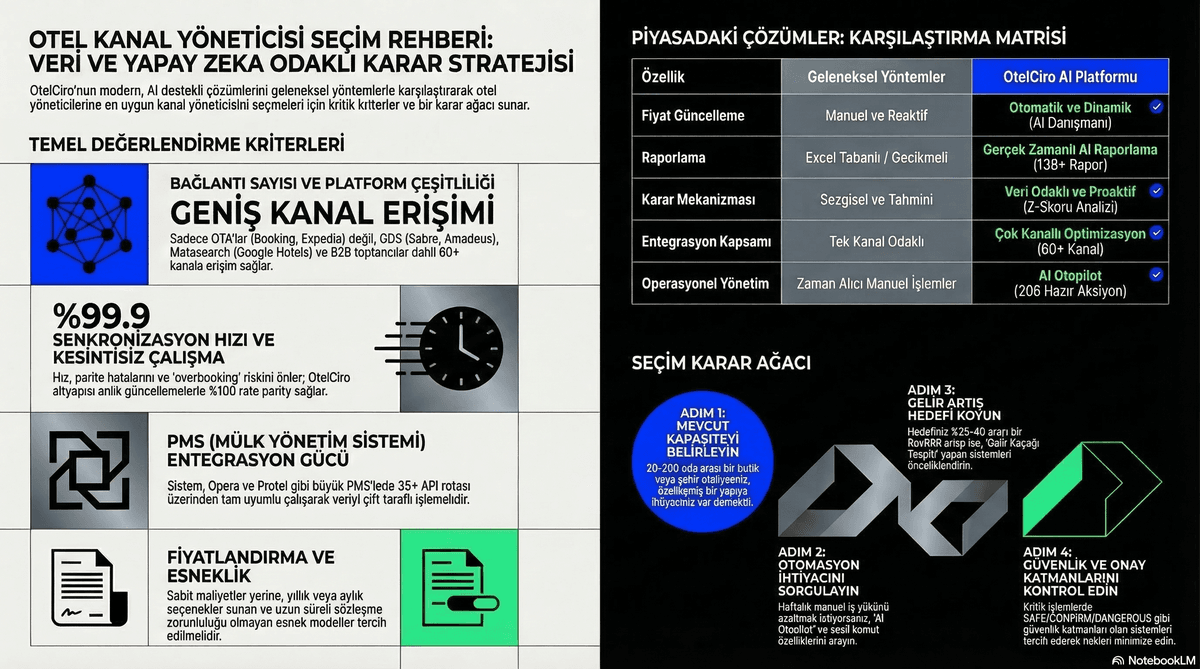
Bidirectional PMS integration ensures that reservations flow automatically from channels into the hotel's operational system, and that inventory changes in the PMS are immediately reflected across all channels. OtelCiro's approach integrates the channel manager directly within the Smart PMS, eliminating integration gaps entirely.
Revenue Management Integration
Channel management and revenue management are two sides of the same coin. The optimal rate for a room depends on which channel it is sold through, and the optimal channel depends on what rate is being offered. OtelCiro's AI Engine manages both simultaneously, making pricing and distribution decisions as a unified strategy.
CRM Integration
Understanding guest profiles across channels enables personalization and relationship building that drives repeat business and lifetime value.
For a comprehensive deep dive into distribution strategy, see our hotel channel management guide.
Related reading: 2026 Hotel Survival Guide: Everything on One Page
Building Your Distribution Strategy: A Practical Framework
Step 1: Audit Your Current Channel Mix
Document every active channel, its commission rate, cancellation rate, average ADR, booking volume, and guest demographics. Identify which channels deliver the highest and lowest net revenue.
Step 2: Define Channel Roles
Assign a strategic role to each channel:
- Volume channels (major OTAs): Provide base demand and visibility
- Premium channels (GDS, luxury OTAs): Deliver high-ADR corporate and luxury travelers
- Profit channels (direct website, Google free links): Maximum margin bookings
- Niche channels (Agoda for APAC, regional OTAs): Targeted geographic demand
Step 3: Set Channel-Specific Strategies
Configure rates, restrictions, content, and promotions tailored to each channel's strengths:
- Longer minimum stays on high-commission channels during peak periods
- Enhanced content and photos on channels with strong visual search
- Exclusive packages on the direct website to differentiate from OTA listings
Step 4: Automate and Monitor
Implement automated channel management through a unified platform and establish a regular review cadence — weekly for tactical adjustments, monthly for strategic evaluation, and quarterly for comprehensive channel mix optimization.
Step 5: Iterate Based on Data
Use channel performance analytics to continuously refine your distribution strategy. The optimal channel mix is not static — it shifts with market conditions, seasonal demand, competitive moves, and platform algorithm changes.
Conclusion
Hotel channel management in 2026 is a strategic discipline that directly determines revenue performance and profitability. The hotels that treat distribution as a systematic, data-driven, technology-enabled function outperform those that manage channels reactively and manually.
The combination of automated real-time synchronization, AI-driven rate optimization, strategic direct booking development, and continuous performance analytics creates a distribution engine that maximizes revenue from every available room across every available channel. With the right technology platform, this level of sophistication is accessible to properties of every size — from boutique independents to large resort operations.