Last year, 40% of independent hotels in Türkiye missed out on potential direct bookings because they were unable to answer website inquiries outside of business hours. This is not just lost revenue; it is an operational gap that leads to guest dissatisfaction. While your front desk is busy at midnight explaining room type differences or booking spa appointments, OTA commissions may be quietly eroding your profits. However, an advanced chatbot can reverse this scenario. This guide will explain step by step how hotels in Türkiye can use AI-powered chatbots to increase direct bookings, improve the guest experience, and reduce operational costs. We will focus on chatbots not just as a support tool, but as a revenue engine.
What You Will Learn
- Why Now? The Strategic Importance of Chatbots for Hotels in Türkiye
- Transforming the Guest Experience: 24/7 Personalized Support
- Chatbot Selection Criteria for Hotels in Türkiye: What to Look For?
- The Role of Chatbots in PMS Integration and Distribution Strategy
- Common Mistakes and Success Metrics in Chatbot Implementation
- Frequently Asked Questions
Why Now? The Strategic Importance of Chatbots for Hotels in Türkiye
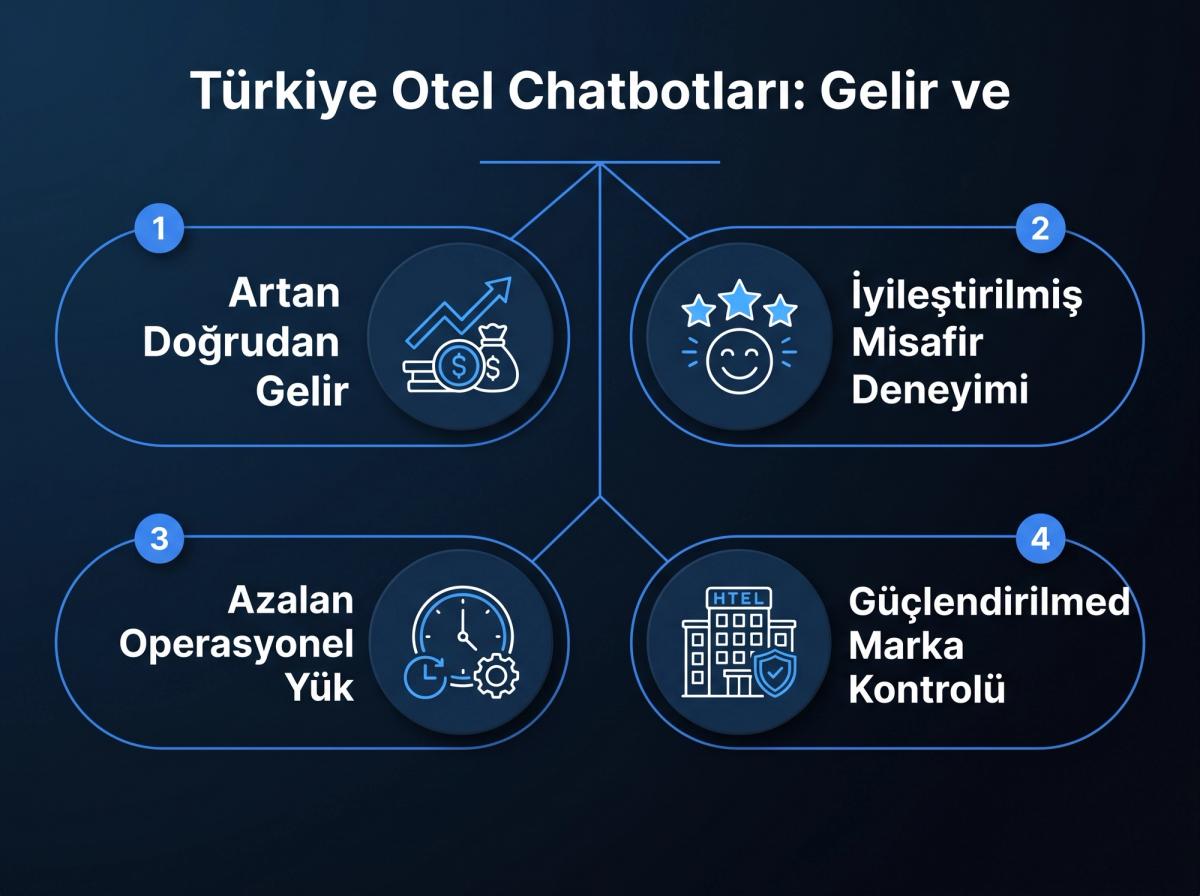
Chatbots are no longer a "nice-to-have" technology, but a strategic investment with a direct impact on revenue and efficiency. Especially in Türkiye's highly competitive market, chatbots provide a competitive edge against OTAs and increase operational efficiency.
Increasing Direct Bookings and Reducing Commissions
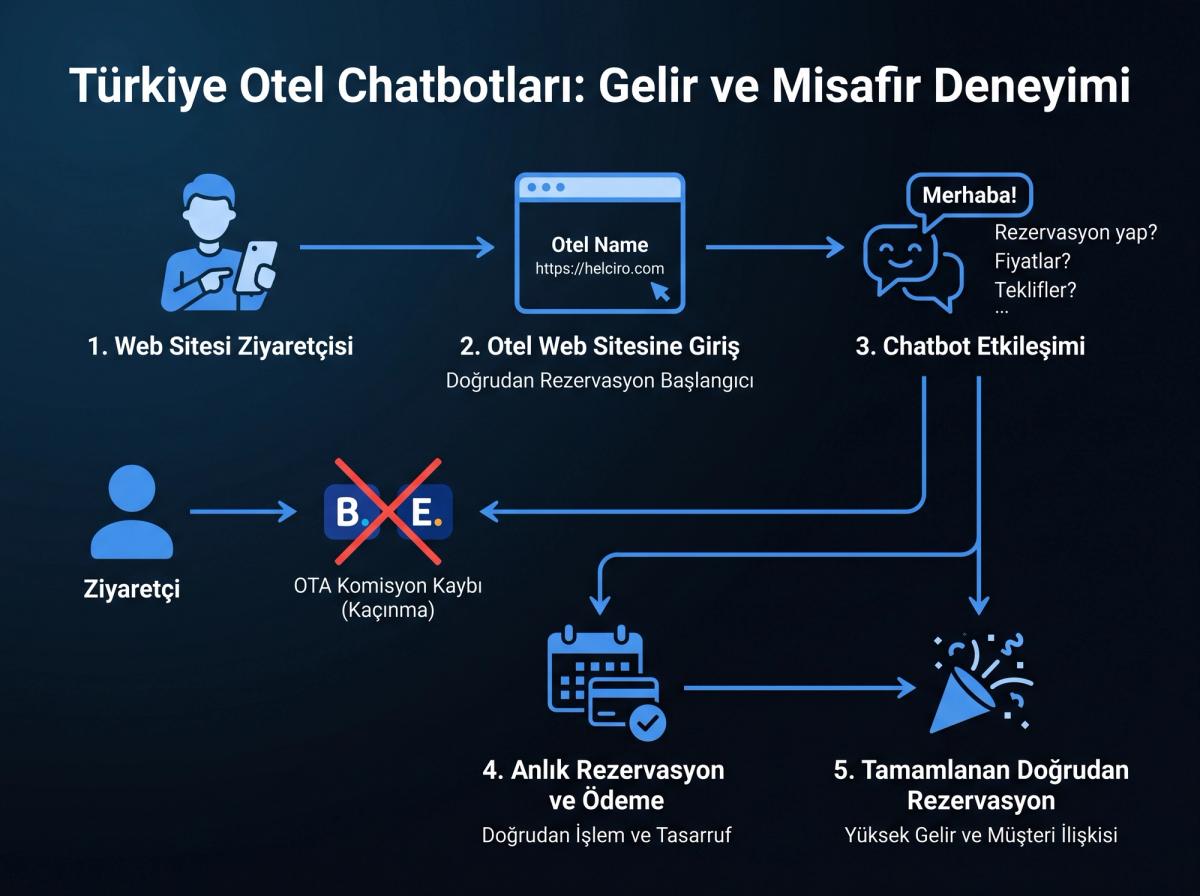
The most tangible benefit of a chatbot is its ability to convert website visitors into direct booking guests. By providing instant 24/7 answers, it guides potential guests through the booking process while answering their questions. This can often translate into a 10% to 20% increase in direct bookings.
In addition, chatbots are an excellent tool for upsell and cross-sell. While a guest is booking a standard room, the chatbot can proactively present offers like "Would you like to upgrade to our sea-view suite for just 1,200 TL more?" or "Would you like to add our discounted spa package to your stay?" These small interactions directly lift your Average Daily Rate (ADR) and Revenue Per Available Room (RevPAR) metrics.
Example: An 80-room boutique hotel in Antalya that converts 5% of its website traffic into bookings via a chatbot can secure an average of 25–30 additional direct bookings per month. Calculated at an 18% OTA commission rate, this translates to over 45,000 TL in commission savings alone each month—money that goes straight to the hotel's bottom line.
Lightening the Operational Burden and Cost Savings
How much time does your front desk team spend on the same questions every day? Repetitive queries like "What time is breakfast?", "Do you have parking?", or "How do I get there from the airport?" can be answered instantly and accurately by a chatbot. This automation frees up your staff to resolve more complex guest issues and create meaningful moments that require personal interaction.
This balances staff workloads—especially during high seasons—lowering overtime costs and enabling more efficient scheduling. Reduced operating expenses and increased revenue have a direct positive impact on Gross Operating Profit Per Available Room (GOPPAR).
Transforming the Guest Experience: 24/7 Personalized Support
Modern guests expect instant answers to their questions. For a guest visiting your website in the middle of the night or from a different time zone, a chatbot acts as your hotel's always-on digital concierge.
Instant Responses and the Power of Multilingual Communication
24/7 instant support is the cornerstone of modern guest expectations. However, for an international destination like Türkiye, multilingual capability is critical. A good chatbot not only delivers excellent Turkish language support, but also communicates fluently in the languages of key feeder markets, such as English, German, Russian, and Arabic. By eliminating the language barrier, it significantly increases the likelihood that international guests will book.
Personalized Recommendations and Issue Resolution
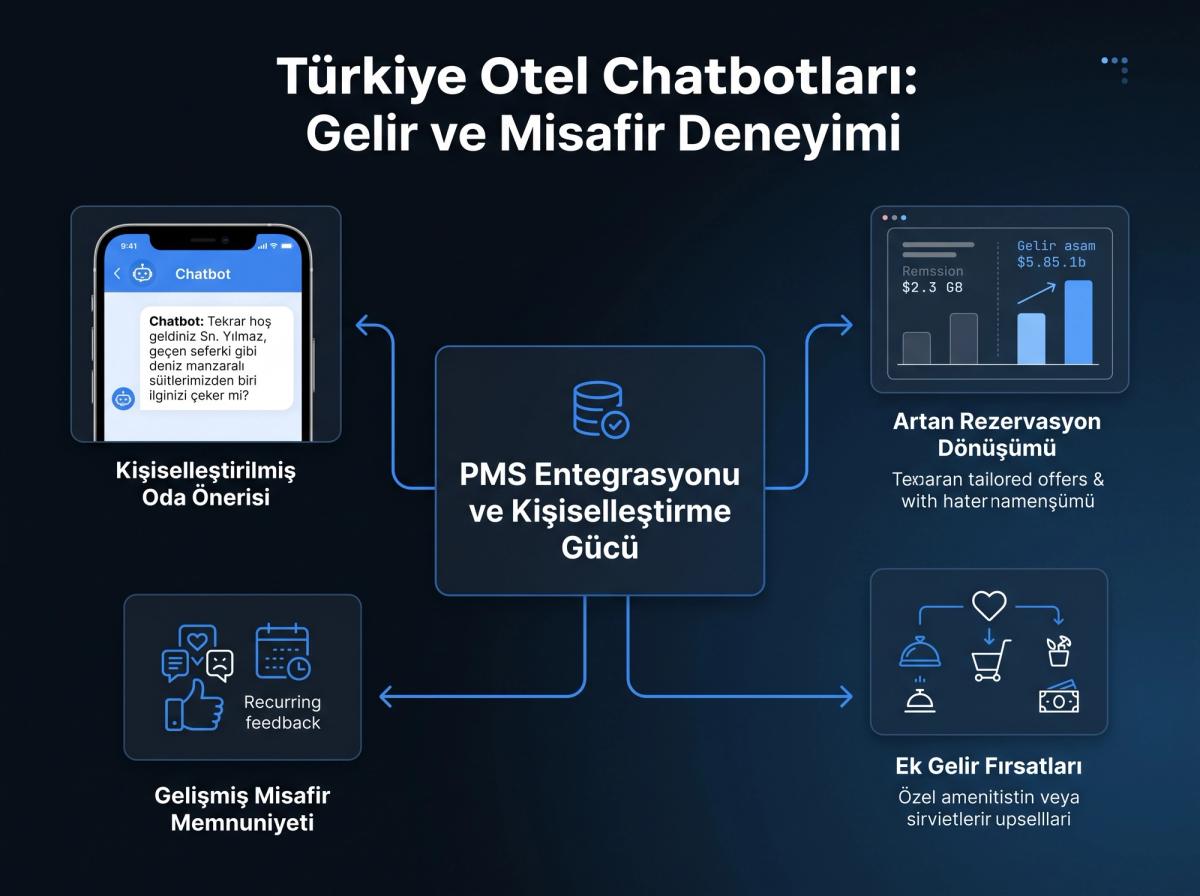
Through PMS integration, a chatbot can deliver personalized recommendations based on a guest's past stays or profile. For example, it can suggest new massage packages to a guest who previously used the spa, or present family room options and nearby activities to a family traveling with children.
Pro Tip: Program your chatbot to resolve the most common minor issues. Automating requests like "What is the Wi-Fi password?", "Can I get extra towels for my room?", or "Can I book a table at the restaurant for dinner?" both delights guests and cuts down on front desk phone traffic. Fast, effective resolution means higher guest satisfaction scores and positive online reviews.
Chatbot Selection Criteria for Hotels in Türkiye: What to Look For?
There are numerous chatbot solutions on the market. Choosing the right one for your hotel requires evaluating several critical factors.
AI Capabilities and Booking Integration
There are essentially two types of chatbots: rule-based and AI-powered. Rule-based bots follow predefined scripts and can be sufficient for simple questions. However, AI-powered chatbots (capable of conversing and learning) understand guest intent, respond to complex queries, and become smarter over time. For a true guest experience transformation, an AI-powered solution should be preferred.
The most critical feature is the chatbot's seamless integration with your hotel's booking engine. The chatbot must be able to check real-time room availability and rates, and take bookings directly through its own interface. Without integration, a chatbot remains merely an FAQ (Frequently Asked Questions) tool.
KVKK Compliance and Vendor Support
A chatbot processes guests' personal data (names, emails, booking details). Therefore, it is a legal requirement that the solution you choose is fully compliant with Türkiye's Personal Data Protection Law (KVKK). Always inquire about where data is stored, how it is processed, and how guest consents are managed.
Watch For: You invest not only in the technology, but also in the support behind it. Especially for hotels in Türkiye, working with a vendor that offers local or Turkish-language support makes a huge difference during setup and ongoing optimization. Also carefully evaluate pricing models (per conversation, per feature, flat fee) and choose the one that best fits your hotel's budget.
The Role of Chatbots in PMS Integration and Distribution Strategy
The value of a standalone chatbot is limited. True power comes from deep integration with the PMS, your hotel's central nervous system.
The Importance of Seamless Integration with Existing Systems
A chatbot's ability to communicate with your existing systems—such as your Property Management System (PMS), CRM, Booking Engine, and Channel Manager—is non-negotiable. This integration allows the chatbot to access critical data such as real-time availability, guest profiles, past preferences, and booking history. This turns an ordinary conversation into a highly personalized and effective interaction.
A comprehensive hotel operating system like Otelciro natively provides this integration. By offering a unified guest data view where guest data and operations converge into a single platform, it allows advanced AI tools like OtelGPT or third-party chatbots to benefit from all this rich information.
Strengthening the Direct Channel and Reducing OTA Dependency
An advanced chatbot is one of the most effective weapons for strengthening your hotel's direct channel. By delivering a superior, engaging, and personalized booking experience on your hotel website or social media channels (WhatsApp, Facebook Messenger), it gives guests a compelling reason to book directly.
This reduces dependency on OTAs. Guests begin to favor the direct channel for reasons such as instant answers, special offers, or loyalty program perks. Even a 5% shift in channel mix (for instance, dropping OTA share from 45% to 40% and increasing direct share from 20% to 25%) can have a substantial impact on profitability through commission savings. This grants your hotel greater control over its own inventory and pricing and strengthens your hotel's direct channel strategy.
Common Mistakes and Success Metrics in Chatbot Implementation
Starting off on the right foot is the key to maximizing the return on your chatbot investment.
Tips for Successful Implementation and What to Avoid
One of the most common mistakes is training the chatbot with insufficient data, or not training it at all. Ensure your chatbot can accurately answer questions specific to your hotel (for example, "What is the difference between your deluxe room and your superior room?"). Another mistake is failing to establish a clear handoff protocol to live staff when the chatbot cannot resolve an issue. A guest should never be left trapped in a technology maze.
Tips for success:
- Start small: Begin with the 10-15 most frequently asked questions and expand the scope over time.
- Continuously monitor and improve: Regularly review chatbot conversations and optimize responses.
- Involve your staff: Train your front desk team on managing and taking over from the chatbot.
- Promote its use: Prominently highlight the chatbot on your website.
Measuring Performance: Which Metrics to Track?
Tracking the right Key Performance Indicators (KPIs) is essential to measure success:
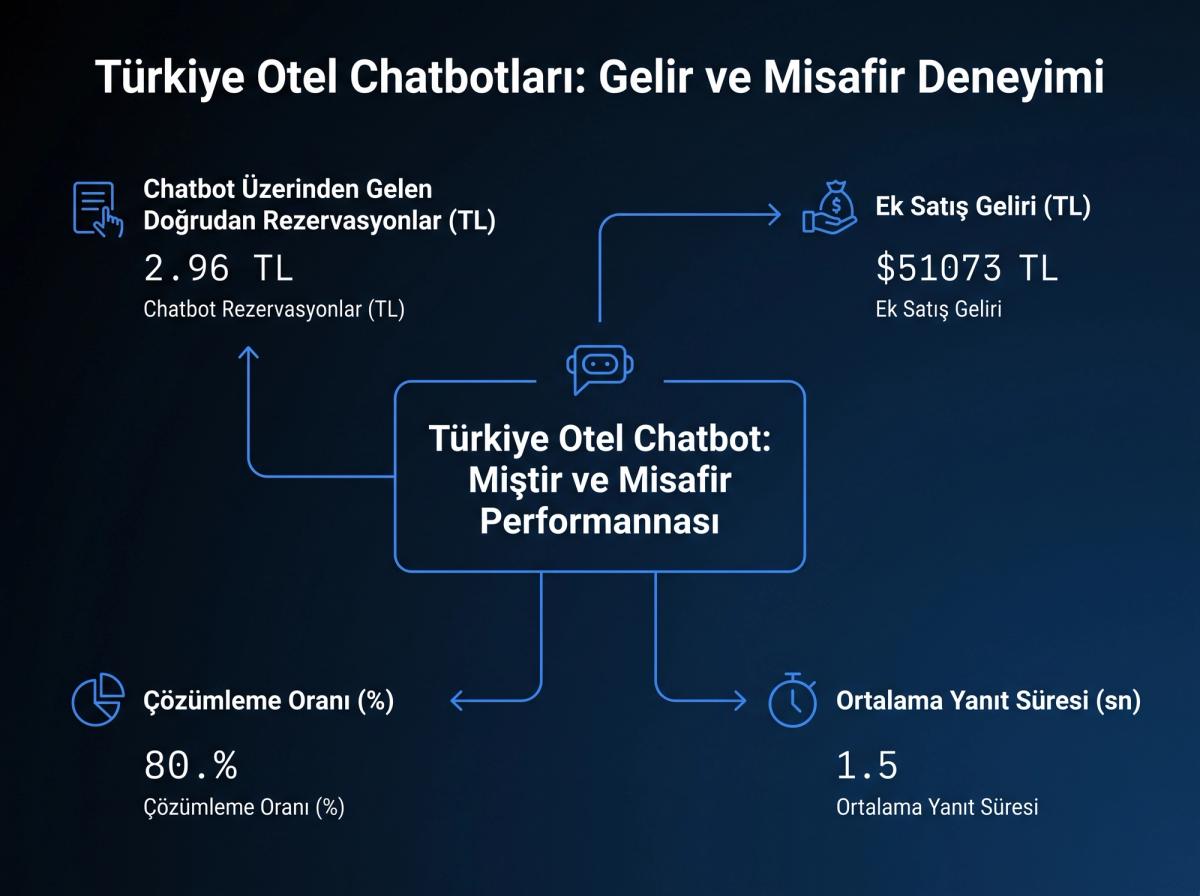
- Revenue Metrics: Conversion rate of direct bookings made via the chatbot, upsell and cross-sell revenues.
- Operational Metrics: Resolution rate (how often the chatbot resolves an inquiry without human intervention), average response time, handoff rate to human staff.
- Guest Satisfaction: Satisfaction scores (CSAT) measured through short surveys conducted after chatbot interactions.
Remember to continuously optimize performance by A/B testing different welcome messages or upsell offers.
Chatbots are no longer just a tech trend for hotels in Türkiye; they are a strategic necessity that increases direct revenue, personalizes the guest experience, and fundamentally transforms operational efficiency. With proper integration and KVKK compliance, these digital assistants keep your hotel's digital front door open 24/7, allowing you to build deeper connections with your guests and stand out in a competitive market. Otelciro's integrated PMS, revenue management, and AI modules like OtelGPT facilitate this transformation by seamlessly merging your chatbot strategy with your hotel's entire operational ecosystem. So, are you ready to take your hotel's digital guest engagement to the next level?
Take Action
Analyze your own hotel website's chatbot performance and guest interactions. Identify which questions are frequently asked and at which points guests need support. Use this data to take the first step toward turning your chatbot into a revenue engine.
Share this post
Frequently Asked Questions
How much can a hotel chatbot increase direct bookings?
A properly configured chatbot integrated with the PMS has the potential to increase direct bookings by 10% to 20% by converting website visitors more effectively. This stems from its ability to provide instant 24/7 responses and simplify the booking process.
What is the difference between an AI-powered chatbot and a standard chatbot?
AI-powered chatbots are advanced tools that understand guest intent and can converse in natural language. Standard (rule-based) chatbots, on the other hand, can only respond to specific pre-programmed commands and scenarios, making them less flexible.
Do hotel chatbots have to comply with KVKK?
Yes, absolutely. Because hotel chatbots process personal data such as guest names, email addresses, and reservation details, they must fully comply with the Personal Data Protection Law (KVKK) in Türkiye. This is a critical legal requirement for data security and guest privacy.
Is it difficult to integrate a chatbot with my existing PMS?
The difficulty of integration depends on the technology of both the chatbot provider and your PMS. Modern, API-based hotel operating systems like Otelciro are designed to facilitate seamless integration with third-party tools. Prioritizing PMS integration capabilities when selecting a vendor is crucial.