
![Hotel Rate Shopping: AI Pricing Intelligence [2026]](https://cdn.sanity.io/images/1la98t0z/production/ccd21447bd6d06ff7d3b0d53ca0f6ddf39c5afbe-1376x768.jpg?w=1920&q=65&auto=format&fit=max)
Know Your Competition or Lose to Them
In hotel revenue management, pricing does not happen in a vacuum. Every rate you set is evaluated by travelers against your competitive set — the 5-15 properties a guest considers before booking. Hotels with systematic competitive intelligence achieve 6-12% higher ADR than those pricing without market context, simply because they position their rates with precision rather than guesswork.
In 2026, the competitive landscape moves faster than ever. Competitors adjust rates multiple times daily, OTA algorithms respond in minutes, and travelers compare prices in seconds. Manual competitive monitoring — checking competitor rates on OTA websites — is no longer viable. AI-powered rate shopping and competitive intelligence tools are now essential infrastructure for any property serious about revenue optimization.

Embed this image on your site
<a href="https://otelciro.com/en/news/hotel-competitive-pricing-intelligence">
  <img src="https://cdn.sanity.io/images/1la98t0z/production/ccd21447bd6d06ff7d3b0d53ca0f6ddf39c5afbe-1376x768.jpg" alt="Hotel competitive pricing intelligence infographic" width="800" />
</a>
<p>Source: <a href="https://otelciro.com">OtelCiro</a> — AI Hotel Revenue Management</p>
Related reading: AI Revenue Management Platform: The Complete Hotel Solution for 2026
Related reading: 65% of Travelers Accept Dynamic Pricing: Transparency Builds Trust
Building Your Competitive Set
Selection Criteria
Your comp set should include properties that guests genuinely consider as alternatives:
- Similar location: Within the same neighborhood or 15-minute drive
- Similar category: Same star rating or quality tier
- Similar product: Comparable room types, amenities, and service level
- Similar price range: Within 20-30% of your standard rate
- Similar market mix: Targeting similar guest segments
Common Comp Set Mistakes
Too aspirational: Including luxury properties when you are midscale flatters your ego but distorts your pricing analysis.
Too narrow: Only 2-3 competitors misses market dynamics. Include 5-8 for a robust view.
Static comp set: Markets evolve. New openings, renovations, or repositioning may require comp set updates annually.
Ignoring non-traditional competitors: In some markets, Airbnb properties or serviced apartments are legitimate competitors that should be monitored.
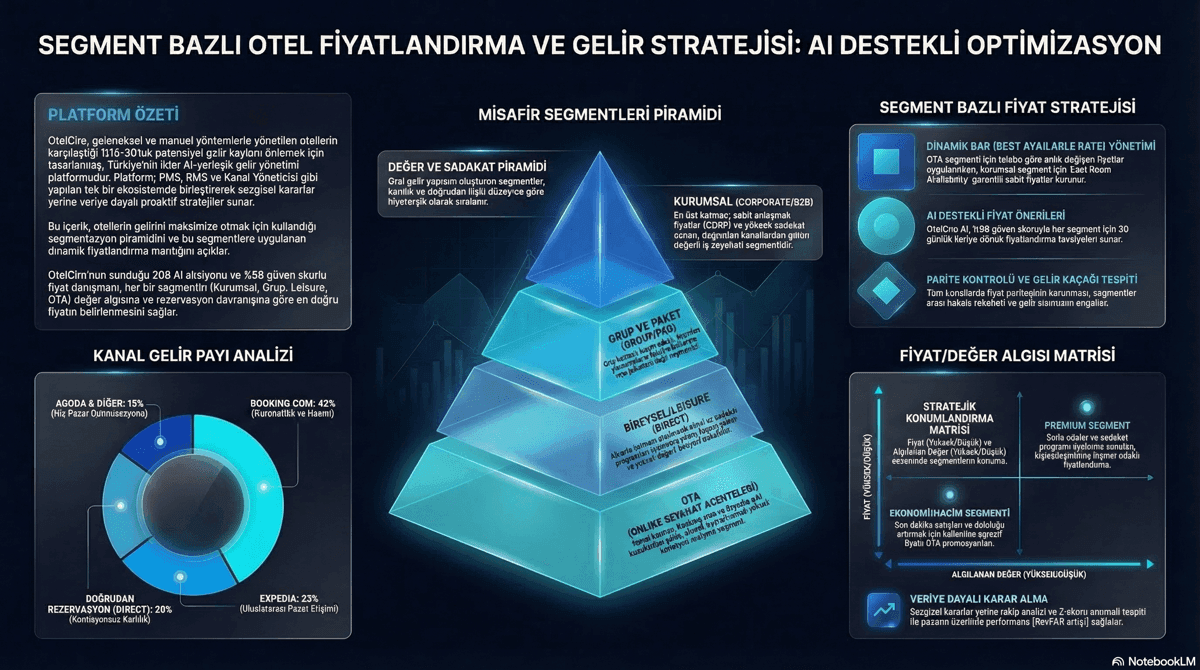
Embed this image on your site
<a href="https://otelciro.com/en/news/hotel-competitive-pricing-intelligence">
  <img src="https://cdn.sanity.io/images/1la98t0z/production/babd172d5d4e9762f3e1ec208c24dd03a431041a-1200x670.png" alt="Segment-based hotel pricing strategy" width="800" />
</a>
<p>Source: <a href="https://otelciro.com">OtelCiro</a> — AI Hotel Revenue Management</p>
Rate Shopping Fundamentals
What to Monitor
| Data Point | Frequency | Why It Matters |
|---|---|---|
| BAR (Best Available Rate) | Daily | Core competitive position |
| Room type rates | Daily | Product-level competition |
| Rate plan availability | Daily | Promotional and restricted rates |
| Minimum stay requirements | Daily | Demand management signals |
| Closed dates | Daily | Sold-out indicators |
| Package pricing | Weekly | Bundled value competition |
| OTA-specific promotions | Daily | Channel-specific competition |
| Review scores | Weekly | Quality-adjusted pricing context |
Price Position Analysis
Your rate relative to the comp set is more important than the absolute number:
| Your Position | Market Signal | Action |
|---|---|---|
| >15% above comp avg | Premium positioning | Justify with superior product/service |
| 5-15% above | Value-based premium | Maintain if reviews support |
| Within ±5% | Parity | Compete on content, reviews, service |
| 5-15% below | Value positioning | Evaluate if margin supports strategy |
| >15% below | Underpricing | Likely leaving money on the table |
Related reading: How Many Hours a Year Does Your Hotel Run Empty? The True Cost of Unsold Rooms
Related reading: Hotel Ancillary Revenue: Unlock Hidden Profit Centers
AI-Powered Competitive Intelligence
Beyond Manual Rate Shopping
AI competitive intelligence systems go far beyond checking competitor prices:
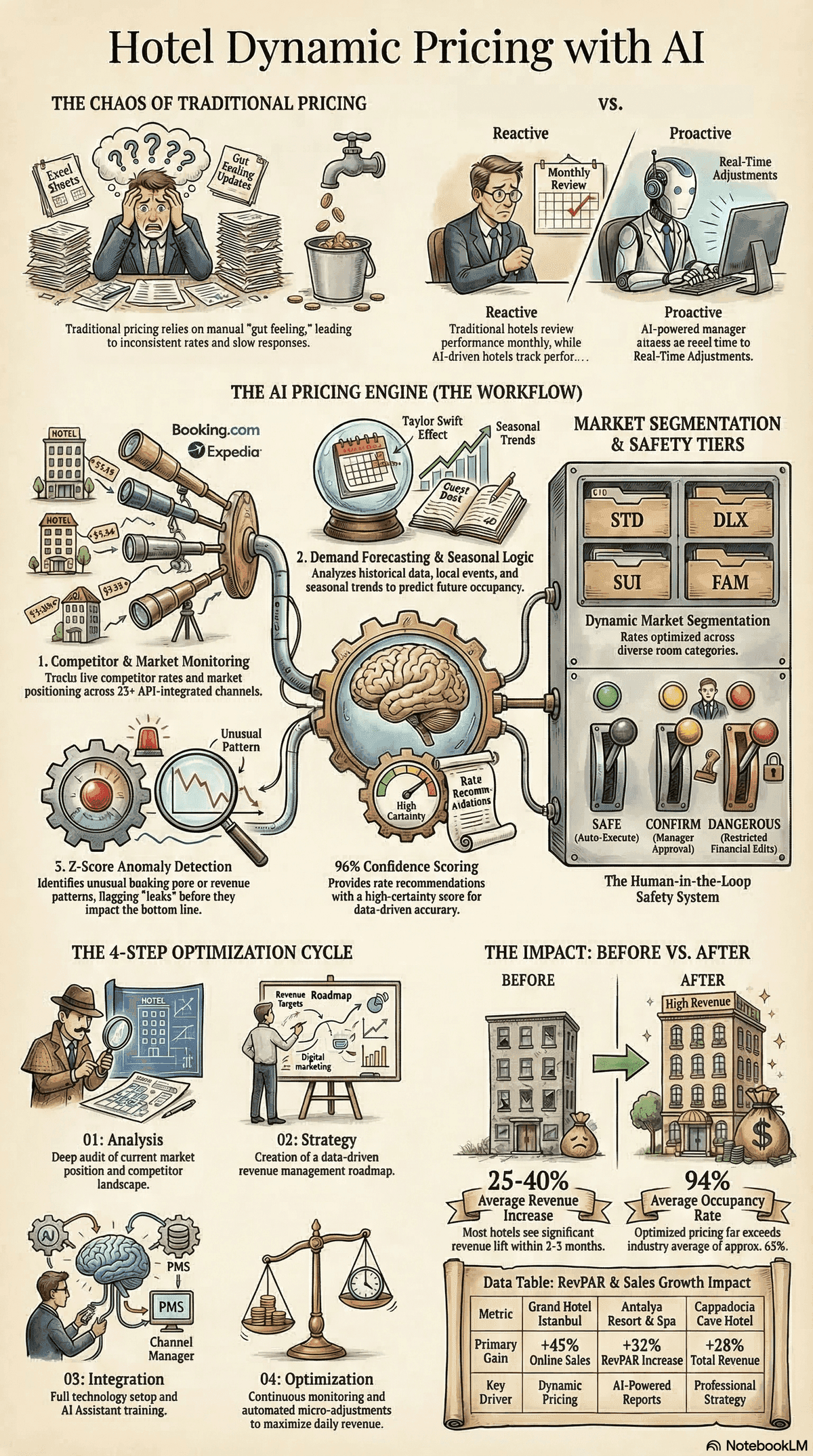
Pattern recognition: AI identifies when competitors systematically change rates (e.g., always raising rates 3 days before an event, always dropping rates on Tuesdays for next week).
Demand inference: By analyzing rate changes, availability restrictions, and promotional activity across the comp set, AI infers market demand levels — even without direct access to competitor occupancy data.
Predictive competitive response: AI models predict how competitors will react to your rate changes, enabling strategic pricing that anticipates competitive responses.
Rate parity monitoring: AI continuously monitors your rates across all channels to identify parity violations — where an OTA or wholesaler is selling your rooms below your authorized rate.
The Competitive Response Matrix
How to respond to competitive rate changes:
| Competitor Action | Your Demand Position | Recommended Response |
|---|---|---|
| Competitor drops rate 10% | Strong demand (80%+ pace) | Hold rates, monitor impact |
| Competitor drops rate 10% | Weak demand (<60% pace) | Consider matching or adding value |
| Competitor raises rate 15% | Strong demand | Follow increase (smaller magnitude) |
| Competitor raises rate 15% | Weak demand | Hold current rate (capture share) |
| Competitor closes dates | Any | Raise rates for those dates |
| New competitor opens | Any | Reassess positioning, strengthen differentiation |
Embed this image on your site
<a href="https://otelciro.com/en/news/hotel-competitive-pricing-intelligence">
  <img src="https://cdn.sanity.io/images/1la98t0z/production/e41b7ac3104ad8488f70d83e78d4135e4a401e88-1200x2150.png" alt="AI-driven hotel dynamic pricing model" width="800" />
</a>
<p>Source: <a href="https://otelciro.com">OtelCiro</a> — AI Hotel Revenue Management</p>
Competitive Intelligence Workflow
Daily Routine (15 Minutes)
- Review rate shopping dashboard for significant changes
- Check parity status across all channels
- Note any competitor availability restrictions
- Identify dates where your position has shifted
Weekly Analysis (30 Minutes)
- Review comp set ADR and occupancy trends
- Analyze rate positioning by day of week
- Identify upcoming dates requiring competitive repositioning
- Assess promotional activity across comp set
Monthly Strategic Review (60 Minutes)
- Evaluate comp set changes (new properties, renovations, repositioning)
- Analyze market share trends (if STR data available)
- Review pricing strategy effectiveness vs. competitive landscape
- Adjust comp set if necessary
Related reading: Dynamic vs. Static Pricing: How the Taylor Swift Effect Can Skyrocket Your Revenue
OtelCiro: Competitive Intelligence Engine
OtelCiro's AI Engine includes built-in rate shopping and competitive intelligence that monitors your comp set 24/7, analyzes pricing patterns, and delivers actionable recommendations. The system does not just show you competitor rates — it explains what they mean and how you should respond.
For comprehensive revenue strategy, explore our dynamic pricing guide and demand forecasting guide.
Conclusion
Competitive pricing intelligence is the eyes and ears of hotel revenue management. Without systematic competitive monitoring, pricing decisions are made in the dark. In 2026, AI-powered rate shopping and analysis have made comprehensive competitive intelligence accessible to hotels of all sizes. The investment is modest — typically $100-300/month for automated rate shopping — while the impact on pricing precision and revenue performance is substantial.
Discover how OtelCiro's AI Engine can provide comprehensive competitive pricing intelligence and automated pricing recommendations for your hotel.


![Hotel Upselling: AI-Driven Revenue Growth [2026]](https://cdn.sanity.io/images/1la98t0z/production/9850350573fc466b95b1490c7f689e8ac39c4f11-1200x669.png?w=1920&q=50&auto=format&fit=max)