
![MCP for Hotels: Connect AI to Your Systems [2026]](https://cdn.sanity.io/images/1la98t0z/production/dbe7337aff9a9567e3b5be2c70302d0e174eb0d0-1376x768.jpg?w=1920&q=65&auto=format&fit=max)
The Missing Link: AI Models Need Hotel Data
Large language models like GPT-4, Claude, and Gemini are powerful reasoning engines — but they are blind without data. An AI model can compose a brilliant response to a guest inquiry, but without real-time access to room availability, pricing, guest history, and property details, that response is generic and potentially inaccurate. This is the integration challenge that the Model Context Protocol (MCP) solves.
MCP is an open protocol that creates a standardized bridge between AI models and external data systems. For hotels, this means AI assistants can access PMS data, check availability, look up guest profiles, review pricing, and interact with operational systems — all in real time, all through a secure, standardized interface.
The result: AI that does not just talk about hospitality — it operates within it.

Embed this image on your site
<a href="https://otelciro.com/en/news/hotel-mcp-ai-integration-protocol">
  <img src="https://cdn.sanity.io/images/1la98t0z/production/dbe7337aff9a9567e3b5be2c70302d0e174eb0d0-1376x768.jpg" alt="MCP for hotels infographic" width="800" />
</a>
<p>Source: <a href="https://otelciro.com">OtelCiro</a> — AI Hotel Revenue Management</p>
Related reading: Hotel Automation: 15 Processes You Should Automate Today
Related reading: Hotel Data Analytics: From Raw Data to Revenue Decisions
What Is MCP?
The Model Context Protocol Explained
MCP (Model Context Protocol) was introduced by Anthropic as an open standard for connecting AI models to external tools, data sources, and systems. Think of it as a universal adapter between AI intelligence and real-world data.
The architecture:
- AI Model (Client): The reasoning engine (e.g., Claude, GPT-4)
- MCP Server: The middleware that exposes hotel data and tools
- Hotel Systems (Resources): PMS, RMS, CRM, channel manager, etc.
How it works:
- Hotel guest asks AI assistant: "Is a sea-view room available next Friday?"
- AI model recognizes this requires real-time data
- MCP server queries the PMS for availability on the requested date
- PMS returns available rooms with pricing
- MCP server formats and delivers data to the AI model
- AI model composes a natural language response with accurate information
Without MCP, the AI would have to say "I'll need to check and get back to you." With MCP, it answers immediately with accurate, real-time data.
Why MCP Matters for Hotels
| Without MCP | With MCP |
|---|---|
| AI gives generic, scripted responses | AI provides accurate, real-time answers |
| Guest must be transferred to staff for specifics | AI resolves inquiry end-to-end |
| AI operates in isolation from hotel systems | AI is integrated into the operational fabric |
| Manual data entry for AI interactions | Automated data flow between AI and systems |
| Limited to FAQ-style automation | Full-service AI assistant capability |
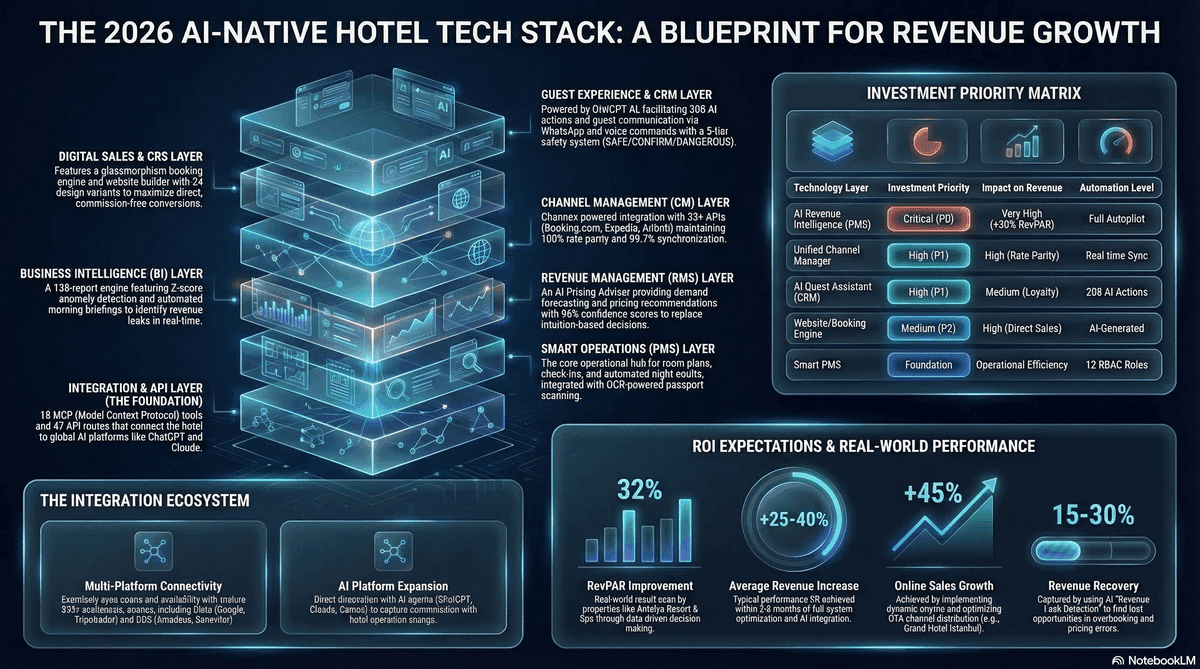
Embed this image on your site
<a href="https://otelciro.com/en/news/hotel-mcp-ai-integration-protocol">
  <img src="https://cdn.sanity.io/images/1la98t0z/production/81bc7a877e8a45c5e6bf4db244cf9b8cb0d343dd-1200x669.png" alt="Essential hotel technology stack tools" width="800" />
</a>
<p>Source: <a href="https://otelciro.com">OtelCiro</a> — AI Hotel Revenue Management</p>
Hotel System Integrations via MCP
Property Management System (PMS)
Data accessible:
- Room availability by type and date
- Guest profiles and stay history
- Reservation details and modifications
- Room status (clean, dirty, occupied, vacant)
- Billing and invoicing
Use cases:
- AI checks availability and quotes rates in real time
- AI accesses guest profile to personalize communication
- AI processes reservation modifications
- AI provides room status updates to housekeeping
Revenue Management System (RMS)
Data accessible:
- Current and recommended pricing
- Demand forecasts by date
- Competitive rate data
- Rate plan configurations
Use cases:
- AI explains pricing rationale to guests and staff
- AI provides revenue performance summaries
- AI flags anomalies in demand patterns
Channel Manager
Data accessible:
- Channel performance metrics
- Rate parity status
- Booking source data
- Availability across channels
Use cases:
- AI reports on channel performance
- AI identifies rate parity violations
- AI recommends channel allocation adjustments
CRM
Data accessible:
- Guest preferences and communication history
- Loyalty program status
- Marketing campaign engagement
- Feedback and complaint records
Use cases:
- AI personalizes all guest interactions based on CRM data
- AI handles loyalty program inquiries
- AI generates targeted marketing recommendations
Related reading: Hotel AI Chatbots: Transforming Guest Service in 2026
Real-World MCP Use Cases in Hotels
Guest-Facing Scenarios
Scenario 1: Booking Assistant Guest: "I need two connecting rooms for a family of 5, next month, ideally with breakfast included." AI (via MCP): Checks PMS for connecting room availability, retrieves breakfast-inclusive rate plan, calculates total cost, and presents options — all in one seamless response.
Scenario 2: In-Stay Concierge Guest: "Can I extend my stay by one night and add a spa treatment?" AI (via MCP): Checks room availability for the extension date, queries spa booking system for openings, calculates pricing, and offers to process both in one step.
Scenario 3: Post-Stay Follow-Up Guest emails asking about a billing discrepancy. AI (via MCP): Pulls the guest's full invoice from PMS, identifies the questioned charge, cross-references with POS data, and drafts a detailed explanation.
Operations Scenarios
Scenario 4: Revenue Morning Briefing Revenue manager: "What does today's forecast look like?" AI (via MCP): Pulls current occupancy, on-the-books data, competitive rates, and demand pace — then generates a narrative briefing with recommended actions.
Scenario 5: Maintenance Coordination Engineering team: "What rooms have open maintenance requests?" AI (via MCP): Queries maintenance system, lists open requests sorted by priority, and suggests scheduling based on current occupancy.
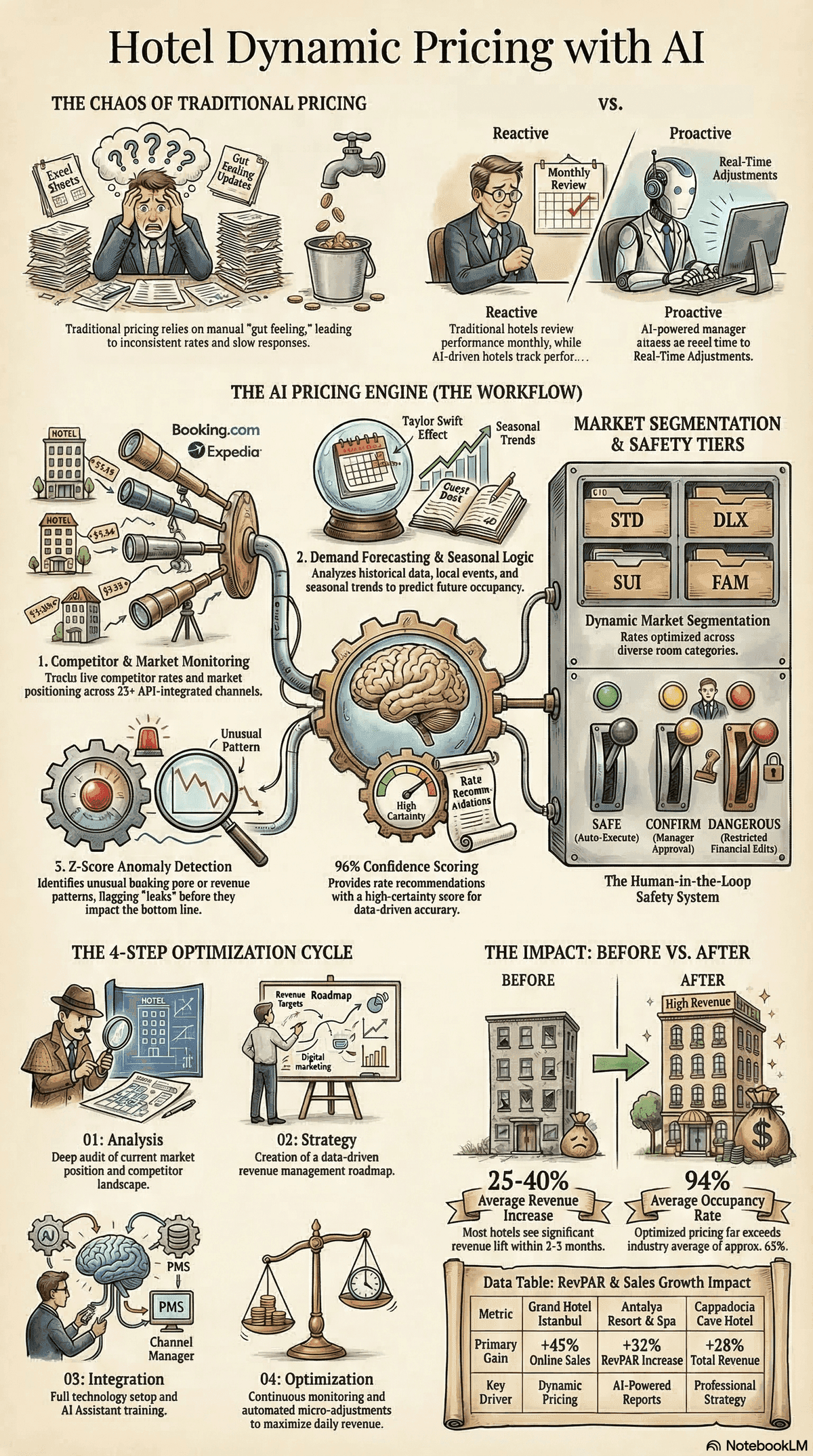
Embed this image on your site
<a href="https://otelciro.com/en/news/hotel-mcp-ai-integration-protocol">
  <img src="https://cdn.sanity.io/images/1la98t0z/production/e41b7ac3104ad8488f70d83e78d4135e4a401e88-1200x2150.png" alt="AI-driven hotel dynamic pricing model" width="800" />
</a>
<p>Source: <a href="https://otelciro.com">OtelCiro</a> — AI Hotel Revenue Management</p>
Implementation Roadmap
Phase 1: Foundation (Month 1-2)
- Deploy MCP server infrastructure
- Connect PMS as the primary data source
- Enable read-only access for AI queries
- Test with internal staff queries
Phase 2: Guest Interaction (Month 2-4)
- Connect AI chatbot to MCP for guest-facing queries
- Enable availability checking and rate quoting
- Add guest profile access for personalization
- Launch on website chat and messaging channels
Phase 3: Operational Integration (Month 4-6)
- Connect RMS, channel manager, and CRM
- Enable operational reporting through AI
- Add write capabilities (reservation creation, modifications)
- Deploy internal operational assistant for staff
Phase 4: Advanced Capabilities (Month 6+)
- Multi-system queries (combining PMS + RMS + CRM in single response)
- Automated workflow triggers based on AI analysis
- Predictive insights generation
- Cross-property data access (for groups/chains)
Security and Data Protection
MCP implementation requires careful attention to security:
- Authentication: Every AI query is authenticated and authorized
- Role-based access: Different AI functions access different data scopes
- Data encryption: All data in transit encrypted via TLS
- Audit logging: Every data access logged for compliance
- PII handling: Guest personal data managed per GDPR/privacy regulations
- Rate limiting: Prevents system overload from excessive queries
Related reading: Hotel Cloud PMS Migration: Step-by-Step Guide
OtelCiro: MCP-Native AI Platform
OtelCiro's MCP integration is built into the platform architecture from the ground up. The OtelGPT AI assistant connects to the Smart PMS, AI Engine, and all operational systems through MCP, delivering truly intelligent, data-aware AI that operates with real-time hotel context.
For related AI topics, explore our generative AI use cases guide and AI revenue management overview.
Conclusion
The Model Context Protocol represents a fundamental shift in how AI interacts with hotel systems. Instead of operating as a disconnected chatbot with scripted responses, MCP-enabled AI becomes an intelligent, integrated member of the hotel team — accessing real data, providing accurate answers, and executing real actions. For hotels evaluating AI technology, MCP support should be a core requirement, not an afterthought.
Discover how OtelCiro's MCP integration can connect intelligent AI to your hotel's operational systems for truly transformative guest service and management capabilities.
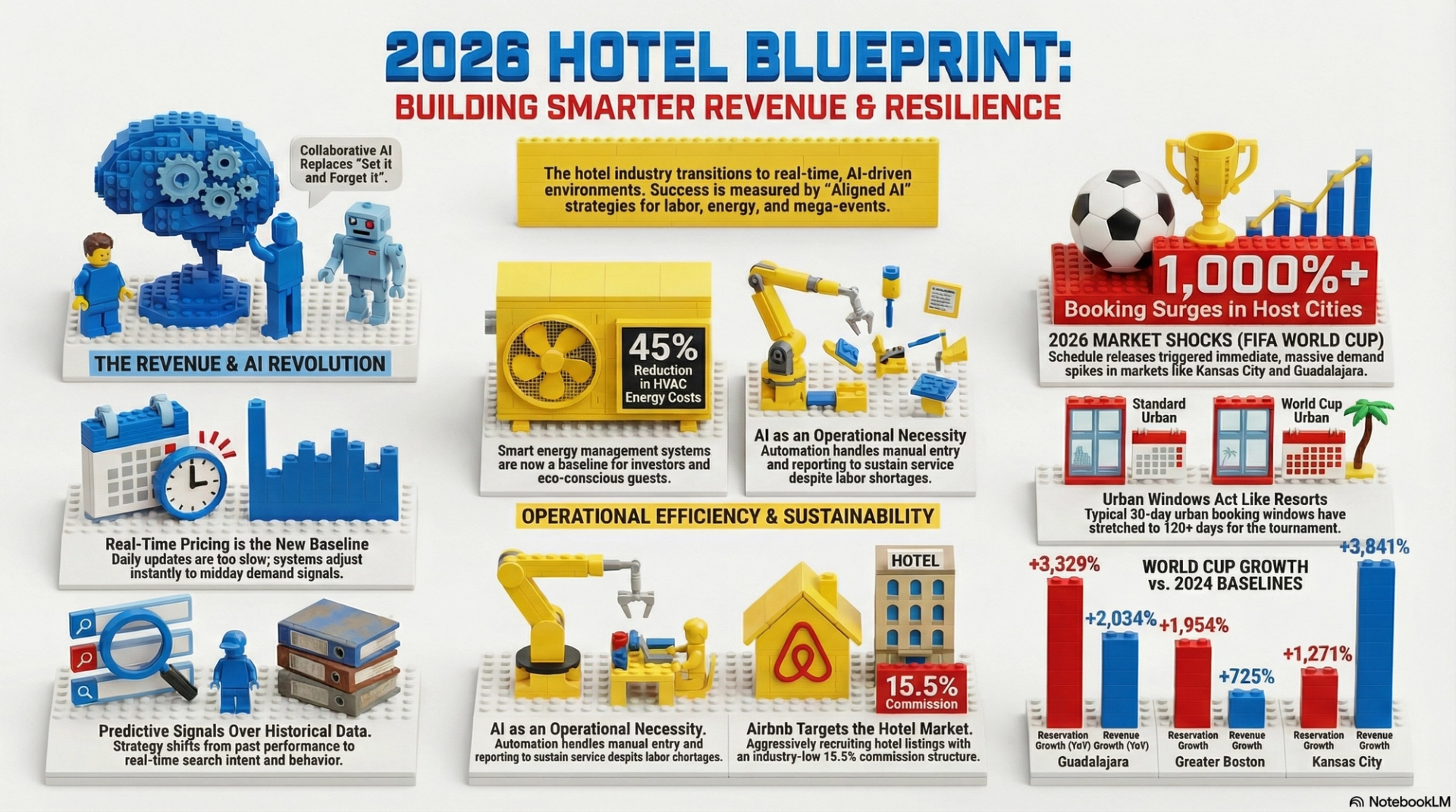
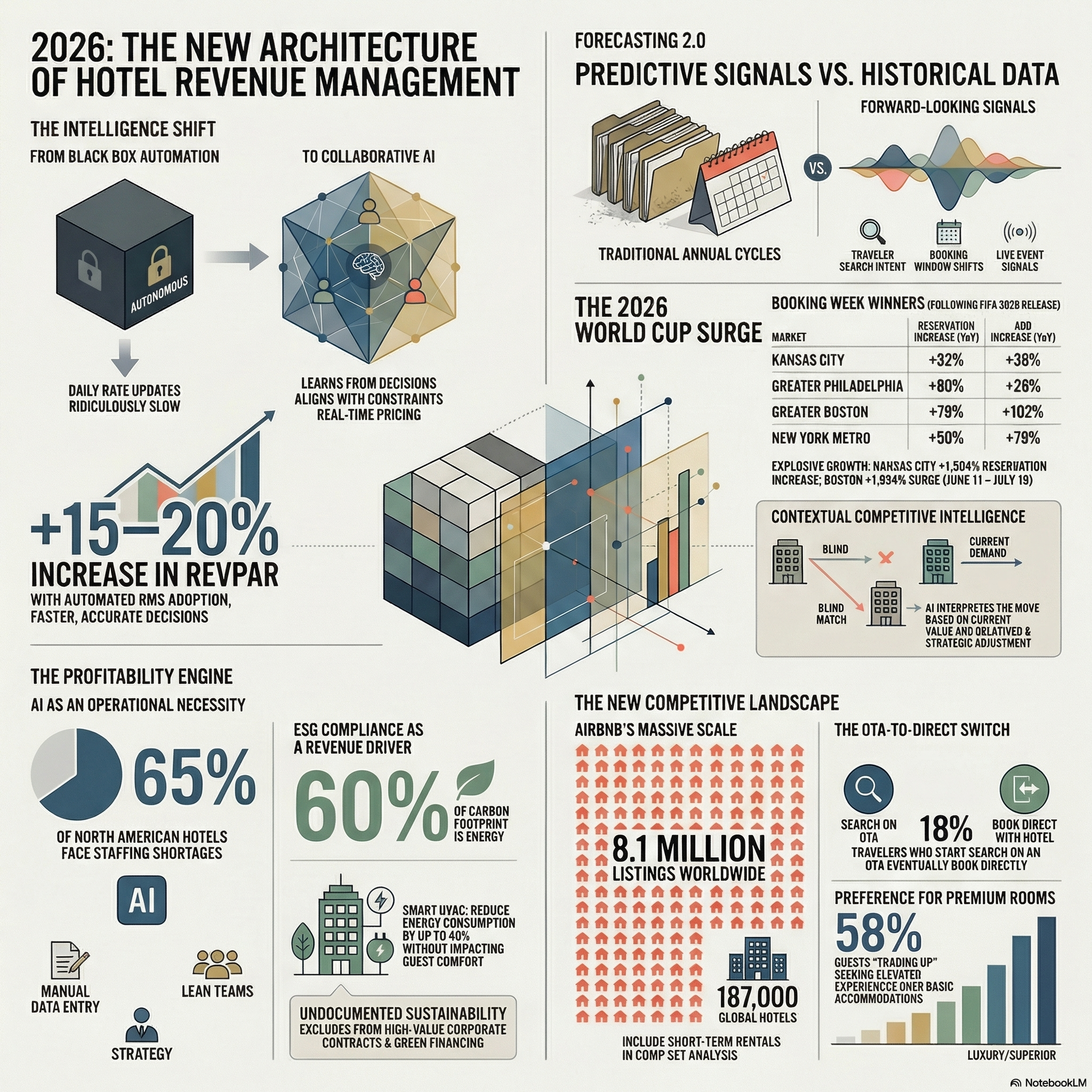
![What Is Hotel PMS? Complete Guide [2026]](https://cdn.sanity.io/images/1la98t0z/production/ed8a88dee7e97989449e8ca197f622a21487d33b-1376x768.jpg?w=1920&q=50&auto=format&fit=max)