Defying the Mediterranean Slowdown
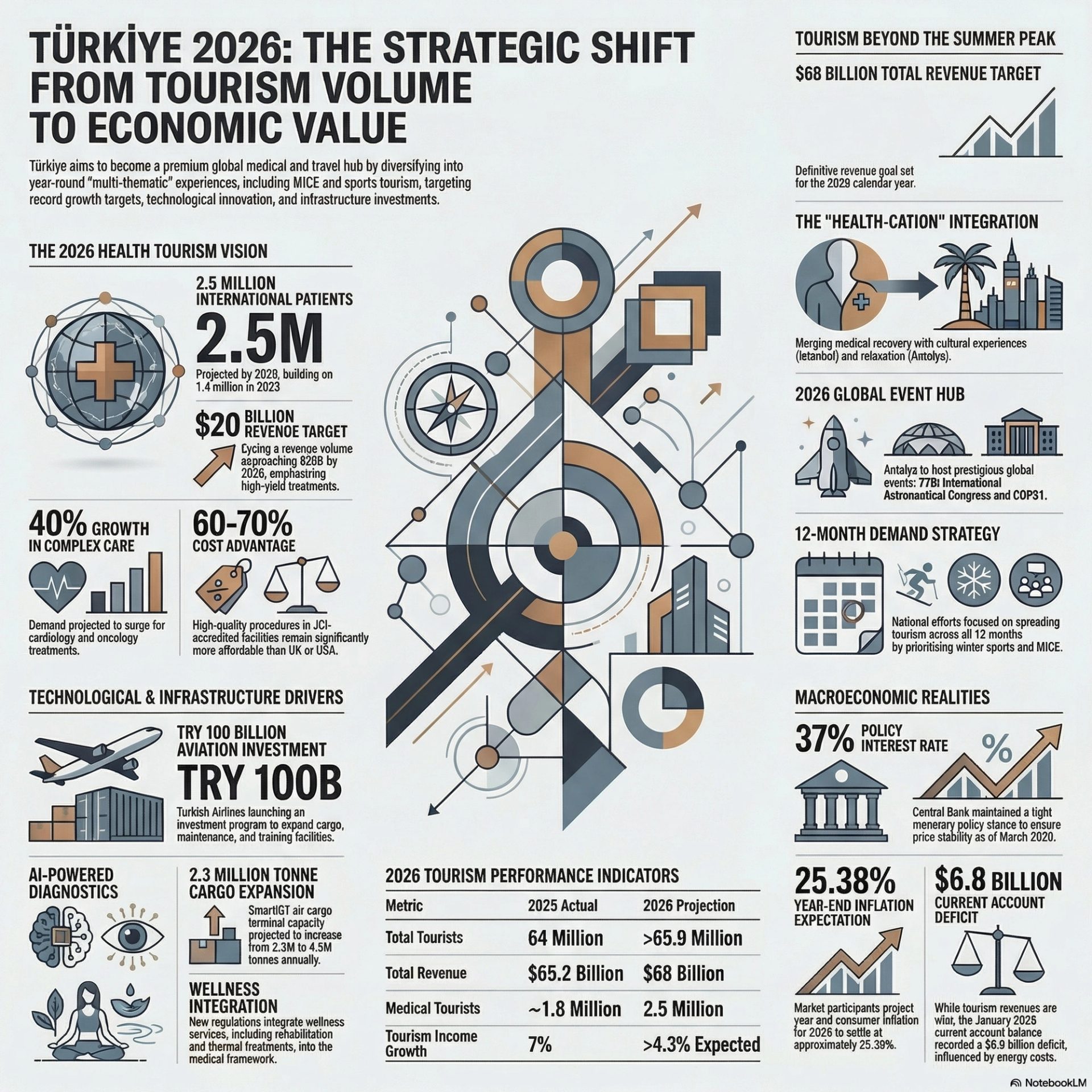
While traditional Mediterranean tourism destinations report softening demand and compressed margins, Turkey continues to chart a different course. Ranked as the 6th most visited country globally, Turkey is targeting over 40 million international tourist arrivals in 2026 — a figure that would represent a new record and a striking contrast to the demand contraction visible across parts of Southern Europe and North Africa.
This resilience is not accidental. It reflects a combination of competitive pricing, destination diversification, infrastructure investment, and increasingly, technology adoption that is allowing Turkish hotels to deliver superior guest experiences at scale.
The Numbers Behind Turkey's Position
Turkey's tourism metrics tell a story of consistent growth against a challenging regional backdrop.
| Metric | 2024 Actual | 2025 Actual | 2026 Target |
|---|---|---|---|
| International arrivals | 36.7M | 38.5M | 40M+ |
| Tourism revenue | $46.3B | $49.8B | $54B+ |
| Average spend per visitor | $1,261 | $1,293 | $1,350+ |
| Hotel occupancy (national avg) | 68.2% | 70.1% | 72%+ |
| RevPAR growth YoY | +8.4% | +7.2% | +6-8% projected |
These numbers gain significance when compared to regional peers. Spain, the Mediterranean's top performer, saw arrival growth decelerate to 2.1% in 2025 after years of 5-8% gains. Greece reported flat arrivals with declining average spend. Croatia and Montenegro face capacity constraints limiting further growth. Italy's tourism growth has been concentrated in a handful of cities, masking stagnation elsewhere.
Turkey's 5-7% annual arrival growth and consistent RevPAR gains stand out in this context.
What Is Driving Turkey's Outperformance
The Value Proposition Advantage
Turkey offers a compelling value equation for international travelers. The cost of a quality hotel stay in Turkey remains 30-45% below equivalent experiences in Western Mediterranean destinations. This is not a race to the bottom — Turkish hotels have invested heavily in property quality and service standards. Rather, it reflects structural cost advantages in labor, real estate, and supply chain that allow Turkish properties to deliver premium experiences at accessible price points.
For European travelers facing inflation-constrained budgets, Turkey represents an upgrade in experience without an upgrade in spending. This dynamic is particularly powerful in the mid-market and upper-mid segments where Turkey's hotel stock has improved dramatically in the past five years.
Destination Diversification Beyond the Coast
Turkey's tourism narrative has evolved beyond Antalya and Bodrum. While coastal resorts remain the volume drivers, the diversification into cultural and experiential tourism has opened new demand streams that are less seasonal and higher-yield.
| Destination Cluster | Primary Appeal | Growth Rate (YoY) | Average Daily Rate Trend |
|---|---|---|---|
| Istanbul | Culture, gastronomy, history | +9% arrivals | +12% ADR |
| Cappadocia | Unique landscape, boutique stays | +14% arrivals | +18% ADR |
| Antalya Coast | Beach, all-inclusive, families | +4% arrivals | +5% ADR |
| Aegean Coast | Boutique, wellness, sailing | +7% arrivals | +9% ADR |
| Southeast (Gaziantep, Mardin) | Gastronomy, heritage | +22% arrivals | +15% ADR |
| Black Sea Coast | Eco-tourism, nature | +11% arrivals | +8% ADR |
Cappadocia's 14% arrival growth and 18% ADR increase reflect the premium that cultural and experiential destinations can command. The Southeast region's 22% growth, albeit from a smaller base, signals an emerging demand that could reshape Turkey's tourism geography over the next decade.
Early Season Boost: Ramadan and Easter Convergence
The 2026 calendar creates a unique early-season opportunity for Turkish hotels. Ramadan and Easter both fall in early spring, creating overlapping demand patterns — religious tourism from Middle Eastern markets during Ramadan, and European leisure travel during the Easter holiday period.
This convergence extends the effective tourism season by 3-4 weeks compared to a typical year, reducing the shoulder-season gap between winter and summer peaks. Hotels in Istanbul, Cappadocia, and the Aegean have already seen forward bookings for the March-April period running 15-20% ahead of the same period in 2025.
The Technology Factor
Turkish hotels are adopting technology at a pace that is widening the service gap with regional competitors. This is particularly visible in two areas.
AI-Powered 24/7 Guest Services
The labor-intensive nature of Turkish hospitality — a strength when staffing is available — creates vulnerability during peak periods. Hotels that have deployed AI chatbots and virtual concierge systems report significant improvements in guest satisfaction and operational efficiency.
AI chatbot deployments in Turkish hotels have demonstrated the ability to handle 65-80% of routine guest inquiries without human intervention. This includes reservation modifications, local recommendations, room service orders, transportation arrangements, and FAQ responses in multiple languages.
The multilingual capability is particularly important for Turkey's diverse visitor base. AI systems that can engage in Turkish, English, German, Russian, Arabic, and French cover over 90% of Turkey's international visitor language preferences — a capability that would require substantial human staffing investment to replicate.
Revenue Management Intelligence
The adoption of AI-powered revenue management systems among Turkish hotels has accelerated markedly. Properties using these platforms report 12-18% RevPAR improvements compared to manual rate management, driven by more responsive competitor monitoring, demand-sensitive pricing adjustments, and optimized channel distribution.
For a market where margins are structurally thinner than Western European competitors, these efficiency gains translate directly to profitability improvements that fund further investment in property quality and guest experience.
The Competitive Position Going Forward
Turkey's tourism resilience is supported by several structural advantages that are difficult for competitors to replicate quickly:
Airport infrastructure. Istanbul Airport (IST) is now Europe's busiest airport by passenger volume, providing unmatched connectivity. Antalya Airport's expanded capacity supports direct charter flights from over 150 cities.
Hotel pipeline. Turkey has over 45,000 hotel rooms in the active development pipeline for 2026-2028, with international brands (Marriott, Hilton, Accor, IHG) accounting for approximately 35% of new supply. This investment signals long-term confidence from global operators.
Government support. Tourism promotion budgets have increased by 25% for 2026, with targeted campaigns in high-potential source markets including the UK, Germany, Gulf states, and increasingly, East Asian markets.
Visa liberalization. Turkey's e-visa system covers 100+ nationalities, reducing friction for international visitors. Ongoing negotiations for visa-free arrangements with additional European markets could further boost arrivals.
Challenges to Monitor
Turkey's tourism sector is not without risks. Currency volatility creates pricing complexity for international visitors and complicates forward revenue planning. Inflation, while moderating, continues to pressure operating costs. Geopolitical perception, though improved, remains a factor in certain source markets.
For revenue managers, these challenges reinforce the importance of sophisticated pricing strategies. Properties that rely on static seasonal rate cards are increasingly vulnerable. The hotels that thrive in Turkey's dynamic market are those using real-time demand signals, competitor intelligence, and AI-powered pricing to optimize rates continuously across all distribution channels.
The Outlook for 2026
Turkey's position as the 6th most visited nation globally is not a ceiling — it is a platform for continued growth. The combination of competitive value, destination diversification, infrastructure investment, and technology adoption positions the Turkish hotel sector to outperform Mediterranean peers through 2026 and beyond.
For hotel operators, the message is clear: the market opportunity is substantial, but capturing it requires the same sophistication in revenue management and technology adoption that has driven Turkey's tourism resilience to this point. Properties that invest in AI-powered operations and data-driven revenue strategies will disproportionately benefit from the sector's continued growth trajectory.