The Biggest Revenue Event in Hotel History
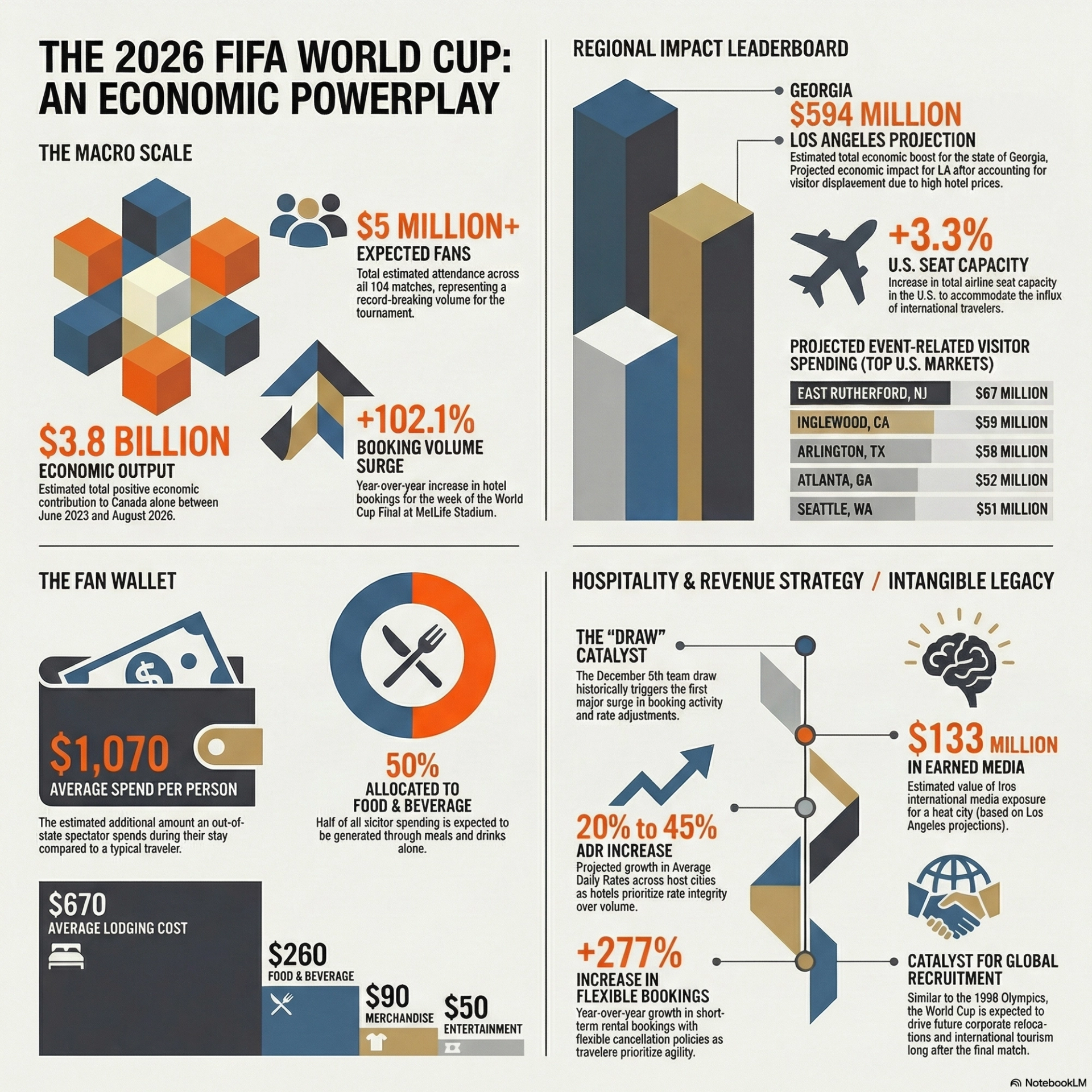
The 2026 FIFA World Cup is not just the largest sporting event of the decade. For hotel revenue managers across 16 host cities in the United States, Mexico, and Canada, it is the single most consequential demand event they will ever manage. The data arriving from early booking patterns confirms what the industry suspected: this event will redefine what is possible for hotel revenue in the summer of 2026.
Booking volumes across host cities are up 173% year-over-year for the tournament window (June 11 -- July 19, 2026). Game-night rates are commanding an average premium of 31.44% over comparable non-event dates. And the demand curve is just beginning to steepen.
Market-by-Market Booking Surge
The booking growth is not uniform. Each host city is experiencing distinct demand patterns shaped by team draw appeal, venue capacity, existing hotel supply, and international accessibility.
| Host City | YoY Booking Growth | Avg. Game-Night Premium | Supply Pressure |
|---|---|---|---|
| Miami | +62% | 38% | High |
| New York/New Jersey | +75% | 42% | Moderate |
| Los Angeles | +58% | 35% | Moderate |
| Dallas | +71% | 29% | Low |
| Houston | +64% | 27% | Low |
| Atlanta | +69% | 31% | Moderate |
| Philadelphia | +55% | 33% | Moderate |
| Seattle | +48% | 28% | High |
| San Francisco | +52% | 36% | High |
| Boston | +61% | 34% | High |
| Kansas City | +83% | 25% | Low |
| Mexico City | +114% | 44% | High |
| Guadalajara | +108% | 39% | High |
| Monterrey | +97% | 36% | Moderate |
| Toronto | +92% | 37% | Moderate |
| Vancouver | +86% | 33% | High |
The Mexico and Canada Effect
The most dramatic surges are occurring in international host cities. Mexico City bookings are up 114%, driven by both domestic demand and international fans choosing a more affordable host country. Canada is following a similar pattern, with Toronto up 92% as European fans leverage favorable exchange rates and direct flight access.
For US-based revenue managers, these numbers are a competitive signal. Some price-sensitive fan segments will choose to attend games in Mexico or Canada rather than pay premium US rates. Pricing strategies must account for cross-border substitution.
The Dynamic Pricing Sweet Spot
Analysis of booking pace data reveals a critical insight for revenue managers: the optimal pricing window for World Cup inventory follows a distinct pattern that differs from typical event-driven demand.
The 5.5-to-6-Month Window
Booking data shows that 5.5 to 6 months before match dates represents the sweet spot for initial rate positioning. At this point, demand signals are strong enough to justify premium pricing, but early enough that fans are still locking in travel plans and are less price-sensitive.
Hotels that set rates too early risk underpricing as demand intensifies. Hotels that wait too long face the risk that fans have already booked alternative accommodations or made different travel plans.
The Pricing Curve
Based on historical mega-event data and current 2026 booking patterns, the recommended pricing trajectory looks like this:
| Time to Match | Recommended Rate Position | Rationale |
|---|---|---|
| 12+ months out | Rack rate + 10-15% | Capture early committed fans |
| 6-9 months | Rack rate + 25-35% | Peak booking velocity window |
| 3-6 months | Rack rate + 35-50% | Scarcity premium kicks in |
| 1-3 months | Rack rate + 50-75% | Last-mile urgency pricing |
| Final 2 weeks | Rack rate + 40-60% | Slight pullback to fill remaining |
| Match day -3 to 0 | Rack rate + 30-50% | Walk-up demand vs. unsold risk |
The key observation is that maximum rates should peak at the 1-to-3-month window, not match day. Walk-up demand exists but carries more unsold inventory risk. Revenue managers should plan for a controlled rate decline in the final two weeks to optimize total revenue rather than chase maximum ADR.
Minimum-Stay Strategies That Work
One of the most effective revenue tactics for mega-events is minimum-stay requirements. For the World Cup, these strategies are already proving their value in early bookings.
Match-Night Minimum Stays
Hotels within 15 miles of a venue should implement 3-night minimum stays centered on match nights. This prevents single-night bookings that leave shoulder nights empty and captures the full economic value of fan stays.
For properties farther from venues (15-30 miles), a 2-night minimum is more appropriate, balancing capture with the lower demand premium at distance.
Group Stage vs. Knockout Round
Minimum-stay requirements should escalate as the tournament progresses:
- Group stage matches: 2-3 night minimum
- Round of 16: 3-night minimum
- Quarterfinals: 3-4 night minimum
- Semifinals and Final: 4-5 night minimum
The knockout rounds carry significantly higher demand intensity because fans are more emotionally invested and willing to pay premium rates. A quarterfinal match in Miami with the US team will generate demand that dwarfs a group stage match between smaller nations.
Revenue Beyond Room Rates
The World Cup revenue opportunity extends well beyond room rates. Hotels that prepare ancillary revenue strategies will capture significantly more per guest.
Food and Beverage
Hotels with bars and restaurants should plan for match viewing events. Average F&B spend per guest on match days at previous World Cups was 2.3x higher than non-match days. Themed menus, watch party packages, and fan gathering spaces turn common areas into revenue centers.
Transportation Packages
Bundling airport transfers and venue transportation with room bookings increases total booking value by 12-18% and reduces last-minute cancellation risk. Fans who have prepaid for transportation are far less likely to cancel.
Merchandise and Experience Partnerships
Partnerships with licensed FIFA merchandise vendors and local experience providers (city tours, restaurant reservations) create additional revenue streams with minimal operational cost. Commission-based models require no upfront investment.
The 31.44% Premium: How to Protect It
The average game-night premium of 31.44% represents an aggregate figure. Individual properties can significantly outperform or underperform this benchmark depending on their revenue management execution.
Rate Fencing
Clear rate fencing prevents premium erosion. World Cup rates should be:
- Non-refundable or with steep cancellation penalties (minimum 50% of total stay)
- Excluded from loyalty program free-night redemptions
- Excluded from corporate negotiated rate programs
- Separate from any ongoing OTA promotions
Channel Management
OTA commissions of 15-20% on premium World Cup rates are a significant margin drag. Hotels should aggressively drive direct bookings for event inventory through:
- Email campaigns to past guests in the host city
- Paid search campaigns targeting World Cup travel keywords
- Direct booking incentives (free parking, breakfast, late checkout)
- Social media content highlighting proximity to venues
A 5% shift from OTA to direct on World Cup inventory translates to meaningful profit improvement when rates are 30-75% above normal.
Competitive Intelligence Is Critical
Revenue managers must monitor competitor pricing continuously during the World Cup booking cycle. The market is highly transparent -- fans comparison-shop aggressively -- and significant overpricing relative to competitive set will result in bookings shifting to alternatives.
Weekly competitive rate shops should increase to daily monitoring starting 3 months before the tournament. Automated rate intelligence tools that track OTA pricing in real-time are not optional for this event -- they are essential.
The Bottom Line
The 2026 FIFA World Cup represents a once-in-a-generation revenue opportunity for hotels in 16 host cities and their surrounding markets. The 173% booking surge confirms massive demand. The 31.44% average premium validates premium pricing strategies. But capturing maximum revenue requires disciplined execution across pricing, minimum stays, channel management, and ancillary revenue.
Hotels that treat this as a standard compression event will leave substantial revenue on the table. Hotels that execute a comprehensive World Cup revenue strategy -- starting now, with the 5.5-to-6-month pricing window as their anchor -- will deliver results that reshape their annual financial performance.
The clock is ticking. The matches are set. The fans are booking. The only question is whether your revenue strategy is ready.