Luxury Is Winning -- But Not Equally
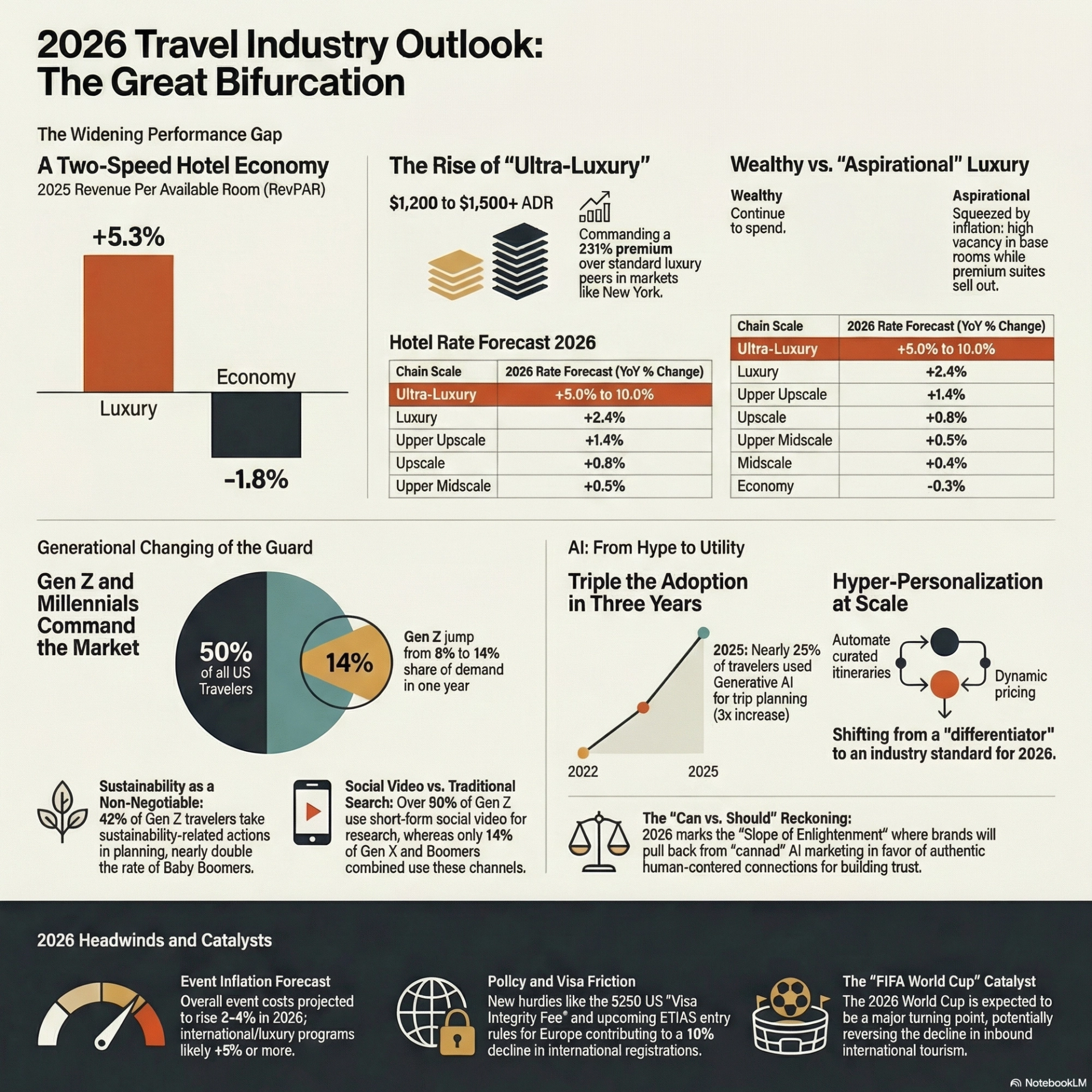
The luxury hotel segment has been the standout performer in global hospitality for the past three years. While upper-midscale and midscale segments have seen RevPAR growth moderate or flatten, luxury continues to push new highs. Global luxury hotel RevPAR grew 12.4% in 2025, compared to 3.8% for upper-upscale and just 1.2% for midscale properties.
But behind these headline numbers lies a more complex story. The luxury market is not growing as a monolith. It is bifurcating -- splitting into two distinct demand segments with fundamentally different behaviors, price sensitivities, and revenue implications.
Understanding this split is not academic. It is the single most important strategic question for any hotel operating in or adjacent to the luxury space in 2026.
The Two Luxury Markets
The Ultra-Wealthy Segment
The top end of the luxury market -- guests spending $1,500+ per night on accommodation alone -- is experiencing demand that appears almost entirely disconnected from broader economic conditions. This segment is defined by:
| Characteristic | Ultra-Wealthy Profile |
|---|---|
| ADR tolerance | $1,500-$10,000+/night |
| Booking lead time | 30-180 days |
| Length of stay | 4-14 nights |
| Price sensitivity | Near zero |
| Cancellation rate | Very low (8-12%) |
| Ancillary spend | 1.5-3x room rate |
| Loyalty program influence | Minimal |
| Primary booking channel | Direct/advisor/concierge |
This segment has grown by approximately 18% in volume since 2023, driven by wealth concentration, a booming stock market through late 2025, and the continued shift from material goods toward experiential luxury. Ultra-wealthy travelers are booking private island resorts, exclusive safari lodges, and penthouse suites at rates that would have been considered extreme even five years ago.
The Aspirational Luxury Segment
The second segment -- the "aspirational luxury" or what some analysts bluntly call the "poor rich" -- represents travelers with household incomes of $150,000-$500,000 who aspire to luxury experiences but are increasingly feeling budget constraints. This segment looks very different:
| Characteristic | Aspirational Luxury Profile |
|---|---|
| ADR tolerance | $400-$1,200/night |
| Booking lead time | 14-60 days |
| Length of stay | 2-4 nights |
| Price sensitivity | Moderate to high |
| Cancellation rate | Higher (18-25%) |
| Ancillary spend | 0.3-0.7x room rate |
| Loyalty program influence | High |
| Primary booking channel | OTA/loyalty/metasearch |
This is the segment that is feeling the squeeze. Inflation has eroded purchasing power. Interest rates remain elevated. And the "revenge travel" surge that powered luxury bookings in 2022-2024 has normalized. Aspirational luxury travelers still want premium experiences, but they are making trade-offs: shorter stays, fewer add-ons, more price comparison, and higher cancellation rates.
The RevPAR Divergence
When you separate luxury RevPAR into these two segments, the picture becomes dramatically clearer:
| Segment | 2023 RevPAR Growth | 2024 RevPAR Growth | 2025 RevPAR Growth | 2026 Forecast |
|---|---|---|---|---|
| Ultra-luxury ($1,500+) | +18.2% | +15.7% | +16.9% | +14-18% |
| Upper luxury ($800-$1,499) | +11.3% | +8.4% | +9.1% | +6-9% |
| Entry luxury ($400-$799) | +8.7% | +4.2% | +3.8% | +1-4% |
| Upper-upscale ($200-$399) | +5.1% | +2.8% | +2.1% | +1-3% |
The data reveals a clear pattern: the higher the price point, the stronger the growth. Entry-level luxury -- the segment most dependent on aspirational travelers -- is converging with upper-upscale performance. The premium that luxury once commanded uniformly is concentrating at the top.
Why the Bifurcation Is Happening
Several structural forces are driving this split, and none of them are temporary.
Wealth Concentration
Global billionaire wealth reached $14.2 trillion in 2025, up 17% from 2023. The number of ultra-high-net-worth individuals (assets over $30 million) grew by 7.6% globally. This expanding pool of ultra-wealthy individuals has enormous travel budgets and is willing to pay for exclusivity.
Meanwhile, the upper-middle class -- the aspirational luxury buyer -- has seen real income growth stagnate in most developed economies. The gap between what the top 0.1% and the top 5% can afford in travel experiences is widening.
The Exclusivity Premium
Ultra-luxury properties have discovered that scarcity drives outsized revenue. Properties limiting access -- through high rates, membership requirements, or simply small room counts -- are seeing the strongest RevPAR performance. The most exclusive properties in the Maldives, Patagonia, and the Swiss Alps are operating at 85-95% occupancy with ADRs above $3,000.
This exclusivity premium does not translate down-market. An entry-level luxury hotel cannot create the same scarcity dynamics because its target customer has alternatives at every price point.
Experience Economy Maturity
The shift from material to experiential spending has matured. Ultra-wealthy travelers are now seeking hyper-curated, one-of-a-kind experiences: private archaeological site access, celebrity chef dinners in remote locations, bespoke wellness programs with dedicated practitioners. These experiences command extreme premiums.
Aspirational luxury travelers want "special" experiences too, but their version -- a spa day, a wine tasting, a boutique hotel stay -- has become commoditized. The experience economy at the aspirational level is saturated with options, putting downward pressure on pricing power.
Implications for Hotel Revenue Strategy
For Ultra-Luxury Properties
Properties operating in the $1,500+ space should lean into the dynamics favoring them:
Push ADR aggressively. Ultra-wealthy price sensitivity is minimal. Properties that raised rates 20%+ in 2025 saw negligible demand impact. The ceiling for this segment remains untested at many properties.
Invest in exclusivity signals. Guest-to-staff ratios, private access, personalized pre-arrival planning, and invitation-only programs all increase willingness to pay. These investments have the highest ROI in the ultra-luxury segment.
Reduce distribution dependency. Ultra-luxury guests are overwhelmingly booked through direct channels, travel advisors, and concierge services. OTA commissions on $3,000/night rooms are a significant margin drain. Investing in advisor relationships and direct booking experiences pays disproportionate returns.
For Entry-Level and Mid-Luxury Properties
Properties in the $400-$1,200 range face a more complex strategic environment:
Acknowledge the bifurcation. Pricing as if all luxury demand is equal will result in either underpricing (missing ultra-wealthy willingness to pay) or overpricing (losing aspirational guests to upper-upscale alternatives). Segment-specific pricing is essential.
Create tiered experiences. Offer a base luxury room at a competitive rate alongside premium tiers (suites, club floors, experience packages) that capture higher willingness to pay from guests who can afford it. This "good-better-best" framework maximizes revenue across both segments.
Protect against downtrading. Aspirational luxury guests are increasingly willing to stay at a beautifully designed upper-upscale hotel instead of an underwhelming entry-luxury property. Competing on design, service quality, and value perception -- not just the "luxury" label -- is critical.
Optimize for ancillary revenue. When room rates face pressure, ancillary revenue becomes the margin differentiator. Spa services, F&B, experiences, and curated partnerships can add $150-$400 per stay without requiring rate increases that risk losing price-sensitive bookings.
For Upper-Upscale Properties
Properties positioned just below the luxury tier have an unexpected opportunity. As aspirational luxury travelers downtrade, upper-upscale properties that deliver exceptional experiences at $200-$400 per night are capturing demand that would have gone to entry-luxury two years ago.
Investing in design upgrades, service training, and lifestyle programming can allow upper-upscale properties to effectively compete for the aspirational luxury segment at a lower cost basis -- a strategic position with strong margin potential.
The Pricing Paradox
The bifurcation creates a paradox that revenue managers must navigate carefully. In the same market, on the same night, two rooms at the same hotel can face opposite pricing dynamics:
- The penthouse suite should be priced at the absolute maximum the market will bear, with minimal discounting, targeting ultra-wealthy guests for whom price is not a decision factor.
- The standard luxury room should be priced competitively, with value-enhancing inclusions, targeting aspirational guests who are actively comparing options.
Hotels that apply a single pricing philosophy across all room types will systematically leave money on the table at the top and lose bookings at the bottom. The solution is bifurcated revenue management -- treating the two segments as distinct demand pools with distinct pricing strategies, even within the same property.
Looking Ahead
The luxury bifurcation is not a cyclical phenomenon. It is a structural feature of the post-pandemic travel economy, driven by wealth concentration patterns that show no signs of reversing. Hotels that recognize this reality and adjust their revenue strategies accordingly will outperform those that cling to a unified view of "luxury demand."
The luxury market is not shrinking. It is splitting. And the revenue managers who understand where their property sits in this split -- and price accordingly -- will capture the full value of whichever segment they serve.