The EU Ecolabel Moment
In March 2026, the European Commission announced a significant expansion of its EU Ecolabel criteria for tourist accommodation, lowering the barrier to entry while tightening performance benchmarks. The updated framework now covers energy efficiency, water conservation, waste reduction, and sustainable procurement — with measurable thresholds that properties must meet annually.
This is not another feel-good badge. The EU Ecolabel is rapidly becoming a commercial differentiator, and properties that ignore it risk losing visibility, bookings, and corporate contracts.
Why Green Certification Suddenly Matters Commercially
Three forces are converging to make sustainability certification a direct revenue driver in 2026:
1. OTAs Are Surfacing Green-Certified Properties
Booking.com's Travel Sustainable programme now applies a visibility boost to properties with recognized third-party certifications. In Q1 2026, the platform reported that certified properties received 18% more impressions than comparable non-certified competitors in the same market. Expedia Group followed suit with its own sustainability filter, and Google Travel now displays certification badges directly in search results.
For revenue managers, this is the equivalent of a free ranking boost — one that compounds over time as traveler preferences increasingly skew green.
2. Corporate Travel Mandates Are Tightening
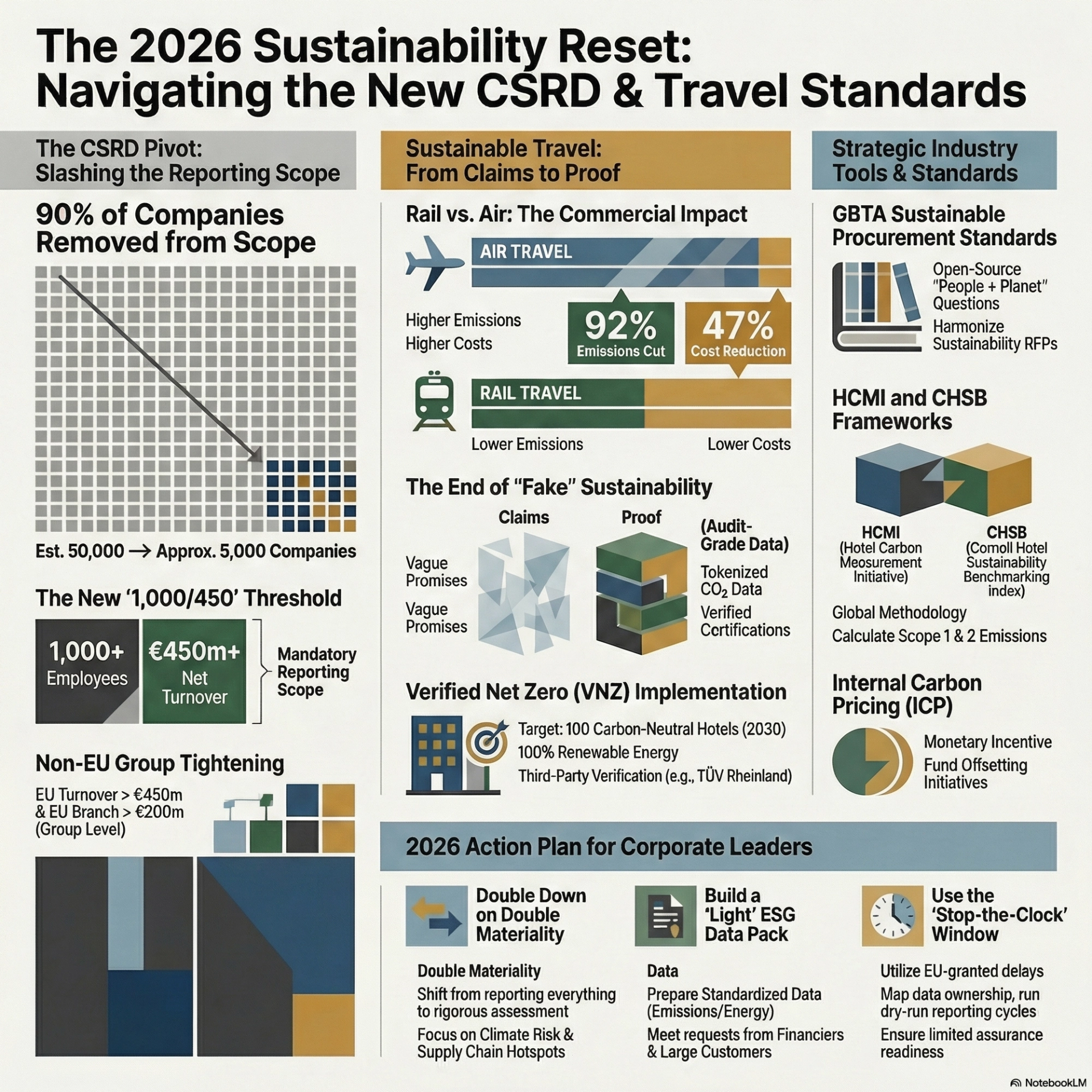
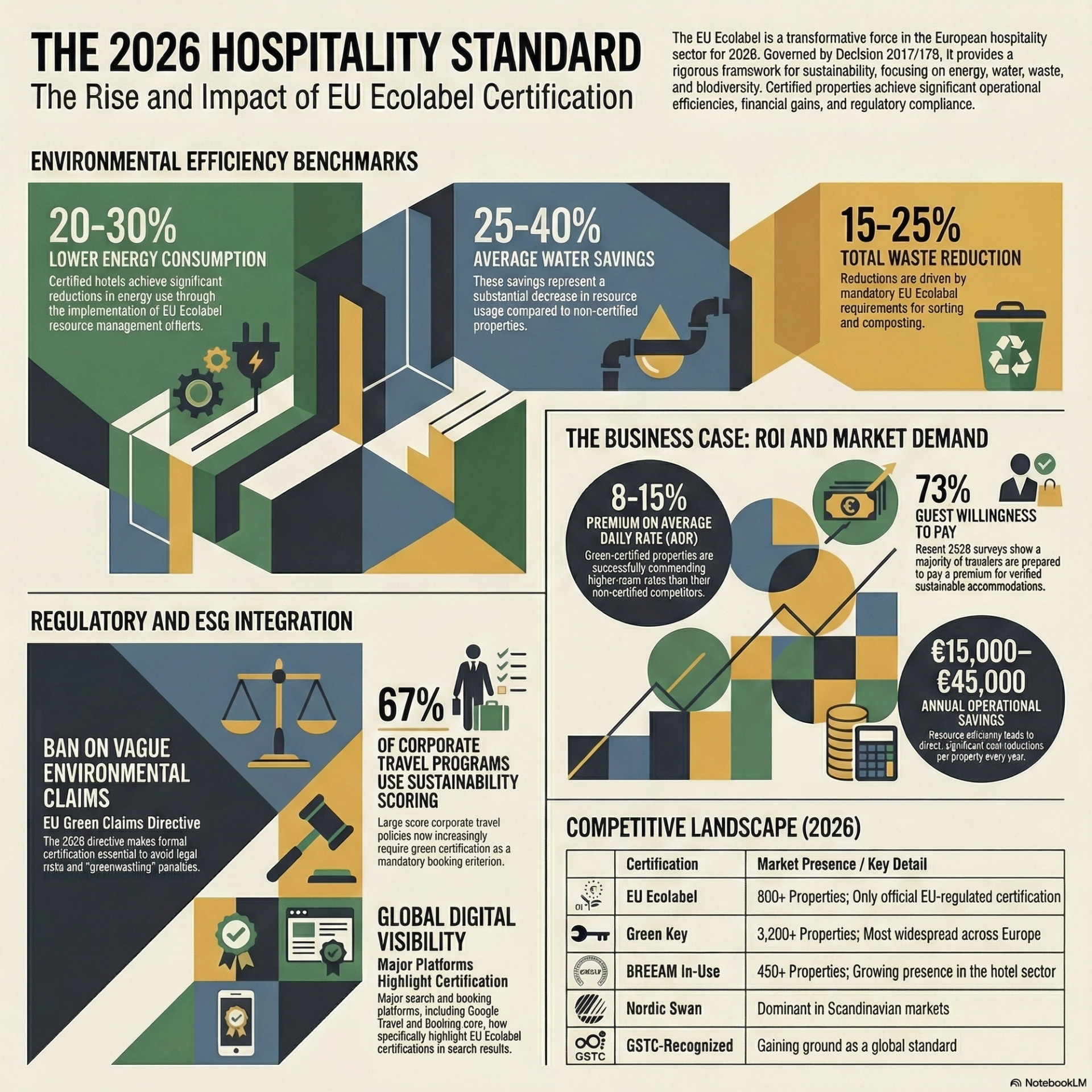
The Corporate Sustainability Reporting Directive (CSRD) requires large EU companies to report on Scope 3 emissions, which includes business travel. By 2026, an estimated 67% of European corporate travel programmes include sustainability criteria in their hotel selection process, up from 41% in 2023.
Global Travel Management Companies (TMCs) like BCD Travel, CWT, and American Express GBT now maintain preferred hotel lists that weight green certification heavily. Properties without recognized certification are increasingly excluded from corporate RFP processes — a channel that typically delivers the highest ADR and most predictable demand.
3. Leisure Travelers Are Willing to Pay More
A 2025 Booking.com survey of 33,000 travelers across 35 countries found that 78% intend to stay in sustainable accommodation at least once in the coming year, and 38% are willing to pay a premium of 10-15% for verified green practices. The keyword is "verified" — travelers are increasingly skeptical of greenwashing and look for recognized third-party labels.
The Certification Landscape: How EU Ecolabel Compares
Not all green certifications are created equal. Here is how the major programmes compare on key dimensions:
| Certification | Scope | Cost (Typical) | Audit Cycle | OTA Recognition | Corporate Acceptance |
|---|---|---|---|---|---|
| EU Ecolabel | Energy, water, waste, procurement | EUR 1,200-3,500/year | Annual | Booking.com, Expedia | High (EU standard) |
| Green Globe | 44 criteria across operations | USD 2,500-5,000/year | Annual + interim | Booking.com | High |
| LEED (Buildings) | Building design and operations | USD 5,000-25,000 (one-time) | Recertification every 5 years | Limited | Very high (US corporates) |
| EarthCheck | Environmental benchmarking | AUD 3,000-8,000/year | Annual | Booking.com | Moderate |
| Green Key | Environmental management | EUR 500-2,000/year | Annual | Booking.com | Moderate |
The EU Ecolabel offers the strongest combination of low cost, high OTA recognition, and corporate credibility for European properties. For hotels outside Europe, Green Globe and Green Key provide similar commercial benefits.
Measurable ROI: The Business Case
The investment case for green certification is no longer theoretical. Data from certified properties across Europe demonstrates clear financial returns:
Energy Cost Reduction
Properties achieving EU Ecolabel certification report average energy cost reductions of 15-25% within the first two years. For a 100-room hotel spending EUR 180,000 annually on energy, this translates to EUR 27,000-45,000 in annual savings — often exceeding the certification cost in year one.
Water Cost Reduction
Certified hotels implement low-flow fixtures, greywater recycling, and smart irrigation systems that reduce water consumption by 20-35%. In water-scarce Mediterranean markets (Spain, Greece, Turkey, Italy), where water costs are rising 8-12% annually, these savings compound aggressively.
ADR Premium
STR data from European markets shows that certified properties achieve a 3-7% ADR premium over non-certified competitors in the same star category and location. This premium is most pronounced in:
- Northern European markets (Germany, Netherlands, Scandinavia): 5-7%
- Southern European markets (Spain, Italy, Greece): 3-5%
- Urban markets with high corporate travel share: 6-8%
Occupancy Lift from OTA Visibility
The OTA visibility boost translates to measurable occupancy gains. Certified properties on Booking.com report 2-4 percentage points higher occupancy on average, driven by improved search ranking and the sustainability badge's influence on booking decisions.
Combined ROI Timeline
For a typical 80-120 room European hotel, the combined ROI from energy savings, water savings, ADR premium, and occupancy lift delivers full payback within 18-30 months, with ongoing annual returns of 8-15% on the certification investment.
Implementation Roadmap for Revenue Managers
Green certification is not just a facilities management project — it has direct implications for revenue strategy:
Phase 1: Assessment (Month 1-2)
Conduct an energy and water audit against EU Ecolabel criteria. Identify the gap between current operations and certification requirements. Most hotels find they are already 60-70% compliant and need targeted investments in:
- LED lighting (if not already complete)
- Low-flow bathroom fixtures
- Waste sorting and recycling infrastructure
- Sustainable procurement documentation
Phase 2: Implementation (Month 3-6)
Execute the capital improvements identified in the assessment. The typical investment ranges from EUR 15,000-50,000 for a mid-sized property, depending on existing infrastructure. Prioritize changes with the fastest payback — LED retrofits typically pay for themselves within 8-12 months through energy savings alone.
Phase 3: Certification and Activation (Month 6-8)
Apply for certification, complete the audit, and immediately activate the commercial benefits:
- Update OTA profiles with certification badges
- Notify corporate accounts and TMC partners
- Adjust rate strategy to capture the ADR premium (start with 2-3% and test elasticity)
- Create sustainability content for direct booking channels
Phase 4: Revenue Optimization (Ongoing)
Monitor the performance differential between your property and non-certified competitors. Use the certification as a differentiator in corporate RFP responses. Track the OTA visibility impact through impression and conversion data.
The Competitive Risk of Inaction
The window for early-mover advantage is closing. As more properties achieve certification, the competitive benefit shifts from "premium for having it" to "penalty for lacking it." In Scandinavian markets, where green certification penetration already exceeds 40%, non-certified properties report losing 8-12% of corporate contract volume annually.
The trajectory is clear: green certification is following the same adoption curve as online distribution did 15 years ago. Properties that treated OTA presence as optional in 2010 paid a heavy price by 2015. The same dynamic is unfolding with sustainability certification today.
Strategic Takeaway
The EU Ecolabel's 2026 expansion is not an environmental story — it is a commercial one. The convergence of OTA visibility algorithms, corporate travel mandates, and consumer willingness to pay creates a measurable revenue opportunity for certified properties. The investment is modest, the payback is fast, and the competitive risk of waiting is growing. For revenue managers, green certification belongs in the same strategic category as channel management and dynamic pricing — it directly impacts your top line.