The Quiet Revolution in Hotel Procurement
There is a transformation underway in how corporate travel managers select hotel partners, and most hoteliers have not noticed it yet. Environmental, Social, and Governance (ESG) mandates — once limited to annual reports and investor presentations — have migrated into the operational machinery of corporate travel procurement. The result is a systematic exclusion of properties that lack sustainability documentation from preferred vendor programs, green financing pipelines, and increasingly, from OTA search results.
This is not a trend. It is a structural shift in how hotels get booked.
The Corporate Travel ESG Mandate Landscape
Global corporate travel spend is projected to reach $1.48 trillion by 2027, with sustainability criteria now embedded in procurement decisions at 73% of Fortune 500 companies. The mechanics are straightforward: corporate travel policies now require employees to book from approved hotel lists, and those lists increasingly filter by sustainability credentials.
| ESG Requirement Level | % of Corporate Programs | Impact on Hotel Selection |
|---|---|---|
| Mandatory green certification | 34% | Properties without certification excluded entirely |
| Preferred status for certified | 41% | Certified properties ranked higher, non-certified deprioritized |
| Reporting only (no mandate) | 18% | Sustainability data collected but not used for selection |
| No ESG requirement | 7% | Decreasing annually by 3-5 percentage points |
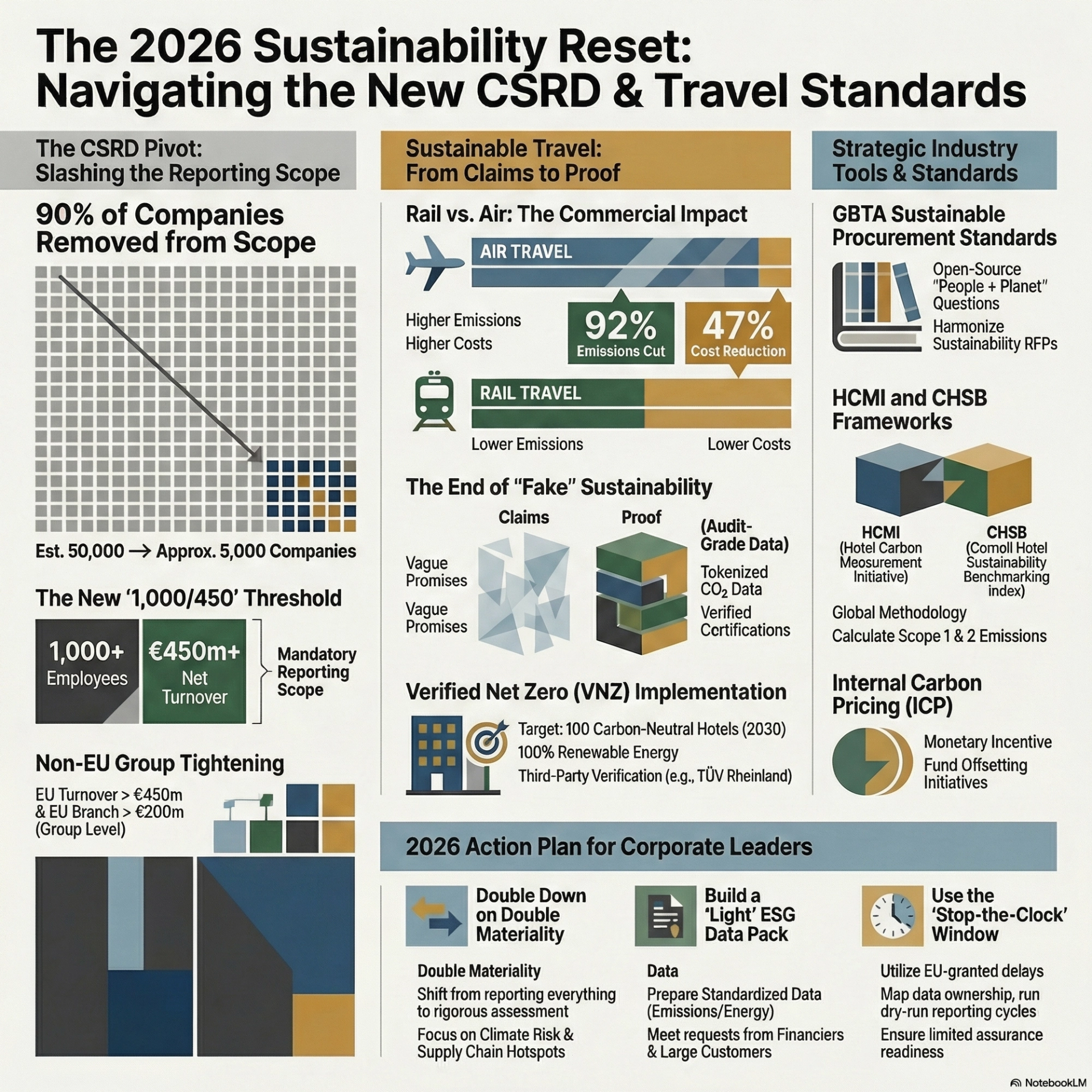
The shift accelerated in 2025 when the EU Corporate Sustainability Reporting Directive (CSRD) began requiring Scope 3 emissions disclosures from large companies. Since business travel falls squarely within Scope 3, procurement teams now need verifiable emissions data from every hotel in their programs.
What Travel Managers Actually Require
Conversations with corporate travel managers reveal a surprisingly specific checklist that goes beyond vague "green" claims:
- Third-party certification (LEED, Green Key, EarthCheck, or equivalent) — self-reported sustainability claims are no longer accepted
- Carbon emissions data per room night — required for Scope 3 reporting calculations
- Waste diversion rates — particularly relevant for meeting and event bookings
- Water consumption metrics — increasingly weighted in water-stressed destinations
- Social governance documentation — labor practices, local sourcing, community impact
Properties that cannot provide this documentation are not rejected outright. They simply never make it onto the approved list.
The Green Financing Connection
The financial incentive structure has shifted decisively toward certified properties. Green bonds, sustainability-linked loans, and preferential refinancing terms are now available exclusively to hotels with verified environmental credentials.
Key Financial Differentiators
Hotels with recognized sustainability certifications access capital at measurably better terms:
| Certification | Financing Benefit | Typical Rate Advantage |
|---|---|---|
| LEED Gold/Platinum | Green bond eligibility | 50-75 basis points |
| Verified Net Zero | Sustainability-linked loan qualification | 40-60 basis points |
| Zero Carbon Certified | Preferential refinancing | 30-50 basis points |
| EarthCheck Gold | ESG fund investment eligibility | Variable |
| Green Key (5 keys) | Regional green financing access | 20-40 basis points |
A 50 basis point advantage on a $15 million property loan translates to approximately $75,000 in annual interest savings. Over a typical 10-year loan term, that is $750,000 — a figure that dwarfs the cost of obtaining and maintaining most sustainability certifications.
OTA Sustainability Filters Are Amplifying the Effect
The distribution impact extends beyond corporate direct bookings. Major OTAs have integrated sustainability filters and badges that influence leisure travelers as well.
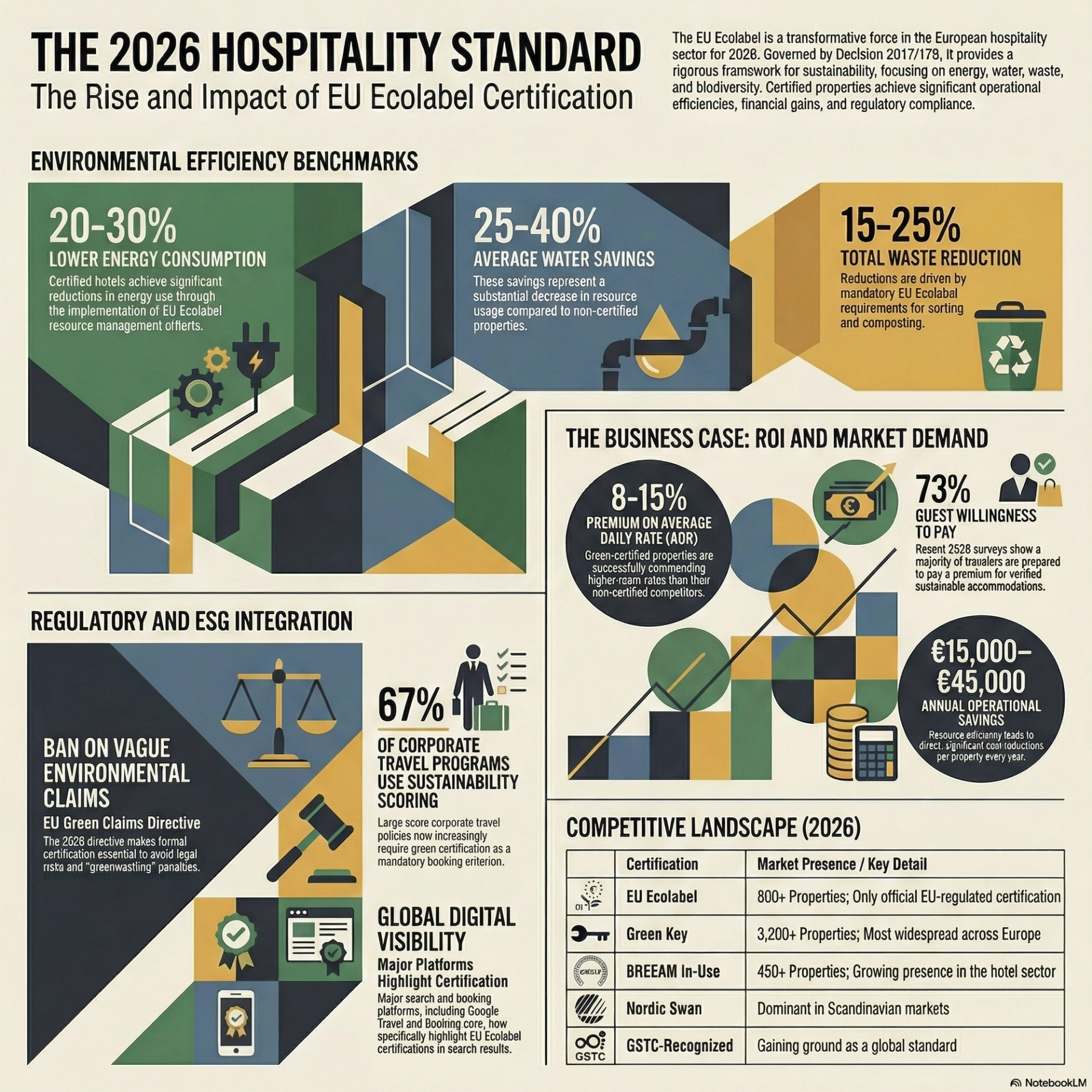
Booking.com's Travel Sustainable badge is now displayed on over 500,000 properties globally. Properties with the badge report 12-18% higher click-through rates from environmentally conscious travelers. Expedia Group's similar program covers 120,000+ properties with measurable booking uplift for certified hotels.
Google Travel has begun surfacing sustainability information in hotel search results, creating a visibility advantage for properties with verifiable credentials. This is particularly impactful for independent hotels that compete primarily on search visibility rather than brand loyalty.
The Two-Tier Market Emerging
The combined effect of corporate mandates, green financing, and OTA visibility is creating a clear two-tier market:
Tier 1: Certified and documented properties enjoy preferential corporate contracts, better financing terms, higher OTA visibility, and access to a growing segment of sustainability-conscious leisure travelers.
Tier 2: Uncertified properties face exclusion from corporate programs, standard (higher) financing rates, reduced OTA visibility, and competition limited to price-sensitive segments.
The gap between these tiers is widening. Properties that delay certification are not standing still — they are falling behind at an accelerating rate.
The Certification ROI Calculation
Hotel owners and revenue managers often cite certification costs as a barrier. The actual economics tell a different story.
| Certification | Initial Cost | Annual Maintenance | Typical ROI Timeline |
|---|---|---|---|
| Green Key | $1,500-3,000 | $800-1,500 | 6-12 months |
| EarthCheck | $5,000-12,000 | $3,000-6,000 | 12-18 months |
| LEED (existing buildings) | $15,000-50,000 | $5,000-10,000 | 18-36 months |
| Zero Carbon Certified | $10,000-25,000 | $4,000-8,000 | 12-24 months |
When corporate contract revenue, financing advantages, and OTA visibility uplift are factored together, most properties achieve positive ROI within 12-18 months of certification. The calculation becomes even more favorable for properties that combine certification with operational efficiency improvements — LED lighting conversions, water recycling systems, and smart HVAC controls that reduce utility costs by 15-30%.
Practical Steps for Revenue Managers
Revenue managers can take immediate action to position their properties for the ESG-driven market:
1. Audit Current Sustainability Documentation
Before pursuing any certification, assess what documentation already exists. Many properties have implemented sustainability measures without formalizing them. Energy audits, waste management contracts, and local sourcing agreements may already satisfy portions of certification requirements.
2. Start with the Lowest-Barrier Certification
Green Key and similar national programs offer the most accessible entry point. The application process typically takes 60-90 days, costs are manageable for properties of any size, and the certification is recognized by major corporate travel programs and OTAs.
3. Build Carbon Emissions Reporting Capability
Regardless of certification status, the ability to provide per-room-night carbon emissions data is becoming a baseline requirement for corporate programs. Revenue management platforms that integrate energy consumption data with occupancy metrics can generate this reporting automatically.
4. Update Distribution Channel Profiles
Ensure sustainability credentials are reflected across all distribution channels — OTA extranet profiles, GDS content, brand.com, and corporate RFP responses. Properties that earn certifications but fail to update their distribution profiles miss the visibility benefits entirely.
5. Price the Premium Appropriately
Sustainability-certified properties can command a 5-12% rate premium from corporate accounts that require green credentials. This premium should be built into corporate rate negotiations, not treated as an afterthought.
The AI-Powered Sustainability Advantage
Technology is accelerating the sustainability transition. AI-powered revenue management systems can now integrate sustainability metrics into pricing and distribution decisions automatically. Properties using these systems report more efficient energy usage during low-occupancy periods, optimized HVAC and lighting schedules that reduce carbon per occupied room, and automated sustainability reporting that satisfies corporate procurement requirements with minimal manual effort.
The convergence of corporate ESG mandates, green financing incentives, and OTA visibility algorithms has created a market where sustainability certification delivers measurable revenue impact. Hotels that treat ESG compliance as a revenue strategy rather than a cost center will capture disproportionate market share in the years ahead.
The silent reshaping of hotel selection is already well underway. The only question is whether your property is positioned on the right side of the divide.