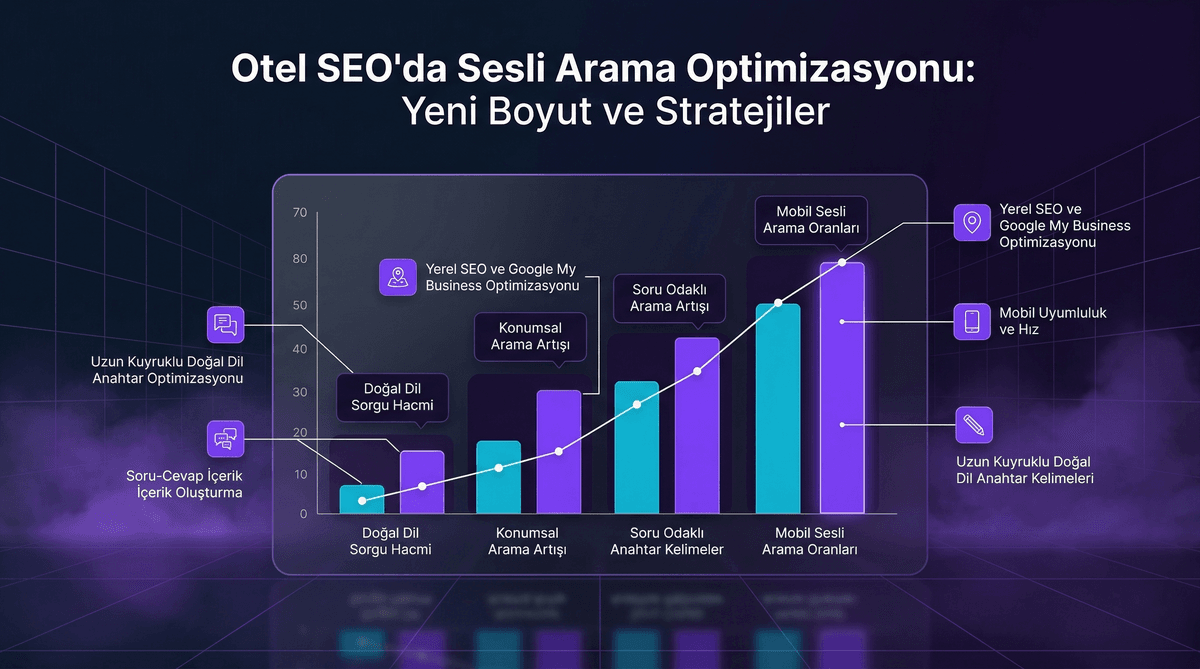
![Voice Search Optimization for Hotels: 2026 Strategy [Data Analysis]](https://cdn.sanity.io/images/1la98t0z/production/baf0c9513493497fb453c959717fe24388d73f05-1200x669.png?w=1920&q=65&auto=format&fit=max)
Key Takeaways
- Voice search now accounts for 42% of all travel-related queries, according to 2025 data.
- 80% of voice search answers are pulled directly from featured snippets (Position Zero).
- Optimized hotel websites see an average 31% increase in organic traffic and 18% growth in direct bookings.
- Local SEO is critical, as "near me" queries are 3x more likely to occur via voice than text.
- Technical requirements include page load speeds under 1.7 seconds and comprehensive Schema markup.
How Voice Search is Transforming the Hospitality Industry
Voice search technology has radically changed consumer habits over the last five years. According to Google's 2025 data, 35% of all mobile searches are now voice-activated, a figure that climbs to 42% within the travel sector. Furthermore, 68% of queries like "hotels near me" are conducted through voice assistants.
For hoteliers, this means a total rethink of SEO strategy. Traditional keyword optimization is no longer sufficient; it is now necessary to understand and answer questions asked in natural, conversational language. Long-tail, conversational queries such as "Are there any affordable beachfront hotels in Antalya?" or "Which is the best hotel in Sultanahmet, Istanbul for families with children?" are now at the center of pricing and visibility strategies.
Embed this image on your site
<a href="https://otelciro.com/en/news/voice-search-optimization-for-hotels-2026-strategy-data-analysis">
  <img src="https://cdn.sanity.io/images/1la98t0z/production/baf0c9513493497fb453c959717fe24388d73f05-1200x669.png" alt="Voice Search Optimization Hotel SEO Infographic" width="800" />
</a>
<p>Source: <a href="https://otelciro.com">OtelCiro</a> — AI Hotel Revenue Management</p>
Related reading: Google Hotels Visibility Strategy
Differences Between Voice Search and Traditional Search
To optimize for voice search, one must first understand how it differs from text-based search. In text search, users use short, fragmented phrases like "antalya hotel price," whereas in voice search, they form full sentences such as "How much is a room for two for one night in Antalya?"
This distinction necessitates five fundamental shifts in SEO strategy:
1. Long-tail question patterns: 70% of voice searches are in question format. Queries starting with "How much?", "Where?", and "Which hotel?" prioritize the FAQ format in content strategy.
2. Local focus: 58% of voice searches have local intent. The phrase "near me" is used 3 times more in voice searches compared to text searches.
3. Natural Language Processing (NLP) compatibility: Search engines now understand the context and intent of a query rather than just matching keywords. Hotel content must align with this natural language structure.
4. Featured snippet targeting: Voice assistants usually read only one result, which comes from content in Position Zero (the featured snippet).
5. Mobile-first: 89% of voice searches are made from mobile devices. Mobile site speed and responsive design are now necessities, not options.
Featured Snippet Strategy: Aiming for Position Zero
80% of Google's voice search answers come from featured snippets. To earn Position Zero for your hotel website, creating structured content is critical.
Use a question-and-answer format: Use frequently asked questions by guests directly as headings in your blog posts and FAQ pages. Provide the answer in the first paragraph clearly and concisely, between 40-60 words.
Apply Schema markup: Provide structured data to search engines using FAQPage, Hotel, LocalBusiness, and Review schema types. Hotel websites using Schema markup are 63% more likely to win a featured snippet.
Create tables and lists: Google is more prone to showing content in table and ordered list formats as featured snippets. Present price comparisons, service lists, and distance information in table format.
OtelCiro's voice search optimization module analyzes guest queries to automatically detect the most frequently asked questions and offers FAQ content suggestions.
The Intersection of Local SEO and Voice Search
The biggest impact of voice search in the hospitality sector appears in local SEO. The "find a hotel near me" query saw a 52% increase in 2025 compared to the previous year.
Steps to take for local voice search optimization:
Google Business Profile optimization: Ensure all information in your business profile is complete and up to date. Correct category selection, operating hours, photos, and features lists directly affect visibility in voice search results.
Local content production: Produce detailed content about events, restaurants, tourist attractions, and transportation options in your hotel's area. This helps you stand out in local queries like "where to go in Sultanahmet?"
Review management: Google prioritizes businesses with high ratings and recent reviews in voice search results. Establish an active review collection strategy and respond to every review.
NAP consistency: Your Name, Address, and Phone (NAP) information must be identical across all platforms. Even small inconsistencies can negatively impact local search rankings by up to 20%.
Related reading: Google Maps Ranking Strategy
Content Production for Conversational AI and Voice Search
Content strategy for voice search optimization requires a different approach than traditional blogging. Your content should be conversational, direct, and answer-oriented.
Use natural language: Instead of targeting "hotel price optimization," aim for natural language patterns like "How can I optimize my hotel prices?" Reflect the language guests actually use in your content.
Concise answers: Provide a clear answer to every question in the first 2-3 sentences, then elaborate. Voice assistants typically read the first 29 words.
Conversational flow: Structure your content around sequential questions. After a guest asks "How much are hotel prices in Antalya?", they will likely ask "When is the most affordable period?" Reflect this natural flow in your content.
Multilingual support: For hotels in Turkey, voice search optimization in both Turkish and English is critically important. Target English queries from international guests, such as "hotels near Taksim Square."
Research shows that hotel websites optimized for voice search experience a 31% increase in organic traffic and an 18% increase in direct bookings.
Technical SEO Requirements for Voice Search
To increase voice search performance, your technical infrastructure must also be ready:
Page load speed: The average load time for pages appearing in voice search results is 1.7 seconds. Your PageSpeed Insights score should be above 90.
HTTPS requirement: 70.4% of voice search results come from HTTPS sites. Ensure your SSL certificate is active and up to date.
Mobile compatibility: Performing well in Core Web Vitals metrics (LCP, FID, CLS) directly affects voice search rankings.
Structured data: Implement Hotel, LodgingBusiness, and FAQ schemas in JSON-LD format. This structured data allows search engines to better understand your content.
Speakable schema: Google's speakable schema markup allows you to specify which parts of your page are suitable for being read aloud. Use this schema type on your FAQ pages and key information sections.
Measurement and Continuous Optimization
To measure the success of voice search optimization, you need to track specific metrics:
- Featured snippet win rate: Percentage of appearing in Position Zero for targeted queries.
- Organic traffic growth: Changes in traffic sourced from voice search (increase in question-format queries in Google Search Console data).
- Bounce rate: The interaction quality of pages receiving voice search traffic.
- Conversion rate: The booking rate of visitors coming from voice search.
- Local pack visibility: Ranking in Google Maps and local search results.
Regularly analyze question-format queries in Google Search Console. Which questions are you appearing for, and which are you missing? This analysis allows you to continuously improve your content strategy.
OtelCiro's AI-powered analytics dashboard tracks your voice search performance in real-time and provides optimization suggestions. You can measure your competitive advantage by benchmarking against industry averages.
Voice search optimization is no longer a choice but an integral part of digital marketing strategy. In 2026, hotels that catch the voice search trend will pull ahead of their competitors and secure more direct bookings.

![Europe's Hotel Construction Boom: 2026 Oversupply Risks [Market Analysis]](https://cdn.sanity.io/images/1la98t0z/production/6dfe59137f56aa14bfcba86d9db3cf05ff89f406-2752x1536.jpg?w=1920&q=50&auto=format&fit=max)