The Hidden Demand Driver No One Predicted
While the hotel industry obsesses over leisure travel trends and corporate booking recovery, a massive demand driver has been quietly reshaping occupancy patterns across the United States and beyond. AI data center construction -- the physical backbone of the generative AI revolution -- is creating sustained accommodation needs in markets that traditional hotel forecasting models never anticipated.
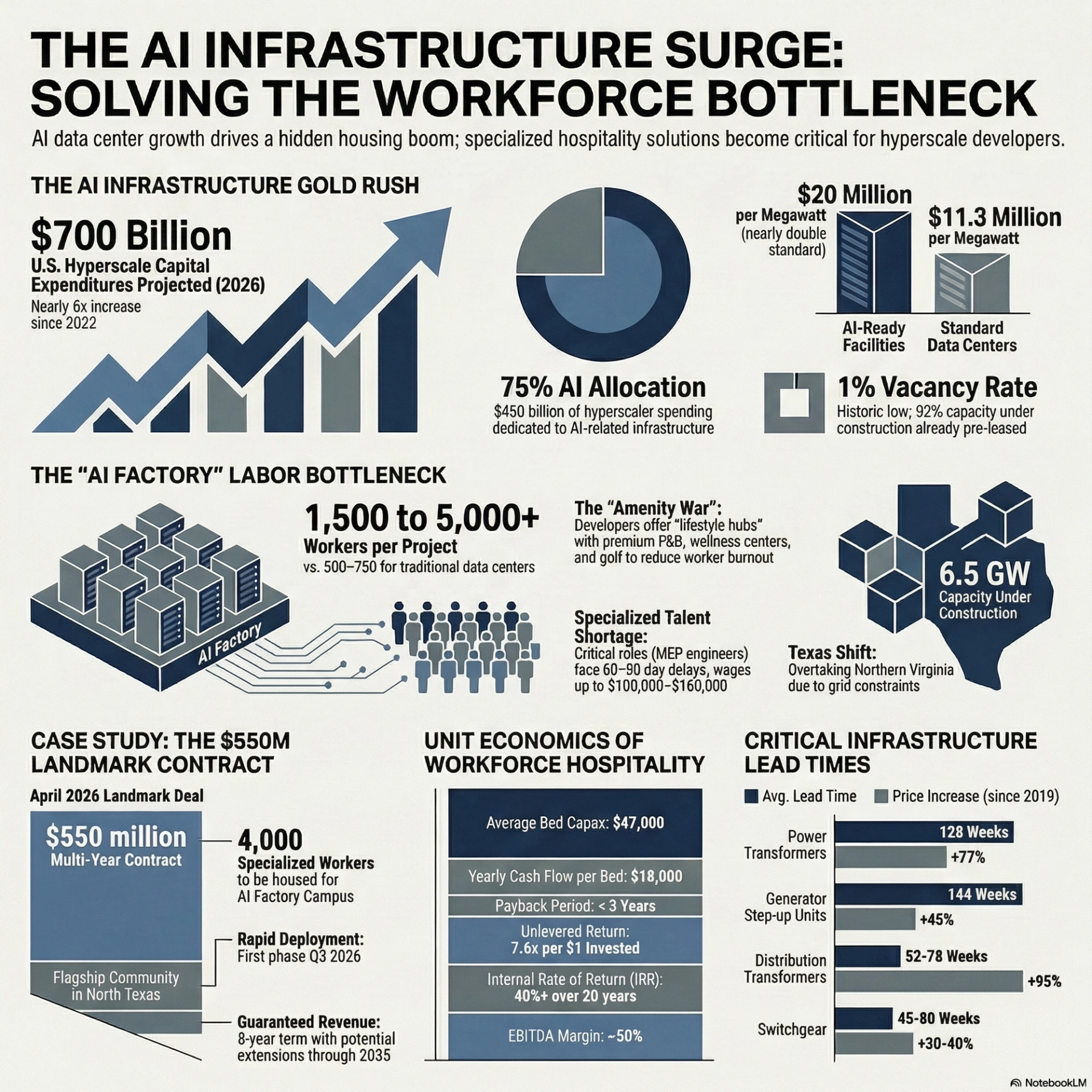
The numbers are staggering. In 2025 alone, planned data center investments in the US exceeded $150 billion, with major projects announced by Microsoft, Google, Amazon, and Meta. Each of these facilities requires thousands of construction workers, engineers, and technicians for build-outs lasting 18 to 36 months. These workers need somewhere to sleep.
Target Hospitality: A $500M Signal
The clearest indicator of this trend came when Target Hospitality secured a $500 million contract to provide accommodations for approximately 4,000 workers supporting AI infrastructure projects in Texas. This is not a short-term spike. It is a multi-year commitment that reflects the scale and duration of these construction programs.
| Metric | Value |
|---|---|
| Contract value | $500M |
| Workers accommodated | ~4,000 |
| Contract duration | Multi-year |
| Location | Texas |
| Primary client sector | AI data center construction |
This single contract represents a revenue stream that many mid-sized hotel markets would envy. And Target Hospitality is just one provider in one state. The pattern is replicating across Virginia, Arizona, Georgia, Indiana, and every other state attracting data center investment.
Why This Matters for Hotel Revenue Managers
Traditional hotel demand forecasting relies on historical patterns: seasonal leisure travel, corporate travel calendars, event schedules, and airline capacity. AI infrastructure construction introduces a demand type that behaves differently from anything hotels have historically tracked.
Sustained Mid-Week Occupancy
Construction workforce travel creates consistent Monday-through-Thursday demand -- exactly the gap most leisure-oriented markets struggle to fill. Workers typically arrive Sunday evening and depart Friday morning, producing a reliable occupancy pattern that can run for 12 to 36 months per project.
Extended Stay Economics
The average construction project worker stay ranges from 30 to 180 days, creating extended-stay demand that dramatically reduces acquisition costs. When a hotel secures a workforce housing contract, the cost-per-occupied-room-night for sales and marketing drops to near zero for those rooms.
Rate Resilience
Workforce housing contracts are typically negotiated at rates 15-25% below retail rack rates but come with volume guarantees and minimal cancellation risk. For revenue managers, this creates a reliable base-load revenue that enables more aggressive dynamic pricing on remaining inventory.
The Geographic Footprint
AI data center construction is not limited to traditional tech hubs. The projects are gravitating toward locations with three key attributes: affordable land, reliable power infrastructure, and favorable tax incentives. This is pushing demand into markets that historically had limited hotel investment.
| State | Announced Data Center Investment (2024-2026) | Estimated Construction Workers | Key Markets |
|---|---|---|---|
| Texas | $45B+ | 25,000-35,000 | Dallas-Fort Worth, San Antonio, Abilene |
| Virginia | $35B+ | 20,000-28,000 | Loudoun County, Prince William County |
| Arizona | $20B+ | 12,000-18,000 | Mesa, Goodyear, Chandler |
| Georgia | $15B+ | 8,000-14,000 | Social Circle, Newton County |
| Indiana | $12B+ | 7,000-12,000 | Lebanon, Westfield |
| Mississippi | $10B+ | 5,000-9,000 | Lowndes County |
These are not markets where hotel developers have historically rushed to add supply. The result is a demand-supply imbalance that benefits existing properties.
How Smart Hotels Are Capturing This Revenue
Hotels that are proactively positioning for workforce housing demand are seeing measurable results. The strategies that work share common characteristics.
Direct Outreach to General Contractors
The construction companies managing data center builds are the decision-makers for worker accommodation. Hotels that build relationships with project managers at firms like Fluor, Bechtel, and Turner Construction are securing contracts months before workers arrive on site. Proactive outreach -- not waiting for inbound requests -- is the differentiator.
Flexible Inventory Allocation
The most effective approach is dynamic allocation rather than fixed blocks. Revenue managers are setting aside 20-40% of inventory for workforce contracts while keeping the remainder available for dynamic pricing. This balances guaranteed revenue with upside capture during peak demand periods.
Amenity Adjustments
Workforce travelers have different needs than leisure guests. Hotels winning these contracts are offering:
- Early breakfast service (5:00-6:00 AM start times are common)
- Laundry facilities or services
- Packed lunch options
- Wi-Fi sufficient for video calls to family
- Flexible check-in/check-out for shift workers
These adjustments cost relatively little but significantly improve contract win rates and renewal probability.
The Revenue Impact: A Case Study
Consider a 120-room hotel in a secondary Texas market with historical occupancy of 62% and an ADR of $95. By securing a workforce housing contract for 40 rooms at $78/night for 18 months, the property transforms its financial profile:
| Metric | Before Contract | With Contract |
|---|---|---|
| Occupancy | 62% | 81% |
| ADR | $95 | $91 (blended) |
| RevPAR | $58.90 | $73.71 |
| Annual room revenue | $2.58M | $3.23M |
| Revenue increase | -- | +$650K (+25%) |
The blended ADR drops slightly, but the occupancy surge drives a 25% increase in total room revenue. More importantly, the guaranteed base load allows the revenue manager to push rates higher on the remaining 80 rooms during periods of strong transient demand.
Risks and Considerations
This opportunity is not without complications. Revenue managers should account for several factors.
Concentration risk. Over-reliance on a single construction project creates vulnerability when that project concludes. Diversifying across multiple contracts and maintaining transient demand channels is essential.
Brand standards. Some hotel brands have restrictions on the percentage of rooms that can be allocated to group or contract business. Verify brand compliance before committing large blocks.
Wear and tear. Construction workers generate higher housekeeping and maintenance costs than typical guests. Factor a 10-15% premium on operational costs for contracted rooms when calculating net revenue.
Market perception. A hotel filled with construction workers may impact its attractiveness to leisure and corporate travelers. Managing this perception through separate floor assignments and common area scheduling can mitigate the risk.
What Comes Next
The AI infrastructure build-out is not a one-year phenomenon. Industry analysts project that data center construction will remain at elevated levels through at least 2030, driven by the exponential growth in compute demand for AI training and inference. Microsoft alone has committed to spending $80 billion on AI-capable data centers in fiscal year 2025.
For hotel revenue managers, this represents a structural shift in demand patterns that warrants strategic attention. The properties that build workforce housing capabilities now will have a competitive advantage that compounds over time as they develop relationships with general contractors and refine their operational model.
The AI revolution is not just changing how hotels price rooms and forecast demand. It is physically creating new demand in places the industry did not expect. The revenue managers who recognize this -- and act on it -- will capture value that their competitors miss entirely.