The $131 Billion Problem
The American Hotel & Lodging Association's 2026 State of the Industry report confirms what every hotel operator already feels: labor costs are the single largest line item on the P&L, and they are not slowing down.
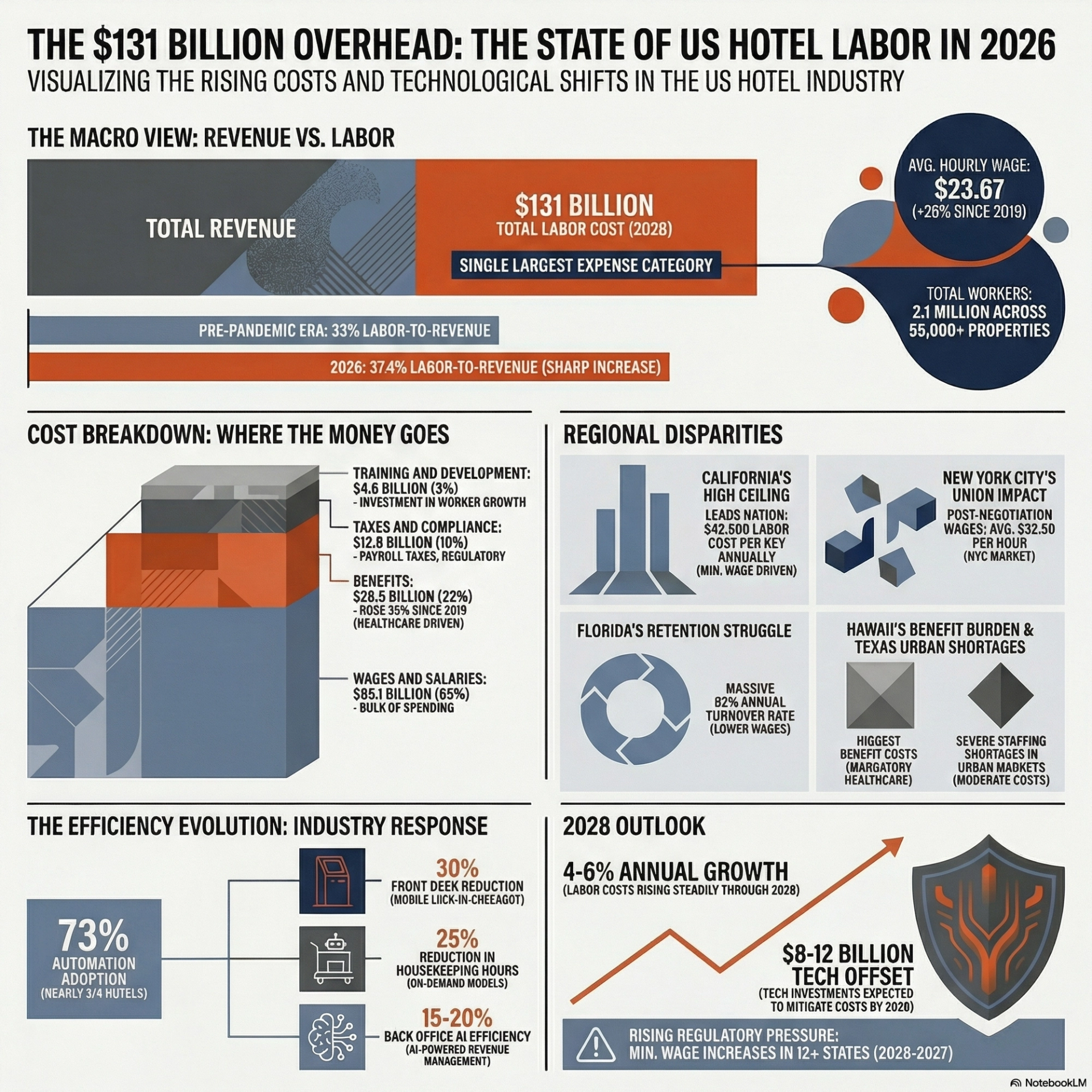
US hotel industry labor costs are projected to reach $131 billion in 2026, up from $127 billion in 2025 — a 3.1% year-over-year increase. This follows a $122 billion figure in 2024 and $115 billion in 2023, representing a cumulative 14% increase over three years.
For context, labor now represents approximately 33-38% of total hotel revenue for full-service properties and 28-32% for select-service, up from 30-34% and 25-28% respectively in 2019. The gap between revenue growth and labor cost growth has widened every year since the pandemic.
What Is Driving the Surge
Wage Inflation
Average hourly wages for hotel workers reached $20.75 in Q1 2026, up 4.2% from a year earlier. While this is a deceleration from the 6-7% wage increases seen in 2022-2023, it still outpaces the industry's RevPAR growth of 2.8% over the same period.
Regional variation is dramatic:
| Market | Avg. Hourly Wage (Q1 2026) | YoY Change | Min. Wage Floor |
|---|---|---|---|
| New York City | $28.40 | +3.8% | $16.50 |
| San Francisco | $27.10 | +4.1% | $18.67 |
| Los Angeles | $25.80 | +5.2% | $17.28 |
| Miami | $19.60 | +4.5% | $13.00 |
| Nashville | $18.20 | +3.9% | $7.25 (federal) |
| Phoenix | $17.90 | +4.8% | $14.70 |
Properties in high-minimum-wage markets face a compression problem: the gap between entry-level and supervisory wages shrinks, forcing upward pressure across the entire pay scale.
Benefits Cost Escalation
Healthcare costs for hotel employees rose 7.8% in 2025 and are projected to increase another 6-8% in 2026. For full-service hotels, benefits add 25-35% on top of base wages, meaning a $20/hour employee actually costs $25-27/hour when benefits are included.
Staffing Model Inefficiency
Despite the labor cost surge, many hotels continue to operate with staffing models designed for a pre-pandemic world. The average US hotel employs 0.52 FTE per available room — a ratio that has barely changed since 2019, even as guest expectations, technology capabilities, and service delivery models have fundamentally shifted.
The Automation Imperative
The math is unforgiving: if labor costs grow 3-4% annually and RevPAR grows 2-3%, margins compress every year. The only way to break this cycle is to fundamentally change the labor-to-revenue ratio through strategic automation.
Smart operators are not trying to eliminate jobs — they are redeploying human labor to high-value, guest-facing activities and automating repetitive, low-value tasks.
AI-Powered Guest Messaging and Chatbots
Guest communication is one of the highest-volume, most automatable functions in hotel operations. The typical 200-room hotel handles 150-300 guest inquiries daily — requests for towels, check-out times, Wi-Fi passwords, restaurant recommendations, and late check-out.
AI chatbot and messaging platforms (Canary Technologies, Akia, Kipsu, and others) can handle 65-80% of these inquiries without human intervention. The remaining 20-35% are escalated to staff with full context, making human interactions faster and more effective.
ROI timeline: 3-6 months. A mid-sized property spending $500-800/month on a messaging platform typically offsets 0.5-1.0 FTE at the front desk, generating net savings of $2,000-4,000/month after accounting for the technology cost.
Automated Check-In and Check-Out
Mobile check-in adoption has reached 38% at major brands in 2026, up from 22% in 2024. Properties with mature mobile check-in programmes report:
- Front desk staffing reduction of 15-25% during peak arrival periods
- Guest satisfaction scores unchanged or improved (guests who choose mobile check-in rate the experience 4.2/5 on average)
- Upsell revenue increase of 8-12% (mobile interfaces present room upgrade and amenity offers more effectively than rushed front desk interactions)
The investment is primarily in software licensing ($200-500/room/year for most platforms) with modest hardware costs for key encoding stations and kiosks.
Housekeeping Optimization
Housekeeping represents the single largest labor category in hotel operations — typically 22-28% of total labor hours. AI-driven housekeeping management systems are delivering measurable efficiency gains:
Predictive scheduling: Machine learning models analyze historical occupancy patterns, booking pace, and stay patterns to forecast housekeeping demand 7-14 days out, improving schedule accuracy by 15-20% and reducing overtime by 25-30%.
Dynamic room assignment: AI optimizes room assignment at check-in to minimize housekeeper travel time and balance workloads. Properties report 8-12% improvement in rooms cleaned per housekeeper per shift without increasing pace or reducing quality.
Stayover optimization: Data-driven stayover cleaning programmes — offering guests the option to skip daily housekeeping in exchange for loyalty points or F&B credits — reduce total housekeeping hours by 10-15% while maintaining guest satisfaction.
Energy Management Automation
Energy is the second-largest controllable cost after labor, and modern energy management systems (EMS) deliver savings that directly offset labor cost pressure:
| Technology | Typical Investment | Annual Savings | Payback Period |
|---|---|---|---|
| Smart HVAC (AI-controlled) | $300-600/room | 15-25% of HVAC costs | 18-30 months |
| Smart lighting (occupancy-based) | $100-200/room | 30-40% of lighting costs | 12-18 months |
| Water management | $50-100/room | 15-20% of water costs | 12-24 months |
| Integrated EMS platform | $150-300/room | 20-30% of total energy | 18-24 months |
For a 150-room hotel spending $350,000 annually on energy, a comprehensive EMS delivering 22% savings generates $77,000/year — equivalent to the fully loaded cost of 1.5-2.0 FTEs.
The Labor Redeployment Framework
The goal of automation is not to have fewer people — it is to have the right people doing the right work. The most successful operators follow a structured redeployment framework:
Tier 1: Fully Automate (No Human Required)
- Wi-Fi password and basic FAQ responses
- Check-in/check-out for loyalty members
- Room temperature and lighting control
- Maintenance request routing
- Wake-up calls and alarm services
- Post-stay survey distribution
Tier 2: AI-Assisted (Human Oversight)
- Complex guest complaint resolution
- Revenue management pricing decisions
- Housekeeping scheduling and assignment
- Inventory and procurement ordering
- Social media response management
Tier 3: Human-First (Technology-Enhanced)
- VIP guest recognition and personalization
- Complex concierge recommendations
- Sales and event planning
- Staff training and development
- Quality assurance and inspection
By systematically moving Tier 1 activities to automation, operators free up 15-25% of labor hours that can be redeployed to Tier 3 activities — the interactions that actually differentiate the property and drive guest loyalty.
Financial Impact Modeling
Here is what the numbers look like for a 200-room full-service hotel with $4.2 million in annual labor costs:
| Initiative | Investment | Annual Labor Savings | Net Year 1 Impact |
|---|---|---|---|
| AI messaging/chatbot | $9,600 | $48,000 (1.0 FTE) | +$38,400 |
| Mobile check-in | $60,000 | $72,000 (1.5 FTE) | +$12,000 |
| Housekeeping optimization | $45,000 | $96,000 (2.0 FTE) | +$51,000 |
| Energy management system | $75,000 | $77,000 (energy, not labor) | +$2,000 |
| Total | $189,600 | $293,000 | +$103,400 |
The combined initiatives deliver $293,000 in annual savings against a $189,600 investment — a first-year net positive of $103,400 with full payback in under 8 months. Importantly, these savings are recurring and compound as technology improves and adoption deepens.
What the Next 24 Months Look Like
The labor cost trajectory is not going to reverse. Union activity is increasing (UNITE HERE has expanded hotel organizing efforts to 15 new markets since 2024), minimum wage floors continue to rise (7 states have increases scheduled for 2027), and the fundamental supply-demand imbalance for hospitality workers persists.
Operators who treat automation as a "nice to have" will find their margins compressed beyond recovery within 2-3 years. The properties that will thrive are those that:
- Audit current labor allocation to identify the highest-volume automatable tasks
- Invest in proven technology with measurable, fast-payback ROI
- Redeploy freed capacity to revenue-generating guest interactions
- Track labor cost per occupied room as a primary KPI, not just total labor cost
Strategic Takeaway
The $131 billion US hotel labor bill is not a problem that will solve itself through wage moderation or increased labor supply. The structural forces driving costs higher — minimum wage legislation, healthcare inflation, reduced immigration, and worker expectations — are durable. The operators who will protect their margins are those who embrace automation not as a replacement for hospitality, but as a tool that lets their people focus on what humans do best: making guests feel valued. The technology exists, the ROI is proven, and the window for competitive advantage is open. The question is execution speed.