![Turkey's Hotel Boom: 354 New Projects by 2026 [Data Analysis]](https://cdn.sanity.io/images/1la98t0z/production/33bd7b6240f4e8a4ed2c4deecea8ca645ba272b1-2752x1536.png?w=1920&q=65&auto=format&fit=max)
Key Takeaways
- Turkey currently holds the third-largest hotel development pipeline in Europe, with 354 new projects and 48,396 beds.
- Istanbul ranks as the second most active city for hotel development in Europe, surpassed only by London.
- Global giants including IHG, Marriott, and Accor are aggressively expanding their Turkish portfolios across all segments.
- The influx of nearly 50,000 new beds will intensify competition, placing RevPAR pressure specifically on independent and unbranded hotels.
- Success for existing properties will depend on AI-driven revenue management, distinct brand differentiation, and direct booking strategies.
Europe's Third Largest Pipeline
The Turkish hotel sector is experiencing the most significant construction wave in its history. According to data from Lodging Econometrics, our country has the third-largest hotel development pipeline in Europe, with 354 new hotels and 48,396 beds. Only the United Kingdom and Germany rank ahead of Turkey.
These figures concretely reflect the confidence international investors and chain hotels have in Turkey. However, like every investment wave, this brings both opportunities and risks.
Pipeline Details
| Indicator | Figure |
|---|---|
| Total new hotels | 354 |
| Total new beds | 48,396 |
| Under construction | 187 hotels |
| In planning stage | 167 hotels |
| Estimated completion | 2026-2028 |
| Total investment (estimated) | $4.8 billion |
Approximately half of the pipeline (187 hotels) is in the active construction phase and will enter the market in 2026-2027. The remainder is in the planning stage and is expected to be completed by 2028.
Istanbul: Second Only to London
The most striking city-based data comes from Istanbul. With 72 new hotel projects, Istanbul ranks second among European cities after London. This confirms Istanbul’s global position as both a tourism and business travel destination.
| City | New Hotels | New Rooms | European Rank |
|---|---|---|---|
| London | 89 | 14,200 | 1 |
| Istanbul | 72 | 11,800 | 2 |
| Paris | 58 | 8,400 | 3 |
| Berlin | 43 | 6,900 | 4 |
| Madrid | 37 | 5,100 | 5 |
| Antalya | 34 | 9.200 | 6 |
Antalya also appears on the list with 34 new hotels. However, Antalya's room count (9,200) is high compared to the number of hotels—this indicates a concentration of large-capacity resort hotels.
International Chains' Turkey Strategy
Major international hotel chains are aggressively expanding their presence in Turkey. Each chain's strategy differs, but the common theme is clear: Turkey is a growth market.
IHG (InterContinental Hotels Group): Aims to increase its portfolio in Turkey by 40% with 12 new projects. It is focusing on city hotels with the Holiday Inn Express brand and the boutique segment with the voco brand.
Marriott International: Holds the most aggressive growth plan with 18 new agreements. It is expanding in the mid-scale segment with Courtyard and Moxy brands, and in the luxury segment with W Hotels and Ritz-Carlton Reserve. The Ritz-Carlton Reserve project in Cappadocia symbolizes Turkey's luxury tourism potential.
Accor: Growing in both resort and city hotels with 14 new projects. It targets luxury projects in Istanbul and Bodrum with the Fairmont brand and expansion in the budget segment with the ibis brand.
Radisson Hotel Group: Focusing particularly on Anatolian cities with 8 new projects. It is positioning itself in secondary markets such as Gaziantep, Trabzon, and Diyarbakır with the Radisson and Park Inn brands.
Supply-Demand Balance Analysis
The entry of 354 new hotels and 48,396 beds into the market poses a critical question for existing hotels: will demand be able to meet this supply?
| Scenario | Demand Growth | Supply Growth | RevPAR Impact |
|---|---|---|---|
| Optimistic | 10%+ | 7.2% | Increase |
| Base | 7-8% | 7.2% | Stable |
| Pessimistic | 4-5% | 7.2% | Decrease (3-5%) |
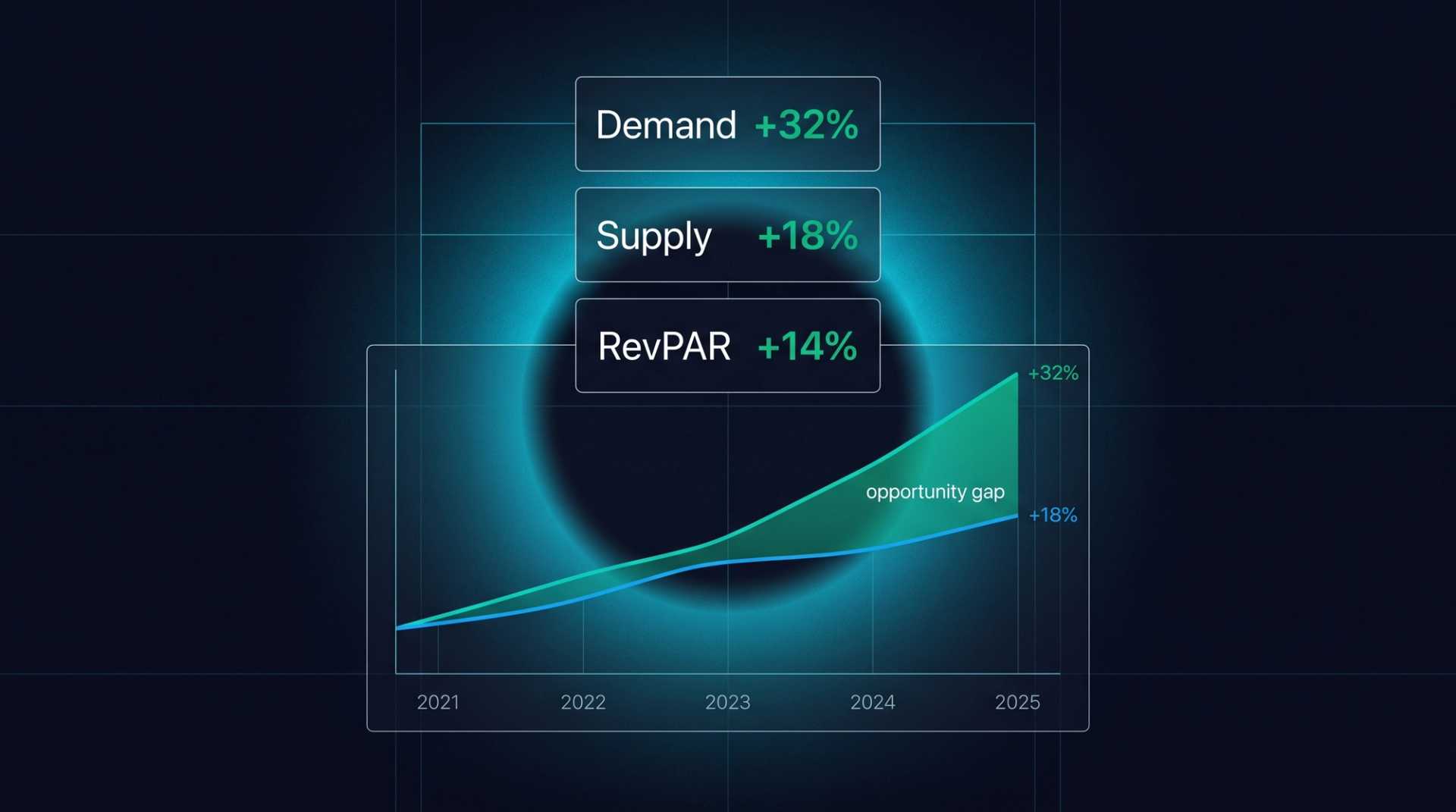
In the base scenario, supply and demand growth are close to each other, meaning RevPAR remains roughly stable. However, in the pessimistic scenario (geopolitical risk, economic slowdown, or contraction in source markets), supply pressure prevails, and RevPAR begins to decline.
The critical factor here is that the majority of new hotels carry international chain brands. These hotels enter the market with stronger distribution networks, loyalty programs, and brand awareness compared to independent hotels. Consequently, independent and unbranded hotels will feel the supply pressure most acutely.
Related reading: Turkey 2025: 63.9 Million Tourists - The Realities of Growth
Regional Opportunities and Risks
The pipeline is not distributed equally across Turkey. While some regions offer opportunities, others carry a risk of oversupply.
High-Opportunity Regions:
- Cappadocia: Limited capacity, high ADR, luxury segment growth.
- Southeastern Anatolia (Mardin, Şanlıurfa): Cultural tourism potential, low existing supply.
- Istanbul Asian Side: Growing accommodation demand driven by Sabiha Gökçen traffic.
Regions Requiring Caution:
- Antalya Lara-Kundu: Existing supply is already high; pressure will increase with new projects.
- İzmir Çeşme: Supply growth is risky before seasonality issues are resolved.
- Bodrum: The premium segment is approaching saturation point.
What Should Existing Hotels Do?
In an environment where 354 new hotels will enter the market, it is inevitable for existing hotels to review their competitive strategies. Three main actions stand out:
First, differentiation. Create a difference against the standardized products of new chain hotels through local experiences, unique design, and personalized service.
Second, revenue management. Price competition will intensify with increasing supply. AI-supported dynamic pricing is the most effective way to obtain maximum revenue from every room night.
Third, investment in direct channels. Build your own customer base and increase your share of direct channels to compete against the loyalty programs of chain hotels.
Related reading: JLL Global Hotel Investment Report 2026
Capitalize on the Growth Opportunity
354 new hotels are proof that the growth story of the Turkish tourism sector continues. However, taking a share of this growth is only possible with the right strategies and tools. Hotels that are caught unprepared may find themselves among the losers even during a period of overall growth.
Strengthen Your Competitive Strategy with OtelCiro
OtelCiro's market analysis and revenue management tools strengthen your hotel's position in an increasingly competitive environment. Turn the supply pressure of new hotels into an opportunity with competitor monitoring, dynamic pricing, and channel optimization.
Request a competitive analysis and strengthen your strategic positioning.
![Europe's Hotel Construction Boom: 2026 Oversupply Risks [Market Analysis]](https://cdn.sanity.io/images/1la98t0z/production/6dfe59137f56aa14bfcba86d9db3cf05ff89f406-2752x1536.jpg?w=1920&q=50&auto=format&fit=max)