![Turkey's 2026 Airbnb Law: Impact on Hotel Performance [Strategy Guide]](https://cdn.sanity.io/images/1la98t0z/production/b9730e7d54b3c904ba638ed6e92de97f4d7305c4-2048x2048.png?w=1920&q=65&auto=format&fit=max)
Key Takeaways
- New 2026 regulations mandate a Tourism Operation License for all stays under 30 days.
- Experts forecast a 30-45% reduction in active short-term rental listings across Turkey.
- Urban hotels are expected to see an occupancy boost of 8-15% following the implementation.
- Regulatory requirements include 51% property owner approval and mandatory 10% VAT.
- Full enforcement is scheduled for January 2027, providing a 9-12 month strategic window for hotels.
The Short-Term Rental Market in Turkey and the Need for Regulation
The short-term rental market in Turkey has exploded over the last five years. According to AirDNA data, by the end of 2025, there were more than 185,000 active short-term rental listings across Turkey—representing a 340% increase compared to 2020. Istanbul alone led the market with 48,000 listings, followed by Antalya with 32,000 and Izmir with 18,000.
This uncontrolled growth brought serious challenges: residential rents increased by 90-120% annually, neighborhood fabrics were disrupted, and unregistered tourism revenue failed to reach the state treasury. According to Phocuswright’s 2025 European Accommodation Report, 62% of short-term rentals in Turkey were operating without any tourism license.
In response, Turkey enacted a comprehensive regulation package at the beginning of 2026. This new legislation registers the sector while creating significant opportunities for hotel businesses.
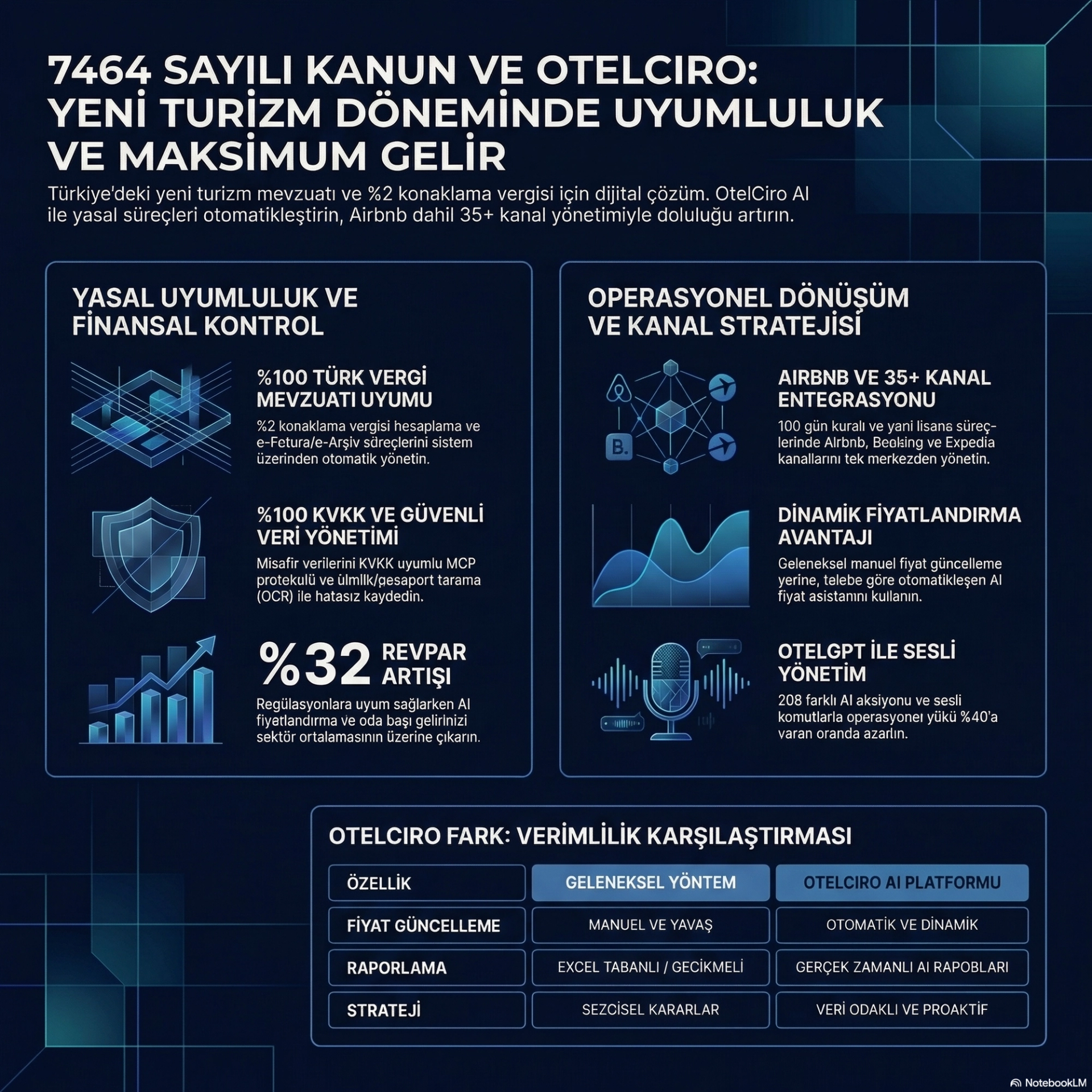
Embed this image on your site
<a href="https://otelciro.com/en/news/turkey-s-2026-airbnb-law-impact-on-hotel-performance-strategy-guide">
  <img src="https://cdn.sanity.io/images/1la98t0z/production/b9730e7d54b3c904ba638ed6e92de97f4d7305c4-2048x2048.png" alt="Turkey Airbnb law and short-term rental regulation hotel impact" width="800" />
</a>
<p>Source: <a href="https://otelciro.com">OtelCiro</a> — AI Hotel Revenue Management</p>
Key Provisions of the New Regulation
Mandatory Tourism Operation License
The most critical clause of the new law is that all rentals shorter than 30 days require a Tourism Operation License. To obtain this certificate:
- 51% approval from property owners is required (for apartment buildings).
- Fire safety and health inspections are mandatory.
- Tax registration and payment of a tourism share are required.
- Annual audits and standard compliance checks will be conducted.
Regional Quota System
Municipalities have been granted the authority to set quotas based on short-term rental density in their regions. In Istanbul's Beyoglu, Kadikoy, and Fatih districts, a ban has been implemented on short-term rentals exceeding 8% of the housing stock.
Tax Obligations
Hosts engaging in short-term rentals must now:
- Pay 10% VAT (classified as an accommodation service).
- Pay a tourism share.
- Collect and remit accommodation tax to the municipality.
- Maintain official bookkeeping if annual income exceeds 240,000 TL.
Related reading: Hotel Tax Optimization: Turkey Legislation Guide
Global Regulatory Experiences: Lessons from Barcelona and New York
Turkey's short-term rental regulation is a synthesis of models implemented worldwide. Two major examples provide critical references for understanding potential impacts.
The Barcelona Model: Zero License Policy
Barcelona has tightened short-term rental regulations since 2014, deciding to cancel all tourist housing licenses by 2028. During this process:
- Hotel occupancy rates rose from 72% to 81% (STR Global, 2025).
- Average Daily Rate (ADR) increased by 18%.
- Unregistered, unlicensed listings decreased by 65%.
- Residential rent increases slowed down but did not stop.
New York City: 70% Supply Drop
New York's 2023 Local Law 18 implementation reduced the number of registered short-term rentals from 40,000 to under 12,000. The effects included:
- Manhattan hotel occupancy reached 84% (pre-pandemic levels).
- Hotel Revenue Per Available Room (RevPAR) increased by 22%.
- However, residential rents did not decrease as much as expected—due to structural supply shortages.
Projections for Turkey
According to Deloitte’s 2025 Tourism Sector Report, while Turkey’s regulation is not as harsh as Barcelona or New York, 30-45% of active listings are expected to be withdrawn from the market. This situation has the potential to increase occupancy rates in urban hotels by 8-15%.
Impact on the Hotel Sector: Opportunities and Risks
Expected Effects on Occupancy and Pricing
According to McKinsey’s 2025 Global Tourism Perspective report, the hotel sector in markets where short-term rental regulations were implemented achieved the following advantages:
| Metric | Pre-Regulation | Post-Regulation | Change |
|---|---|---|---|
| Hotel Occupancy | 65% | 74% | +14% |
| ADR | 100 units | 112 units | +12% |
| RevPAR | 65 units | 83 units | +28% |
| Direct Booking Share | 18% | 24% | +33% |
While these figures represent global averages, Turkey's unique dynamics (high seasonality, currency advantages, mass tourism volume) may produce different results.
Segment-Based Analysis
Urban Hotels (Highest Benefit): City hotels in Istanbul, Ankara, and Izmir are the segments that will experience the greatest gain. Short-term rentals were competing directly with hotels in these markets. According to STR data, 40% of Airbnb supply in Istanbul was within the price range of 3-4 star hotels.
Resort Hotels (Moderate Impact): The impact will be more limited for resort hotels in Antalya, Mugla, and the Aegean coasts. Since villa and apartment rentals cater to a different customer segment, the direct transition rate may remain low.
Boutique Hotels (Mixed Impact): Boutique and small-scale hotels may experience a dual effect. While a demand increase presents an opportunity, some boutique operators may be affected by the costs of new licensing requirements.
Impact on Platforms
The impact of the regulation on platforms like Airbnb, Booking.com, and VRBO should not be ignored. Although Airbnb is experienced in complying with global regulations, it will lose a significant portion of its listings in Turkey. This may change the platform's marketing strategy—meaning more space for licensed accommodation facilities (i.e., hotels). Since Booking.com already hosts both hotel and short-term rental listings, it is likely to make algorithm updates that prioritize hotel listings after the regulation.
Related reading: Hotel Cybersecurity: Guest Data Protection and PCI-DSS
Strategic Steps Hotels Should Consider
1. Dynamic Pricing Adaptation
The withdrawal of short-term rental supply will shift the supply-demand balance. Hotels need to update their pricing strategies accordingly:
- Measure the price sensitivity of the new demand flow by performing a price elasticity analysis.
- Redefine your competitor set—your rivals are no longer just other hotels, but also licensed short-term rentals.
- Review minimum length of stay strategies—you can apply premiums as supply for short stays decreases.
2. Direct Channel Investment
Guests shifting away from short-term rentals often book via Google search and direct websites rather than OTAs. During this transition:
- Increase Google Hotel Ads campaigns.
- Add "apartment alternative" content to your website.
- Attract apartment customers by creating extended stay packages.
3. Product Diversification
Short-term rental customers typically look for kitchen access, washing machines, and more space. To meet these demands, hotels can:
- Develop suites and apart-hotel concepts.
- Offer in-room kitchenette options.
- Create weekly/monthly stay packages.
4. Local Marketing and Community Integration
Following the regulation, hosts may turn some properties toward long-term rentals or hotel collaborations. This opportunity allows you to:
- Develop franchising or management agreement models with local property owners.
- Offer the "local living" feel that short-term rental customers seek by creating neighborhood experience packages.
Compliance Timeline and Transition Process
The implementation timeline for the regulation is planned in stages:
| Stage | Date | Requirement |
|---|---|---|
| Registration | March 2026 | Municipal registration of all active listings |
| License Application | June 2026 | Tourism operation license application |
| Inspection | September 2026 | Commencement of the first audit period |
| Full Implementation | January 2027 | Deactivation of unlicensed listings |
This transition process provides hotels with a 9-12 month preparation window. During this time, it is critical to update market analyses, revise pricing strategies, and prepare marketing campaigns.
Turkey-Specific Dynamics: Seasonality and Currency Impact
Turkey's tourism structure contains several key dynamics that will differentiate the impact of short-term rental regulation from other countries.
Seasonal Demand Concentration
According to Ministry of Culture and Tourism data, 58% of Turkey's tourism revenues are concentrated in the June-September period. Short-term rentals compete with hotel capacity especially during this peak season. The full implementation date of January 2027 gives hotels a strategic positioning opportunity before the following summer season.
Currency Exchange Advantage
The depreciation of the Turkish Lira makes Turkey price-attractive for foreign tourists. The narrowing of short-term rental supply will direct tourists looking for this price advantage straight to hotels. According to World Travel & Tourism Council data, Turkey rose to 7th place in the world rankings for price-performance in 2025.
Digital Nomad and Long-Stay Segment
Antalya, Istanbul, and Bodrum are among the most preferred cities for digital nomads. This segment typically preferred short-term rental platforms for stays of 30-90 days. With the new regulation, unlicensed accommodation options will decrease, and this demand will shift to facilities with apart-hotel concepts and hotels offering long-stay packages. According to Nomad List data, there are an average of 4,200 digital nomads per month in Antalya.
Domestic Tourism Impact
Annual domestic tourism movement in Turkey exceeds 85 million overnights. Airbnb usage had been increasing rapidly among domestic tourists—especially family groups and large teams who preferred apartments with kitchens and multiple rooms. Hotels offering alternatives for this segment (family suites, connecting room options) will gain an advantage post-regulation.
Tracking with Data: Measuring the Impact of Regulation
To measure the real impact of the regulation on your hotel's performance, monitor these KPIs:
- Occupancy rate trend: Monthly comparison before and after the regulation.
- ADR change: Especially in price segments that compete with short-term rentals.
- Booking source distribution: Whether there is an increase in the direct channel.
- Length of stay: Changes in the average length of stay.
- RevPAR index: Relative performance against the competitor set.
OtelCiro's Reporting Engine monitors these metrics in real-time to clearly demonstrate the impact of the regulation on your hotel.
Conclusion: Seize the Opportunity with a Proactive Strategy
Turkey's short-term rental regulation is the most significant structural change for the hotel sector in a decade. Experiences in Barcelona and New York show that such regulations significantly improve hotel performance.
However, this opportunity is not automatic—it requires a proactive strategy. Update your pricing, strengthen your direct channels, expand your product range, and track the impact of the regulation with data.
Hotels that prepare early will gain a competitive advantage in the 2026-2027 period. OtelCiro's AI Revenue Management module allows you to manage this transition period most efficiently by adapting to changing market conditions in real-time.
![Europe's Hotel Construction Boom: 2026 Oversupply Risks [Market Analysis]](https://cdn.sanity.io/images/1la98t0z/production/6dfe59137f56aa14bfcba86d9db3cf05ff89f406-2752x1536.jpg?w=1920&q=50&auto=format&fit=max)