![Optimizing Spa Operations: Capacity & Therapist Scheduling [2026 Guide]](https://cdn.sanity.io/images/1la98t0z/production/3952986c7ae83516bc13e5b30a0bbd05af0a19b0-1200x669.png?w=1920&q=65&auto=format&fit=max)
Key Takeaways
- Spa departments can achieve 60-75% gross profit margins through effective operational management.
- Strategic scheduling can increase spa revenue by 25-40% without additional capital investment.
- Successful optimization requires the simultaneous management of therapists, treatment rooms, and supplies.
- Implementing dynamic pricing and no-show policies significantly protects and grows the bottom line.
- Digital scheduling systems typically offer a rapid return on investment (ROI) within 2 to 4 months.
Spa: The Highest Margin Revenue Source for Hotels
When managed correctly, the hotel spa department has the potential to be the most profitable unit in the hotel, with gross profit margins ranging from 60-75%. However, in 60% of hotels in Turkey, spa operations perform significantly below expected revenue levels. The primary reason for this is operational inefficiency: therapists sit idle while guests cannot find appointments, treatment rooms remain unused, supply waste occurs, and revenue potential is never realized.
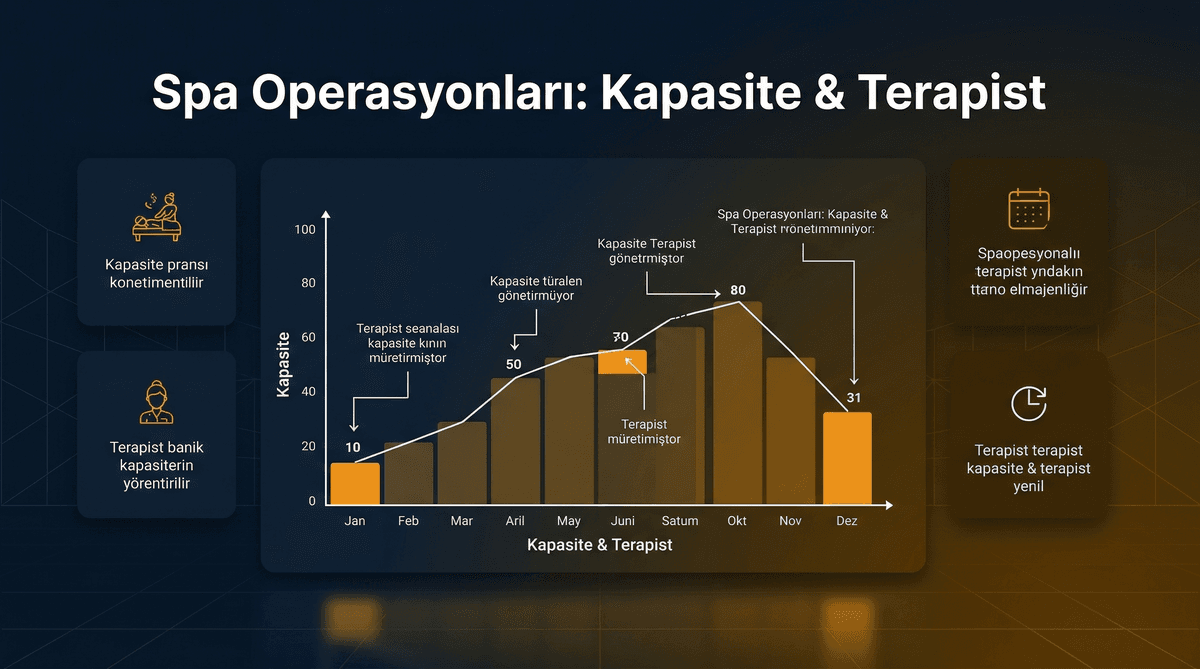
According to industry data, spa revenue can be increased by 25-40% through optimum scheduling—without any additional investment or staff increases. Simply using existing resources more efficiently is enough. A spa department in a 200-room hotel can generate 1.5-3 million TL in annual revenue; however, with poor scheduling, this figure remains stuck between 800,000 and 1.5 million TL.
Embed this image on your site
<a href="https://otelciro.com/en/news/optimizing-spa-operations-capacity-therapist-scheduling-2026-guide">
  <img src="https://cdn.sanity.io/images/1la98t0z/production/3952986c7ae83516bc13e5b30a0bbd05af0a19b0-1200x669.png" alt="Spa Operation Scheduling Infographic" width="800" />
</a>
<p>Source: <a href="https://otelciro.com">OtelCiro</a> — AI Hotel Revenue Management</p>
Related reading: Operations Management with the OtelCiro Ecosystem
The Three Dimensions of Spa Scheduling
Spa operations require the simultaneous management of three resources: the therapist, the treatment room, and the supplies. The optimal coordination of these three dimensions is the core of the scheduling problem.
Therapist Management
Therapists are the most valuable and expensive resource in a spa. Each therapist has different specialties:
- Massage Therapist: Classic massage, aromatherapy, sports massage, stone massage.
- Esthetician: Facials, peeling, anti-aging treatments.
- Body Treatment Specialist: Body wraps, cellulite treatment, detox programs.
- Nail Technician: Manicure, pedicure, gel/prosthetic nails.
Each treatment takes a different amount of time: Classic massage (50 minutes), deep tissue massage (80 minutes), facial (60 minutes), full package (120 minutes). The preparation time between treatments (room cleaning, supply setup) is 15-20 minutes. If this "buffer time" is not accounted for in scheduling, all appointments will be delayed via a domino effect.
Efficiency Goal: A therapist's effective working rate during an 8-hour shift should be 65-75%. Below 65% represents wasted capacity; above 75% leads to staff burnout. This translates to roughly 5-6 treatments in an 8-hour shift.
Room Management
Spa rooms have different equipment, and each treatment can only be performed in a specific room type:
- Massage Room: Massage bed, heating system, ambient lighting.
- Wet Area Room: Turkish bath (hammam), steam room, water treatments.
- Skin Care Room: Skin analysis device, steam generator, specialized lighting.
- Couples Room: Two massage beds, usually for couple packages.
- VIP Suite: Jacuzzi, private shower, relaxation area.
The number of each room type is limited. For example, in a spa with 5 massage rooms, 2 skin care rooms, 1 couples room, and 1 VIP suite, a maximum of 9 treatments can be performed at the same time—but only if the number of therapists and the treatment types align.
Supply Management
Spa treatments use various materials: massage oils, creams, serums, towels, bathrobes, paraffin, mud, and sea salt. A standard set of supplies is defined for each treatment, and usage is tracked.
Supply costs typically account for 10-15% of the treatment price. With uncontrolled usage, this ratio can climb to 20-25%. Through digital supply tracking, usage amounts are monitored by therapist, and anomalies are identified.
Components of a Digital Scheduling System
A modern spa scheduling system consists of the following modules:
Online Reservation Engine: Guests book spa appointments through the hotel website, app, or in-room tablet. The system shows real-time availability and automatically matches the appropriate therapist and room.
Therapist Calendar: Daily and weekly calendars for every therapist are displayed. Treatments, breaks, training hours, and leaves are managed on a single screen. Overlaps and gaps are automatically detected.
Room Allocation Matrix: Visually shows which room is allocated to which treatment on an hourly basis. Preparation and cleaning times are included.
Waiting List Management: A waiting list is created for fully booked hours. When a cancellation occurs, the guest on the waiting list is automatically notified.
Package Sales and Cross-selling: When a guest selects a single treatment, the system suggests suitable packages and additional services. Dynamic offers like "Add a facial to your classic massage for 20% off" increase revenue.
Related reading: Hotel Upselling and Cross-selling Techniques
Capacity Optimization and Revenue Management
Spa scheduling is essentially a revenue management problem. Limited capacity must be distributed to generate the highest possible revenue.
Peak Hour Management: Peak times in spas are usually between 2:00 PM and 7:00 PM. High-priced treatments (VIP packages, long-duration treatments) are prioritized during these hours. Low-priced treatments are directed toward morning hours.
Dynamic Pricing: Prices are adjusted based on occupancy rates:
- Low demand hours (below 30% occupancy): 15-20% discount.
- Normal hours (30-70% occupancy): Standard price.
- Peak hours (above 70% occupancy): 10-15% premium.
With this strategy, occupancy during low hours increases by 20-30%, and total revenue rises by 15-25%.
Package Optimization: Packages are designed based on best-selling treatments and guest segments. Spa packages integrated with accommodation (room + massage) increase both spa and room revenue. Total spending per guest is 30-40% higher in stays that include a spa package.
Cancellation and No-show Management: The no-show rate for spa appointments is 10-15%. This represents a serious loss of revenue. Effective policies include:
- Free cancellation up to 24 hours in advance.
- Cancellation within the last 24 hours: 50% fee.
- No-show: 100% fee.
- SMS/email reminders (24 hours and 2 hours before): Reduces no-show rates to below 5%.
Therapist Performance and Satisfaction Management
The success of a spa depends directly on the quality of its therapists. A digital system measures therapist performance using objective data:
Productivity Rate: Revenue per working hour. Target: 500-1,000 TL per hour.
Customer Satisfaction Score: Short surveys collected from guests after each treatment. Average score tracking out of 5.
Request Rate: The percentage of guests who request the same therapist again. Above 30% is an indicator of a "star performer."
Upselling Success: The rate at which a therapist sells additional products or treatments during or after a session.
Attendance and Cancellation: The therapist's attendance rate for planned shifts.
This data is used for commission systems, career development, and training planning. High-performing therapists are directed toward VIP guests and high-revenue treatments.
At the same time, therapist satisfaction is critical. Constant excessive workload, physical fatigue, and monotony lead to burnout. A good scheduling system balances workload, ensures sufficient breaks, and offers a variety of treatments.
Implementation and ROI
Investment in a spa scheduling system:
Software Platform: 3,000-8,000 TL monthly PMS and POS Integration: 20,000-40,000 TL (one-time) Online Reservation Module: 15,000-30,000 TL (one-time) Staff Training: 10,000-20,000 TL Total First Year: 81,000-186,000 TL
Expected Returns:
- Increase in capacity utilization (20-30%): 200,000-500,000 TL/year additional revenue
- Dynamic pricing: 80,000-200,000 TL/year additional revenue
- Package sales: 60,000-150,000 TL/year additional revenue
- Reduction in no-shows: 30,000-80,000 TL/year protected revenue
- Supply savings: 20,000-50,000 TL/year
- Total Annual Gain: 390,000-980,000 TL
Payback period: 2-4 months.
Spa scheduling optimization is one of the operational improvements with the fastest ROI in a hotel. Smarter use of existing capacity increases revenue by 25-40% without requiring additional investment. While a digital scheduling system empowers the spa manager with data-driven decision-making, it provides the guest with a seamless and personalized experience.
![Europe's Hotel Construction Boom: 2026 Oversupply Risks [Market Analysis]](https://cdn.sanity.io/images/1la98t0z/production/6dfe59137f56aa14bfcba86d9db3cf05ff89f406-2752x1536.jpg?w=1920&q=50&auto=format&fit=max)