![Optimizing Hotel WiFi: Infrastructure & Guest Experience [2026 Guide]](https://cdn.sanity.io/images/1la98t0z/production/f724c896b9f68bb3e0275c1f453cee479c2100f4-1024x1024.png?w=1920&q=65&auto=format&fit=max)
Key Takeaways
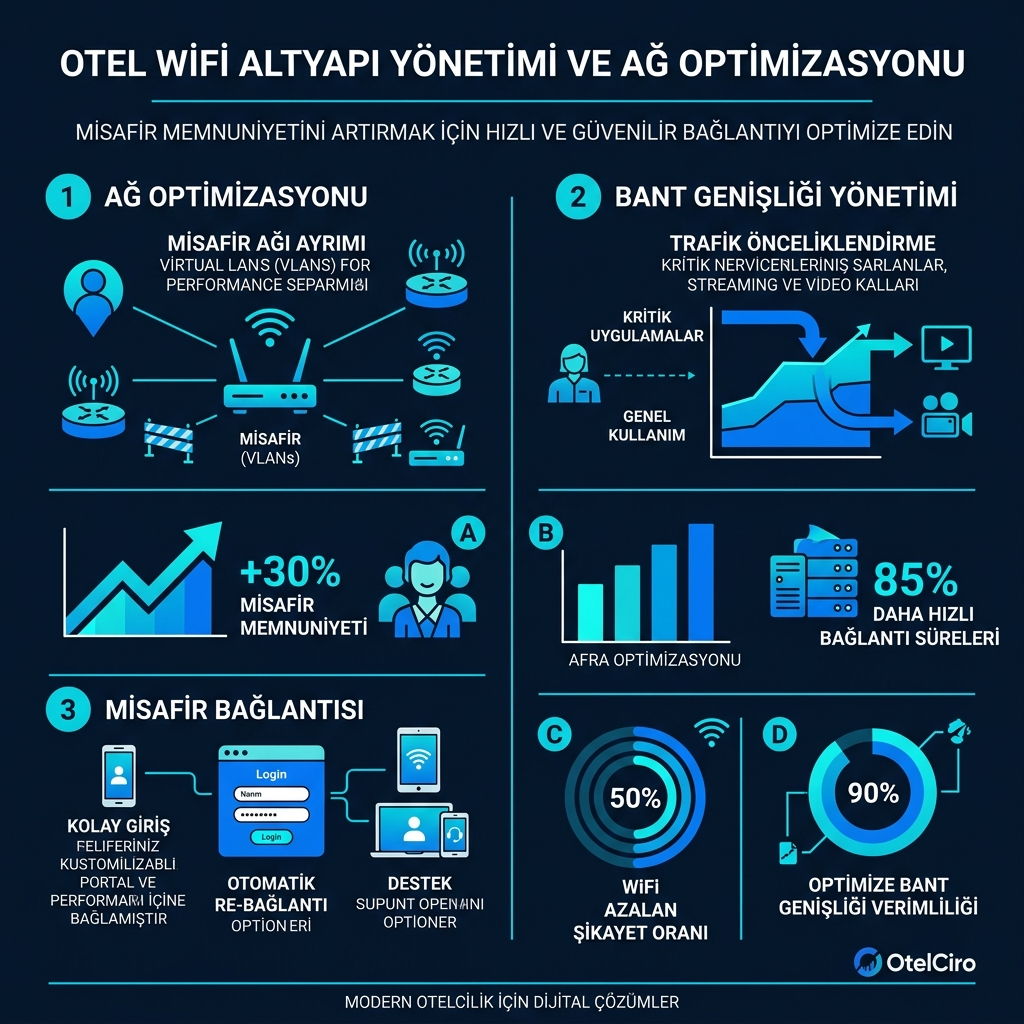
- WiFi quality is now a top guest priority, influencing 73% of negative reviews when suboptimal.
- In 2026, guests average 3.2 devices, requiring at least 25-50 Mbps per device in mid-to-high-tier hotels.
- Upgrading to WiFi 6E or WiFi 7 is essential for handling high device density and reducing latency.
- Robust security via VLAN segmentation and client isolation is mandatory for guest data protection.
- High-quality WiFi infrastructure can increase repeat bookings by 12% and guest satisfaction scores by up to 0.5 points.
WiFi: The Most Complained About Hotel Service in 2026
In guest surveys, WiFi quality has surpassed breakfast variety to become the most evaluated hotel service. According to the J.D. Power 2025 Hotel Satisfaction Study, 73% of guests who are dissatisfied with their WiFi experience mention it in their negative reviews. According to Booking.com data, the phrase "slow internet" remains one of the top five most used complaints in hotel reviews.
This is not surprising. In 2026, the average hotel guest travels with 3.2 devices: a smartphone, laptop, tablet, and increasingly, a smartwatch or wireless headphones. Business travelers perform bandwidth-intensive tasks such as video conferencing, cloud file transfers, and VPN connections.
Embed this image on your site
<a href="https://otelciro.com/en/news/optimizing-hotel-wifi-infrastructure-guest-experience-2026-guide">
  <img src="https://cdn.sanity.io/images/1la98t0z/production/f724c896b9f68bb3e0275c1f453cee479c2100f4-1024x1024.png" alt="Hotel WiFi Infrastructure Management Infographic" width="800" />
</a>
<p>Source: <a href="https://otelciro.com">OtelCiro</a> — AI Hotel Revenue Management</p>
Related reading: Hotel IoT and Smart Room Technologies
Capacity Planning: How Much Bandwidth Is Required?
Bandwidth Calculation per Guest
Hotel WiFi capacity should be calculated using the following formula:
Total Requirement = Number of rooms x Occupancy rate x Devices per guest x Concurrency rate x Bandwidth per device
According to 2026 standards, minimum values are:
- Economy segment: 10 Mbps per device (web, email, social media)
- Mid-scale segment: 25 Mbps per device (HD video streaming, video calls)
- Upscale / Business hotel: 50 Mbps per device (4K video, large file transfers, multiple devices)
Calculation for a 200-room mid-scale hotel with an 80% occupancy rate: 200 x 0.80 x 3 x 0.40 x 25 Mbps = approximately 4,800 Mbps total bandwidth. This figure requires a symmetric line of at least 2-3 Gbps from the ISP.
Currently, 56% of hotels in Turkey still serve guests with an internet infrastructure below 100 Mbps—this capacity can drop to 2-3 Mbps per guest during peak periods.
ISP Redundancy
A single ISP connection is an unacceptable single point of failure for hotel WiFi infrastructure. Connections should be obtained from at least two different ISPs, and automatic load balancing and failover should be configured. If possible, fiber infrastructure should reach the hotel through different physical routes.
Access Point (AP) Planning
Coverage Area Design
60% of hotel WiFi problems stem from inadequate or poorly positioned access points. Effective AP planning is based on these principles:
- AP per Room: In upscale hotels, placing an independent AP in every room provides the best experience but carries the highest cost.
- Corridor Placement: The most common approach for the mid-scale segment. An AP is placed every 2-3 rooms. Wall thickness and material determine signal loss; reinforced concrete walls cause 40-60% signal loss.
- Floor-based Planning: A separate site survey should be conducted for each floor. High-density areas such as the lobby, restaurant, and meeting rooms require specific capacity planning.
WiFi 6E and WiFi 7 Technology
If investing in hotel WiFi infrastructure in 2026, APs supporting WiFi 6E (802.11ax) or, if possible, WiFi 7 (802.11be) should be preferred:
| Feature | WiFi 5 | WiFi 6E | WiFi 7 |
|---|---|---|---|
| Maximum Speed | 3.5 Gbps | 9.6 Gbps | 46 Gbps |
| Frequency Bands | 2.4 + 5 GHz | 2.4 + 5 + 6 GHz | 2.4 + 5 + 6 GHz |
| Latency | 20-30 ms | 5-10 ms | 1-5 ms |
| Concurrent Devices | 30-50 | 100-200 | 200-500 |
| Hotel Suitability | Inadequate | Recommended | Ideal |
The 6 GHz band of WiFi 6E is unaffected by current device density and eliminates channel congestion, which is the biggest problem in hotels.
Related reading: Hotel Cybersecurity and Data Protection
Network Security and Guest Isolation
A hotel WiFi network serves hundreds of unknown devices simultaneously. This creates serious security risks:
- VLAN Segmentation: The guest network, operational network (PMS, POS, security cameras), and management network must be isolated from each other. Guest devices must never access operational systems.
- Client Isolation: Guest devices on the same network should not be able to see each other; peer-to-peer traffic must be blocked.
- Captive Portal: The guest login page provides authentication, ensures acceptance of terms of use, and offers marketing space for hotel services.
- Content Filtering: Harmful content should be blocked due to legal obligations, and logs must be kept within the scope of Law No. 5651.
- Bandwidth Limits: A maximum limit per device should be set to prevent a single device from consuming all capacity.
Guest Experience Optimization
The design of the connection experience is as important as the technical infrastructure:
- Fast Connection: The captive portal process should not exceed 3 clicks. Logging in with room number and last name is the fastest method.
- Automatic Reconnection: Once a guest has connected, they should automatically reconnect throughout their stay.
- Seamless Roaming: The connection should not drop when moving from the room to the restaurant, poolside, or lobby.
- Access to Speed Tests: Guests should be provided with a tool to test their own speed—this transparency builds trust.
- Premium Tier: Offering a paid high-speed package to business travelers creates revenue while protecting the experience of standard users.
With the OtelCiro operations management module, WiFi infrastructure status, access point performance, and guest connection analytics can be monitored from a centralized panel.
Conclusion: WiFi is No Longer an Amenity, It is Core Infrastructure
In 2026, WiFi has risen to third place in hotel selection criteria, following location and price. Guests view a fast, reliable, and seamless internet connection as a service as fundamental as hot water or clean towels.
The right investment in hotel WiFi infrastructure increases guest satisfaction scores by an average of 0.3-0.5 points, reduces negative review rates by 25%, and increases repeat reservation rates by 12%. These figures clearly demonstrate that WiFi infrastructure investment is an integral part of a hotel's revenue management strategy.
![Europe's Hotel Construction Boom: 2026 Oversupply Risks [Market Analysis]](https://cdn.sanity.io/images/1la98t0z/production/6dfe59137f56aa14bfcba86d9db3cf05ff89f406-2752x1536.jpg?w=1920&q=50&auto=format&fit=max)