![Optimizing Hotel Pool Maintenance for Safety and ROI [2026 Guide]](https://cdn.sanity.io/images/1la98t0z/production/9f7ed4116adb910d7996bce10b21fdf91a25449f-1024x1024.png?w=1920&q=65&auto=format&fit=max)
Key Takeaways
- Pools influence 78% of guest booking decisions but represent significant operational risks and costs.
- Proper chemical balancing (pH 7.2-7.6) is essential to prevent equipment corrosion and guest health issues.
- Implementing automated dosing and IoT monitoring can reduce chemical consumption by 20-30%.
- Following a structured daily, weekly, and monthly maintenance schedule is critical for regulatory compliance.
- Predictive maintenance strategies can lower unexpected repair costs by up to 60%.
Swimming Pools: The Hotel’s Most Valuable and Risky Asset
The swimming pool is one of the most important facilities influencing a guest's decision to stay at a hotel. According to Booking.com data, 78% of leisure travelers consider the presence of a pool "very important" or "decisive" when choosing a hotel. However, the pool is also the area with the highest maintenance costs and the greatest safety responsibility for the hotel.
In Turkish resort hotels, annual pool maintenance costs range between 200,000 and 800,000 TL depending on the pool size. Approximately 40% of this cost stems from chemicals, 30% from energy consumption, 20% from personnel expenses, and 10% from equipment maintenance.
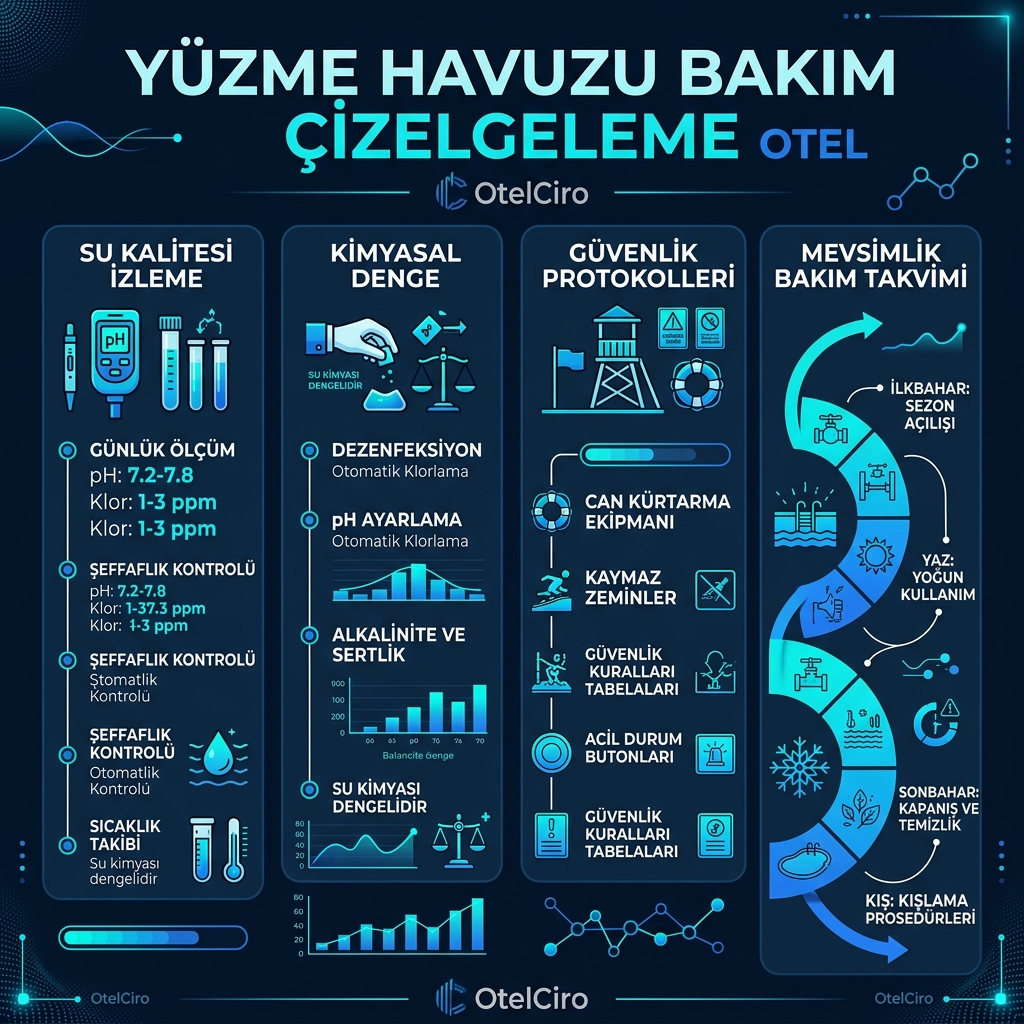
Embed this image on your site
<a href="https://otelciro.com/en/news/optimizing-hotel-pool-maintenance-for-safety-and-roi-2026-guide">
  <img src="https://cdn.sanity.io/images/1la98t0z/production/9f7ed4116adb910d7996bce10b21fdf91a25449f-1024x1024.png" alt="Swimming Pool Maintenance Scheduling Infographic" width="800" />
</a>
<p>Source: <a href="https://otelciro.com">OtelCiro</a> — AI Hotel Revenue Management</p>
Recommended reading: Hotel Operations Automation: Digital Transformation in Business Processes
Pool Water Chemical Balancing: Science and Art
Pool water chemical balance is critical for guest health and the lifespan of the facility. Improperly balanced pool water causes skin and eye irritation for guests and shortens the life of pool equipment.
pH Value Management
The ideal pH value for pool water is between 7.2 and 7.6. When the pH level falls below this range, the water becomes acidic and corrodes metal equipment. When it rises above this range, chlorine effectiveness drops by up to 50%, leaving disinfection inadequate.
Chlorine Level Control
Free chlorine levels should be maintained between 1-3 ppm. Since sunlight rapidly breaks down chlorine in outdoor pools, daily chlorine consumption increases by 60-80% during summer months. While the use of a stabilizer (cyanuric acid) reduces this loss, stabilizer levels must not exceed 50 ppm.
Alkalinity and Calcium Hardness
Total alkalinity should be between 80-120 ppm, and calcium hardness should be between 200-400 ppm. Imbalances in these parameters lead to scaling or erosion on pool surfaces. Since water hardness is high in many regions of Türkiye, calcium management is particularly important.
Daily, Weekly, and Monthly Maintenance Schedule
Daily Checks (15-30 minutes)
- Measurement of pH and chlorine levels (morning and evening)
- Surface cleaning and removal of leaves/debris
- Pump and filter pressure check
- Inspection of safety equipment around the pool
- Water level check and top-off if necessary
- Temperature control (for indoor pools)
Weekly Checks (1-2 hours)
- Measurement of total alkalinity and calcium hardness
- Filter backwashing process
- Brushing of pool walls and floor
- Calibration of the automatic chlorine dosing system
- Cleaning of poolside tiles
- Detailed cleaning of the jacuzzi/spa area
Monthly Checks (half-day)
- Detailed inspection of pump motors and seals
- Heating system efficiency check
- Testing of lighting fixtures
- Inventory check of safety equipment
- Sending water samples to the laboratory for analysis
- Chemical stock evaluation and order planning
Recommended reading: IoT and Predictive Maintenance: Pre-failure Intervention in Hotel Facilities
Automated Pool Management Systems
Modern hotel pool management technologies significantly simplify maintenance processes:
Automated chemical dosing: Sensors continuously measure pH and chlorine levels, and deviations are corrected instantly. These systems increase water quality consistency while reducing chemical consumption by 20-30%.
IoT sensor networks: Water temperature, flow rate, filter pressure, and energy consumption are monitored in real-time. Anomalies are sent instantly as notifications to a mobile application.
Predictive maintenance algorithms: Pump vibration data and energy consumption patterns are analyzed to plan maintenance before a failure occurs. This approach reduces unexpected repair costs by 50-60%.
Cloud-based reporting: All maintenance logs, chemical consumption data, and audit reports are stored digitally. Documentation required for legal compliance is generated automatically.
Safety Standards and Regulatory Compliance
In Türkiye, hotel pools are regulated under the "Regulation on Health Principles and Conditions to be Followed by Swimming Pools." According to this regulation:
- Pool water must be analyzed at least 4 times a day.
- Water samples must be sent to an authorized laboratory monthly.
- Lifeguards must be present.
- Pool depth markings and warning signs must be visible.
- Annual capacity reports must be submitted to the Provincial Directorate of Health.
Failure to meet these requirements can lead to serious fines or even the closure of the pool. A digital operations management system ensures all these checks are performed and documented on time.
Pool Management During Seasonal Transitions
The climate structure of Türkiye requires seasonal strategies in pool management:
Season Opening (April-May): Opening pools that have been closed all winter is a systematic process. Cleaning pool surfaces, equipment testing, filling water, and chemical balancing take 3-5 days. Mistakes made during this process can affect the entire season.
Peak Season (June-September): Daily maintenance requirements increase due to high temperatures and heavy usage. Chlorine consumption rises 3-4 times compared to winter months. It is recommended to test the water 2-3 times daily.
Season Closing (October-November): Winterizing the pool affects equipment lifespan in the long run. Proper winterization procedures reduce equipment replacement costs by 30-40%.
The return on investment for pool maintenance is quite high. Automated chemical dosing and IoT monitoring systems pay for themselves within 18-24 months. More importantly, these systems protect the hotel's greatest asset—its reputation—by safeguarding guest health.
In conclusion, professional pool maintenance scheduling directly impacts both guest safety and hotel profitability. A systematic maintenance program supported by digital tools ensures the highest safety standards while keeping costs under control. An approach that adapts to seasonal changes and adopts predictive maintenance principles offers the most sustainable solution in the long run.
![Europe's Hotel Construction Boom: 2026 Oversupply Risks [Market Analysis]](https://cdn.sanity.io/images/1la98t0z/production/6dfe59137f56aa14bfcba86d9db3cf05ff89f406-2752x1536.jpg?w=1920&q=50&auto=format&fit=max)