Key Takeaways
- Most hotels misattribute revenue: 78% of hotels still use the last-click attribution model, leading to suboptimal marketing spend and underestimated channel value.
- Boost Marketing ROI: Hotels adopting correct attribution models achieve an average of 23% higher marketing ROI by allocating budgets more effectively.
- Diverse Attribution Models: While no single model is universally "correct," multi-touch models like Time Decay and Data-Driven models offer more accurate insights into the complex guest journey (average 4.7 touchpoints over 17 days).
- Account for the Billboard Effect: OTA presence can increase direct website traffic by 9-26%. Integrating this "billboard effect" into attribution models reveals a significantly lower net cost for OTA channels.
- Prepare for Cookie-less Future: With third-party cookies phasing out by 2026, hoteliers must prioritize first-party data strategies, server-side tracking, and advanced analytics to maintain accurate attribution and competitive advantage.
The Revenue Attribution Problem: How Much Are You Really Losing?
A guest searches for your hotel on Google, reads reviews on Booking.com, compares prices on TripAdvisor, and finally books directly on your hotel's website. To which channel will you attribute this sale? Most hotels, following a last-click model, record this revenue under the "direct channel." However, without Google, Booking.com, and TripAdvisor, this reservation might never have occurred.
Revenue attribution models exist precisely to solve this problem. According to 2026 data, 78% of hotels still use the last-click model, leading to channel investment decisions based on incorrect data. Hotels using the correct attribution model see an average of 23% higher marketing ROI — because they allocate the right budget to the right channel.
Related reading: Hotel Distribution Cost Analysis
Attribution Models: Which One Is Right?
Different attribution models offer different perspectives. None is "absolutely correct," but each has strengths and weaknesses.
Last-Click Model: Attributes 100% of the revenue to the last interaction channel before booking. It is the simplest and most common model. Its advantage is ease of implementation; its disadvantage is completely ignoring the contribution of channels in the discovery and evaluation phases. This model systematically undervalues OTAs' contributions because guests often research on OTAs before booking directly.
First-Click Model: Attributes 100% of the revenue to the first channel the guest interacted with. It rewards awareness-stage channels but neglects the conversion stage. It increases the perceived value of awareness channels like Google Ads while underestimating retargeting and late-stage channels.
Linear Model: Distributes revenue equally among all touchpoints. If a guest interacted with 4 different channels, each channel receives 25% of the revenue. Simple and democratic, but it doesn't reflect the reality that some touchpoints are more effective than others.
Time Decay Model: Gives more credit to touchpoints closer to the moment of reservation. The last interaction receives the highest share, while past interactions receive decreasing shares. It rewards channels close to conversion and stands out as the most logical option for many hotels.
Data-Driven Model: Statistically calculates the true contribution of each channel using machine learning algorithms. It provides the most accurate results but requires a sufficient volume of data (minimum 500+ reservations per month) and advanced analytical infrastructure.
Multi-Touch Attribution: How to Implement in Practice?
Multi-touch attribution tracks all touchpoints in the guest's purchasing journey to measure each one's contribution. Steps required for implementation:
Step 1 — Data Collection Infrastructure: An infrastructure must be established to track guest interactions across all channels. Google Analytics 4's cross-channel tracking feature provides a foundational starting point for website and advertising channels. Traffic and reservation data from OTAs are collected via channel manager or PMS integration.
Step 2 — Guest Journey Mapping: A typical hotel guest's purchasing journey involves an average of 4.7 touchpoints and takes 17 days. Mapping this journey is crucial to understanding which channels play a role at each stage.
Research indicates a typical guest journey for the Turkish market progresses as follows:
- Discovery: Social media or friend recommendations (38%)
- Research: Google search + meta-search (72%)
- Evaluation: OTA profile review + reading reviews (65%)
- Comparison: Price comparison sites (41%)
- Booking: Direct site or OTA (100%)
Step 3 — Channel Value Calculation: Each channel is assigned a value based on its role in the purchasing journey. Discovery channels (awareness value), research channels (evaluation value), and conversion channels (final step value) are scored with different weights.
Billboard Effect and Channel Cannibalization
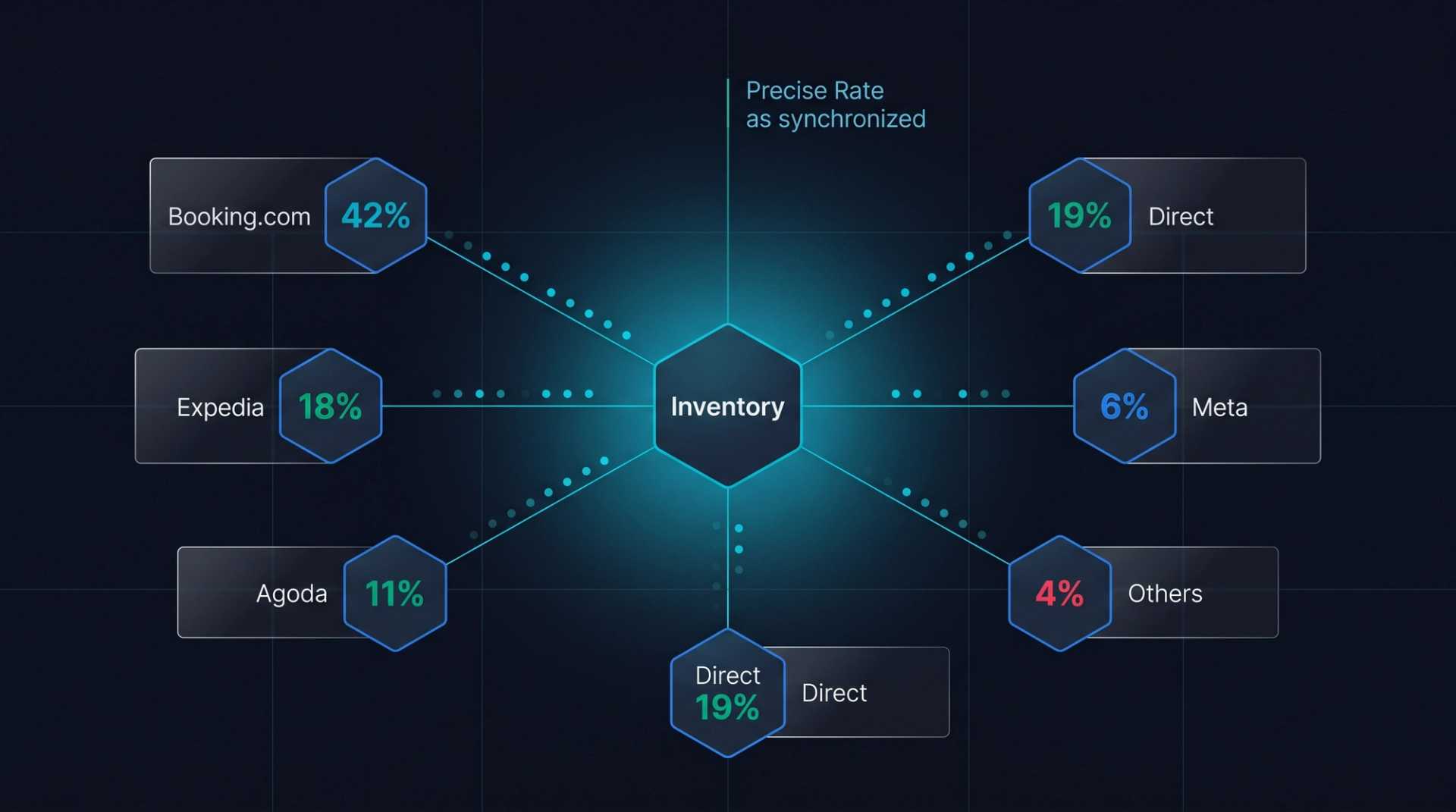
One of the most debated topics in revenue attribution is the OTA billboard effect. According to Cornell University research, hotels' presence on Booking.com and Expedia increases direct website traffic by 9-26%. This means OTAs don't just generate sales through their own channels but also direct traffic to the direct channel.
Failing to include this billboard effect in the attribution model creates a significant calculation error. When calculating the true cost of the OTA channel, direct reservation revenue attributed to the billboard effect should be subtracted from the OTA commission.
Example calculation: A hotel's annual commission paid to Booking.com is 500,000 TL. Additional direct reservation revenue estimated from the billboard effect is 180,000 TL. True net OTA cost: 320,000 TL — which is 36% lower than perceived.
OtelCiro's reporting module consolidates revenue data from all channels to provide comprehensive attribution analysis. With channel-based true ROI calculation, you can base your budget decisions on data.
Practical Implementation: Building an Attribution System in 4 Steps
A practical guide for small and medium-sized hotels to set up an attribution system:
1. Basic Tracking Setup: Use Google Analytics 4 to track all web traffic by source. Tag each channel, campaign, and ad group with UTM parameters. Report PMS data weekly on a channel-by-channel basis.
2. Simple Weighted Model: Instead of last-click, apply a simple weighted model. Assign 20% weight to the discovery channel, 30% to the evaluation channel, and 50% to the conversion channel. This alone yields results 35% more accurate than the last-click model.
3. Monthly Channel Performance Scorecard: For each channel, calculate total revenue, acquisition cost, attribution-based revenue, and net ROI. Evaluate channels not just by the revenue they bring, but by their overall contribution to the guest journey.
4. Quarterly Budget Review: Optimize channel budgets based on attribution data. Shift budget from underperforming channels to high-performing ones.
Future Outlook: Attribution in a Cookie-less World
With the deprecation of third-party cookies in 2026, traditional tracking methods are becoming more challenging. This situation increases the importance of a first-party data strategy in the hotel sector. Loyalty programs, email list sign-ups, and direct account creation are becoming the most reliable ways to track the guest journey.
Server-side tracking, probabilistic matching, and data clean room technologies are among the evolving solutions to maintain attribution accuracy in a cookie-less world. Hotels that are prepared for this technological shift will continue to make more accurate investment decisions by retaining their data advantage.
A correct revenue attribution model is not just an analytical tool; it is a strategic decision-support mechanism. Knowing which channel truly drives sales is fundamental to using a limited marketing budget most efficiently.
![Europe's Hotel Construction Boom: 2026 Oversupply Risks [Market Analysis]](https://cdn.sanity.io/images/1la98t0z/production/6dfe59137f56aa14bfcba86d9db3cf05ff89f406-2752x1536.jpg?w=1920&q=50&auto=format&fit=max)